
A B2B lead generation agency is a partner that finds the right companies, reaches the right people inside them, and turns interest into qualified pipeline your sales team can close. In 2026 the job is less about cold lists and more about timing: reading buying signals, verifying intent, and routing a clean record into your CRM at the moment an account is ready to talk. This guide covers what an agency actually does, why companies use one, and how to tell whether hiring beats building in-house.
What does a B2B lead generation agency do?
A good agency runs an end-to-end motion, not a single task. Each stage feeds the next, and the value is in how they connect, not in any one output.
- ICP definition and targeting: agreeing who you sell to, who you exclude, and which accounts to prioritise this quarter.
- Data and enrichment: building and verifying contact and company data so outreach reaches real people, not bounced inboxes.
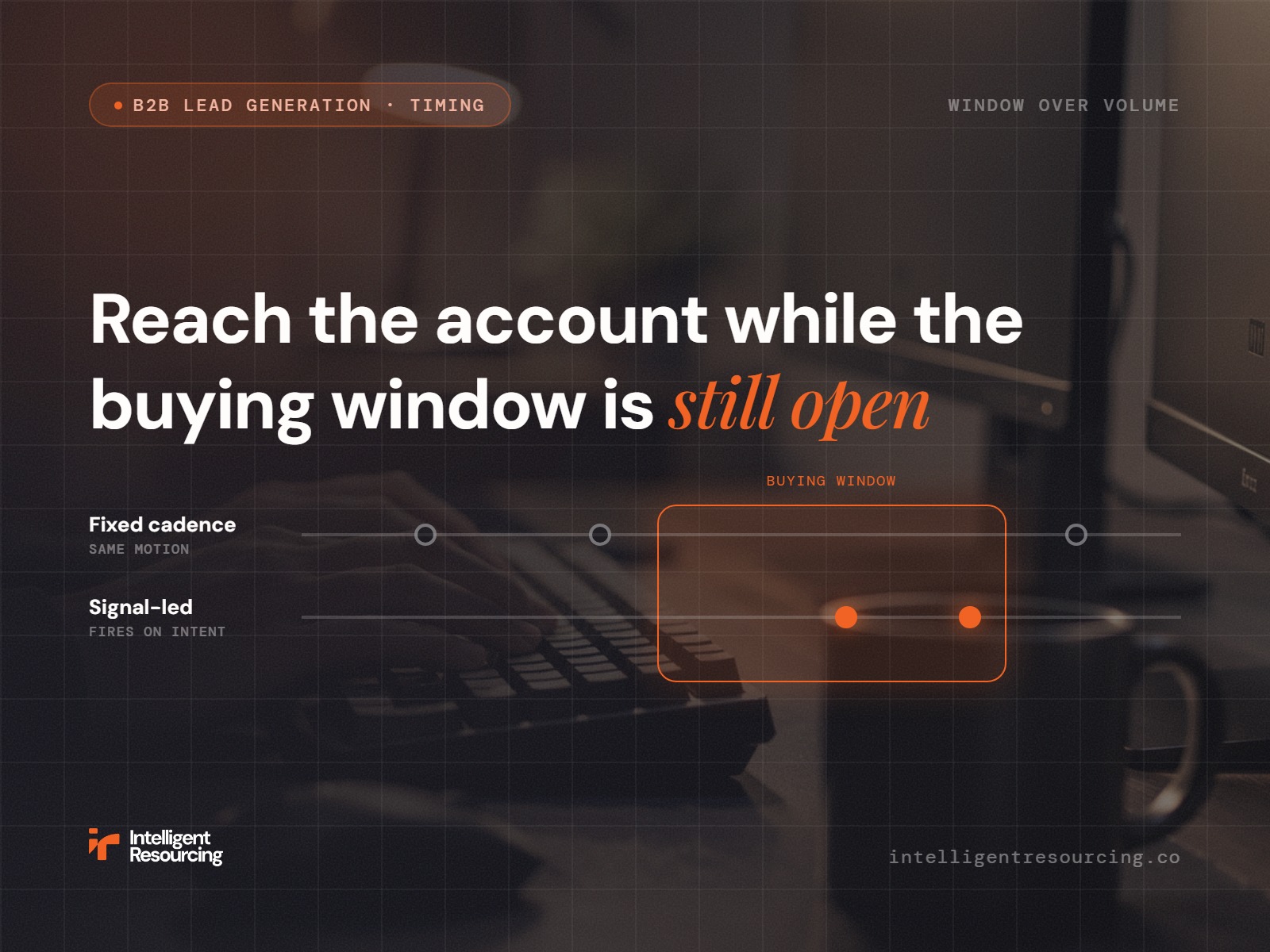
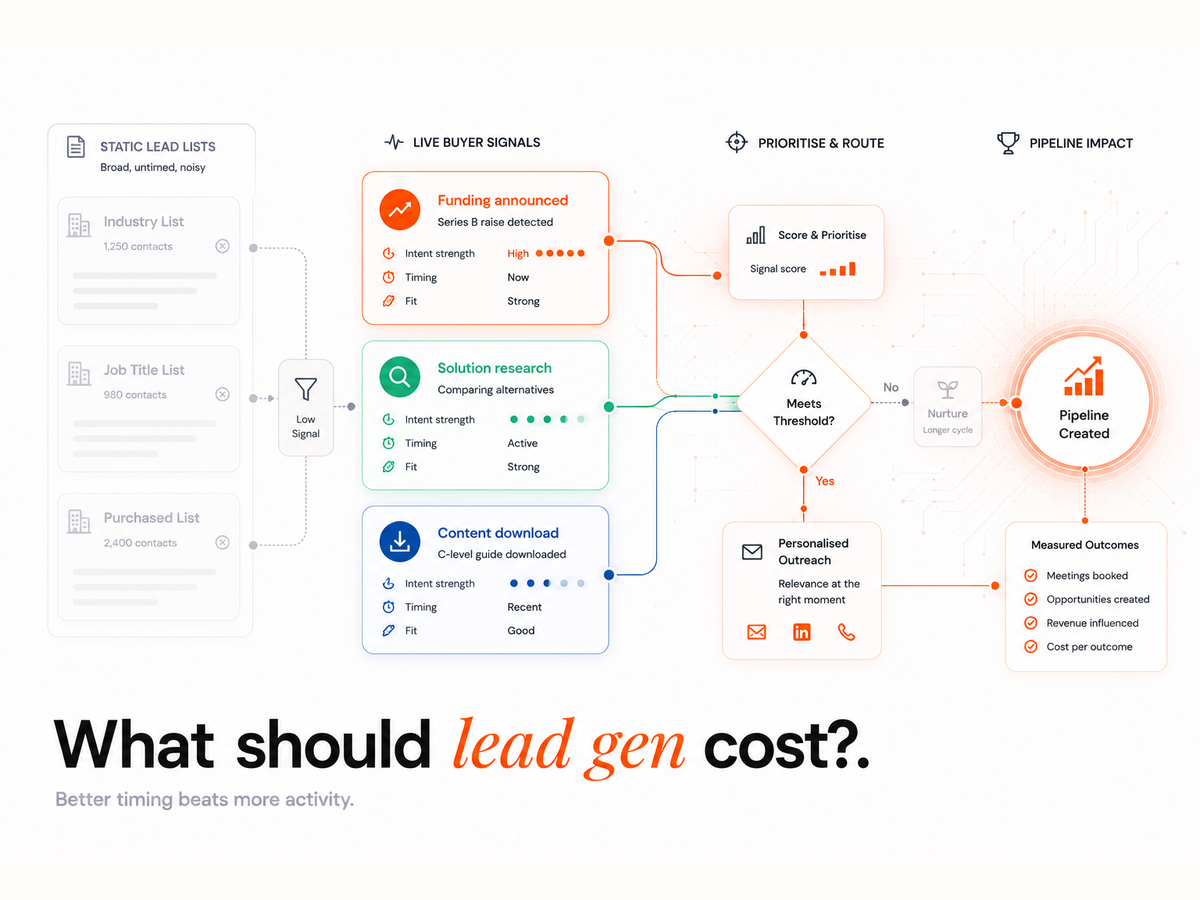
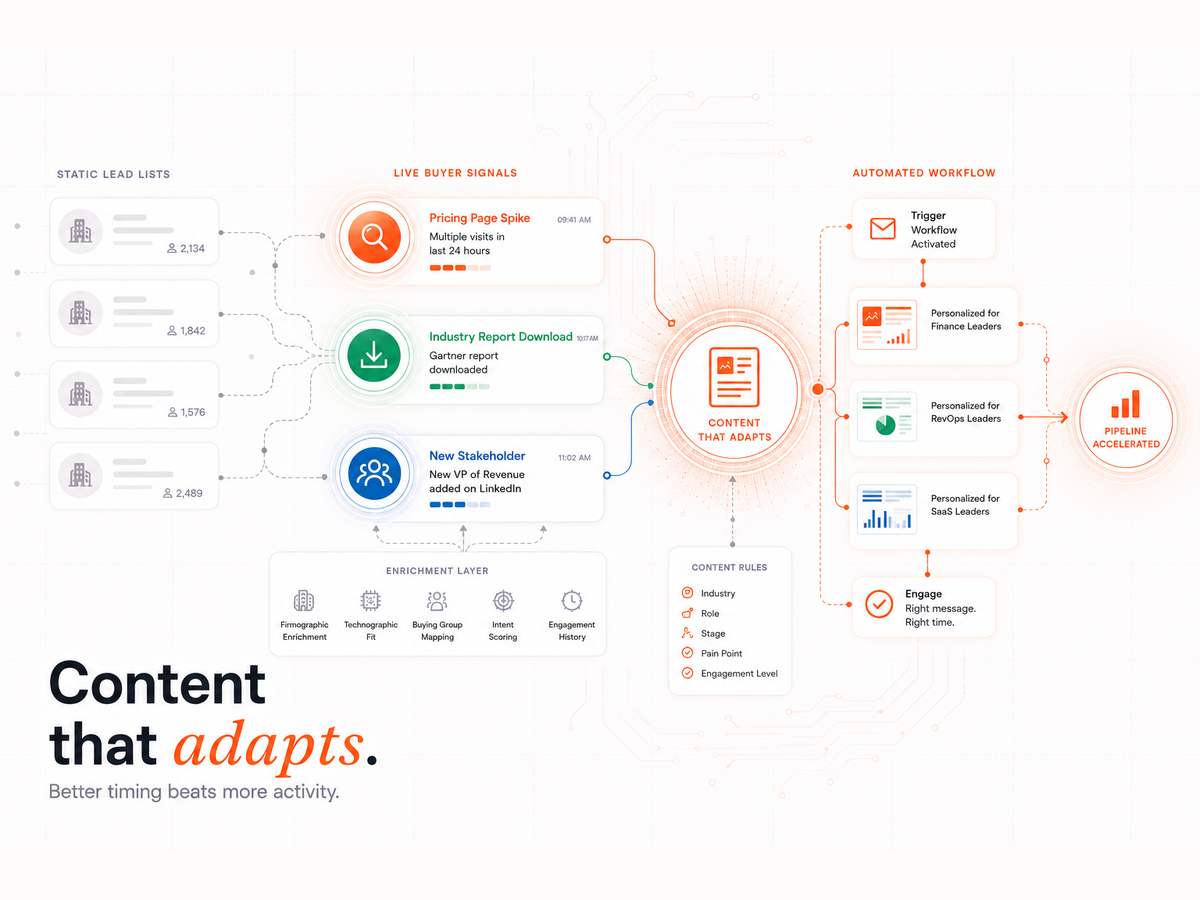
- Signal and intent monitoring: watching for the behaviours that show an account is moving toward a decision, then acting while the window is open.
- Multichannel outreach: email, LinkedIn, calling, and ads sequenced together so timing signals compound instead of running in silos.
- Qualification: separating real intent from polite interest before a meeting reaches your reps.
- CRM routing and attribution: landing every touch cleanly in your CRM so you can see what actually drove the pipeline.
The thread running through all of it is decision logic. A partner worth hiring can explain where intent comes from, how it maps to a verified buying window, and what they do when the signal goes quiet. For the wider model this sits inside, see signal-based selling.
Does an agency run inbound, outbound, or both?
A full-service agency runs both, but they are different motions. Inbound captures demand that already exists, turning the behaviour of buyers who are researching you into qualified pipeline. Outbound starts conversations with accounts that fit your ICP but have not raised a hand yet. The strongest agencies connect the two, so inbound signals tell outbound exactly when an account is ready.
| Dimension | Inbound | Outbound |
|---|---|---|
| What it is | Capturing demand from buyers already researching you | Starting conversations with fit accounts before they raise a hand |
| Trigger | Buyer behaviour: content, search, AI discovery | ICP match plus a buying signal (funding, hiring, tech change) |
| Best for | Categories with active search demand and strong content | Defined ICPs, named accounts, lower-awareness categories |
| Speed to pipeline | Slower to build, compounds over time | Faster to start once targeting and data are set |
| Main risk | Waiting for buyers who never self-identify | Burning TAM with poorly timed, irrelevant outreach |
| What good looks like | Signals scored and routed, not just form fills | Outreach fired on a verified buying window, not a calendar |
Read the detail on each motion: inbound B2B lead generation and outbound lead generation automation. Whichever motion leads, the bigger divide is how an agency works the data: a traditional, volume-led model versus a signal-led one, which is the model we run. See the difference between traditional and signal-led lead generation.
Why do companies use a lead generation agency?
The honest reason is that modern B2B buying is hard to win on effort alone. Buyers want contact, but on their terms: Sopro's research found 88% of B2B buyers want to hear from vendors while they research and evaluate options. The opportunity is real, but reaching them at the right moment, in the right order, takes infrastructure most teams do not have spare.
It also takes persistence. Sopro's sales research found four in five successful sales take five or more follow-ups, which is exactly the disciplined, unglamorous work that quietly stalls when an in-house team is stretched. An agency absorbs that grind and keeps the cadence running.
The deeper draw is the system. A capable agency brings ICP calibration, signal monitoring, and clean CRM routing as a working machine, so you buy a motion rather than a to-do list. The same discipline underpins any signal-based marketing programme: reach the right people in the right order.
Agency vs in-house: which makes sense for you?
This is the decision most teams are really making. It is not agency versus no agency, it is whether to rent a working system now or build one over the next year.
Cost is the first fork. A fully loaded in-house SDR runs roughly $85,000 to $110,000 or more a year once tooling, management, and ramp are counted, according to Martal, and that is before the system around them exists. Speed is the second fork. Callbox puts in-house setup at three to six months against two to four weeks for an outsourced team, which matters when you need pipeline this quarter rather than next year.
| Factor | Lead generation agency | In-house team |
|---|---|---|
| Time to pipeline | Weeks: systems and ICP already built | Months: hire, tool, and ramp first |
| Cost shape | Variable retainer, scalable up or down | Fixed salaries plus tooling and management |
| Expertise | Cross-client patterns and tested playbooks | Deep product and customer knowledge |
| Control | Shared: needs clear scope and reporting | Full: direct ownership day to day |
| Best when | You need a working system faster than you can build it | The motion is core to your moat and you have operators |
When do you actually need a lead generation agency?
A few clear signs mean an agency is the right call now rather than later:
- You need pipeline before you can hire. The quarter has targets the current team cannot reach, and ramping new reps takes too long.
- Your data and routing are leaking. Outreach happens, but nobody can say what drove a meeting, because the stack was never built to track it.
- You lack signal infrastructure. You know timing matters but have no system to detect a buying window and act on it.
- Outbound is not your core skill. Your team is strong at product and delivery, and outbound is a tax on their attention.
Before you commit, get clear on which buying signals matter for your market, so you can judge whether a partner reads the same ones you do.
When to keep lead generation in-house
An agency is not always the answer. Keep it in-house when outbound is part of your moat and you already employ the operators to run it, when your sales motion is highly technical and only your own team can qualify well, or when you have the systems and want to protect institutional knowledge rather than rent it. The strongest setups are often hybrid: an agency builds and runs the engine while transferring capability, then hands you documented workflows you own.
What good delivery looks like
The difference between a partner and a vendor is process. As quality pioneer W. Edwards Deming put it, if you cannot describe what you are doing as a process, you do not know what you are doing. A strong agency can name its signal sources, define how it verifies a buying window, show its exclusion rules, and tell you what breaks first.
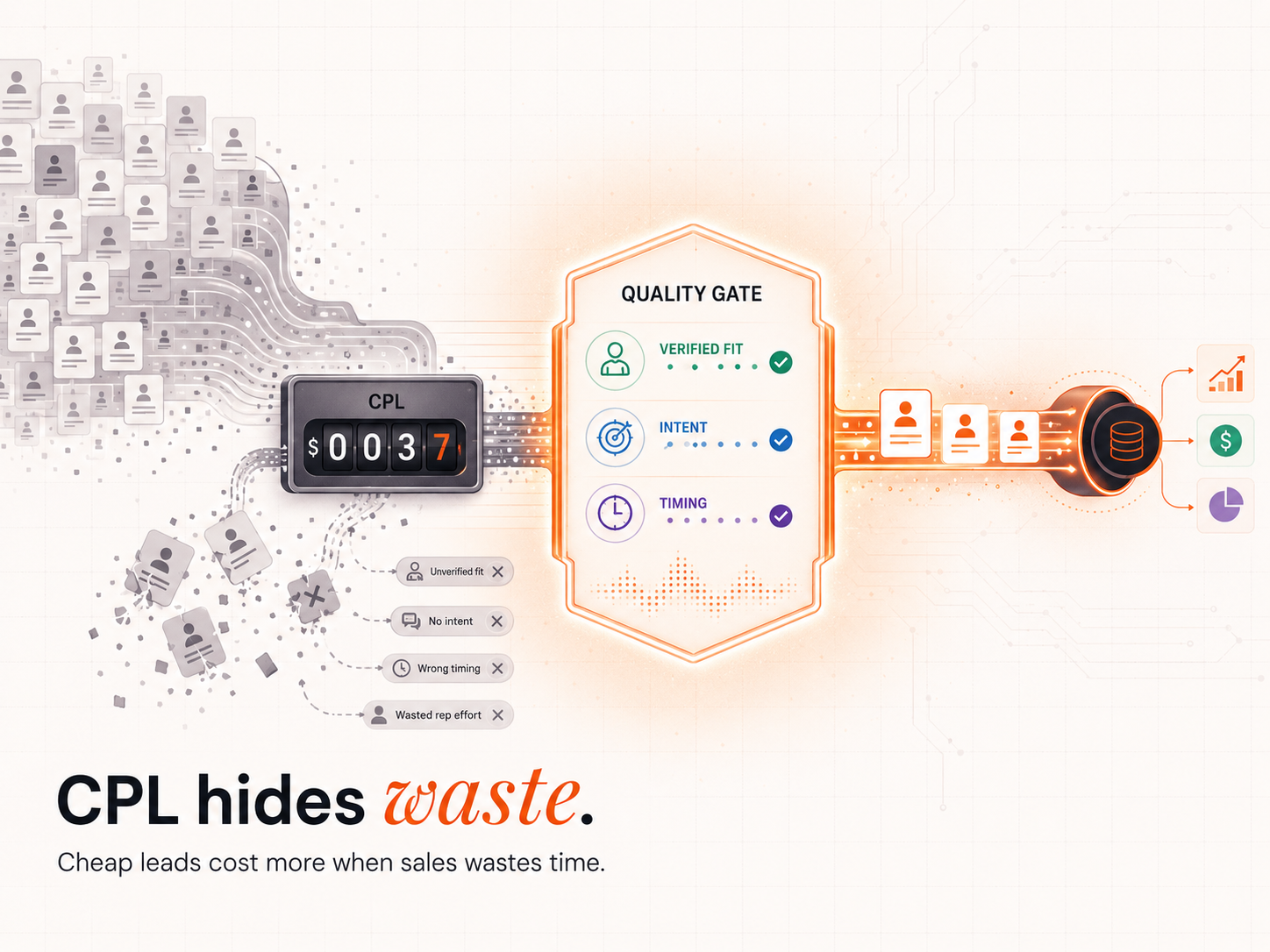
Watch the incentives. When an agency is paid purely for meetings booked, you get meetings, often with the wrong accounts at the wrong time. This is Goodhart's Law in practice: when a measure becomes a target, it ceases to be a good measure. The fix is to tie the contract to qualified pipeline and stage movement, so the agency wins only when you do. For the full set of selection criteria, see how to choose a B2B lead generation agency.
How lead generation agencies price their work
Most agencies use one of three models. Pay-per-lead can reward low-friction conversions over qualified pipeline, because it pushes the agency to chase anyone who replies rather than anyone who buys. Retainers are usually safer when the cycle is long, qualification is nuanced, and attribution needs real instrumentation. A sensible hybrid pairs a stable base retainer for delivery and systems with a quality gate, such as ICP-verified meetings, and a pipeline or stage-based kicker rather than raw lead counts. The pricing model should reward the outcome you actually want, which is revenue, not activity.
Compliance: who carries the risk?
When an agency sends outreach in your name, the legal responsibility still sits with you. In the UK, B2B direct marketing has clear rules, and in Australia, consent and unsubscribe requirements are explicit. Any partner you hire should enforce suppression, consent, and data provenance inside the workflow, not treat them as an afterthought.
Key takeaways
- An agency runs a motion: targeting, data, signals, outreach, qualification, and CRM routing connected as one system
- Companies hire one for speed: a working engine in weeks instead of a team built over months
- Match the choice to your motion: rent the system when you need pipeline now, build in-house when it is core to your moat
- Tie pay to pipeline: reward qualified pipeline and stage movement, not meetings booked
- Own the output: a good partner leaves you documented workflows and a clean CRM, not a black box
Lead Generation
Bring your current proposal or agency scorecard. We'll stress-test it against a signal-first checklist and show you where buying intent is being lost.