
What is a good cost per lead metric and what counts as a "lead"?
CPL is only a useful benchmark when every channel uses the same definition of "lead." One provider counting any form completion and another counting only sales-accepted leads produce numbers that look comparable but measure completely different outcomes. Standardising the definition before comparing CPL is the prerequisite, not the optional step.
CPL is simple to calculate:
CPL = total lead gen cost ÷ number of leads
Differences exist in how "total cost" is calculated and what counts as a "lead." If one provider counts any form completed, and another counts only sales-accepted leads, your CPL comparison is faulty before you start.
A practical definition for 2026: a lead is only a lead if it is ICP-aligned, contactable, and consent-safe for outreach, as defined by ACMA.
Our definition: a lead is ICP-aligned with clear signals and triggers that show the prospect is actively considering a purchase and ready to engage.
What is a "good" cost per lead in 2026?
No single CPL figure applies across all B2B markets. HubSpot's 2026 CPL benchmarks show the average B2B CPL sits at $84 across all channels, with industry ranges from $83 in ecommerce to $653 in financial services. The right target depends on ACV, qualification standard, and the channel driving the lead.
CPL varies by industry, channel, competition, and intent. Treat benchmarks as ranges, then adjust to your qualification standard.
- Indicative global range: B2B CPL runs from $83 (ecommerce) to $653 (financial services), with an all-channel average of $84. Industries with longer buying cycles and higher ACV see CPL at the top of this range.
- Channel reality check (paid search): Google Ads CPL in B2B runs $100-$175 at the top of funnel and $300-$750 at the bottom of funnel. CPC and CPL move together, which is why "cheap clicks" and "cheap leads" are different problems.
One rule to follow: a "good" CPL is the one that produces a pipeline you can close, inside your capacity, without breaking consent or the spam rules.
Why does CPL drop while pipeline quality gets worse?
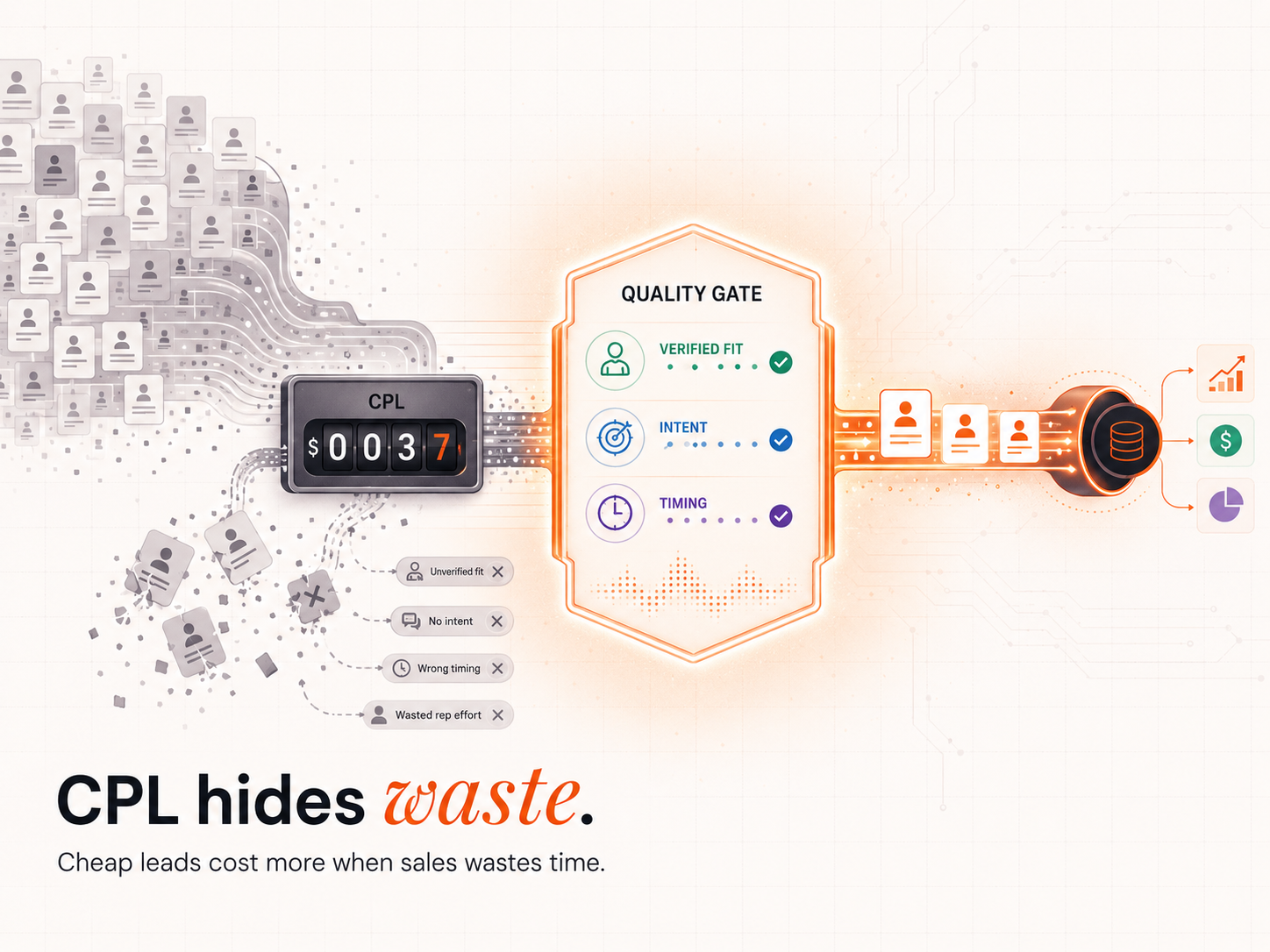
CPL drops when targeting broadens. That shift lowers the metric while inflating the hidden cost: more sales conversations with unqualified accounts, higher CRM noise, and deliverability damage from increased unsubscribes. Green Hat's 2025 APAC research shows the average B2B buying group runs 11 people deep, which means a low-quality lead wastes access to an entire account.
CPL drops when you loosen the parameters:
- Broader targeting
- Lower intent forms
- More aggressive outreach volume
- Less ICP qualification
This creates a second-order consequence in increased costs: sales time, CRM inefficiencies, and deliverability damage. In B2B, that damage is amplified because buying groups are large and timing matters. An average buying group of 11 people makes "one lead" a weak proxy for "one deal."
What should you track instead of CPL?
CPL works as a diagnostic metric. It breaks when you optimise for it in isolation. The metrics that connect lead generation spend to revenue outcomes are cost per qualified lead (CQL), cost per sales-accepted lead (SAL), cost per opportunity (CPO), and pipeline-to-spend ratio. Each one adds a qualification gate that CPL alone skips.
Instead, use this framework:
1. Cost per qualified lead (CQL)
Measures the cost of leads that meet your ICP. This ensures you generate high-quality leads that are sales-ready.
2. Cost per sales-accepted lead (SAL)
A lead reviewed and accepted by your sales team, confirming it meets criteria for further engagement. This stage ensures only leads with verified interest and conversion potential are prioritised.
3. Cost per opportunity (CPO)
Measures the cost of leads that progress to an opportunity, where a clear path to conversion exists. It focuses on the leads that turn into potential revenue.
4. Cost per $ of pipeline (pipeline-to-spend ratio)
Reflects the total cost of generating pipeline value. It measures the return on investment for the lead generation created.
If your CPL improves but CPO worsens, you did not improve efficiency. You shifted waste downstream.
Why does chasing lead volume increase cost per opportunity in 2026?
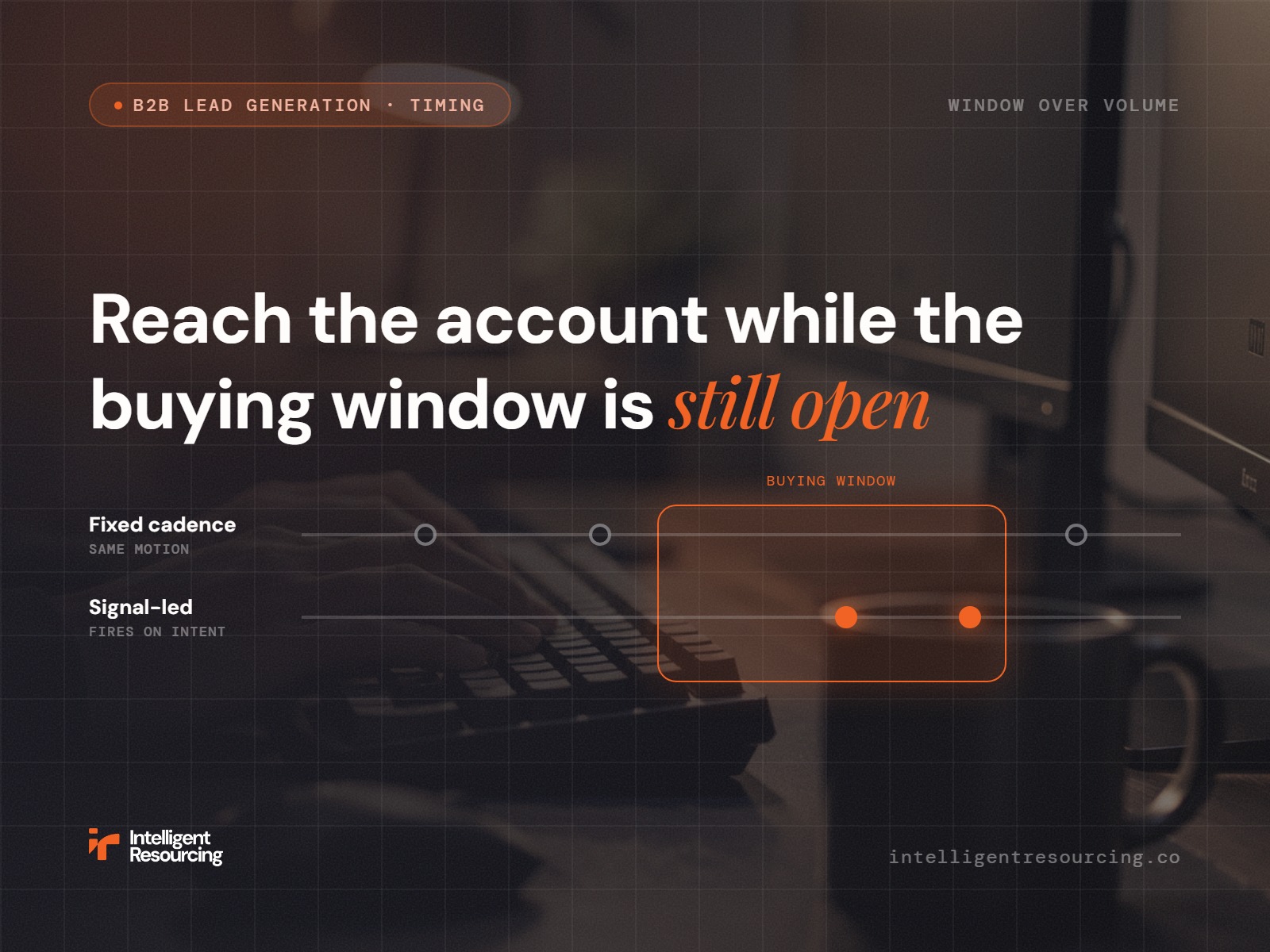
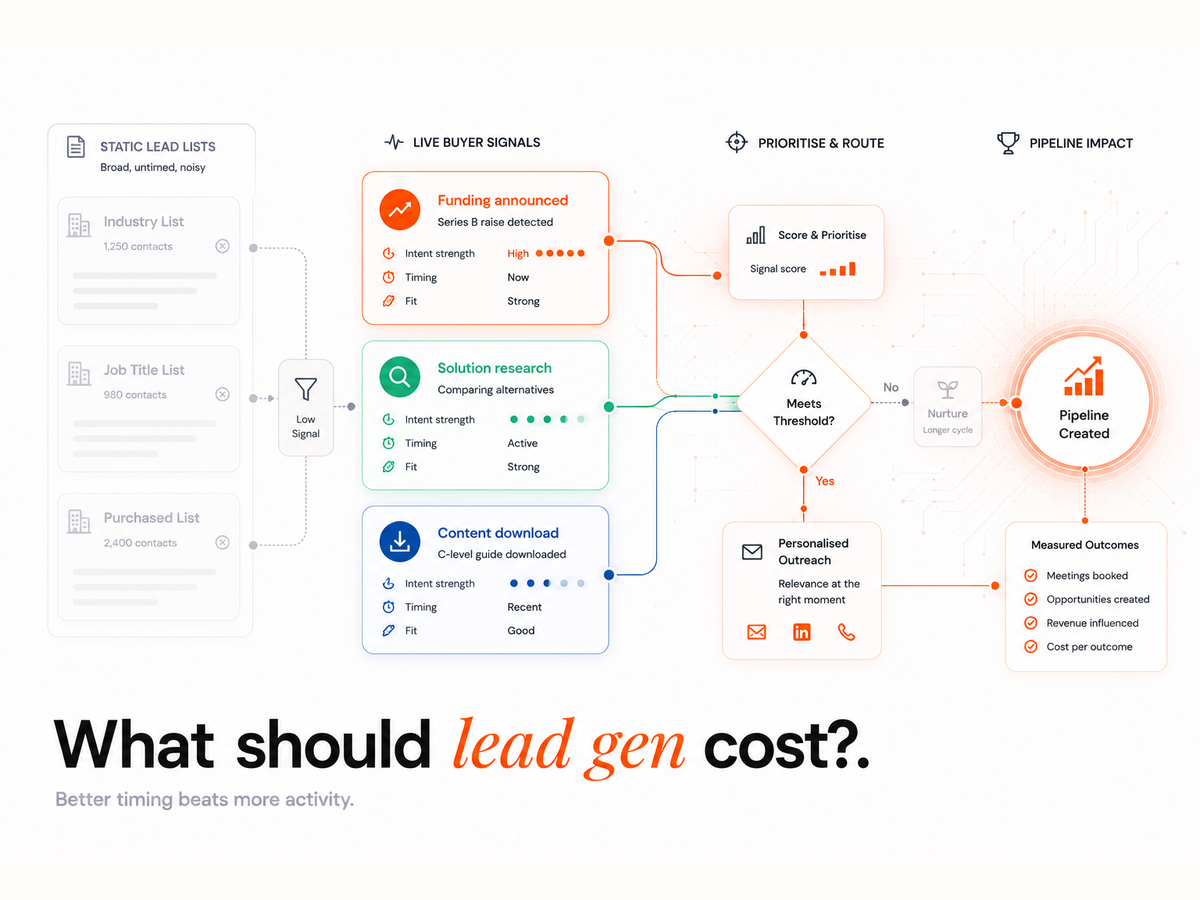
Volume-based lead generation buys speed: meetings without adding headcount. In 2026, the secondary cost of volume is outreach that hits accounts with no buying activity, burning through your total addressable market before the 11-person buying group at each account has any reason to engage. Timing precision separates CPL from cost per opportunity.
If you are comparing lead generation services, you are buying speed: enquiries and meetings without hiring and training your own sales staff.
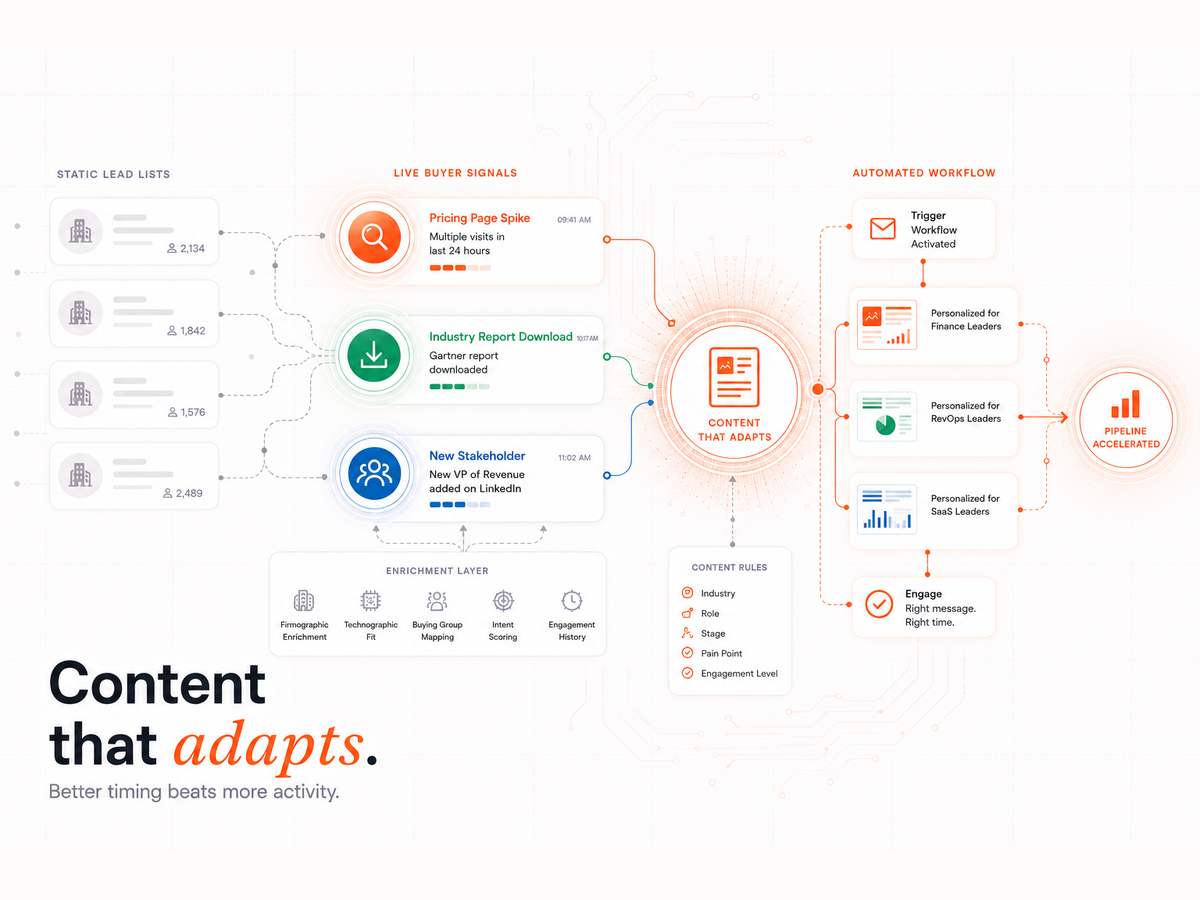
Volume without timing increases waste. Signal-Led Growth triggers outreach only when an account is in a Verified Buying Window, reducing dead conversations and improving conversion timing. For a deeper look at how signal capture feeds lead generation signals into qualified pipeline, that guide covers the full architecture.
How do you reduce cost per lead without sacrificing lead quality?
The fastest way to reduce CPL without losing lead quality is to remove wasted spend before outreach runs. Eftsure cut CPL by 40% not by reducing ad spend but by improving attribution through the LinkedIn Conversions API and Dreamdata. Better measurement surfaces which spend is already working, making budget cuts precise rather than broad.
The key is to reduce waste, not lower your standards.
1. Tighten your "qualified lead" definition (before you run campaigns)
Use a scorecard so every channel is measured the same way.
| Field | Pass/Fail rule | Why it matters |
|---|---|---|
| ICP fit | Matches firmographics + use case | Stops broad, low-fit CPL |
| Contactability | Valid role + email/phone hygiene | Reduces bounce and no-shows |
| Consent-safe | Consent basis documented | Reduces spam complaints |
| Buying signal | Trigger present (event/intent) | Improves timing and relevance |
| Routing ready | Owner + SLA + sequence attached | Prevents lead rot |
2. Fix routing and speed-to-lead (so paid spend is not wasted)
If leads sit untouched, CPL is irrelevant. You paid for an opportunity then missed it.
Optimise both routing and speed-to-lead. Automate follow-up and ensure leads are acted upon immediately to maximise the value of each interaction. This process falls under GTM engineering, which covers lead scoring, routing, and automation workflows that prevent wasted spend.
3. Improve measurement (so you stop funding the wrong channel)
LinkedIn's own example shows why measurement changes CPL outcomes: Eftsure paired the LinkedIn Conversions API with Dreamdata and reported a 40% CPL reduction, tied to better attribution and full-funnel visibility. Measurement that links spend to pipeline lets you cut waste faster than creative tweaks alone.
What pricing models change your cost per lead outcome?
The commercial model your agency uses changes CPL outcomes independently of channel or creative. CPL pricing incentivises volume, not quality, because the agency's revenue ties to lead count, not pipeline value. Retainer and hybrid models flip that incentive only when deliverables are defined as pipeline outcomes rather than activity metrics.
Cost-per-lead (CPL) pricing
- Best for: low-ticket, high-volume offers where rejects are cheap
- Watch out: incentives drift towards quantity, not quality
Retainer or hybrid pricing
- Best for: B2B where qualification, routing, and system health matter
- Watch out: you must define deliverables as outcomes (CPO, pipeline), not "activity"
Intelligent Resourcing's B2B lead generation pricing guide positions agency pricing broadly from $2,500 to $19,000+ per month, with higher tiers covering signal-led systems rather than manual volume. Understanding hidden costs in lead gen agencies don't disclose is the first step to an accurate comparison.
What is the difference between a lead generation agency and a Revenue Operations Studio?
A traditional lead generation agency increases top-of-funnel activity. Without clean routing, automated CRM attribution, and a signal layer underneath it, that activity resets every month and does not compound. A Revenue Operations Studio installs the permanent system behind your pipeline: signal definitions, automation rules, routing logic, and reporting tied to revenue outcomes.
A traditional lead generation agency increases top-of-funnel activity. Activity alone does not guarantee a clean handover, automated routing, accurate measurement, or CRM survivability. Without these foundational elements, the cost of managing poor-quality leads outweighs the savings of a lower initial CPL.
A Revenue Operations Studio builds the permanent system behind your pipeline. Instead of buying leads, a Studio defines signal orchestration, builds automation and routing rules, and establishes reporting tied directly to revenue outcomes.
The result is a system where efficiency compounds over time instead of starting from scratch every month. For a side-by-side comparison of active providers, see top lead gen companies in Australia.
What compliance rules raise your real CPL in Australia?
Non-compliance with ACMA's spam laws does not just trigger financial penalties. It damages domain reputation, deliverability, and brand trust, inflating the real cost of every compliant lead you generate in the following months. Australia's enforcement record shows the cost of ignoring the rules is measured in millions.
ACMA's guidance is explicit: you need consent, clear sender identification, contact details, and a working unsubscribe. This applies even if another business sends messages on your behalf.
Two 2026-relevant details to include in your planning:
- SMS Sender ID rules from 1 July 2026: businesses sending branded SMS must register with the SMS Sender ID Register. Unregistered senders will have messages labelled "unverified."
- ACMA penalised TAB $4 million for spamming VIP customers, part of more than $16.9 million in spam enforcement actions over the prior 18 months.
How do you forecast cost per lead before running a campaign?
CPL forecasting before spend removes the most common B2B budgeting failure: discovering the channel is uneconomical only after 3 months of spend. Four inputs produce a workable estimate: click or contact cost, conversion rate, operations cost, and your qualification acceptance rate. The model surfaces the gap between headline CPL and cost per opportunity before you commit.
Use this simple forecasting model:
1. Estimate click cost (CPC) or outreach cost (per contact)
2. Estimate conversion rate (click-to-lead or contact-to-lead)
3. Add operations cost (tools + labour + verification)
4. Apply a quality filter (your CQL/SAL acceptance rate)
Example:
- If you pay $3 per click (CPC) and 3% of clicks become leads, CPL from media alone is about $100
- If only 30% of those leads are sales-accepted (SAL), the cost per sales-accepted lead is about $333
This is why signal gating (who/when) and routing (what happens next) reduce cost more than creative refreshes.
Lead Generation
Treat cost per lead as a diagnostic, not a KPI. Intelligent Resourcing installs the signal-led system behind the pipeline, gating outreach to the Verified Buying Window so spend converts to opportunities, not just leads.
FAQs
Why is my CPL low but sales says the leads are poor?
CPL drops when targeting broadens or qualification loosens. That shifts cost into sales time, CRM noise, and missed follow-up, which increases cost per opportunity.
How can I reduce cost per lead without increasing spam risk?
Use verified signals and qualification gates, document consent workflows, and ensure unsubscribes work reliably. ACMA requires consent and an easy unsubscribe, even when a third party sends messages for you.
When should I choose a Revenue Operations Studio instead of a lead gen agency?
Choose a studio when you need the system behind the pipeline: signal definitions, automation, routing, CRM hygiene, and reporting tied to revenue outcomes, not just lead volume.
What is a Verified Buying Window and how does it reduce CPL waste?
A Verified Buying Window is the period when a target account shows confirmed buying signals, a cluster of events such as executive hires, tech stack changes, and renewed CRM activity, that indicates genuine purchase readiness. Outreach triggered inside this window reaches accounts with a real reason to engage, reducing dead conversations and lowering cost per opportunity without cutting contact volume.