
Why do traditional B2B lead generation services fail to produce reliable pipeline?
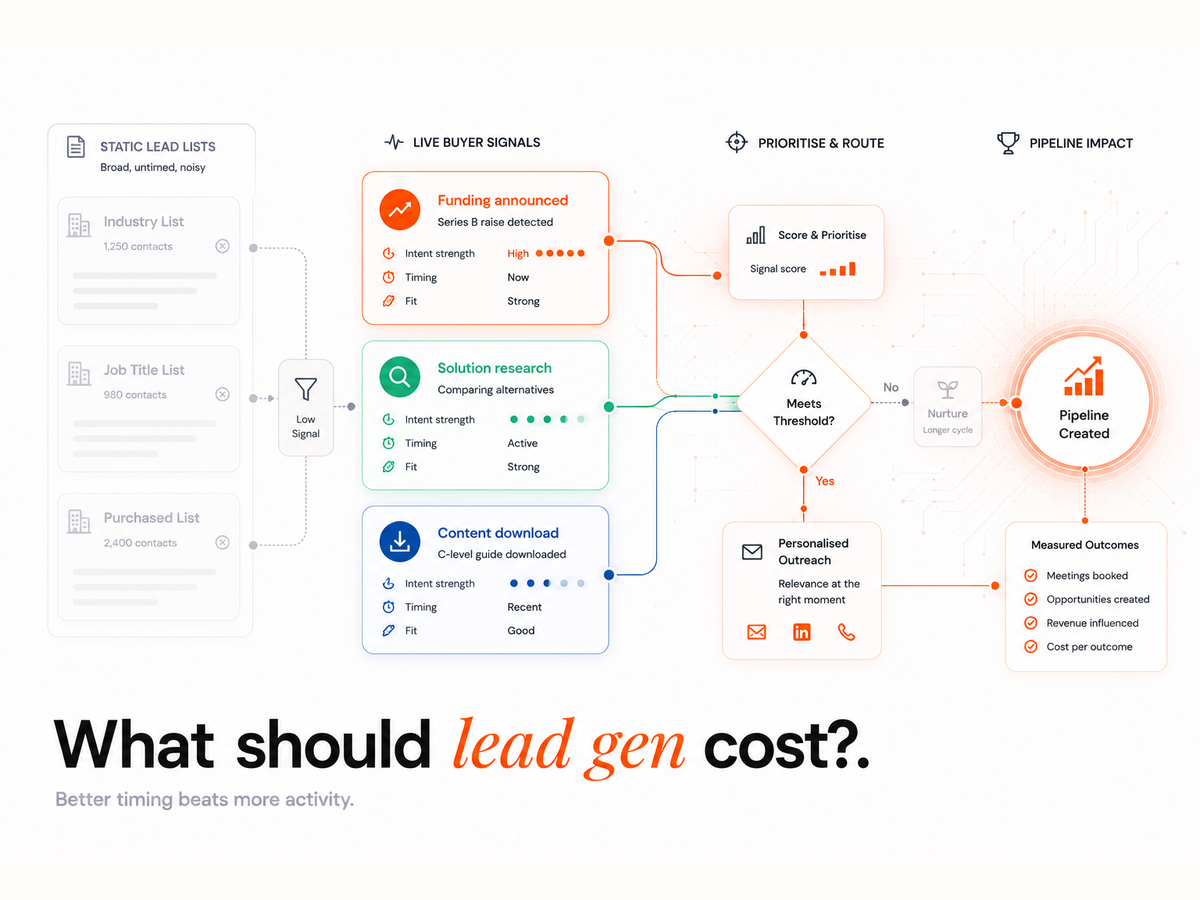
Traditional lead generation services were built for a simpler buying model: capture a contact, pass it to sales, repeat. Three assumptions underpinned that model. Buyers surface intent via forms. Volume compensates for weak relevance. Outreach itself generates demand. Modern B2B buying behaviour has invalidated all three.
B2B growth historically relied on lead generation services promising increased leads, meetings, and speed. These services assumed: buyers surface intent via forms; volume compensates for weak relevance; outreach itself generates demand.
Harvard Business Review's New Sales Imperative research indicates B2B buyers now complete most of their evaluation before engaging any sales rep, relying on peer perspectives, content, and internal consensus well before traditional lead stages. In this context, form captures and outsourced outreach access only a fraction of actual demand.
Organisations depending solely on lead capture encounter predictable failure patterns:
- False positives: contacts lacking urgency or decision authority
- False negatives: actual buying committees remain invisible
- Pipeline volatility: activity is confused with progress
The problem is a broken model optimised for visibility rather than timing. Increasing lead volume only amplifies underlying issues while draining resources.
What is modern B2B lead generation in 2026?
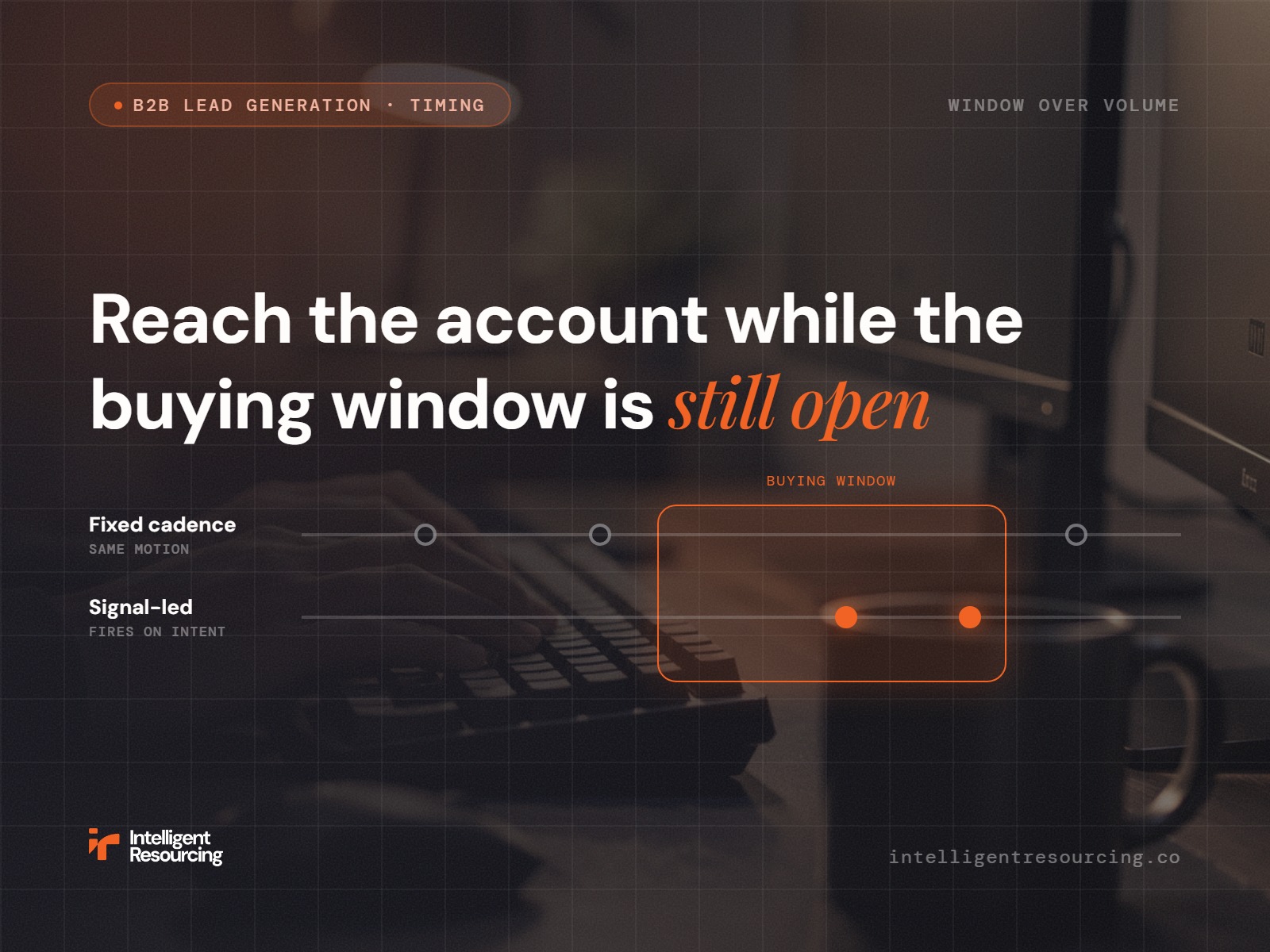
Modern B2B lead generation functions as a signal-led system, not a volume-driven funnel. The shift from "how do we generate more leads?" to "what evidence indicates an account is entering a buying window?" defines the operational difference between pipeline that compounds and pipeline that resets every quarter.
Contemporary B2B lead generation functions as a signal-led system. High-performing teams reframe from "How do we generate more leads?" to "What evidence indicates account buying-window entry and how do we respond?"
Modern B2B buying is non-linear, digitally driven, and consensus-based. Intent surfaces across multiple interactions over time, not in isolated conversion moments, which is why single-event lead capture misreads readiness.
Signal-led lead generation characteristics:
- Predictive rather than descriptive
- Dynamic rather than static
- Time-sensitive rather than permanent
Leads represent system output, not entry points.
Which B2B lead generation strategies consistently convert in 2026?
High-performing teams structure around signals, not channels. Channels activate after intent appears, not simultaneously. The four-layer framework below describes how signal-based prospecting, multi-channel orchestration, inbound-outbound integration, and timing-driven activation work together to produce predictable pipeline rather than activity spikes that fade within a week.
High-performing teams align four layers:
1. Signal-Based Prospecting
Accounts receive priority based on behaviour and context, not static firmographic ranking.
2. Multi-Channel Orchestration
Channels activate after intent appears, not simultaneously.
3. Inbound + Outbound Integration
Inbound captures signals; outbound converts them at optimal moments.
4. Timing-Driven Activation
Evidence triggers outreach, not sales cadence.
RAIN Group's prospecting research found top performers that target the right buyers with customised, value-focused outreach generate 2.7x more conversions and 1.8x more quality outcomes than the rest. Signal-first strategies consistently exceed volume-based campaigns.
What does a signal-led B2B lead generation workflow look like?
Workflow design is what separates modern lead generation from traditional lead generation services. Tools collect signals but workflows act on them: capturing intent across touchpoints, applying qualification logic, routing accounts automatically, and handing to sales with context. Focus Digital's analysis puts the average B2B purchase at 28.87 touchpoints, rising to nearly 47 for enterprise deals above $100K, confirming that multi-touch orchestration, not single-event capture, drives pipeline.
From Signal Capture to Sales-Ready Lead
"Tools alone do not create pipeline. Systems do."
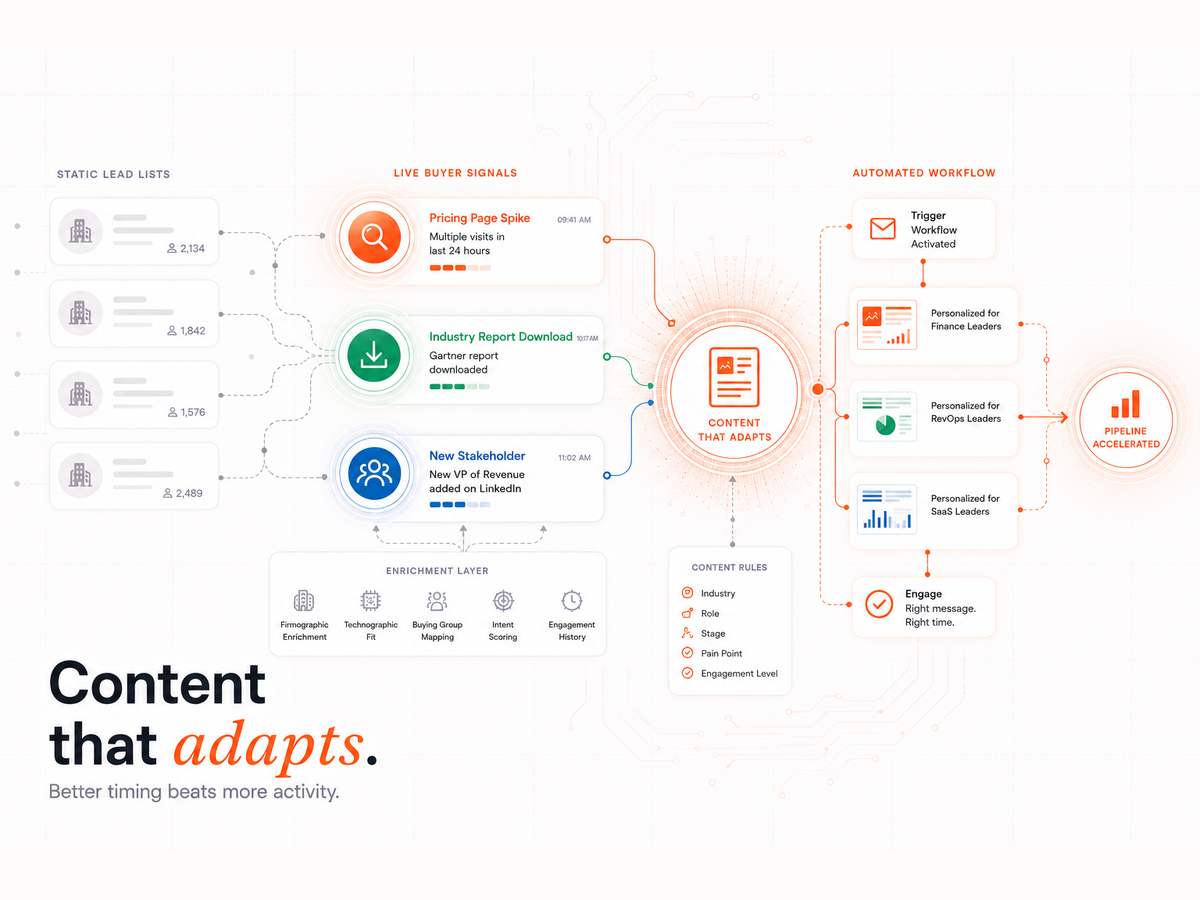
Signal-led lead generation workflows follow four stages:
1. Signal Capture
Data collection spans behavioural, contextual, and engagement touchpoints, extending beyond forms.
2. Qualification Logic
Signals undergo stacking, weighting, and time-binding. Readiness thresholds replace static lead scores.
3. Automated Routing
Accounts receive dynamic assignment based on intent, segment, and opportunity context.
4. Sales Handoff
Sales receives timing, insight, and narrative, not raw contacts.
For a practical look at how signal-based automation eliminates wasted outreach at each workflow stage, that guide covers the full routing architecture.
How does signal-based lead generation predict pipeline rather than just contacts?
Signal-based lead generation answers a different question than traditional lead generation. Firmographic signals answer "could they buy?" Behavioural and contextual signals answer "are they buying now?" B2B buying is non-linear, digitally driven, and consensus-based, making pattern recognition across touchpoints more valuable than firmographic fit alone.
Signal-based lead generation emphasises what buyers are doing, not identity alone.
- Firmographic signals answer: Could they buy?
- Behavioural and contextual signals answer: Are they buying now?
The pattern is consistent across modern B2B research: success depends on recognising account momentum and buying signals rather than relying on static lead scoring or list-based qualification.
Effective signal characteristics:
- Qualified: filtered for relevance and intent
- Time-bound: diminish if unreinforced
- Actionable: directly inform workflow decisions
Signal-based models consistently outperform traditional lead approaches by eliminating wasted effort on unready accounts, accelerating engagement with ready ones, and providing sales context that improves conversation quality and close rates.
See signal-based lead generation for the full operational model behind this approach.
Why do tools fail when there is no orchestration system behind them?
Most B2B teams have adequate tools but lack the orchestration to connect them. Point solutions fail when signals are collected without qualification, data silos exist across platforms, and automation lacks decision logic. QuotaPath's survey found 91% of companies fail to hit 80% or more of their quota targets, a pattern consistent with tool accumulation without systemic coordination.
Most B2B teams possess adequate tools but lack orchestration. Point solutions fail when signals are collected without qualification, data silos exist across platforms, and automation lacks decision logic. Teams accumulate intent providers, marketing automation, sales engagement tools, and analytics that neither communicate nor coordinate.
High-performing teams design revenue automation systems where workflows, not tools or departments, own outcomes. These systems eliminate passing leads from marketing to sales. Instead, workflows qualify readiness and route accounts to appropriate next actions (continued nurture, sales outreach, or account-based plays) based on signal strength and account traits.
Sales receives qualified accounts with context explaining why engagement is warranted, not arbitrary lists.
GTM engineering is the discipline that builds this orchestration layer, connecting signals, scoring logic, CRM routing, and attribution into a system rather than a collection of tools. For workflow patterns that connect scoring, routing, and execution, see Clay lead scoring workflows.
How do signals, workflows, and playbooks create a unified system?
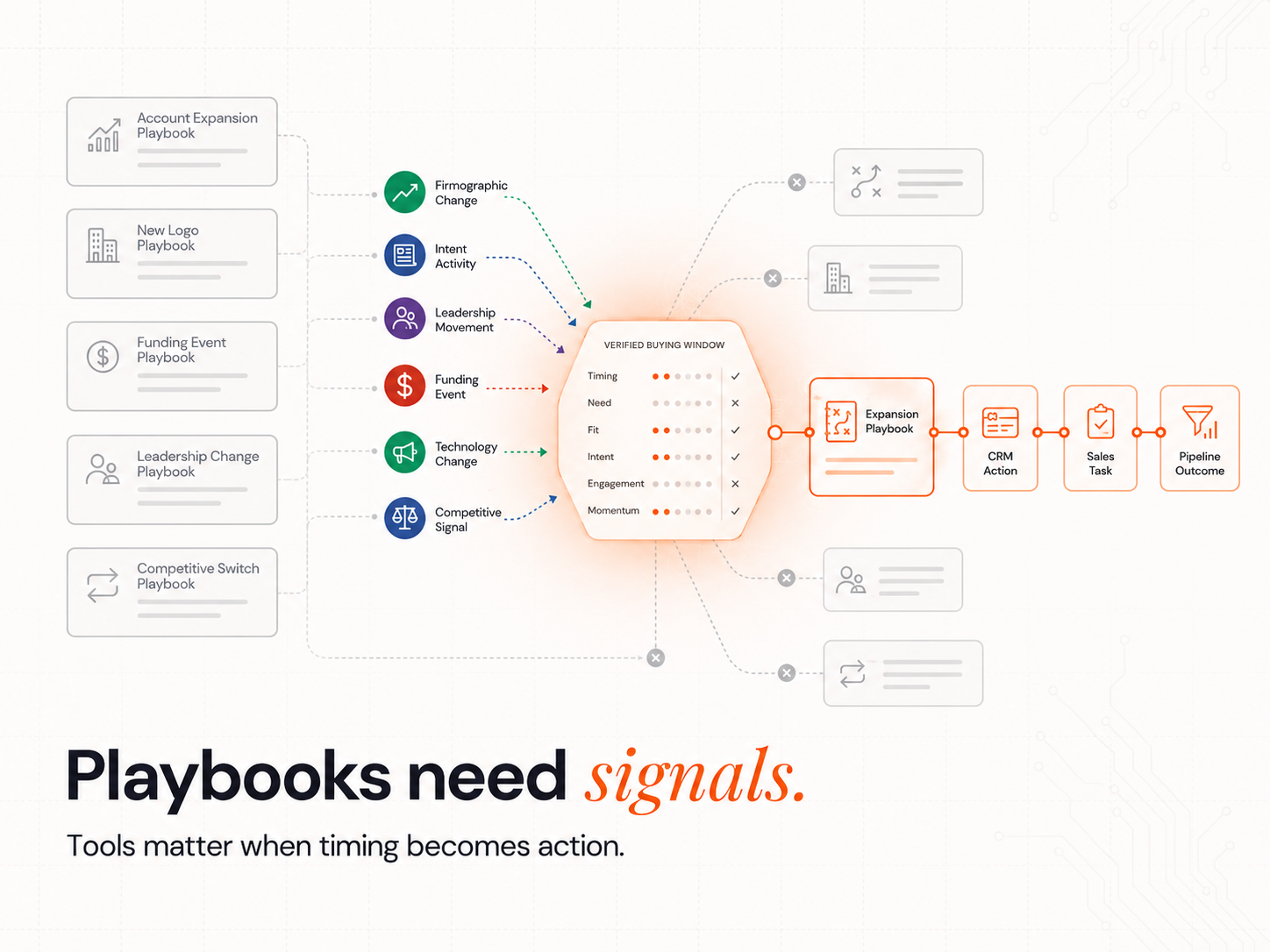
Signals, workflows, and playbooks do not function as separate components. Each feeds the next. Signals define what is happening in target accounts. Workflows convert that intelligence into action. Playbooks specify the channel, message, and timing for each signal type. Together they create a signal-led go-to-market system, not a volume-driven funnel.
Modern B2B lead generation aligns three pillars:
Signals capture behavioural and contextual intent evidence across touchpoints, defining buyer readiness.
Workflows automate qualification, routing, and engagement based on signal patterns, converting intent to action.
Playbooks provide channel-specific tactics matched to signal type and buying stage, defining engagement where and how.
Together they create signal-led go-to-market systems. These systems recognise that pipeline creation requires readiness recognition and precise response, not increased activity.
Lead Generation
Tools collect signals; systems act on them. Intelligent Resourcing builds the orchestration layer as a Revenue Operations Studio, connecting signals, workflows, and playbooks so pipeline creation is repeatable, not purchased.
FAQs
What is B2B lead generation in 2026?
A signal-led system capturing buying intent, qualifying readiness, and activating sales when evidence warrants engagement.
Are lead generation services obsolete?
They increasingly misalign with modern buying behaviour and rarely independently generate predictable pipeline.
What is the difference between signals and intent data?
Intent data serves as raw input. Signals represent qualified, time-bound evidence that triggers action.
Where should B2B teams start?
Define signals indicating readiness before selecting channels, tools, or services.