
Why does ICP matching alone fail to predict when an account is ready to buy?
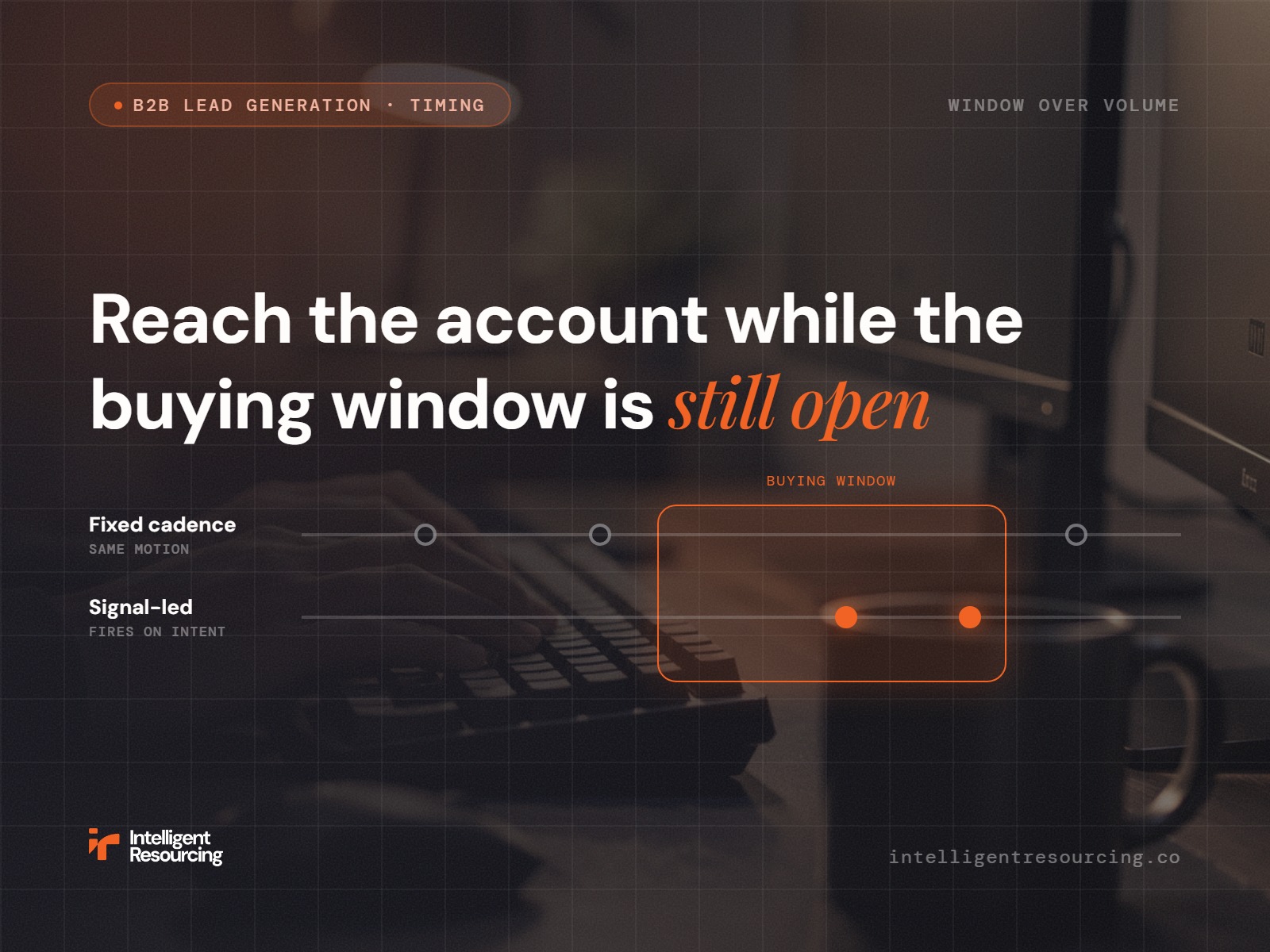
Matching your Ideal Customer Profile tells you which companies could buy from you. It does not tell you which ones are buying now. That distinction controls pipeline velocity more than any other variable in B2B go-to-market. The timing gap between "fits ICP" and "is actively buying" is where most outreach budgets disappear.
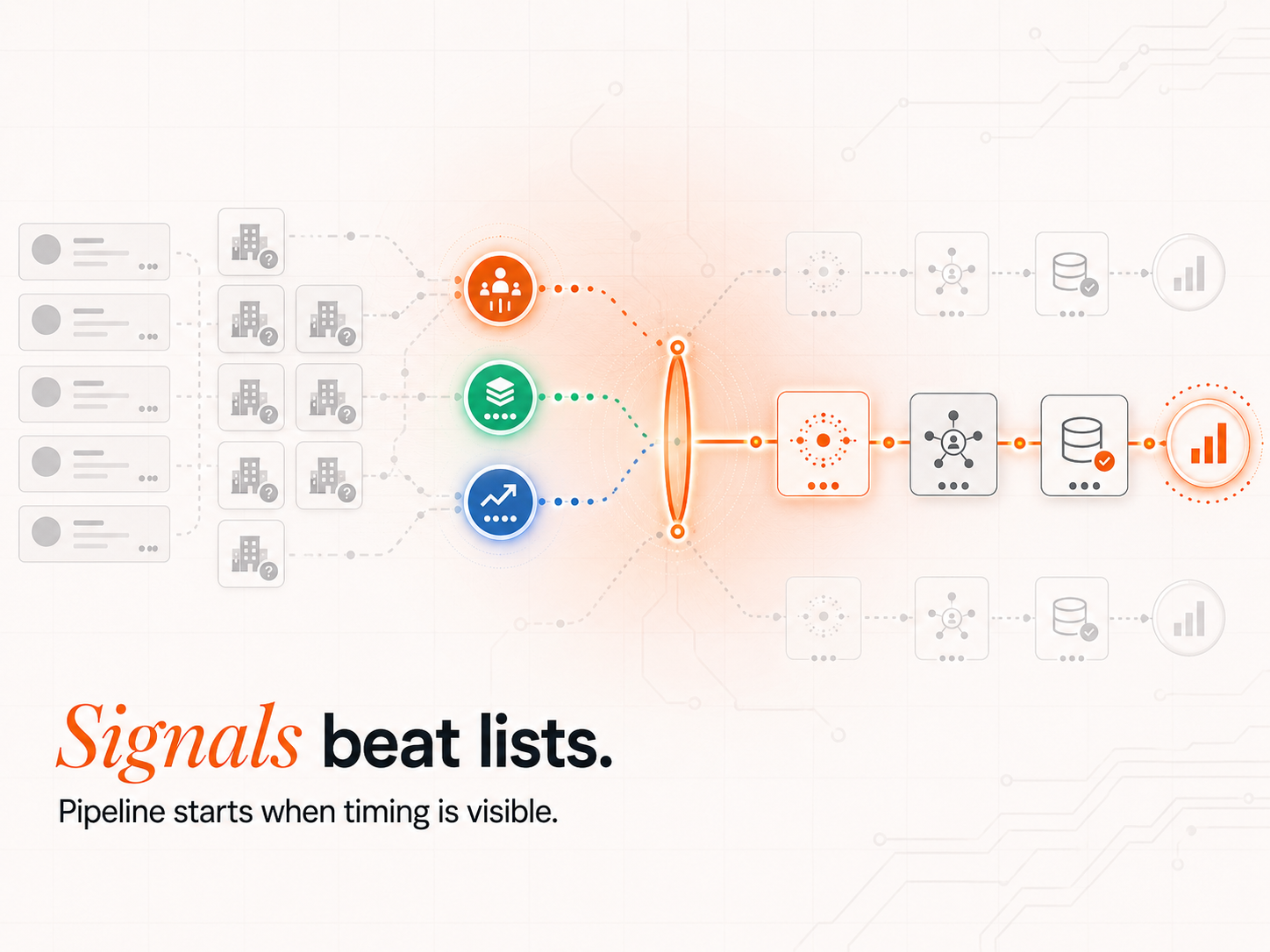
Signal-based lead generation surfaces buying triggers before a prospect officially becomes a lead. Instead of paying for a high volume of names, teams monitor for real-world triggers:
- Hiring changes and leadership moves
- New technology implementations
- Early research and engagement patterns
- Key company milestones or commercial events
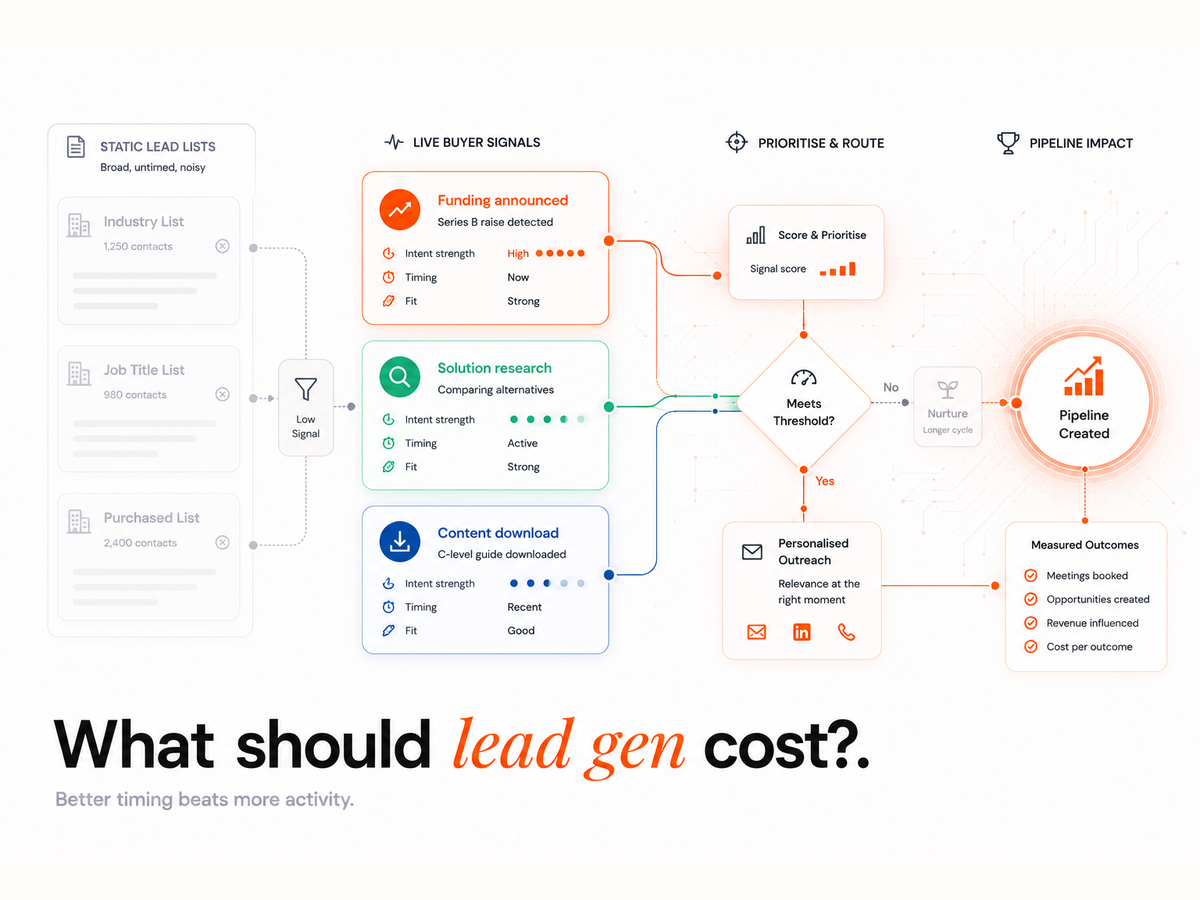
Once captured, signals are enriched, scored, and routed to the right rep at the moment timing and relevance align.
Matching your ICP tells you who to target. It does not tell you when to engage. To build a reliable pipeline, you must detect meaningful, time-sensitive changes inside target accounts. Instead of waiting for a form fill, you actively monitor for triggers: executive hiring, tech stack shifts, funding rounds, renewed CRM activity. This identifies the exact moment an account transitions from researching to buying.
A signal-based approach prioritises precision over volume. It connects intelligence to action across three dimensions:
- Validates intent before a single piece of outreach is sent
- Integrates operations by connecting data enrichment, automated scoring, rep routing, and CRM attribution
- Measures success through pipeline movement, conversion rates, and revenue impact, not activity counts
In this model, the test of a lead is not just who they are. It is identifying what changed inside their business, proving that change indicates buying readiness, and executing the right next action the moment it happens.
Why does traditional lead generation break down in 2026?
Traditional lead generation assumes buyers announce themselves through a form fill or a list purchase, they do not. Three structural failures turn volume into noise: the timing problem (pitching the 95% who are not in-market), the data rot problem (lists degrade faster than sequences run), and the late-signal problem (reacting after buyers have already formed shortlists).
Volume hides terrible timing
Ehrenberg-Bass research shows only 5% of your target market is actively looking to buy at any given time. The remaining 95% are not yet ready.
Pushing high volumes of cold names into outreach sequences does not create opportunity. It burns through your total addressable market by pitching accounts that are structurally unready. You deplete your contact database while generating noise. The 95% who are not buying now will not convert because you reached them. They convert when their internal situation changes.
Disconnected systems create blind spots
When list building, data enrichment, and outreach live in separate silos, you lose sight of what actually works. You stop learning which signals predict meetings and which produce noise.
This lack of coordination explains the data quality crisis in B2B CRM systems. Validity's 2025 CRM report found 76% of companies have less than half their CRM data accurate and complete, and 37% have directly lost revenue as a result. Disconnected systems do not just slow outreach. They corrupt the intelligence your reps rely on.
Leads arrive too late
A traditional lead appears after the buyer has already spent weeks researching, comparing vendors, and talking to peers. By the time someone fills out a form or books a demo, their shortlist is formed. If your system only reacts to those late-stage actions, you miss the window where buyers form opinions and build preferences.
Optimising for volume over intent does not build a pipeline. It builds a backlog of wasted effort.
Which buying signals reliably predict pipeline?
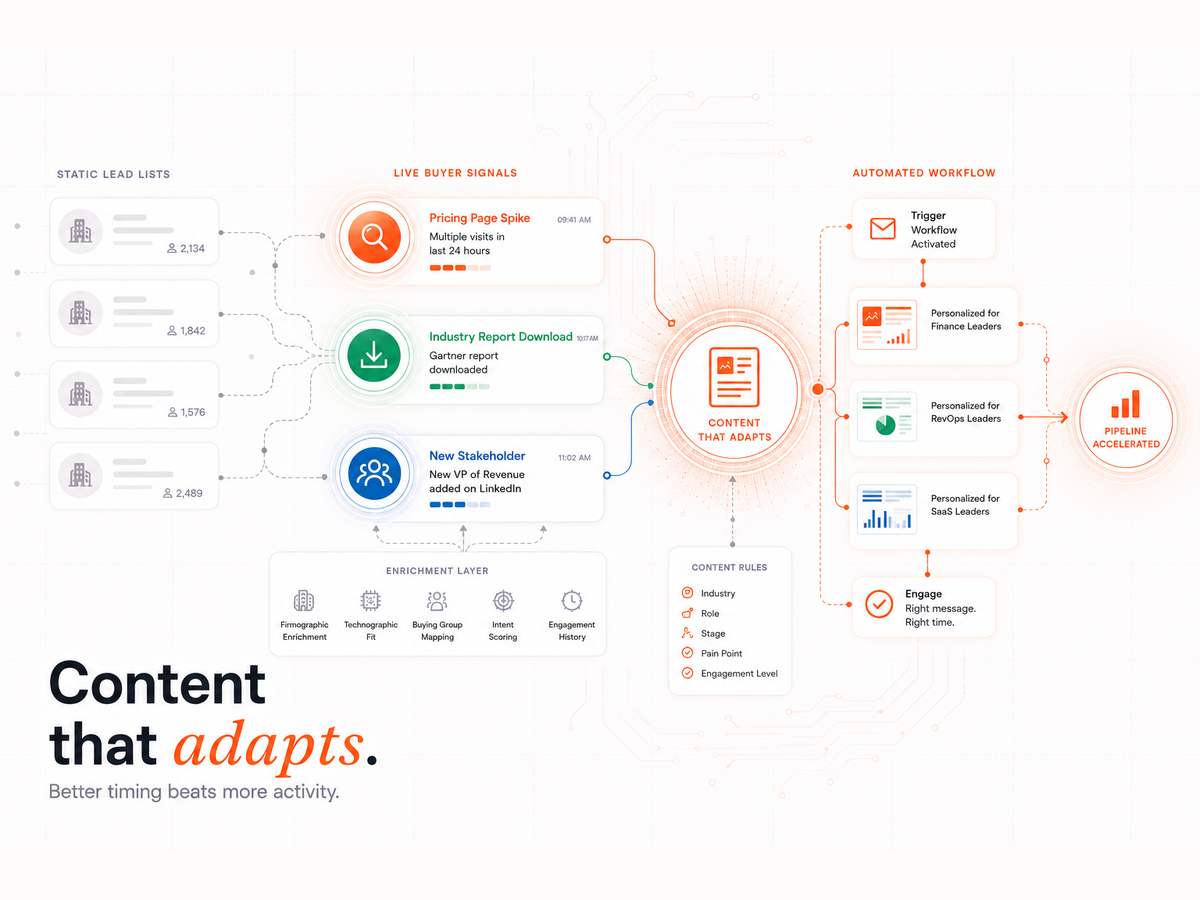
Not all signals carry equal weight. The value of signal-based prospecting lies not in any single event but in how signals cluster and how quickly your system verifies them. Five categories signal genuine buying readiness in B2B: hiring and organisational change, technology movement, commercial expansion, behavioural engagement, and CRM re-engagement from known demand.
Hiring and organisational change. New roles, team expansion, and leadership hires signal budget movement, operational pressure, or a change in priorities. A single vacancy is a weak signal. A cluster of related hires in the same function is far stronger. A new VP of Sales arriving from a competitor that uses your category of tool is a high-probability trigger.
Technology changes. New tools entering the stack, legacy systems being replaced, or implementation partners appearing signal a coming purchase motion. These signals are especially useful when your offer depends on integration, migration, or workflow redesign.
Funding, restructuring, and expansion. Commercial change creates buying windows. Expansion into a new market, fresh investment, or a reorganisation triggers new operational requirements and vendor reviews.
Behavioural signals. Repeated visits to pricing, comparison, or service pages; content engagement across multiple sessions; return visits from several people in the same account; and growing AI discovery visibility all signal emerging demand.
CRM and sales interaction signals. Reopened opportunities, revived dormant contacts, multi-threaded email engagement, and repeated touches from related stakeholders are stronger than a fresh list of net-new names. They show movement inside known demand, not theoretical fit.
How does signal-based lead generation work in practice?
Signal-based lead generation follows five sequential steps: capture the trigger event, enrich and validate the account against your ICP and CRM history, score the signal by fit and timing, route to the right action, and feed outcomes back to sharpen the model. A failure at Step 2 undermines every step downstream.
Step 1: Signal capture, events not lists
Prospecting starts with events, not a static list.
Instead of pulling a thousand names and running sequences, teams monitor for specific triggers that indicate buying readiness:
- Executive hires: A new leader looking to make an early impact
- Tech stack shifts: A competitor contract expiring or a new integration being added
- CRM re-engagement: Renewed activity or high-intent website behaviour
- Commercial growth: New funding or rapid department expansion
The goal is not to collect every possible data point. It is to identify the 3 or 4 specific signals that consistently prove a Verified Buying Window has opened in your market. Timing and relevance drive the decision, not volume.
Step 2: Enrichment and validation
A raw signal on its own does not justifies action. It needs context to become an opportunity. Before a signal moves forward, it passes a validation test across four layers:
- Company fit: Does this account match your Ideal Customer Profile?
- Role relevance: Is the signal from a decision-maker or someone outside the buying motion?
- History: What does your CRM show? Existing relationship or fresh entry?
- Data accuracy: Is the contact information verified and current?
The final check, data accuracy, is where most systems fail. Without verified, current contact data, even the strongest signal routes to the wrong person or a dead address. This is where the 76% CRM accuracy problem identified in the Validity research above destroys outreach before it starts.
Step 3: Prioritisation and scoring
Not every ICP-matched account should be activated, and not every signal deserves the same response. Good scoring models balance who they are against when they are buying.
In practice, a perfect-fit account with no recent movement is less valuable than a good-fit account showing multiple signals in the same week. Three scoring principles drive this:
- Signal weighting: A new VP of Sales is a stronger signal than a single website visit. Score them differently.
- Signal clustering: One event is interesting. Three events at the same account in the same week is a high-priority opportunity.
- Automated decision rules: Tools like Clay combine enrichment and verification instantly, so only the highest-scoring accounts, right fit and right timing, push through to your sales team.
Your reps stop guessing who to contact and focus on accounts that have already shown buying behaviour through their actions.
Step 4: Routing and action
This is where signal-led systems either build pipelines or create noise. A signal is a starting point, not a reason to send a generic email.
Depending on signal strength and type, the right action varies:
- High-intent signals: Route directly to a sales rep for a personalised, manual reach-out
- Early-stage signals: Trigger a LinkedIn touch or a founder-led soft introduction
- Low-weight signals: Move the account into long-term nurture until more activity is detected
- Review queue: Flag for manual review before any outreach begins
Gong Labs' analysis of 1.8 million deals shows closed-won deals involve twice as many buyer contacts as lost deals, and multi-threading boosts win rates by 130% in deals over $50,000. Signal routing is what makes coordinated, multi-threaded outreach possible at scale rather than dependent on individual rep initiative.
See how we push signals directly into the CRM, from detected events to activated sales opportunities.
Step 5: Feedback into CRM
Signal-based lead generation only improves when outcomes feed back into the system. Without a feedback loop, you repeat the same actions without learning what works. Track three questions:
- Which signals created meetings?
- Which combinations led to a qualified pipeline?
- Which signals looked promising but failed to convert?
When results sync back to your CRM, Step 1 (Signal Capture) sharpens over time. You stop chasing noise and concentrate effort on the triggers that close.
What is the role of tools in a signal-based system?
Tools accelerate signal processing but do not generate the strategy behind them. Precisely's 2024 data research found 64% of organisations now rank data quality as their top challenge, up from 50% the prior year. A Clay, HubSpot, or n8n stack runs faster and scales further, but only when the signal definitions and routing logic beneath it are correct.
A strong tech stack collects events, scores accounts, and launches actions faster. But if the underlying logic is noisy, you automate noise. The real advantage does not come from buying a signal platform. It comes from:
- Deciding which signals matter to your specific business and market
- Identifying signal combinations that confirm a genuine buying window
- Orchestrating how signals route through your GTM system into the right rep action
Many teams reach for more tools when what they need is cleaner signal definitions, better orchestration, and tighter feedback loops. Signal-led growth is not anti-tool. It is anti-random automation.
For readers mapping the tech side, signal-based marketing tools covers what each layer of the stack actually does and when you need it.
Should you build signal-based lead generation in-house or get outside help?
The decision depends on what you are optimising for: long-term ownership of the signal logic, or speed to first pipeline results. RAIN Group's benchmark, drawn from 488 B2B buyers representing $4.2 billion in purchases, shows top-performing teams generate 2.7 times more conversions than the rest. The separating factor is timing logic, not contact volume.
Build in-house when ownership is the priority
Building internally makes sense when your category is nuanced and your sales motion is consultative. If you want the signal logic to become a durable competitive asset, keeping the system inside your company gives you full control over every trigger, routing rule, and workflow.
Buy outside help when speed is the priority
External support is best when you understand the problem but do not have the capacity to build the technical architecture. An outside partner accelerates workflow design, enrichment logic, and implementation, putting first pipeline results weeks ahead of an internal build timeline.
The hybrid model: the strongest path for most teams
For most teams, a hybrid approach delivers the best outcome. External experts build the machine and handle the architecture, while your internal team takes ownership of:
- Signal definitions: What "ready to buy" looks like in your specific market
- Routing rules: Which rep receives which signal at which stage
- CRM governance: Keeping the feedback loop clean and attributable
Teams evaluating this path compare a hands-on automated lead generation build with a full GTM Engineering systems engagement.
Why does signal-led growth outperform volume-led outreach?
Gong's 2024 deal analysis of 1.8 million B2B deals shows closed-won deals involve twice as many buyer contacts as lost deals, and multi-threading driven by signal routing boosts win rates by 130% in deals over $50,000. Signal-led systems create the conditions for that multi-threading. Volume-led systems cannot.
Signal-led growth wins on four dimensions:
Timing. Teams act on movement instead of static lists. Outreach arrives when accounts are in transition, the moment when buyers are most open to new vendor conversations.
Relevance. Outreach reflects what changed in the account, not just who fits an ICP. A message that references a specific hire, a known technology change, or a recent funding event earns response rates that generic sequences cannot match.
Attribution. Signals, routing decisions, and pipeline outcomes trace back through the same operating system. You know exactly which trigger types close and which produce noise.
Waste reduction. Fewer actions launch at the wrong moment. Budget and rep time concentrate on the 5% of accounts that are genuinely in-market, the only accounts Ehrenberg-Bass research shows are actually ready to buy right now.
Lead Generation
Pick the model that matches your sales motion (volume vs system), then choose the partner that proves signal logic and integration depth. Intelligent Resourcing builds and runs signal-to-pipeline as a Revenue Operations Studio, not a campaign retainer.
FAQs
How is signal-based lead generation different from lead generation services?
Lead generation services optimise for output: list size, booked meetings, hand-raisers. Signal-based lead generation optimises for timing, context, and pipeline probability. The output is not a volume of contacts. It is a set of verified accounts where something just changed to indicate buying readiness.
How do signals become pipelines?
Signals become pipeline when they are captured, enriched against your ICP and CRM history, scored by timing and fit, and routed into the right outreach motion. Clean data and a documented feedback loop are required at every stage. Without them, the signal degrades before it reaches a rep.
Should I build this in-house or get outside help?
Build in-house when strategic ownership of the signal logic matters most to your competitive position. Buy outside help when speed is the priority and your team lacks the technical capacity to build the architecture. Most teams get the best result from a hybrid: external support accelerates the build, and the internal team takes ownership of signal definitions, routing rules, and CRM governance.
What tools are used in signal-led growth?
Common components include enrichment platforms (Clay for B2B signal capture and waterfall logic), workflow orchestration tools (n8n for cross-system routing), CRM platforms (HubSpot or Salesforce), sequencing tools (Smartlead, Lemlist), and analytics layers for attribution. The tools are secondary to the logic. Clear signal definitions and reliable routing create value. The stack executes that logic at speed.
What is a Verified Buying Window?
A Verified Buying Window is the period when a target account shows enough buying signals, clustered, timed, and validated against your ICP, to justify a direct, personalised outreach motion. It differs from broad intent data in that the window is confirmed through multiple corroborating signals, not inferred from a single data point.