Replace rented seats with engineered revenue.
The brief
What's actually wrong with your revenue infrastructure?
Answer
• Your teams are doing the work, but your infrastructure is billing you for the gaps. • Marketing, Sales, and Finance live in separate tools (HubSpot, Pipedrive, Xero) with data moving late, breaking in transit, or requiring manual spreadsheet repairs. • This is a pricing model problem disguised as a data and handoff problem. • Seat-based AI and SaaS pricing ties vendor revenue to your headcount, not workflow performance vendors get paid whether the workflow works or not. • Your bill rises while your team spends hours repairing records, chasing mismatched data, and fixing handoffs. • Invoices reveal the truth faster than keynotes—pricing tells you what the vendor optimises for. • We don't sell seats. We engineer Revenue Infrastructure that lets revenue grow without adding more manual ops work.
Seat-based software can look predictable on paper. It locks inefficiency into the cost model instead of removing it.
The Reality
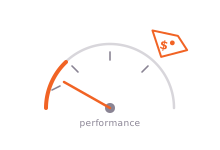
Pricing Hides Underperformance
You pay for access, not outcomes, so inefficiency stays billable every month.

The Reality
Waste Stays Invisible
Underused seats rarely trigger action, yet the invoice still clears each month.
The Reality
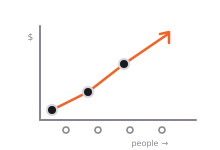
Cost Scales With People
Every new process often adds another licence, another login, another dependency.
The reality: predictable seat costs protect vendors from your efficiency gains. If you want to physically connect your tools so data flows without human intervention, you need a Revenue Architect.
The List
The Signal
We do not sell seats. We engineer Revenue Infrastructure.
Revenue operations improve when hygiene, connection and visibility work as one system, not three separate tools.
Signal Intelligence Brief
Live record
Trigger — When
Evergreen Data Protocol keeps records true
Duplicates merged, fields validated, low-confidence data flagged before routing.
Contact — processor
Integration Architecture moves the data
A deal closes in Sales. Onboarding fires in Customer Success. No human carries it.
Context — Why now
Revenue Scoreboard tracks the friction
Pipeline velocity, handoff latency and data confidence by stage.
Objective — Outcome
One working system, not three tools
Revenue capacity grows while software cost and headcount stay controlled.
We don't sell another seat. We engineer the plumbing between the tools you already own. What you get is one working system across marketing, sales and finance.
This is not another seat. Here is what changes.
In our work, about 99% of the account information we deliver is verified accurate.
Clear, practical options. No heavy package selling.

The Diagnostic (Audit)
For Teams Overpaying for Underperformance
We review your stack, map how data moves across marketing, sales and finance, and identify where seats should be replaced by scripts, workflows or API connections.

The Foundation (Build)
For Teams Ready to Engineer the Core System
We clean the data environment, build the integration logic, implement routing protocols, and stand up the reporting layer.

The Guardian (Optimisation)
For Teams That Need Ongoing Reliability
APIs change. Tools update. Data decays. We monitor the system, fix breakpoints, and optimise the logic as your revenue motion evolves.
What this requires
This is NOT for
If this fits how your team works, the next step is simple. We show you where your budget is being lost first.
Seat-heavy tooling can still leave your team repairing data, supervising handoffs, and paying for inefficiency every month. Most RevOps waste comes from fragmented execution, missed timing, and manual handoffs across marketing, sales and finance. We audit your current revenue flow and show where the budget is being lost, where signal quality breaks, and where automation can recover team capacity first.