
Why Is HubSpot’s Stock Down 65%?
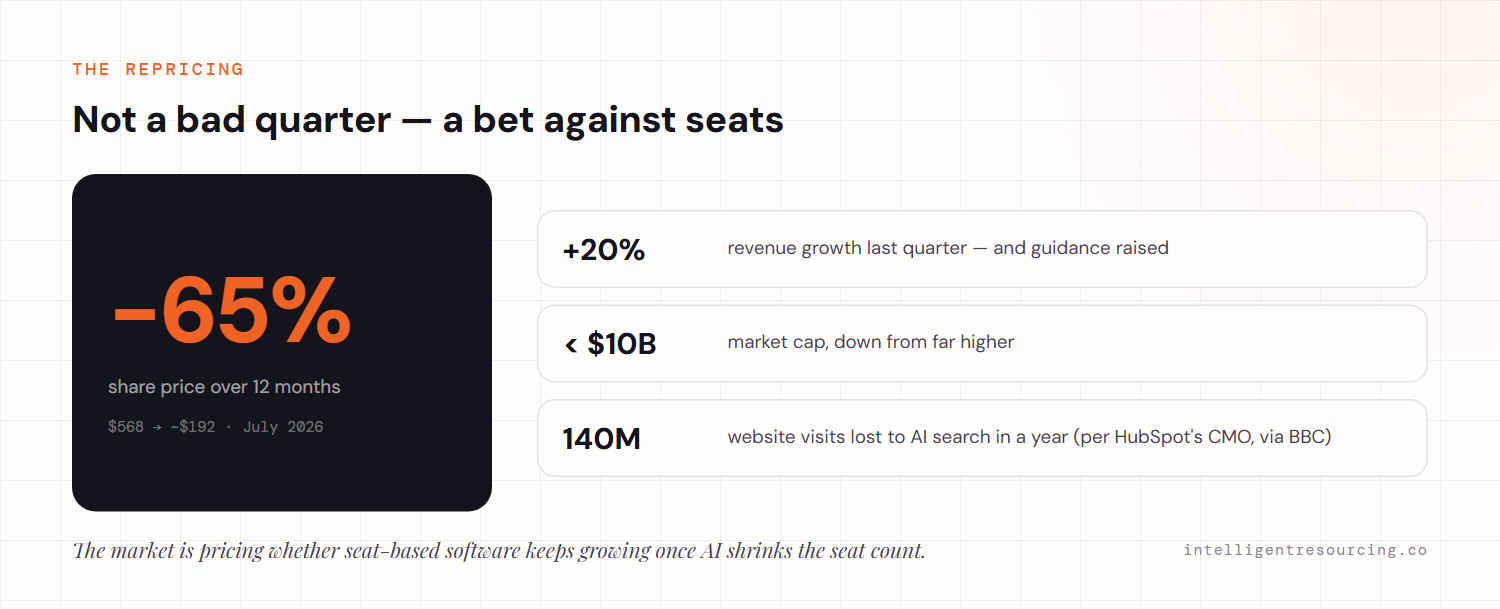
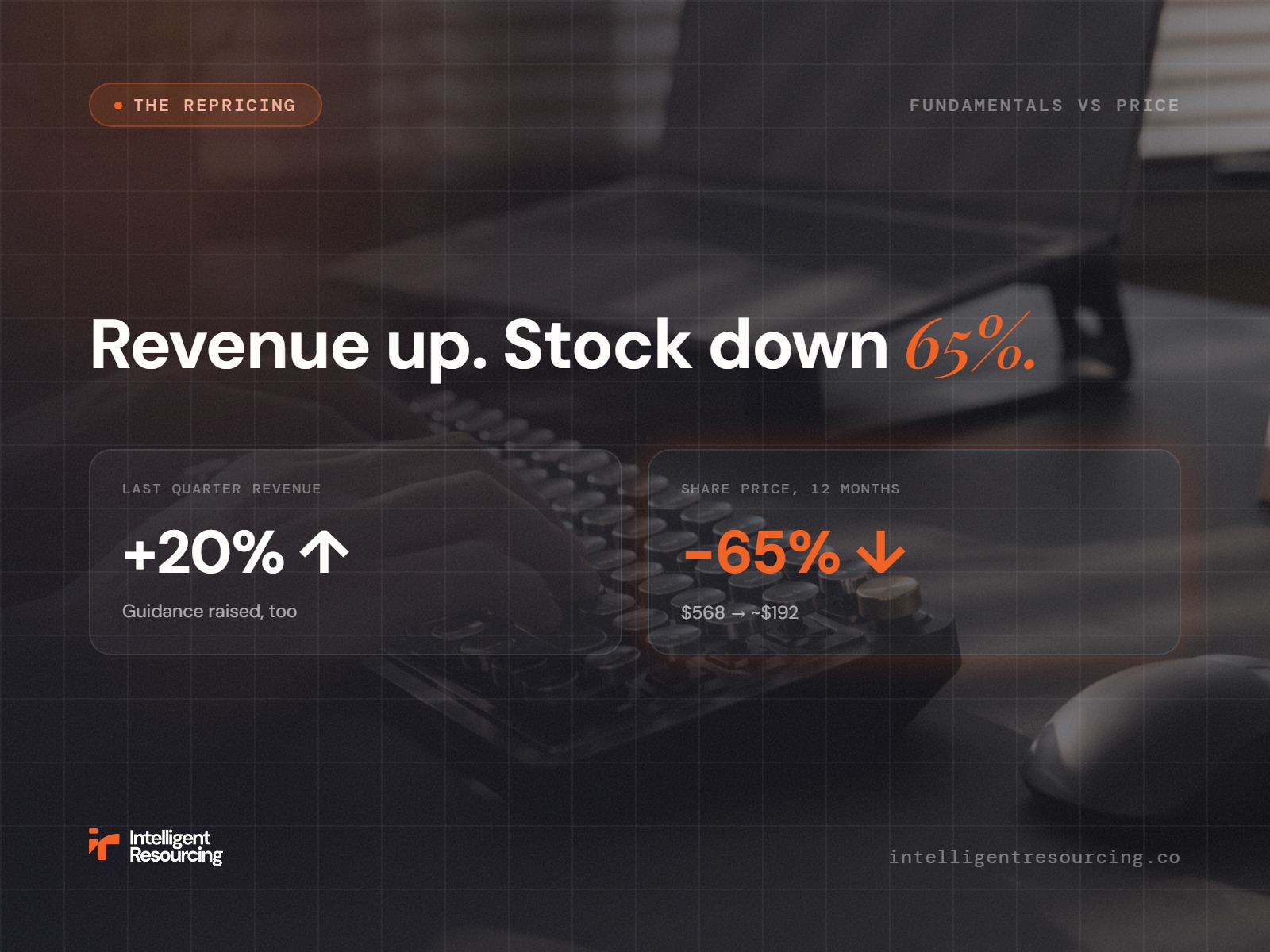
HubSpot’s share price has fallen 65-66% over the past year, from a 52-week high of $568.16 to about $192 as of July 2026. Revenue grew over 20% last quarter, and HubSpot raised guidance. The stock isn’t pricing a bad quarter. It’s pricing whether seat-based software keeps growing once AI reduces how many seats a team needs.
Market cap has fallen under $10 billion, per market data as of July 2026. Part of the pressure is structural: AI search cost HubSpot roughly 140 million website visits in a single year, according to BBC reporting citing HubSpot’s own CMO Kipp Bodnar. HubSpot isn’t alone in this repricing. The same question is hitting SaaS companies across the category as investors reassess per-seat pricing in an AI-native buying environment.
What Was Originally Announced With HubSpot’s Data Changes?
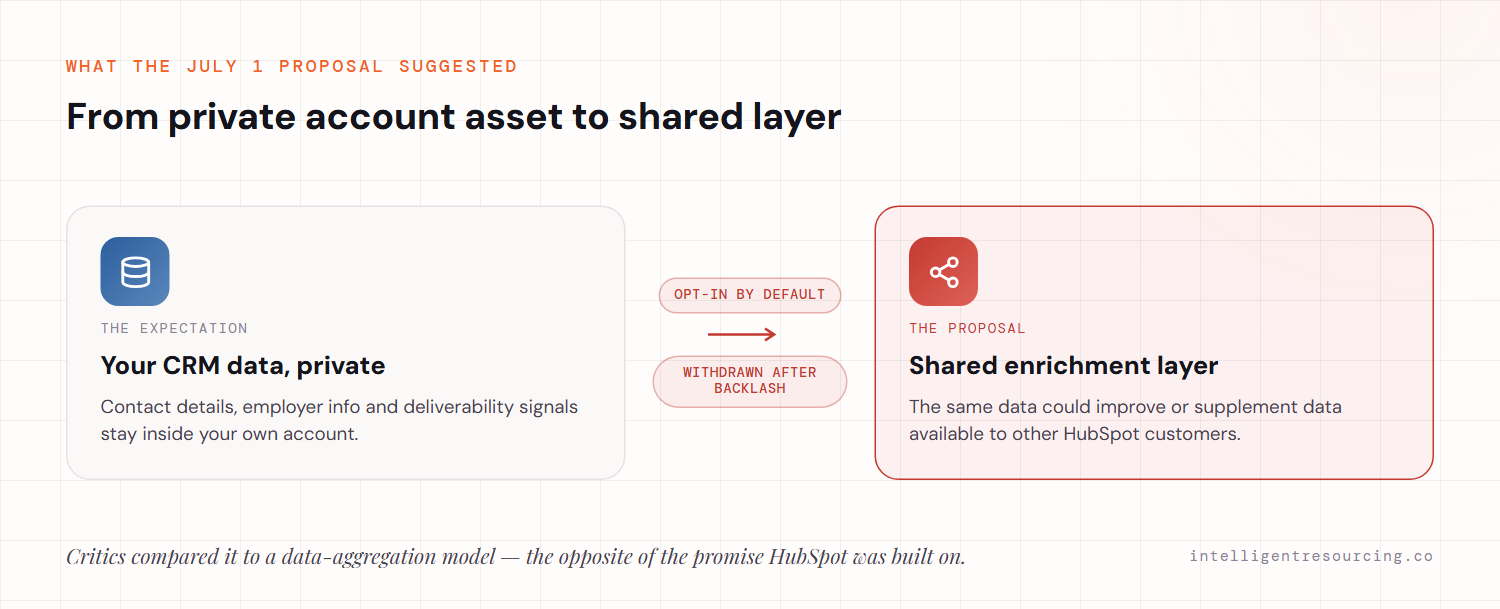
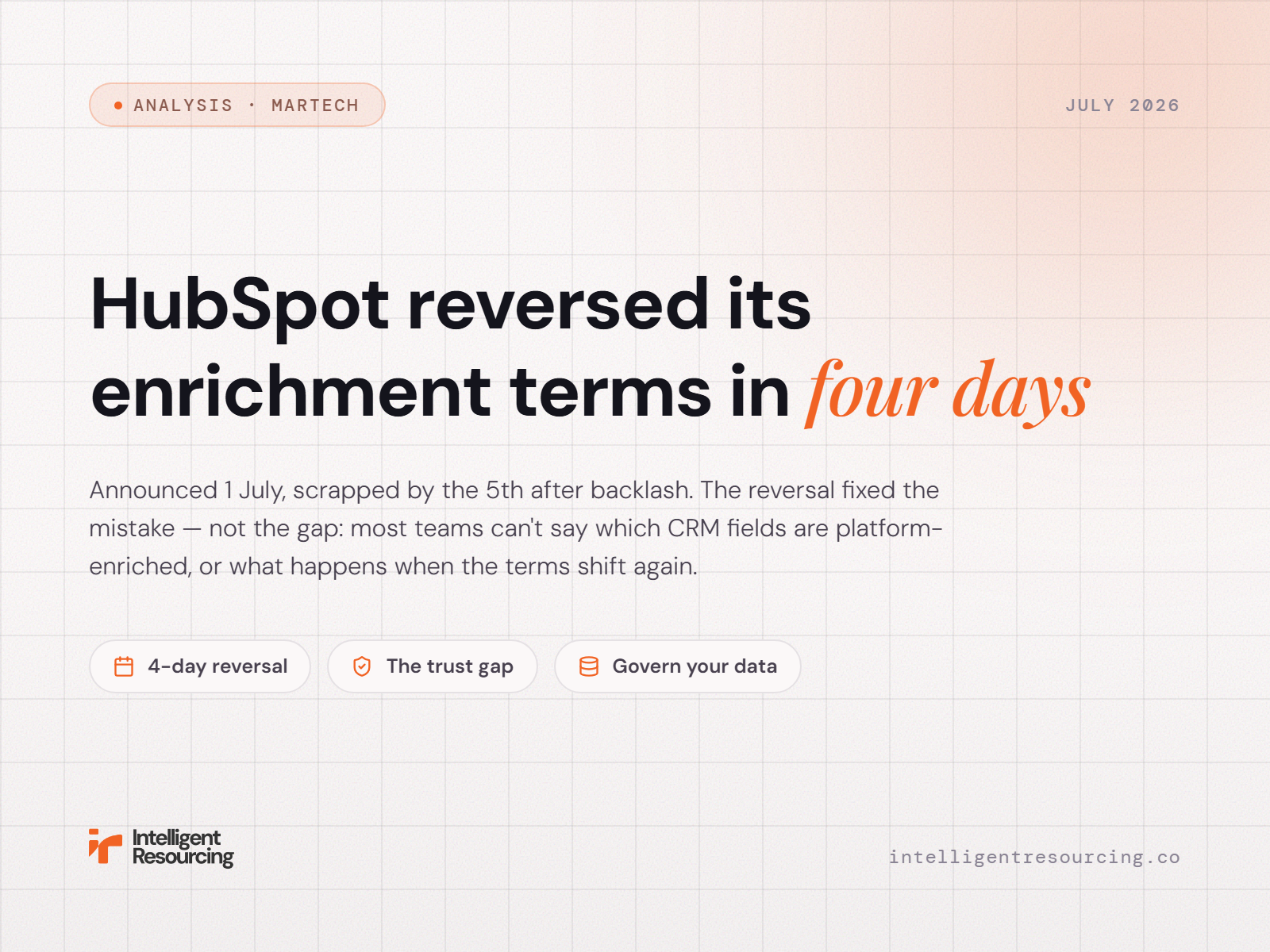
HubSpot’s July 1 announcement proposed changes tied to Contact Discovery and enrichment data, with the rollout originally connected to August 4 settings access. The update raised concern because it appeared to move some CRM-adjacent data from a private account asset into a shared enrichment layer that could improve data available across HubSpot’s customer base. HubSpot later said it would not move forward with the July 1 terms changes, so this should be treated as a withdrawn proposal rather than a confirmed August 4 change.
| Area | What the July 1 Announcement Suggested | Why Customers Reacted |
|---|---|---|
| Enrichment data | Business contact details, employer information and email deliverability signals could support HubSpot’s enrichment dataset | Customers were concerned that CRM-adjacent data could be used beyond their own account |
| Cross-customer use | Enrichment data could help improve or supplement data available to other HubSpot customers | This challenged the expectation that CRM data stays inside the customer’s own account |
| Default exposure | Accounts already using enrichment appeared to be affected unless admins changed the relevant settings | The rollout felt automatic rather than clearly opt-in |
| Admin controls | Controls appeared to sit across enrichment settings, Contact Discovery, tracking-code intent data and AI model training | Customers wanted one clear account-level control, not separate settings across the platform |
| Brand trust | HubSpot had built trust around customer control of CRM data | The announcement made customers feel the data relationship was changing underneath them |
| Market comparison | Critics compared the model to data aggregation businesses such as ZoomInfo | The reaction was sharper because HubSpot was not perceived as a data-brokerage product by default |
The August 4 date is no longer the main story. The real issue is the governance risk the announcement exposed. A CRM, enrichment layer, tracking code and AI setting can all affect how customer data is collected, enriched or reused. HubSpot’s enrichment documentation already shows that enrichment is not a single feature; it includes contact enrichment, company enrichment, buyer intent data and email engagement quality signals.
For B2B teams, the practical takeaway is simple: vendor data settings cannot be checked once at implementation and then ignored. The July 1 backlash shows how quickly a platform update can create legal, commercial and trust questions if nobody owns recurring review of enrichment, AI and data-sharing settings across the SaaS stack.
Is the Data Change Connected to the Stock Price?
HubSpot has never stated that its data-sharing change was a response to its share price. What is verifiable is that both are happening in the same window: a company under pressure to prove its growth model, and a new source of revenue sitting in the enrichment data already inside its accounts.
The theory is reasonable, not confirmed. Pooling and monetising account data, the way ZoomInfo already does, is one plausible way to build a new revenue line once a market stops rewarding seat-based growth alone. The difference is that ZoomInfo customers knew what they signed up for. HubSpot built its brand on the opposite promise, and that’s what makes the theory worth taking seriously even without HubSpot confirming it.
What Should B2B Teams Check Now?
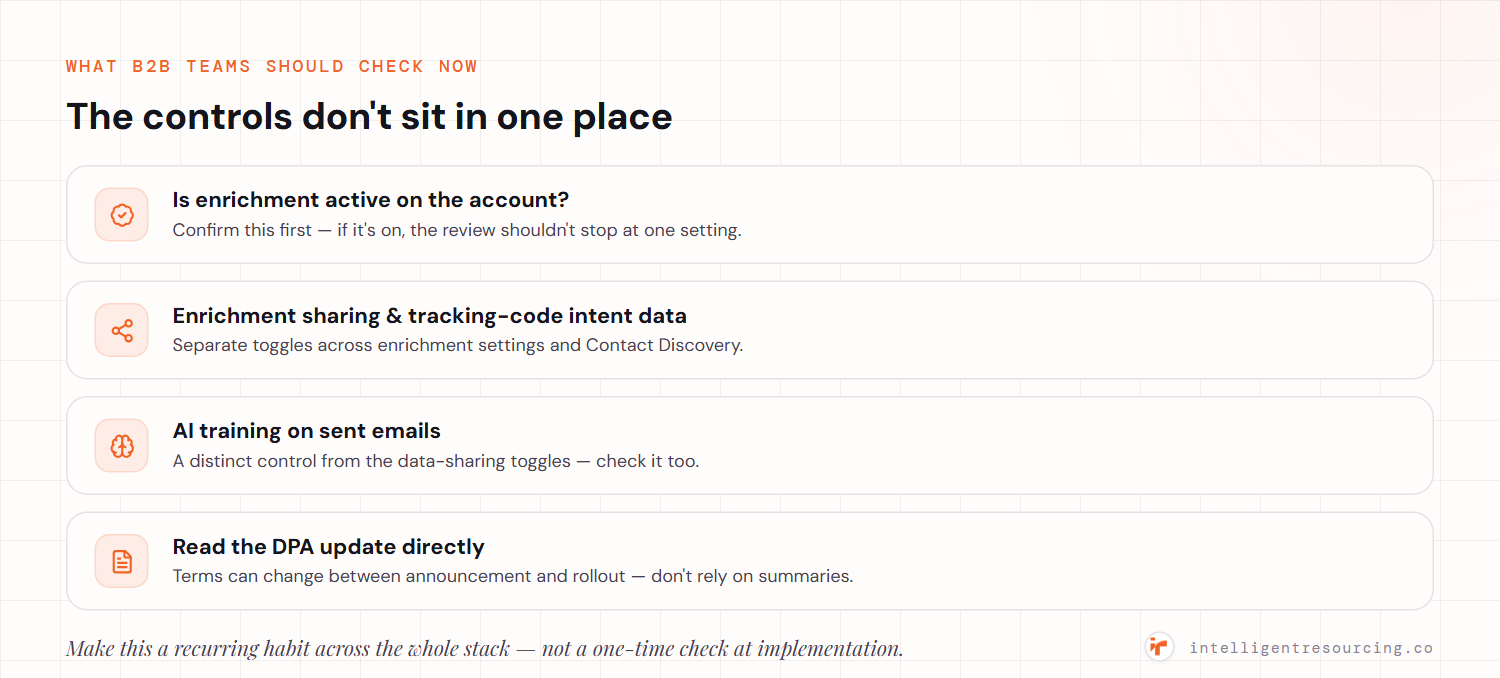
B2B teams should first confirm whether enrichment is active on the account. If it is, the review should not stop at one setting, because the relevant controls may sit across separate parts of the platform:
- enrichment sharing
- tracking-code intent data
- AI training on sent emails
Teams should read any DPA update directly rather than relying only on summaries or platform commentary. Vendor terms can change between announcement and rollout, so the risk is not just what the policy says on day one, but whether anyone is watching for changes before the effective date.
This should also become a recurring governance habit across the full SaaS stack, not just HubSpot. Any platform that stores CRM, account, contact or usage data may eventually expand how that data is used. A team that only checks settings during implementation can miss policy changes that appear between normal review cycles.
Where Does Intelligent Resourcing Fit?
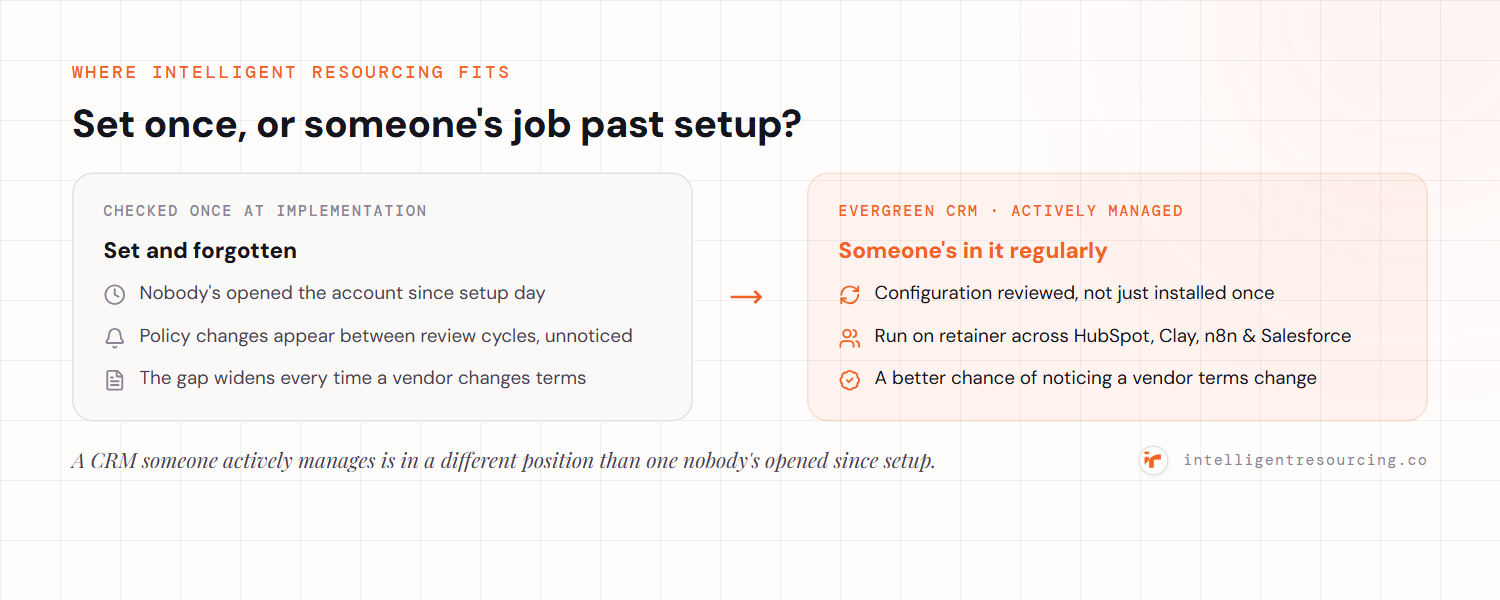
Intelligent Resourcing runs client CRM stacks, HubSpot, Clay, n8n, and Salesforce among them, on an ongoing retainer rather than a one-time build handed over and left alone, as part of a broader GTM engineering practice. That is the operating premise behind Evergreen CRM: the system stays someone’s responsibility past initial setup, with configuration reviewed, not just installed once.
A managed account has a chance of noticing a vendor terms change because someone is actually in the account regularly, not because there’s a specific alert built for DPA updates. That’s a narrower claim than “we’d have caught this.” It’s this: a CRM someone is actively managing is in a different position than one nobody’s opened since setup day, and that gap gets wider every time a vendor changes its terms without asking first.
RevOps Tools
Find out whether your CRM and its connected tools are actively managed or running on default settings from setup day.
FAQs
Why is HubSpot’s stock down 65%?
HubSpot’s share price fell from a $568 high to about $192 over the past year, a 65-66% drop, even as revenue grew over 20% and the company raised guidance. The market is questioning whether seat-based software holds up as AI reduces how many seats teams need, not reacting to weak performance.
What was going to change with HubSpot’s data on August 4?
Under a DPA announced July 1, enrichment data, including contact details, employer information, and email deliverability signals, would have been shared with other HubSpot customers from August 4, with existing enrichment users opted in by default. HubSpot withdrew the terms after customer backlash.
Is HubSpot’s data-sharing change caused by the stock drop?
That’s a theory, not a confirmed fact. HubSpot hasn’t stated a reason for the DPA change. What’s verifiable is that the stock decline and the data policy change happened in the same window.
How does Intelligent Resourcing fit into this?
Intelligent Resourcing manages client CRM stacks, including HubSpot, on an ongoing retainer rather than building them once and leaving. Under Evergreen CRM, the account gets reviewed regularly rather than sitting on whatever settings were active on setup day.