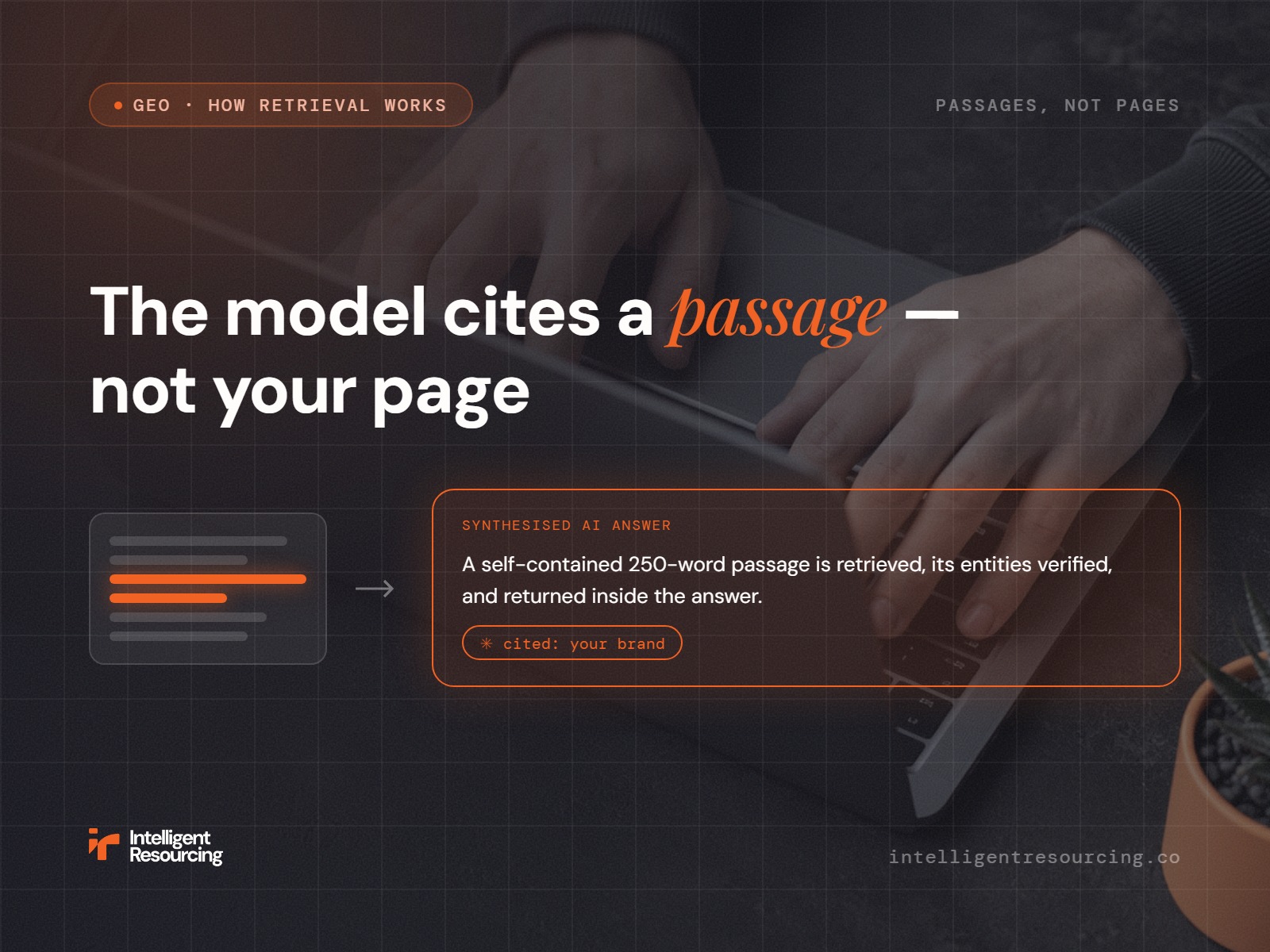
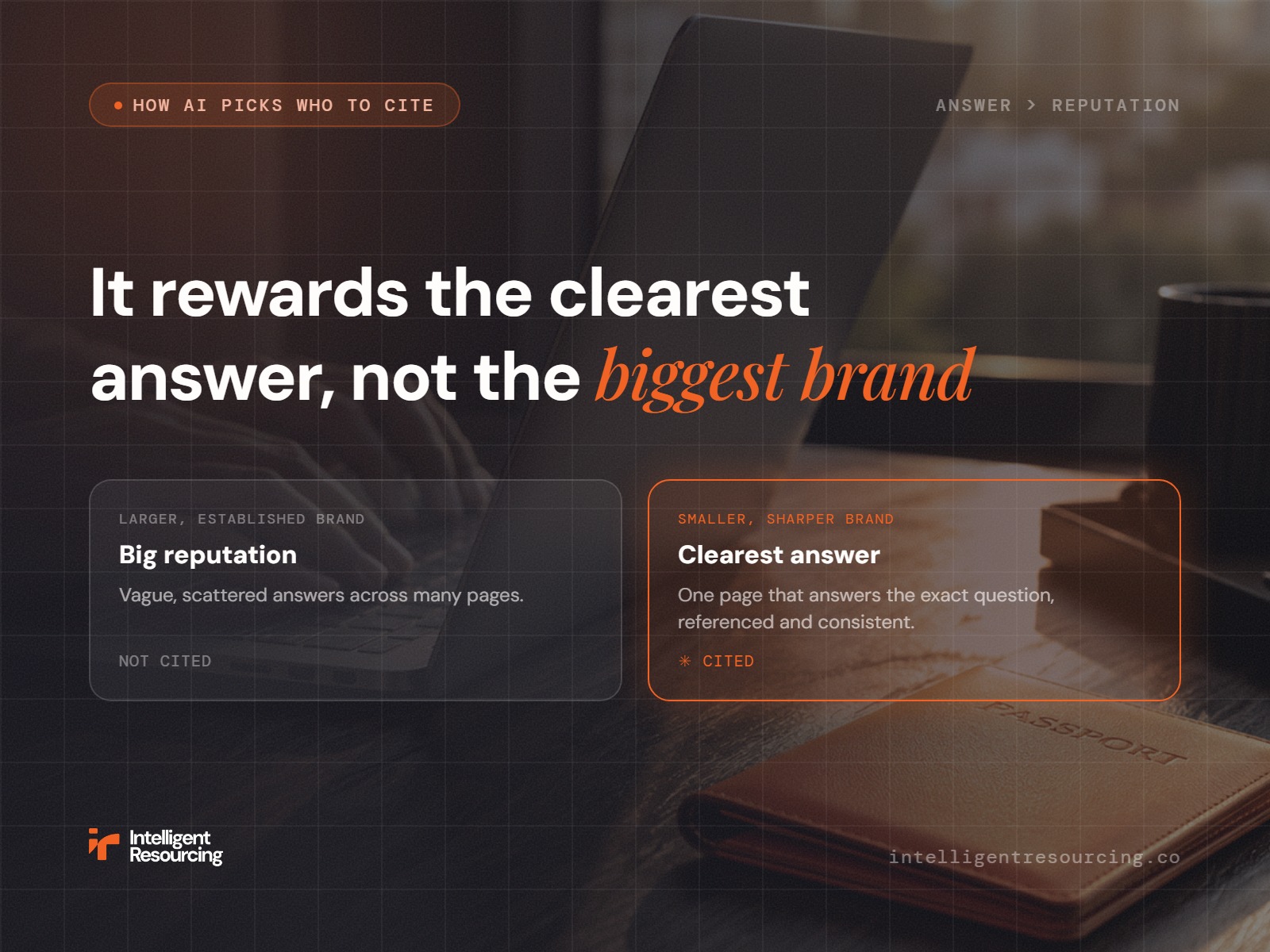
You are publishing more and getting cited less. Volume stopped working when AI started answering for your buyers.
The brief
What's actually changed in content production?
Answer
• AI-assisted content creation is now the baseline for competitive teams, which means manual-only production is too slow to keep up with the speed, coverage, and consistency the market now expects. • Your human marketing team cannot and should not try to out-publish a machine, so the job is no longer pure output — it's building a content system that combines AI production with human creativity, editorial sense-checking, and commercial judgement. • We help teams build a larger, more useful digital footprint by turning content into a scalable system, so your business is easier to find across more buyer searches, use cases, and decision-stage questions.
AI-assisted content creation is now the optimal way to scale output. Answer Engineering gives that output structure.

The Content Mill
Manual-Only Team
Human-led production protects quality but limits coverage. Strong content in small volumes, weak footprint growth.

The AI Content Churn
Volume-Only Team
Fast publishing expands page count but weakens trust and clarity. More pages, more noise, limited commercial impact.
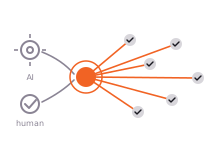
Answer Engineering
The Method
AI for production speed, human judgement for relevance. Wider footprint, stronger discoverability, real buying support.
The verdict: AI has already changed the production baseline, so manual-only teams fall behind on coverage and AI-only teams drown in low-value output. Answer Engineering wins with machine speed for scale and human judgement for quality, trust and search visibility.
The List
The Signal
We do not chase volume. Instead, we engineer answers.
More coverage makes you easier to find, but better delivery makes content useful enough to act on.
Signal Intelligence Brief
Live record
Trigger — When
Demand Mapping reads the market
CRM, Search Console and analytics show what prospects search, revisit and compare.
Contact — processor
Workflow Architecture splits the work
AI handles drafting speed. Humans handle positioning, originality and commercial judgement.
Context — Why now
Asset Provisioning expands coverage
Human-reviewed pages, comparisons, calculators and checklists across high-intent topics.
Objective — Outcome
Easier to find, useful enough to act on
Every asset ships with a clear review and delivery path before it reaches a buyer.
We don't publish for volume; we engineer a supply chain from demand signal to shipped asset, so what you get is content built to be found and acted on.
This is not another content mill, and here is what changes.
In our work, engineering content for AI citation took Kynection to 20.9% AI share of voice, first in category (June 2026).
Execution creates results. We deliver this in three steps: audit, build and optimise.

The Inventory Audit (Rationalisation)
For Teams With Too Many Assets
We audit your content library, identify the assets that influence pipeline, and remove low-value content. You get a prioritised inventory, keep or cut decisions, and a focused improvement plan.

The Architecture Build (Engineering)
For Teams Ready to Scale
We build the production rules, review paths, nurture flows and routing workflows that connect content to buyer stages. You get a working content automation system with clear handoffs.

The Optimisation Loop (Retainer)
For Teams That Want Ongoing Gains
We track usage, test timing and messages, and improve the system based on what buyers actually do. You get ongoing gains tied to commercial outcomes.
WHAT THIS REQUIRES
THIS IS NOT FOR
If this fits how your team works, the next step is simple. We show you where content is quietly costing you visibility first.
Visibility decides whether content creates value, so quality alone is not enough in an AI-assisted market. Content Automation Services helps you build a system that expands coverage and improves delivery, so buyers can find your business earlier and choose with more confidence.