
What Was HubSpot’s Contact Discovery Change?
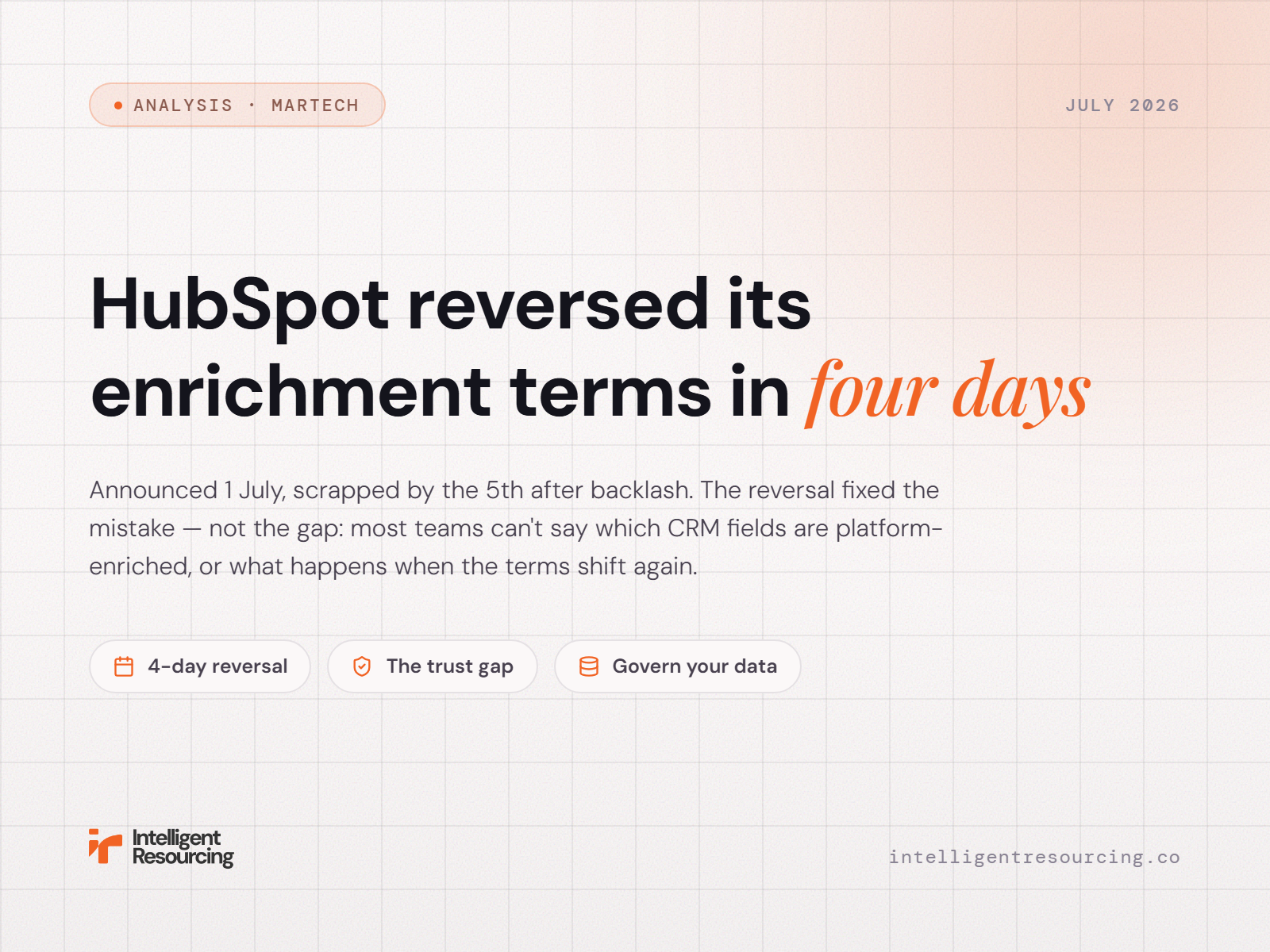
On 1 July 2026, HubSpot updated its Product Specific Terms. Customers using enrichment features would allow HubSpot to add enrichment data to its commercial dataset, which could then be used to enrich other customers’ records. Contact Discovery, planned to launch 4 August, was built on top of that shared pool.
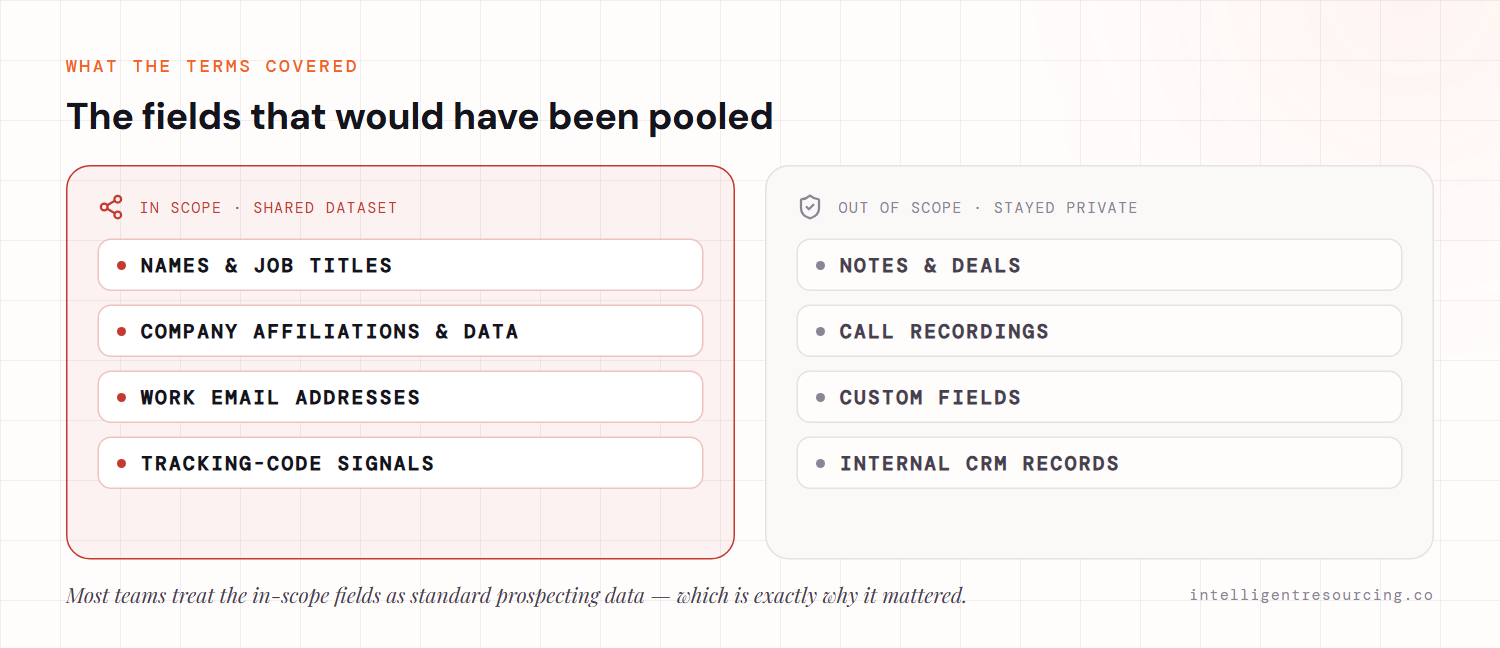
In scope: names, job titles, company affiliations, work email addresses, company data and tracking-code signals.
Out of scope: notes, deals, call recordings, custom fields and internal CRM records.
Most B2B teams treat the in-scope fields as standard prospecting data, which is exactly why the change was commercially significant. Customers pushed back for three reasons:
- Business contact data powers prospecting and outreach decisions directly.
- Customers had not explicitly agreed to their contacts contributing to a shared dataset.
- The opt-out lived inside Settings under Data Management and Data Enrichment, a location most customers had never visited.
The pushback in HubSpot’s own community thread centred on customers being opted in by default rather than asked, with critics arguing the plan treated customer-built CRM data as HubSpot’s to redistribute.
HubSpot’s Reversal and the Trust Gap It Exposed
On 5 July, HubSpot’s chief product and technology officer posted a public reversal titled “We Got This Wrong. And We Are Fixing It.” The terms changes were scrapped. Future enrichment features using customer data would be transparent and fully opt-in, and CRM data would not be used without explicit permission.
The reversal was the right call. What the backlash confirmed is that most customers had not read the updated terms, did not know the opt-out existed, and could not explain how their contact data was being used inside the platform running their pipeline. That is the common state for most B2B teams using any CRM with enrichment enabled, not just HubSpot customers.
Commercial intelligence is the raw material of revenue. Contact records, engagement signals and buying behaviour tell a team who to contact and when. When a team cannot account for where that data comes from, how it updates or what governs it, the pipeline built on top of it is fragile. A term change makes that fragility visible. So does a data audit, a compliance review, or a sales rep questioning a stale contact record.
Regional exposure varies too. Analysis from Mi3 Australia points out that Australian brands can face separate privacy compliance questions if business contact data collected for sales or marketing is later used for AI training or enrichment without disclosures that align with the Privacy Act.
The Problem That Outlasts the Rollback
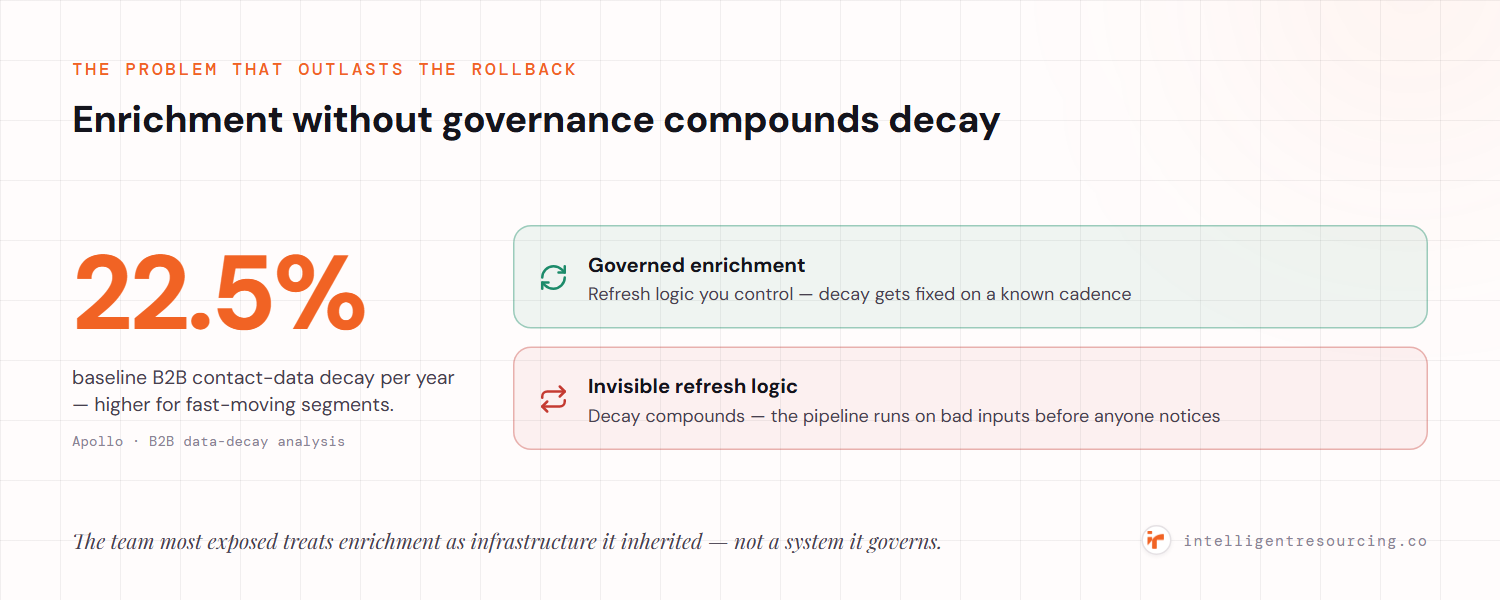
B2B data enrichment done well is one of the highest-impact actions a revenue team can take. Fresh contact data, accurate job titles and verified company signals improve outreach precision directly. The problem is enrichment running without governance.
The data also goes stale fast. Apollo’s analysis of B2B data decay puts baseline contact decay at roughly 22.5% a year, and higher for fast-moving segments. Enrichment that refreshes on invisible logic compounds that problem instead of fixing it.
A team most exposed when a platform changes its terms treats enrichment as infrastructure it inherited rather than a system it governs. The settings were configured during onboarding, the data has been refreshing in the background ever since, and nobody on the revenue team can say with confidence which fields are platform-enriched, which are first-party, and which have never been touched.
The HubSpot incident spread because the terms change surfaced in a community post. Most platform updates land in a legal notice or changelog nobody reads. By the time a team realises its signal logic shifted, the pipeline has already been running on bad inputs.
How Does a Governed Signal Layer Work?
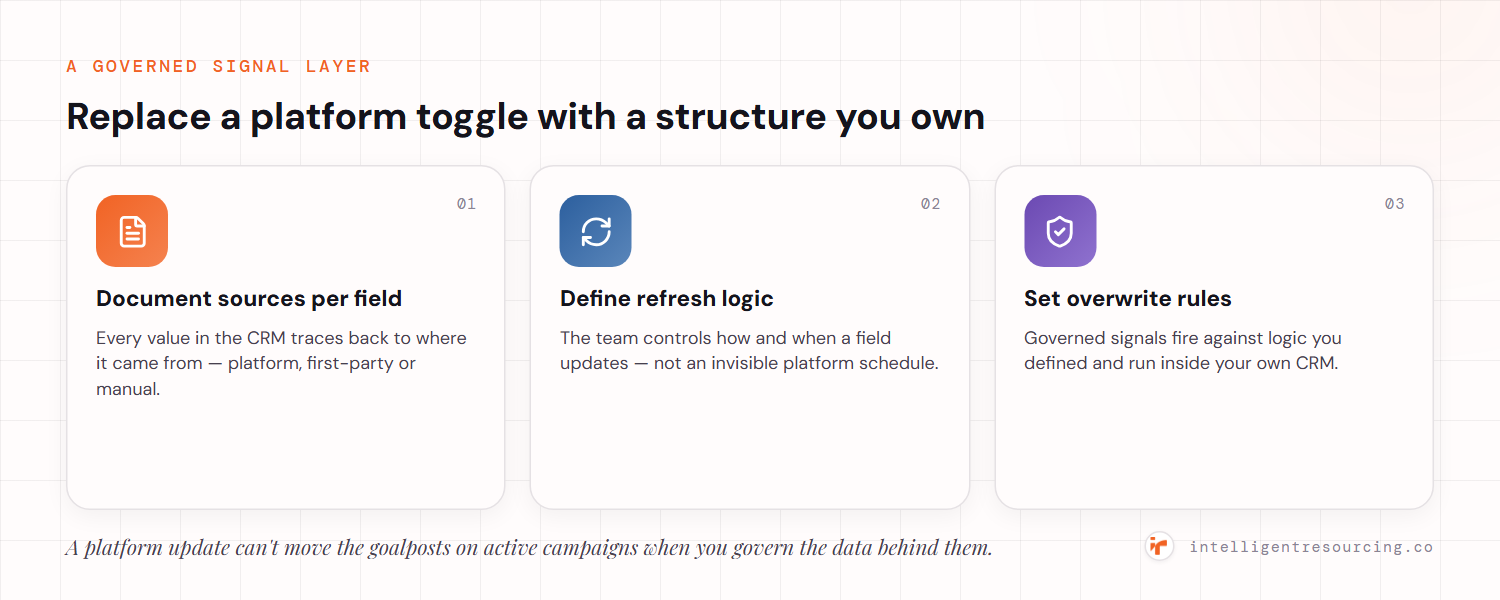
Intelligent Resourcing’s GTM Engineering practice builds and runs the governed enrichment layer before any outbound motion starts:
- Documents sources per field, so every value in the CRM can be traced back to where it came from.
- Defines refresh logic, so the team controls how and when a field updates.
- Sets overwrite rules the team controls day to day, replacing a platform toggle with a governed structure Intelligent Resourcing builds and runs as ongoing capability.
Platform-provided buyer intent signals are generated on your data but processed through a platform’s infrastructure. When a platform changes its terms or its signal methodology, outreach logic shifts with it. Governed signals such as technographic triggers, hiring events, funding rounds and leadership changes fire against logic defined with the client’s team and run inside their existing CRM, so a platform update does not move the goalposts on active campaigns. Intelligent Resourcing’s CRM enrichment approach runs this kind of signal detection inside a client’s existing CRM, rather than waiting on a platform’s own roadmap.
The same principle applies at the AI search layer. Before any content is produced or outreach initiated, a business needs to confirm its brand entity, category signals and data consistency across every touchpoint. Intelligent Resourcing’s Answer Engine Optimisation service applies this at the level of AI answer engines rather than CRM records. In both cases, the platform serves the strategy only when the team controls the data behind it.
Checks Worth Running Before the Next Platform Update
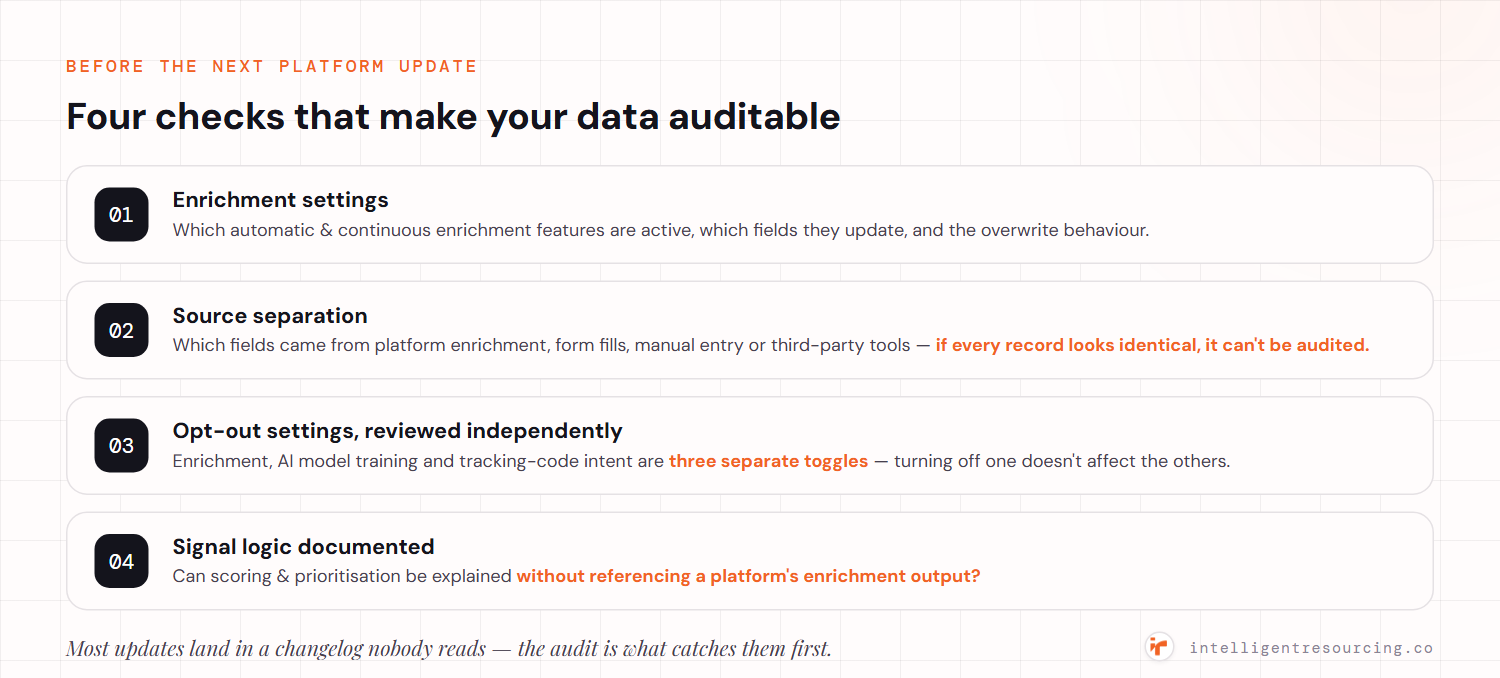
| # | Check | What to confirm |
|---|---|---|
| 1 | Enrichment settings | In HubSpot: Settings → Data Management → Data Enrichment. Which automatic and continuous enrichment features are active, which fields they update, and what the overwrite behaviour is. |
| 2 | Source separation | Which contact fields came from platform enrichment, first-party form fills, manual entry, or third-party data tools. If every record looks identical regardless of source, data quality cannot be audited. |
| 3 | Opt-out settings reviewed independently | HubSpot’s updated DPA applies controller-to-controller terms across enrichment features, AI model training, and tracking-code intent data sharing, as three separate settings. Turning off one does not affect the others. |
| 4 | Signal logic documented | Can outreach sequences, account prioritisation rules and lead scoring logic be explained without referencing a platform’s enrichment output? If not, the signal system is borrowed, not governed. |
Fit Check
Best for:
- B2B teams using HubSpot enrichment who have not reviewed their settings since 1 July 2026
- Revenue leaders relying on platform-provided enrichment without a documented first-party signal layer
- Companies building outbound systems that need to compound over time rather than shift with platform terms
Not for:
- Early-stage teams where manual outreach covers the full addressable market and enrichment is not yet in use
The trade-off: a governed B2B data enrichment system takes longer to build than enabling a platform enrichment toggle. The toggle is faster to turn on. The governed system is harder to have turned off on you.
RevOps Tools
Your CRM data is already generating commercial intelligence. The HubSpot backlash proved that governing your enrichment layer is a revenue decision.
FAQs
What did HubSpot announce on 1 July 2026?
HubSpot updated its Product Specific Terms to allow enrichment data from customer instances to feed its commercial dataset and enrich other customers’ records. Business contact information, company data, website visitor signals and email engagement data were in scope. Notes, deals and call recordings were not.
Why did HubSpot reverse the decision?
Customers objected to their business contact data contributing to a shared dataset without explicit opt-in. HubSpot acknowledged it did not communicate the changes clearly and confirmed on 5 July the terms would not go forward.
What separates platform enrichment from governed enrichment?
Platform enrichment runs on the platform’s schedule and logic, invisible to the team depending on it. Governed enrichment documents sources, refresh rules and confidence scoring per field, so the team controls data quality rather than inheriting platform defaults.
Does turning off HubSpot enrichment cover the other settings?
No. HubSpot applies controller-to-controller terms across three separate settings covering enrichment features, AI model training and tracking-code intent data sharing. Each needs to be reviewed and configured independently.