
Why Did HubSpot Buy Warmly in 2026?
HubSpot bought Warmly on June 30, 2026 because organic search stopped filling its customers’ pipelines. CEO Yamini Rangan said organic traffic for HubSpot’s customers is down 27% this year, and the same coverage reported HubSpot’s AI Engine Optimisation leads converting at three times the rate of traditional search leads.
Spread across HubSpot’s full customer base, a 27% organic traffic decline means every B2B marketer relying on search rankings is losing a channel that used to fill the top of the funnel.
The acquisition confirms what Intelligent Resourcing’s Evergreen CRM was already built around: when search traffic shrinks, the signal has to come from somewhere other than the website, because there won’t be more visitors next quarter to compensate.
What Do Warmly’s 3 AI Agents Actually Do Inside HubSpot?
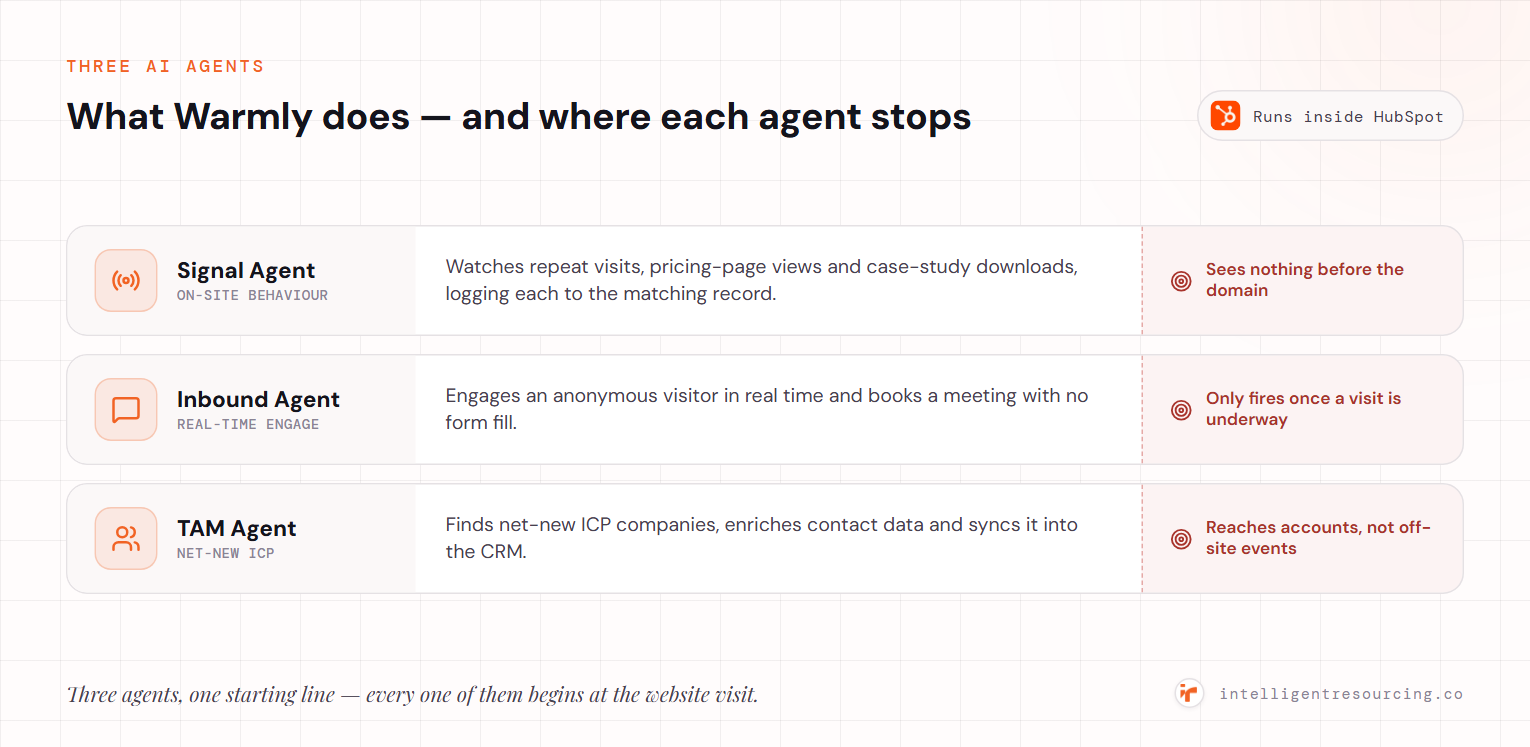
Warmly runs 3 AI agents inside HubSpot CRM: the Signal Agent tracks on-site behaviour like repeat visits and pricing page views, the Inbound Agent engages arriving visitors in real time and books meetings without a form, and the TAM Agent finds net-new ICP companies and enriches them with verified contact data.
| Agent | What it does | Where it stops |
|---|---|---|
| Signal Agent | Watches on-site behaviour: repeat visits, pricing page views, case study downloads. Logs each as an activity on the matching HubSpot record. | Sees nothing before the visitor reaches the domain |
| Inbound Agent | Engages an anonymous visitor in real time and books a meeting without a form fill. | Only fires once a visit is already underway |
| TAM Agent | Finds net-new ICP companies, enriches contact data, syncs into HubSpot. | Extends reach to accounts, not to off-site events on those accounts |
Warmly sold its agents as paid Marketplace plans before the deal closed, and its announcement confirms current contracts, pricing, and product experience stay unchanged for existing customers for now. For a HubSpot-native team, it’s the closest thing to a buying-signal layer the platform has offered. It still starts at the website.
Why Can’t Warmly See Signals That Happen Before a Website Visit?
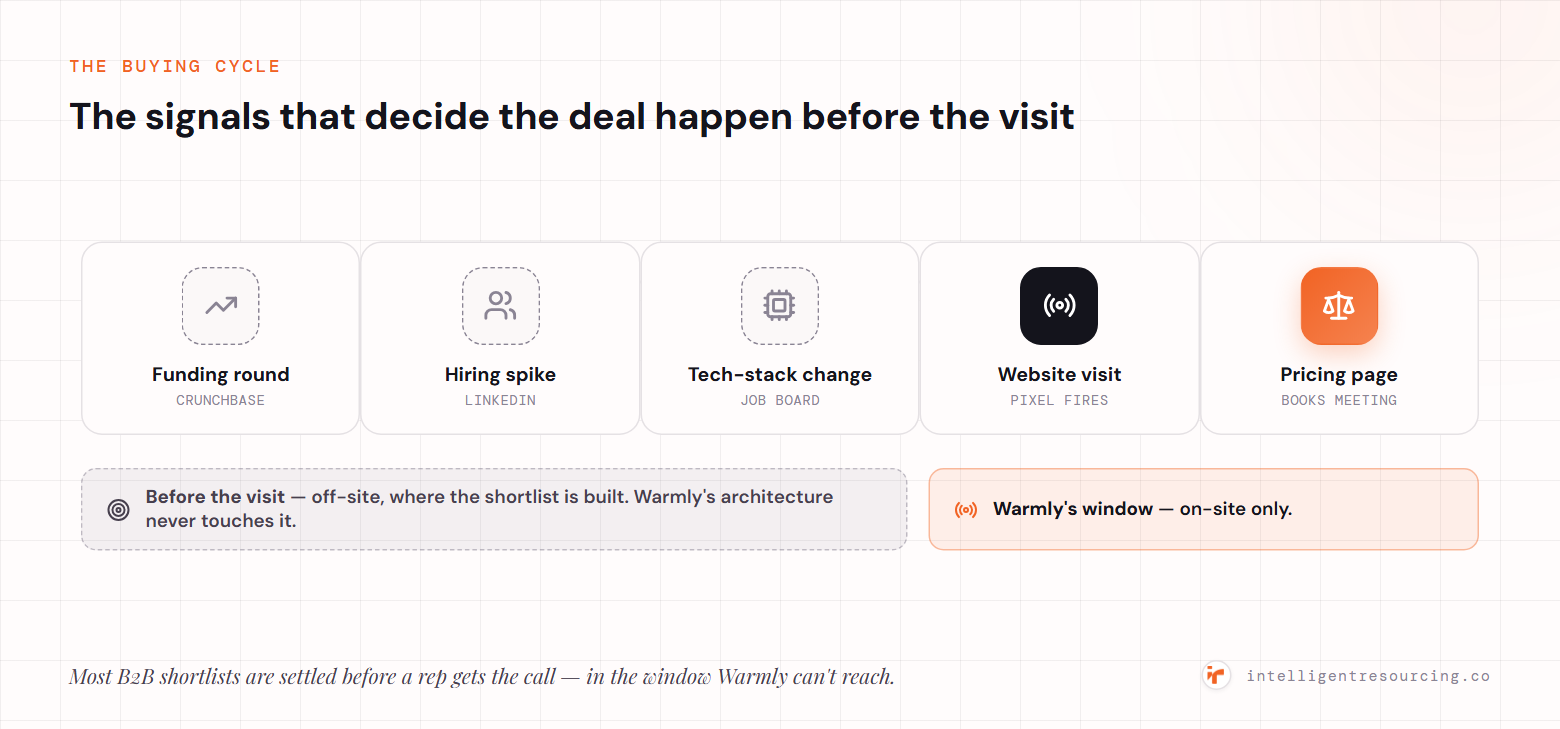
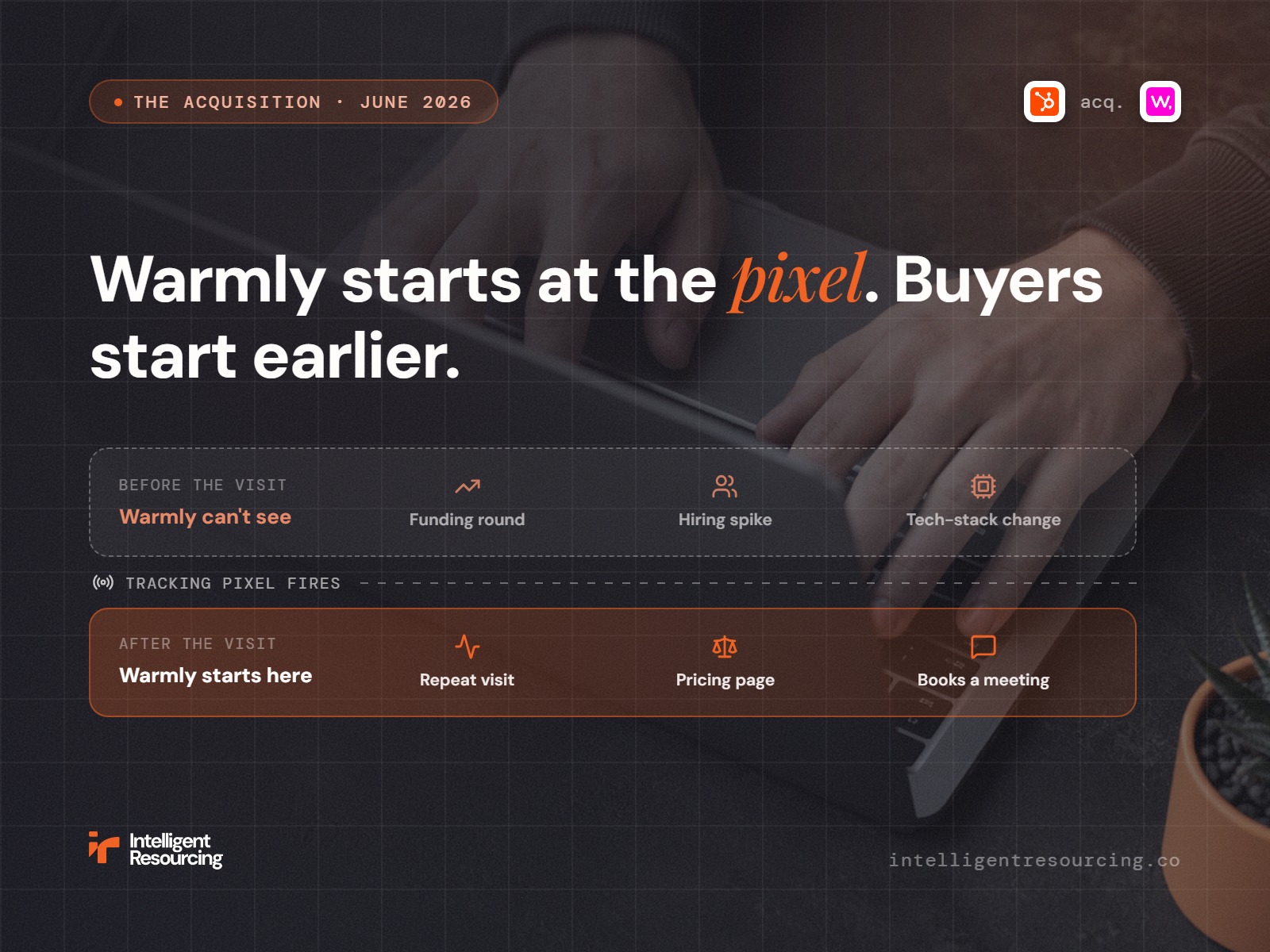
Warmly’s Signal Agent only activates once a visitor lands on the client’s website. A funding round, a hiring spike in a target function, a tech-stack change, or a job posting that points to a team restructure never appears inside Warmly’s architecture, because none of those events happen on the client’s domain.
Warmly’s own acquisition announcement frames its value around these questions:
- Who is the buyer, and what do they care about?
- When do they care, and how do we help?
Answering “when” from website visit data is one version of that answer. It is not the only version. A funding round or a hiring spike answers the same question from outside the website, and Warmly’s architecture has no way to read either one, because both live on LinkedIn, Crunchbase, or a job board, not inside HubSpot’s tracking pixel. HubSpot itself already treats pre-arrival intent as valuable: its own AEO launch coverage reports those leads converting at roughly three times the rate of other sources. The company understands the pre-arrival signal is worth more, and its Warmly investment only captures the on-site half of it.
How Does Intelligent Resourcing’s Evergreen CRM Already Cover the Gap Warmly Can’t?
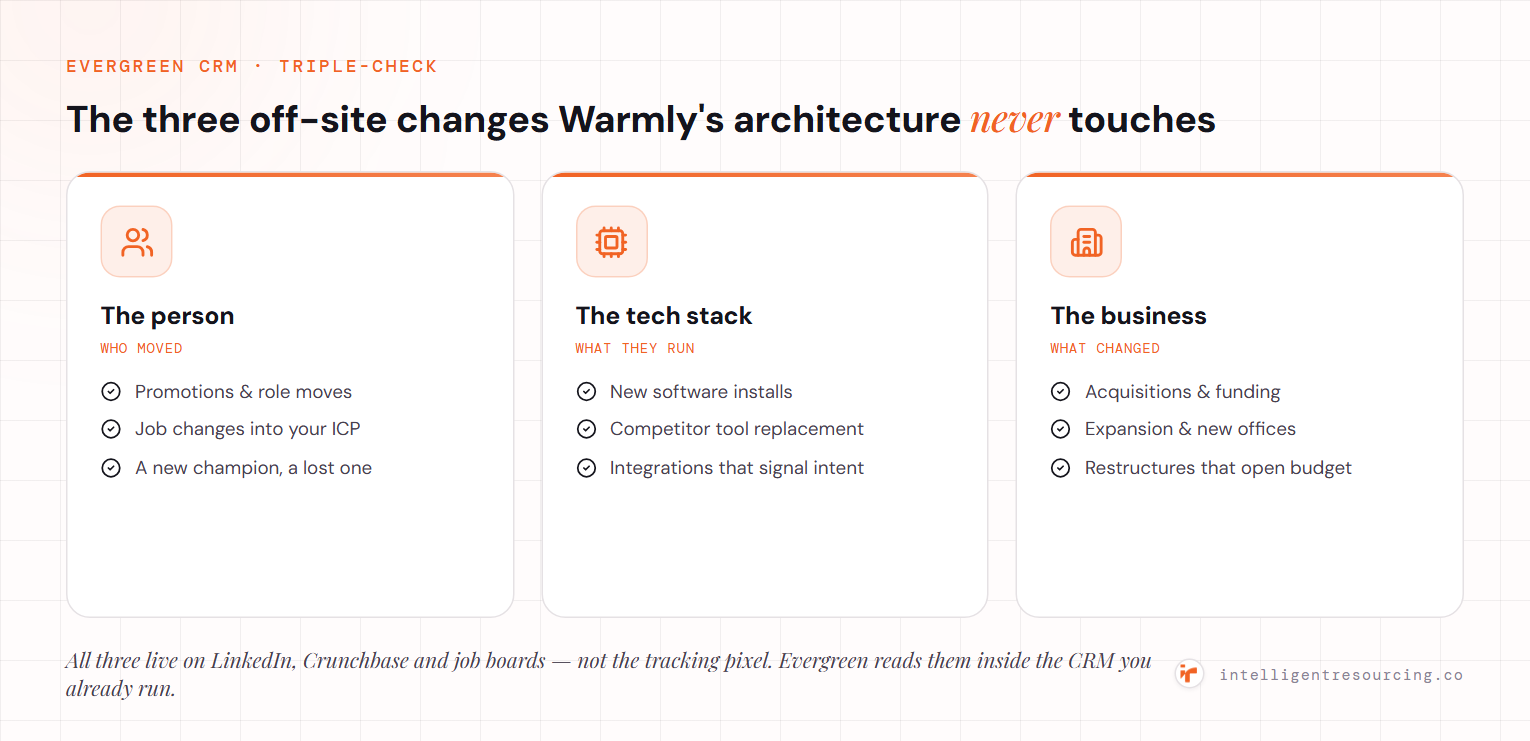
Intelligent Resourcing’s Evergreen CRM runs three systems inside a client’s existing CRM.
- Waterfall Logic: fills missing contact and company data by cascading through multiple providers instead of relying on one.
- Triple-Check: watches three categories of change Warmly’s architecture never touches: the person (promotions, job changes, role moves), the tech stack (new software installs, competitor tool replacement), and the business (acquisitions, funding, expansion, new offices).
- No-Silo: syncs every update across connected systems instantly, so Sales, Marketing, and RevOps work from one record instead of three conflicting versions.
Most B2B purchase decisions are effectively settled before a sales rep ever gets a call: buyers build a shortlist early, then spend the rest of the cycle confirming it.
- That early window is the one Warmly can’t reach, because its architecture starts at the website visit, not the decision that preceded it.
- Evergreen CRM runs inside the client’s own CRM, whether that’s HubSpot, Salesforce, Pipedrive, or a Clay-connected stack.
- It uses the same enrichment waterfall logic Intelligent Resourcing’s Clay workflow builds already run for clients today.
How Long Will It Take HubSpot to Roll Warmly Out to Every Tier?
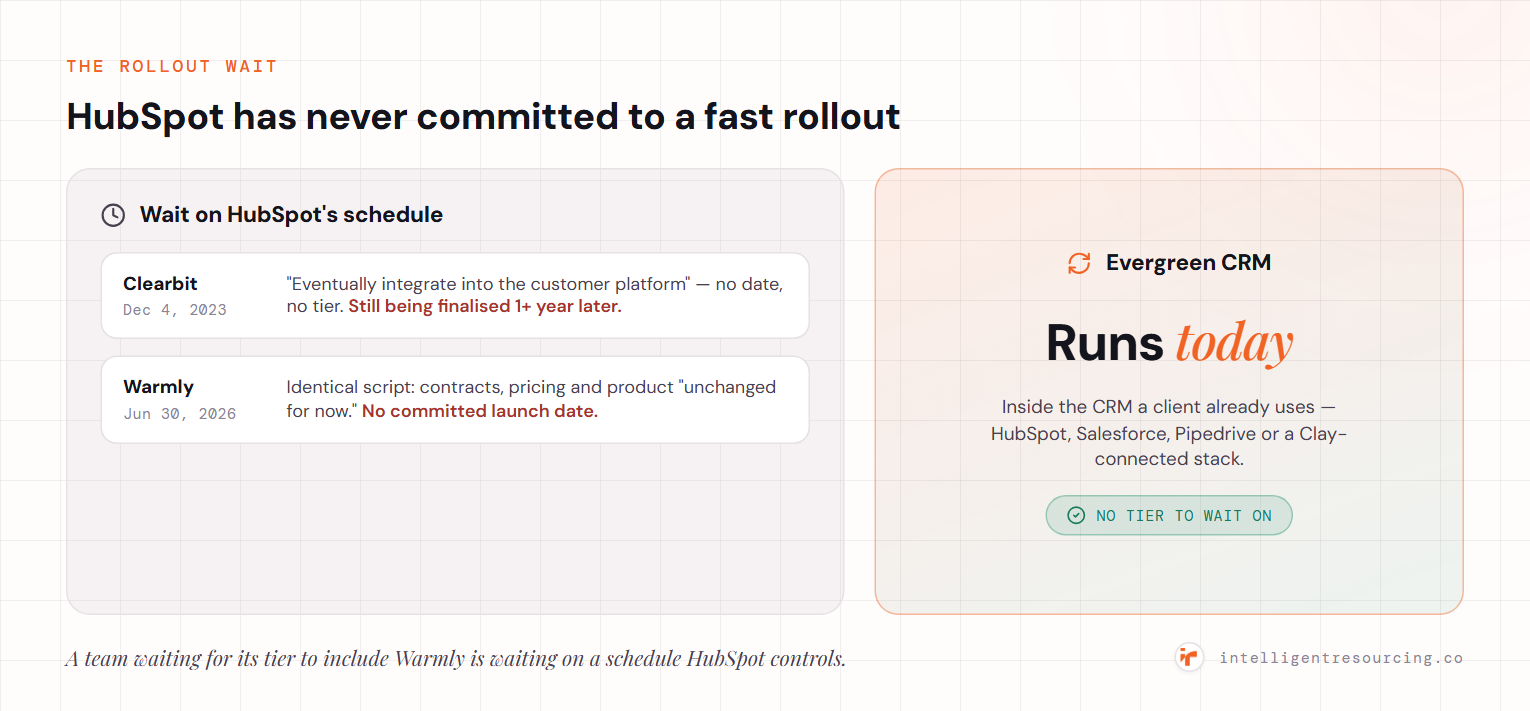
HubSpot has never committed to a fast rollout for an acquired product. When it bought Clearbit in December 2023, the company said the data would become integrated into its customer platform eventually, without naming a date or a tier. Warmly is following the identical script.
TechCrunch’s coverage of the Clearbit deal confirmed HubSpot’s own language: Clearbit would eventually integrate into its customer platform, with the CEO framing it as a strong fit for customers rather than committing to a launch date.
HubSpot completed that acquisition on December 4, 2023, and tier access was still being finalised more than a year later. Warmly’s own announcement confirms the same posture for this deal: current contracts, pricing, and product experience stay unchanged immediately after close. A team waiting for its tier to include Warmly’s coverage is waiting on a schedule HubSpot controls, for a capability Evergreen CRM already runs today.
What Should You Do Instead of Waiting for Warmly to Reach Your Tier?
Start by mapping the signals your sales team already tracks. If every one is a downstream event, a form fill, a demo request, a replied email, an upstream signal exists for each: the job posting before the hire, the funding round before the budget, the pricing page visit before the demo request.
When Intelligent Resourcing scopes a new signal system, the first step is always the same: pull the last 10 accounts that closed and find where the first detectable signal appeared outside the CRM. That gap is what Triple-Check is built to close, inside the CRM a client already runs, without waiting on HubSpot’s tier and packaging decisions to set the pace.
Pulling the last 10 deals that closed and finding where the first signal appeared outside the CRM takes an afternoon. Building the system that catches the next one starts with Intelligent Resourcing’s lead generation team.
Buyer Intent
HubSpot is still scheduling its rollout. The off-site signal system it bought Warmly to build is already running inside client CRMs today.
FAQs
What is Warmly and why did HubSpot acquire it?
Warmly identifies website visitors who show buying intent without a form fill. HubSpot acquired it on June 30, 2026 after reporting a 27% organic traffic decline for its customers.
How much does Warmly cost inside HubSpot?
HubSpot has not published post-acquisition pricing or tier packaging. Warmly sold its agents as paid Marketplace plans before the deal, and its announcement says existing contracts and pricing stay unchanged for now.
What buying signals can Warmly detect?
Warmly’s Signal Agent tracks on-site behaviour: repeat visits, pricing page views, case study downloads. Each logs as an activity on the matching HubSpot record.
What buying signals does Warmly miss, and how does Evergreen CRM catch them?
Warmly can’t see off-site signals like funding rounds, hiring spikes, or tech-stack changes. Evergreen CRM’s Triple-Check tracks all three inside the client’s existing CRM.
When will Warmly reach every HubSpot pricing tier?
No published timeline. HubSpot’s Clearbit acquisition took over a year to integrate, and Warmly is following the same pattern.
Can a company run this kind of signal detection without waiting on HubSpot?
Yes. Evergreen CRM already runs inside HubSpot, Salesforce, Pipedrive, or a Clay-connected stack, catching off-site signals now.