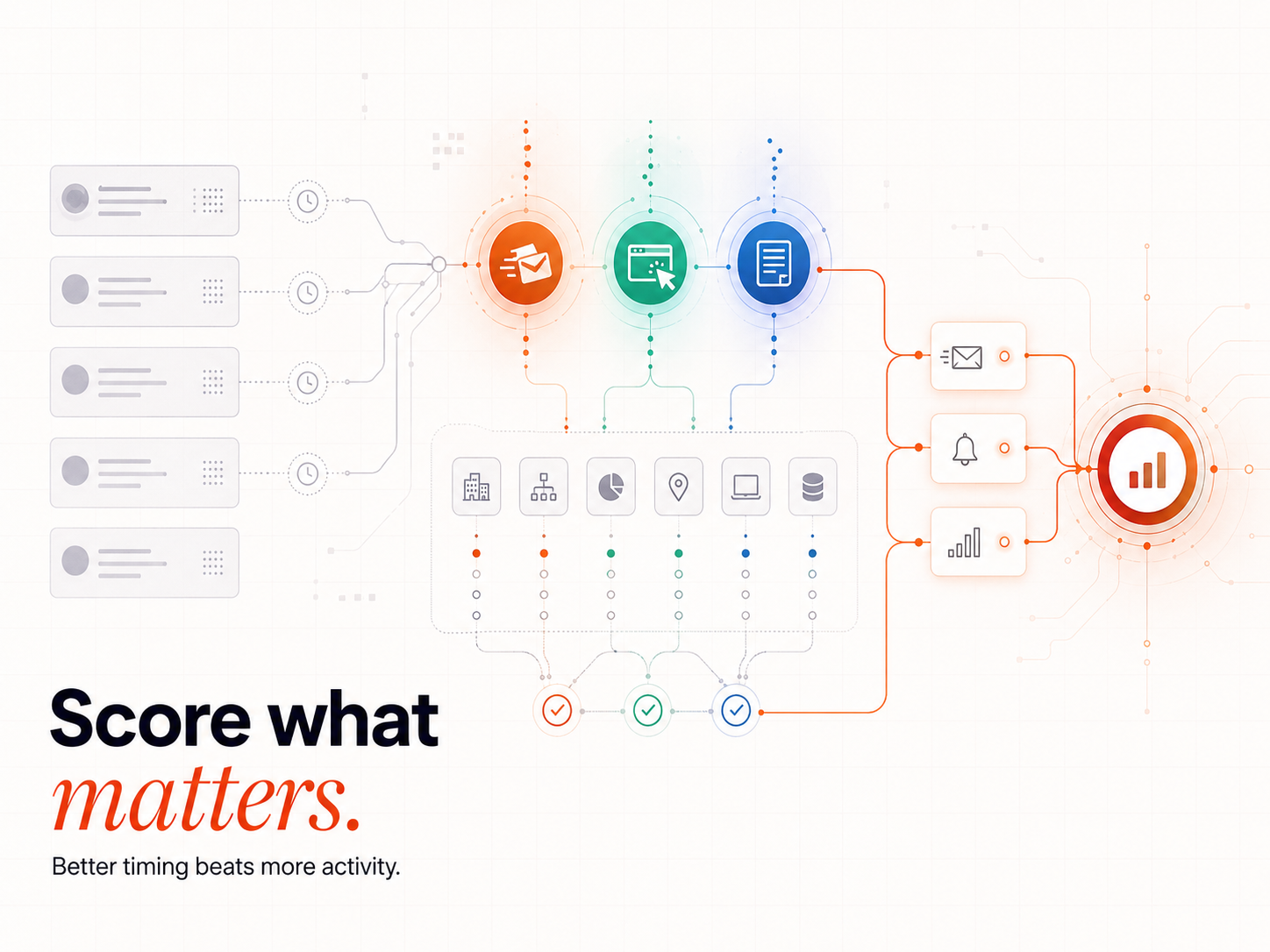

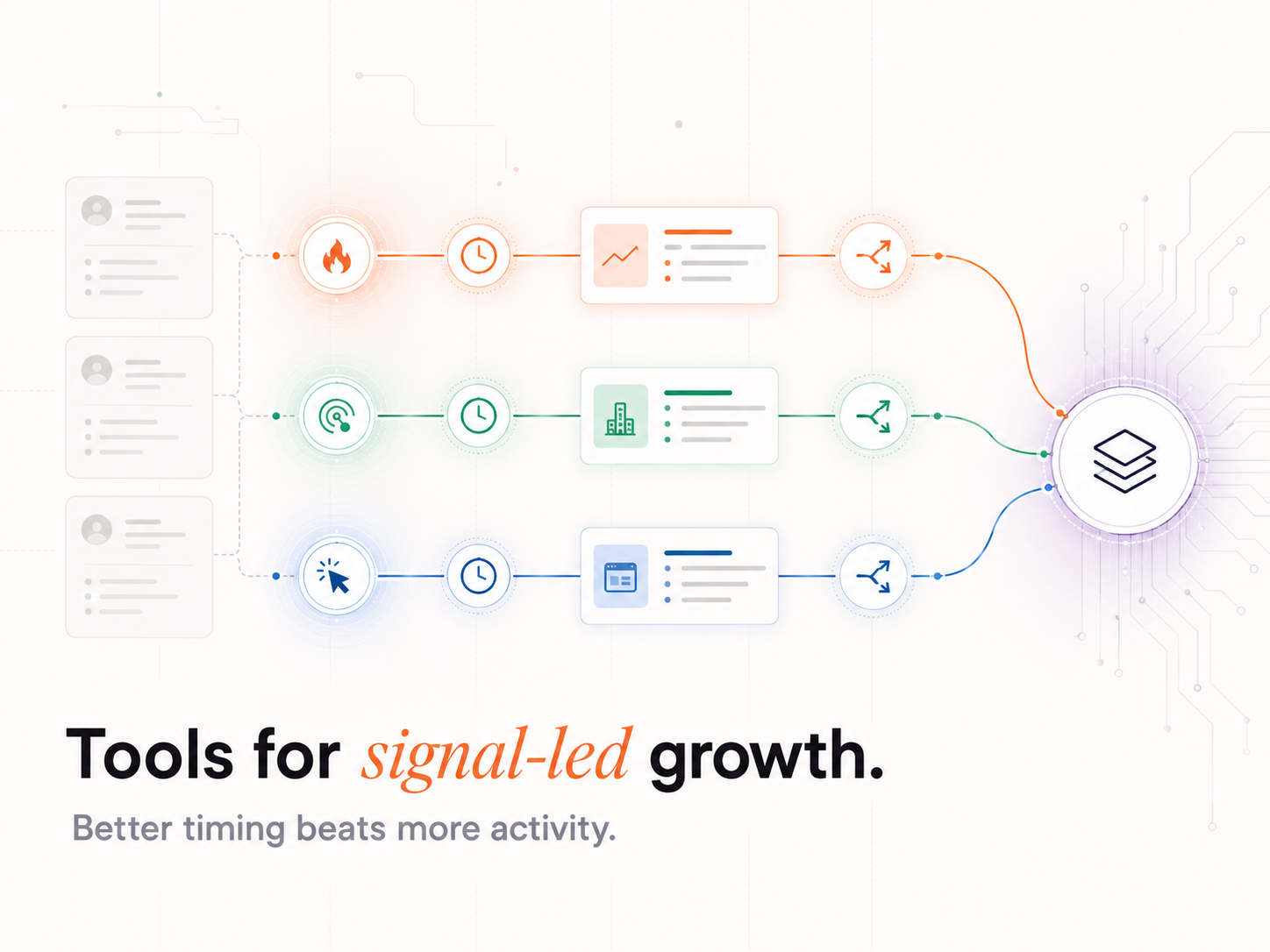
Signal-based marketing only works when your tools can capture a buyer action, decide whether it matters, and fire a response while the buyer is still paying attention. Out-of-the-box MarTech rarely does all three well, so most teams end up choosing tools layer by layer. This guide breaks the stack into five layers and names the tool we would shortlist for each, with verified 2026 pricing.
The reason this matters is timing. 6sense research on the dark funnel shows most B2B research happens anonymously before a lead ever forms, so the value is in catching the signal early and acting fast, not in owning more software. The same logic sits behind signal-based lead generation and the wider signal-led approach to going to market.
What makes a tool signal-based?
A signal-based tool does one of five jobs, and the test for each is whether it acts on live behaviour rather than a static list. Use these layers as your evaluation criteria before comparing brands.
- Capture: records behavioural events from your site, product and apps.
- Intent and CDP: unifies signals and adds external buying intent.
- System of record: the CRM that holds the contact and lifecycle.
- Real-time automation: triggers a response the moment a signal fires.
- Orchestration: connects the layers so a signal flows through to action.
Two questions decide every shortlist: does the tool trigger on live behaviour, and does it integrate with the rest of the stack? A tool that does neither adds technical debt, not signal.
Signal-based marketing tools at a glance
Eight tools, one per gap most B2B teams have, mapped to the five layers. Starting prices are the lowest published tier; full detail sits in each entry below. Most of these tools bill in US dollars, so AUD figures are approximate conversions at roughly US$1 = A$1.41 and EUR 1 = A$1.63 (June 2026).
| Tool | Layer | Best for | Starting price |
|---|---|---|---|
| Google Analytics 4 | Capture / analytics | Free behavioural-data foundation | Free |
| Segment | Capture / CDP | Unifying signals from many sources | US$120/mo (~A$170) · free tier |
| 6sense | Intent data | Seeing in-market accounts pre-lead | Custom quote |
| HubSpot | CRM + automation | Capture, scoring and activation in one CRM | US$20/mo (~A$28); Pro $890 (~A$1,255) |
| ActiveCampaign | Real-time automation | Affordable multichannel triggers | US$15/mo (~A$21) |
| Customer.io | Real-time automation | Event-triggered product messaging | US$100/mo (~A$141) |
| Clay | Orchestration / signal assembly | Combining external signals into outreach | US$185/mo (~A$261) · free tier |
| n8n | Orchestration | Custom, low-cost signal workflows | Free self-hosted / €24/mo (~A$39) |
Capture and analytics layer
This layer records what buyers actually do. Without clean capture, every downstream signal is guesswork.
Google Analytics 4
Unlike paid intent platforms that start at four figures a month, Google Analytics 4 captures on-site behavioural signals for free and exposes them by API for downstream activation.
GA4 is Google's web and app analytics platform. It is not a trigger engine, but it is where most teams first see behavioural signals, page paths, events and conversions, and it can push them onward through the Measurement Protocol and a raw BigQuery export.
Best for: teams that need a free, universal behavioural-data foundation before paying for intent tools.
Key features:
- Event-based tracking, so any interaction can be defined as a signal you act on later.
- Free BigQuery export, which means raw event data is available for custom signal logic.
- Audiences and Measurement Protocol, so signals can be forwarded to other tools.
Pricing: Free. The enterprise tier (GA360) is custom-quoted. (verified June 2026)
Limitation: It reports and forwards signals but does not act on them, so it always needs an automation layer downstream.
Segment
Unlike point integrations that break when you swap a tool, Segment collects each behavioural event once and fans it out to every connected destination.
Twilio Segment is a customer data platform. It captures events from your site, product and apps, unifies them into one profile per user or account, and routes them to hundreds of destinations, so the same signal reaches your CRM, warehouse and automation tools at once.
Best for: teams unifying behavioural signals from several sources before routing them to activation tools.
Key features:
- Collect once, send everywhere, which removes per-tool tracking code and drift.
- Identity resolution stitches scattered events into a single profile.
- Reverse ETL pushes modelled warehouse data back into your activation tools.
Pricing: Free tier for up to 1,000 visitors a month (evaluation only); the Team plan starts at US$120/month (about A$170) for 10,000 tracked users; Business is custom-quoted. (verified June 2026)
Limitation: It is plumbing, not activation: Segment moves signals but does not score or act on them, and cost climbs steeply with tracked-user volume.
Intent data layer
Intent tools add the demand you cannot see on your own site, the accounts researching your category elsewhere.
6sense
Unlike first-party tools that only see visitors who reach your site, 6sense detects accounts researching your category anonymously across the wider web.
6sense is an account intent and predictive platform. It blends third-party intent data, technographics and web activity to flag which accounts are in-market before they ever fill in a form, the dark-funnel demand most tools never see.
Best for: B2B teams running account-based programmes that need to see demand before a lead appears.
Key features:
- Anonymous account identification surfaces in-market accounts you would otherwise miss.
- Predictive scoring ranks accounts by buying stage, so effort goes to the closest.
- Intent keywords show what an account is researching, so outreach matches the topic.
Pricing: Custom only. 6sense does not publish pricing; cost is quote-based and scales with data and seats. (verified June 2026)
Limitation: It is enterprise-priced and complex to run, and the third-party intent signal is probabilistic, so first-party behaviour should confirm it before sales acts.
CRM and system of record
The CRM holds the record every other tool reads from and writes to. CRM-native automation keeps capture and activation on one data layer.
HubSpot
Unlike stacks that bolt automation onto a separate CRM, HubSpot fires behavioural triggers off the same database that holds the contact record.
HubSpot Marketing Hub is a CRM-native marketing platform. Because the CRM, lead scoring and automation share one data layer, a behavioural signal such as a page visit or form fill can update a score and launch a workflow with no sync step in between.
Best for: B2B teams that want capture, scoring and activation in a single CRM-led platform.
Key features:
- Built-in CRM and workflows, so triggers act on live contact data without a sync.
- Real-time lead scoring updates on behaviour, which keeps reps on the hottest records.
- Breeze AI agents extend automation across marketing and sales tasks.
Pricing: Starter from US$20/month per seat (about A$28); Professional from US$890/month (about A$1,255, 3 seats, 2,000 contacts); Enterprise from US$3,600/month (about A$5,080). (verified June 2026)
Limitation: Professional is the first tier with serious automation, so the real entry cost is around $890/month, and deep external-intent capture still needs a best-of-breed layer.
Real-time automation layer
This is where a signal becomes a message. The test is whether the tool triggers on a live event, not a nightly list refresh.
ActiveCampaign
Unlike enterprise suites priced for large teams, ActiveCampaign delivers behaviour-triggered automation and a CRM from $15 a month.
ActiveCampaign is a marketing automation and CRM platform built around event-triggered workflows. It launches email, SMS and CRM updates off site behaviour, email engagement and custom events, with AI-assisted scoring layered on top.
Best for: small to mid-sized teams that want affordable, multichannel signal-triggered automation.
Key features:
- A visual automation builder chains triggers and actions without code.
- Site and event tracking fires workflows on page visits and custom events.
- AI predictive sending and scoring prioritise the contacts most likely to convert.
Pricing: Starter from US$15/month (about A$21), Plus $49 (A$69), Professional $79 (A$112), Enterprise $145 (A$205), on annual billing for 1,000 contacts; no free plan, 14-day trial. (verified June 2026)
Limitation: Pricing is contact-based, so cost rises as the list grows, and the strongest AI features sit on the higher tiers.
Customer.io
Unlike list-based email tools, Customer.io triggers messaging off real-time product and behavioural events rather than static segments.
Customer.io is an event-driven messaging platform. It ingests behavioural and product events by API and fires email, push, in-app and SMS the moment a defined signal occurs, which suits product-led and high-volume signal workflows.
Best for: product-led and technical teams triggering messaging off live behavioural events.
Key features:
- Event-based triggers act on any tracked event in real time.
- Multichannel delivery spans email, push, in-app, SMS and webhooks from one workflow.
- Data-warehouse sync keeps messaging logic aligned with your source of truth.
Pricing: Essentials from US$100/month (about A$141, 5,000 profiles, 1M emails); Premium $1,000/month (about A$1,410); Enterprise custom; a 12-month free start-up programme for companies that have raised under $10M. (verified June 2026)
Limitation: It expects clean event data piped in, so it needs engineering setup, and the entry price is higher than list-based tools.
Orchestration and signal assembly layer
Orchestration connects everything, assembling signals from many sources and routing them to action. Without it, intent data just sits in a dashboard. This is the same discipline behind automated lead generation with Clay and n8n.
Clay
Unlike single-source tools, Clay combines signals from more than 150 data providers and AI agents into one table, then triggers enrichment and outreach from it.
Clay is a no-code data and orchestration platform. It assembles signals from many sources (LinkedIn, web, APIs, intent), enriches and scores them with Claygent AI research agents, and pushes the result into a CRM or sequencer, the signal-assembly layer of the stack.
Best for: GTM teams combining several external signals into personalised, triggered outreach.
Key features:
- A 150-plus source waterfall fills and verifies data from many providers in order.
- Claygent AI agents run custom research, so you capture signals no single tool exposes.
- Native CRM and sequencer push turns an enriched signal straight into action.
Pricing: Free plan at $0; Launch US$185/month (about A$261, 2,500 data credits, signal tracking); Growth $495/month (about A$700, CRM sync, web intent); Enterprise custom. Pricing was restructured in March 2026. (verified June 2026)
Limitation: Credit-based pricing makes heavy enrichment hard to forecast, and building reliable tables has a real learning curve.
n8n
Unlike closed automation tools, n8n is open-source, so you can build custom signal-to-response workflows across any system without per-seat fees.
n8n is an open-source workflow automation tool. It connects CRMs, webhooks, APIs and AI models into custom signal-response flows, and self-hosting makes it the most flexible, lowest-cost orchestration layer for teams with technical resource.
Best for: teams with technical resource building custom signal-response automation across many systems.
Key features:
- Open-source and self-hostable, which gives full control with no per-seat cost.
- Over 400 integrations plus webhooks connect almost any signal source.
- Custom code nodes handle logic that no-code tools cannot.
Pricing: Self-hosted Community edition is free; Cloud Starter from EUR 24/month (about A$39, 2,500 executions), Pro EUR 60/month (about A$98), Business EUR 800/month (about A$1,305); 14-day trial. (verified June 2026)
Limitation: It needs technical skill to build and, if self-hosted, to maintain, so it is not a no-code tool for non-technical marketers.
Which tool fits your situation?
Match the layer you are missing to the shortlist, rather than buying the biggest platform.
- If you need a free behavioural-data foundation, start with Google Analytics 4.
- If you are unifying signals from many sources, use Segment.
- If you need to see in-market accounts before they convert, evaluate 6sense.
- If you want capture, scoring and activation in one CRM, choose HubSpot.
- If you want affordable multichannel automation, pick ActiveCampaign.
- If you trigger off live product events, use Customer.io.
- If you are assembling external signals into outreach, use Clay.
- If you want custom, low-cost orchestration and have technical resource, run n8n.
Honourable mentions
Credible tools that serve a narrower need than the main shortlist:
- Bombora supplies co-op intent data that many platforms, including 6sense, draw on.
- Salesforce Marketing Cloud fits enterprises that already run Salesforce and need deep customisation.
- Iterable is strong for cross-channel lifecycle messaging, with a more B2C lean.
- Brevo is a budget automation option for small teams.
- Zapier is a lighter, no-code orchestration alternative to n8n for non-technical teams.
How to choose and roll out your stack
Pick tools against the gap you have, not the feature list. A short, disciplined rollout beats a big-bang purchase.
- Audit your current stack and find which of the five layers is missing.
- Map the signals that matter, then the response each should trigger.
- Shortlist tools with native triggers and CRM sync; skip anything that cannot integrate.
- Pilot one or two signals end to end before buying more.
- Set a response SLA (a two to three hour target is a sensible start) and document the trigger-to-response map.
A clean signal-to-response map is what stops a stack becoming shelfware:
| Signal | Suggested response |
|---|---|
| Pricing page visit | Send an ROI case study or a tailored offer |
| Intent engine account alert | Launch an ABM sequence to the buying group |
| Multiple site revisits | Trigger a demo invite for sales |
| Resource download | Start a behaviour-based nurture sequence |
The same routing discipline drives real-time signal-based lead scoring, and the records should land in the CRM the way enriched contacts flow through the Clay and HubSpot integration.
Where signal-based marketing is heading
Two shifts are reshaping the stack. AI is moving from scoring signals to deciding which ones matter and activating workflows automatically, and the loss of third-party cookies is pushing capture toward first-party and server-side data. Both reward teams whose tools already act on owned behavioural signals rather than bought lists. The full picture of wiring these tools together sits in our guide to the Clay, HubSpot and Smartlead stack.
Buyer Intent
You don't need more tools — you need the right ones working together. Connect with us to transform your marketing stack into a signal engine.