
What is signal-based lead generation?
Signal-based lead generation uses observable buyer behaviour and context to infer when an account is entering a buying cycle, then activates sales on that timing. A signal is any action or change that indicates movement toward a purchase, and the predictive power comes when several signals align within a short window.
- Predictive, not descriptive: it forecasts timing rather than recording identity.
- Dynamic, not static: scores rise and fall as behaviour changes.
- Time-sensitive, not permanent: signals decay, so recency matters.
It does not discard lead generation; it redefines it around evidence. This is the same foundation as a modern B2B lead generation framework and the wider signal-led approach to going to market.
Why do traditional lead generation services fail to predict pipeline?
Because they are built to capture contacts, not intent. Form fills, list growth and MQL counts measure volume, which says little about buying readiness, so the forecast built on them is unreliable. Modern buyers also research anonymously and non-linearly, long before they become a named lead.
6sense research on the dark funnel shows that the majority of buying activity happens before a prospect ever surfaces as a lead. Relying on leads alone produces three predictable failures: false positives (leads with no urgency), false negatives (high-intent accounts never surfaced), and an unpredictable pipeline where volume masks readiness. The problem is the data model, not the effort. Capturing the missing demand is what the buying signals that matter most are for.
Which signals actually predict pipeline?
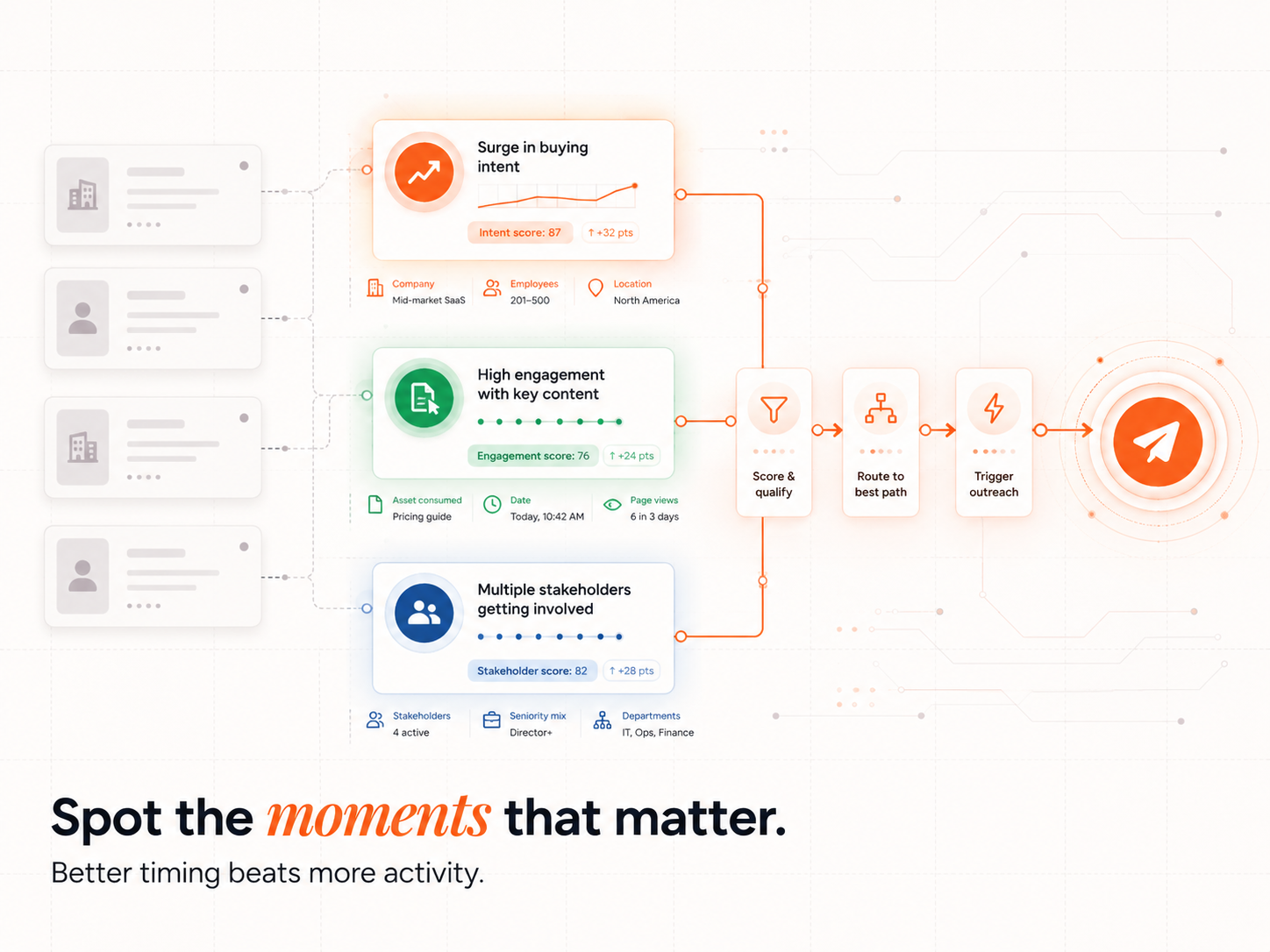
Combinations predict pipeline, not single categories. Firmographics filter, behaviour shows timing, and context explains why behaviour accelerates. Behavioural and contextual signals together consistently outperform firmographics alone.
Firmographic signals: context, not intent
Company size, industry, geography and revenue answer one question: could this account buy from us? They do not answer whether the account is buying now, so they are useful for filtering and prioritisation, not prediction.
Behavioural signals: intent in motion
Behaviour shows what buyers are actively doing: repeated content consumption, pricing or comparison page visits, return frequency and depth, and cross-channel engagement. HockeyStack multi-touch analysis across real B2B funnels shows pipeline is influenced by many behavioural interactions, not a single attribute.
Contextual signals: change events
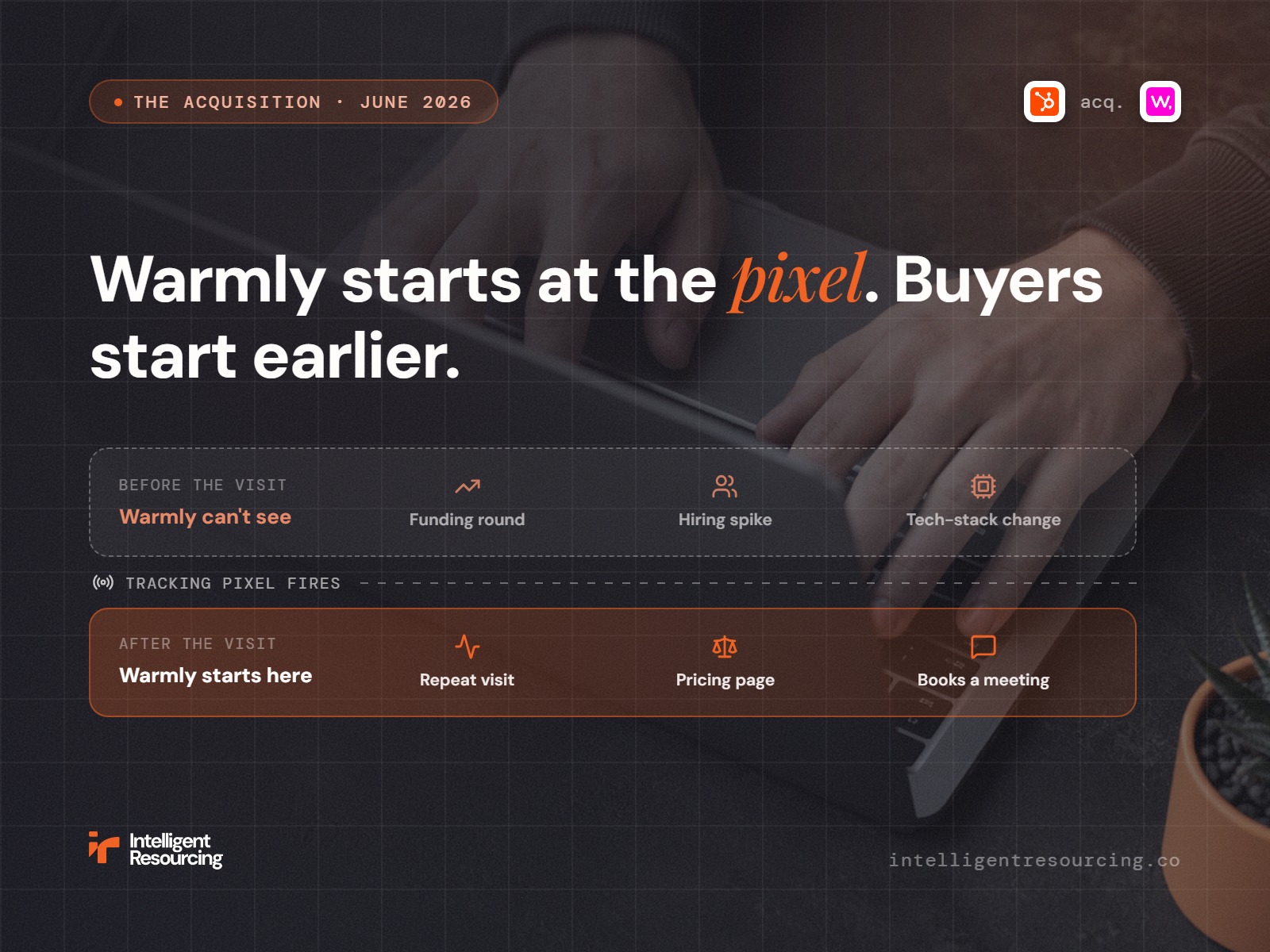
Context explains why intent might accelerate now: hiring for relevant roles, funding or expansion, and technology-stack changes. A contextual trigger on top of active behaviour is far stronger evidence than either signal on its own.
How do you capture and resolve signals?
Tools do not create signal-based lead generation; workflows do. Most teams fail by collecting signals without deciding which matter, how they combine, and when they should trigger action. Effective capture runs in three stages.
Ingestion
Capture signals from website behaviour, content engagement, product or demo interactions, and external change data. Breadth matters here, because a single source only ever shows part of the buying group.
Resolution
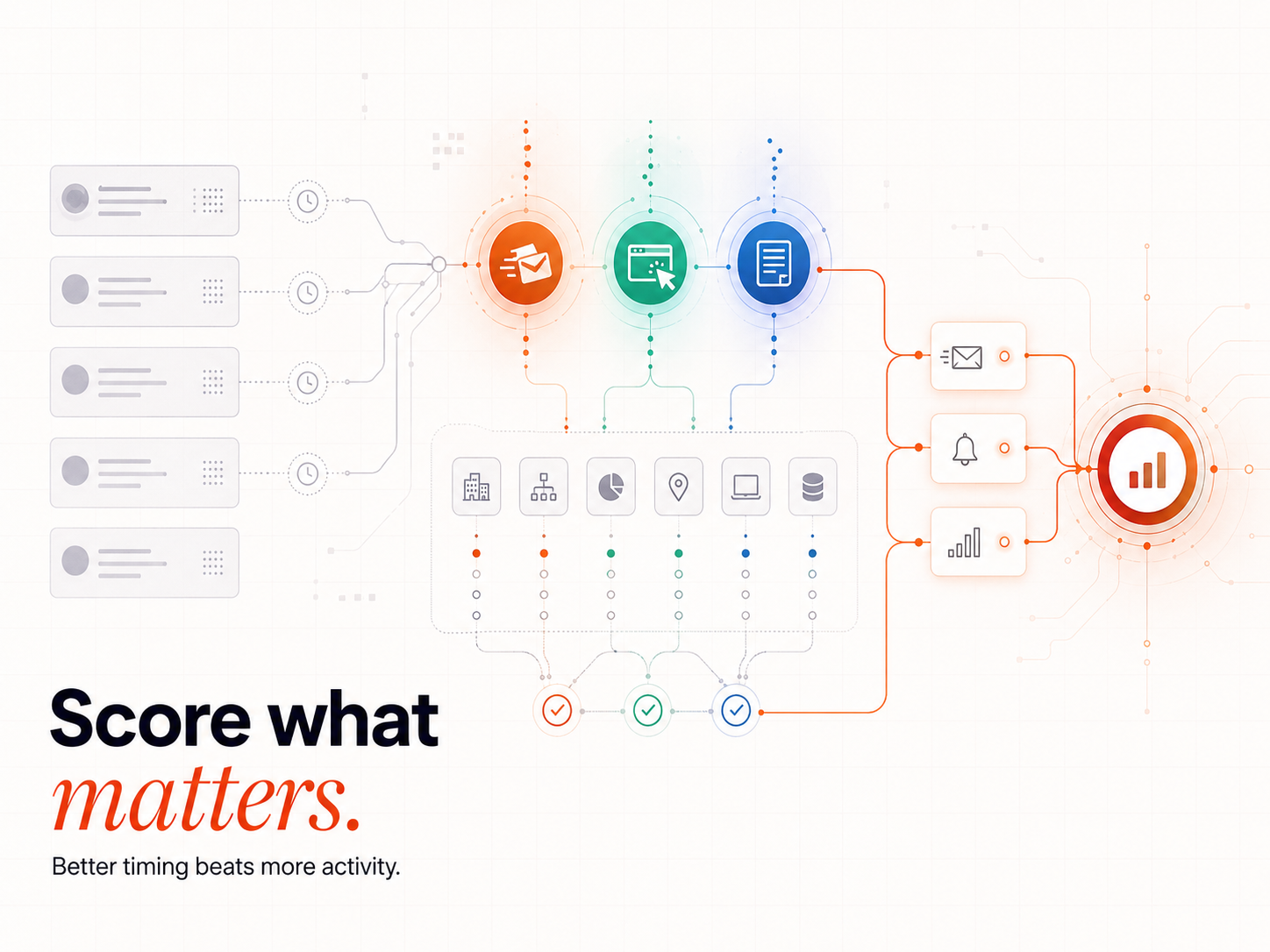
Map signals to accounts rather than isolated individuals, normalise them across sources, and time-stamp each for recency. Account-level resolution is what lets you see a buying group moving together rather than scattered clicks.
Orchestration
Feed resolved signals into revenue automation workflows, not dashboards, so intent turns into action at scale. Without orchestration, even clean intent data just becomes another report nobody acts on.
How do you qualify signals into sales-ready evidence?
Qualification is the difference between insight and pipeline. High-performing teams avoid single-trigger logic and instead combine signal stacking, decay and recency weighting, and activation thresholds, so sales is only notified when the evidence is real.
- Signal stacking: multiple signals within a defined window, behaviour reinforced by context, confirmed across channels.
- Decay and recency: recent signals weighted higher and old ones discounted, which prevents stale "hot leads".
- Activation thresholds: only when signals pass the bar does the workflow notify sales, route the account, and trigger outreach.
Demand Gen Report buyer research shows buyers disengage when outreach does not match their research stage, which confirms that premature activation damages trust and conversion. Sales-ready is a signal state, not a static score, and the same scoring discipline drives signal-based lead scoring and real-time lead scoring.
How does this connect to lead generation and automation?
Signal-based lead generation is the timing layer between demand creation and activation. Lead generation defines what pipeline to create, automation defines how signals become action, and signals define when sales should engage. Aligned, they form a signal-led go-to-market motion rather than a volume-driven funnel.
The two failure modes are symmetrical: automation without signal logic just amplifies noise, and signals without automation never scale. Routing qualified accounts into the CRM, the same way enriched records flow through the Clay and HubSpot integration, is what turns a Verified Buying Window into a worked opportunity.
What are the common signal-based lead generation mistakes?
The recurring failures are predictable: collecting signals with no qualification logic, acting on single triggers, ignoring decay so old signals look hot, and piping intent into a dashboard instead of a workflow. Each one turns a promising signal model back into noise.
- Capturing signals without deciding which matter, how they combine, or when they fire
- Single-trigger activation, which produces the same false positives as MQL volume
- No recency weighting, so stale signals trigger wasted outreach
- Routing intent to a dashboard rather than an action workflow
Buyer Intent
Stop capturing leads that never buy. We design GTM systems that turn real buying signals into qualified pipeline.
FAQs
What is signal-based lead generation?
It is a method of generating pipeline by tracking and qualifying real buying signals rather than relying on static lead data. It captures behavioural and contextual signals, scores them by stacking and recency, and activates sales only when proven intent appears within a short window, so engagement is driven by timing rather than contact volume.
How is it different from intent data?
Intent data is the raw input; signal-based lead generation is the system around it. Intent data alone is a feed of activity, whereas signal-based lead generation adds qualification logic, recency weighting, activation thresholds and routing. The difference is what turns a stream of signals into a decision about when sales should actually engage.
Are firmographic signals still useful?
Yes, but for filtering and prioritisation rather than predicting buying readiness. Firmographics such as size, industry and revenue answer whether an account could buy from you, not whether it is buying now. They work best as a qualifier layered under behavioural and contextual signals, which supply the timing.
How many signals indicate buying intent?
There is no fixed number. What matters is that several aligned signals appear within a short timeframe, with behaviour reinforced by context and confirmed across channels. A single signal is usually noise; a stack of related signals inside a tight window is what indicates a real buying decision in motion.
What is the dark funnel and why does it matter?
The dark funnel is the majority of buyer research that happens anonymously, before a prospect ever becomes a named lead. It matters because teams relying on form fills never see most of their real demand. Signal-based lead generation infers that hidden activity from behavioural and contextual evidence instead of waiting for a contact.
Do you still need lead generation if you use signals?
Yes. Signals do not replace lead generation, they redefine when you act on it. Lead generation still defines what pipeline to create and automation defines how it is worked; signals decide the timing of engagement. The three together form a signal-led go-to-market motion rather than a volume funnel.