
Why Are B2B Teams Replacing Manual Prospecting With Signal-Led Automation?
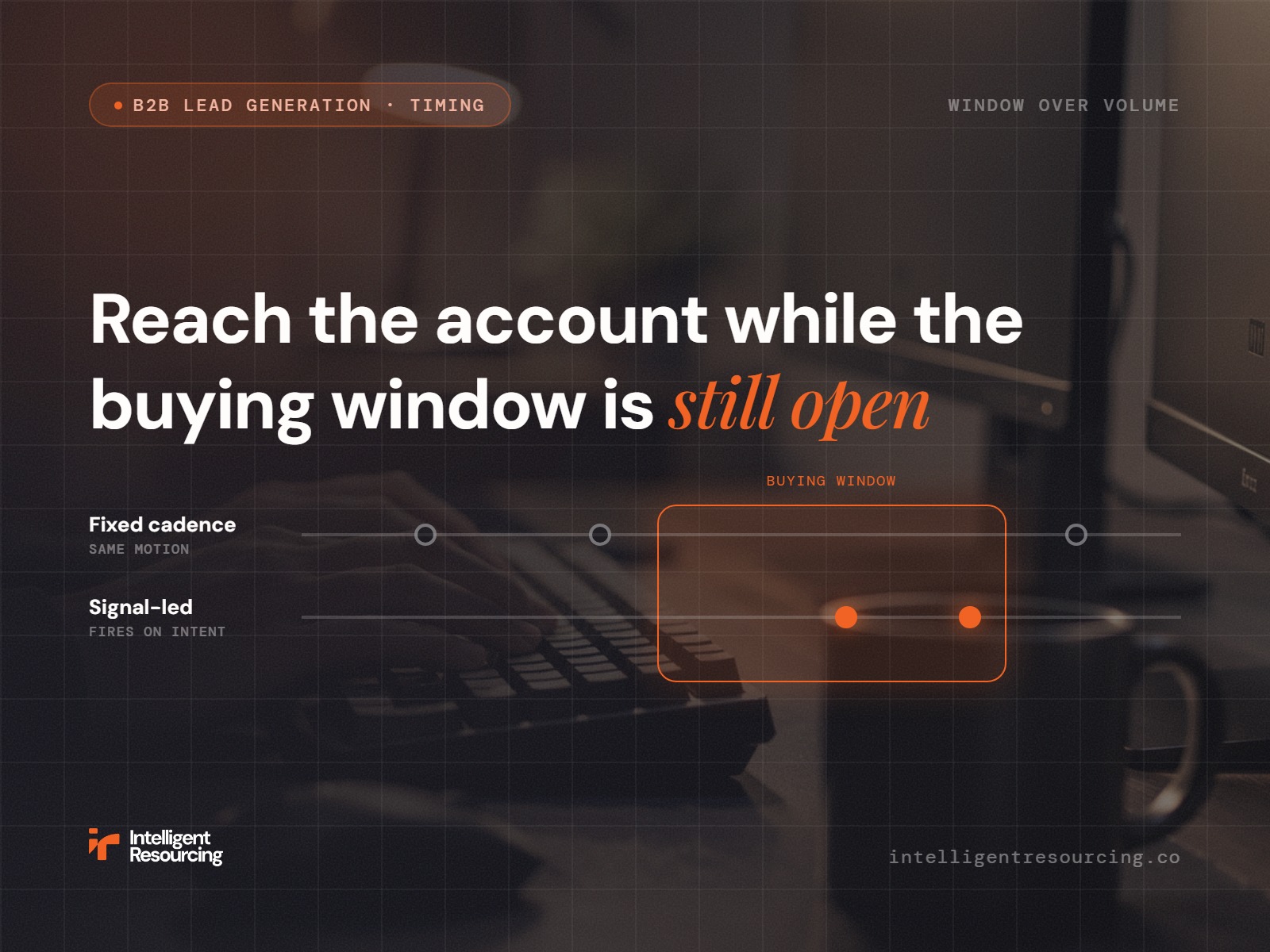
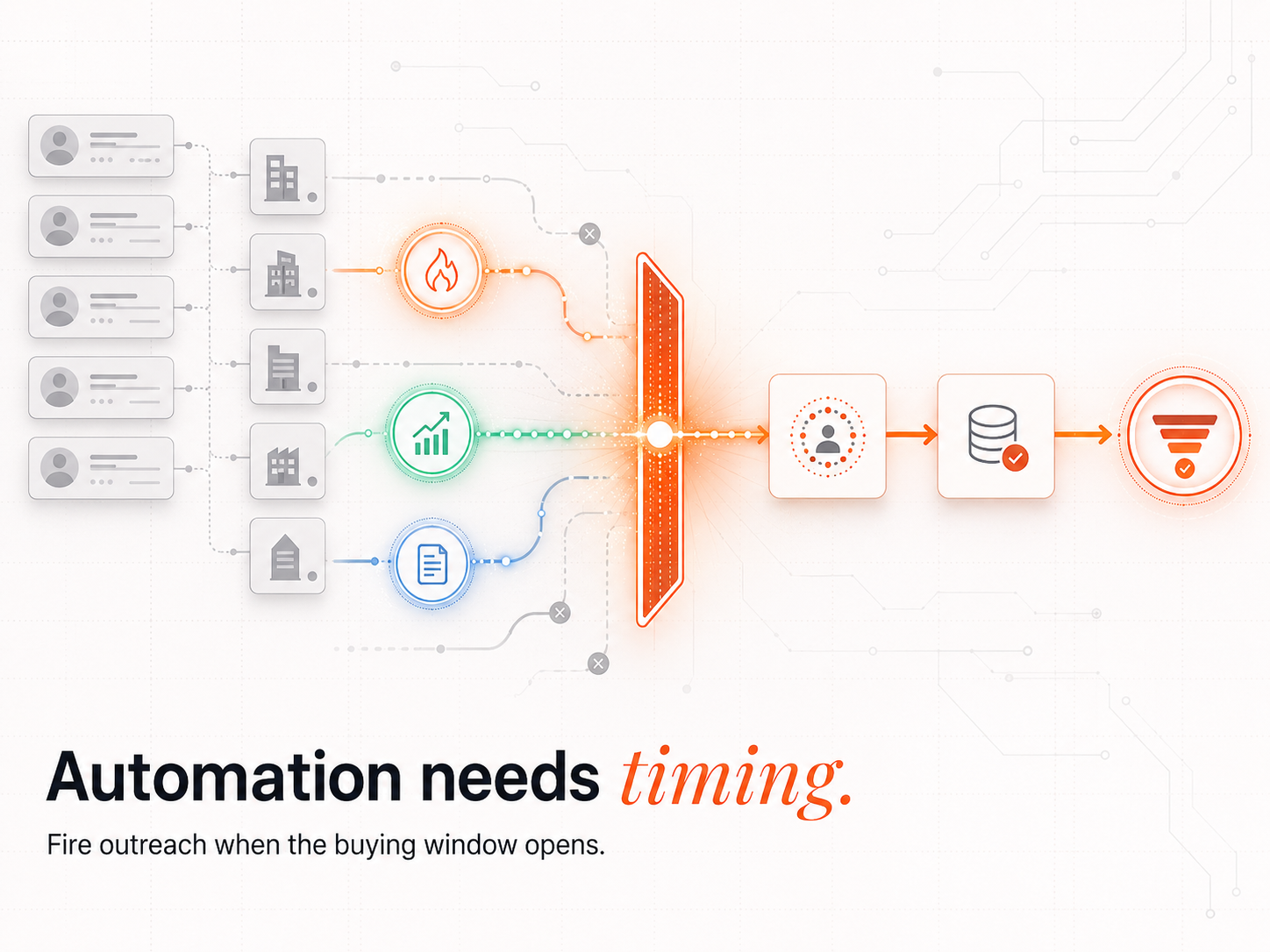
B2B teams are replacing manual prospecting because manual research produces inconsistent qualification and slow response times, since each rep applies different criteria. Signal-led automation in 2026 detects live buying signals such as funding events, leadership changes, and tech installs, then triggers enrichment, scoring, and outreach only when a Verified Buying Window opens.
What goes wrong with manual prospecting?
Manual prospecting fails at the timing layer. HubSpot's 2024 State of Marketing report found that 61% of marketers say generating quality traffic and leads is their top challenge, because static lists decay daily and reps work on calendars rather than signals.
Teams that rely on manual research produce inconsistent qualification because each rep applies different criteria, works at a different pace, and surfaces a different subset of accounts. Therefore the same target market generates different pipelines depending on which SDR is on shift.
The deeper problem is timing. A target account may be raising a Series B today and ready to buy in 14 days, but a static prospecting list captured last quarter does not know that. AI-assisted lead scoring updates each account in real time as Clay pushes new enrichment data into HubSpot, which means the score reflects what the buyer is doing right now, not last quarter.
What does signal-led automation actually mean?
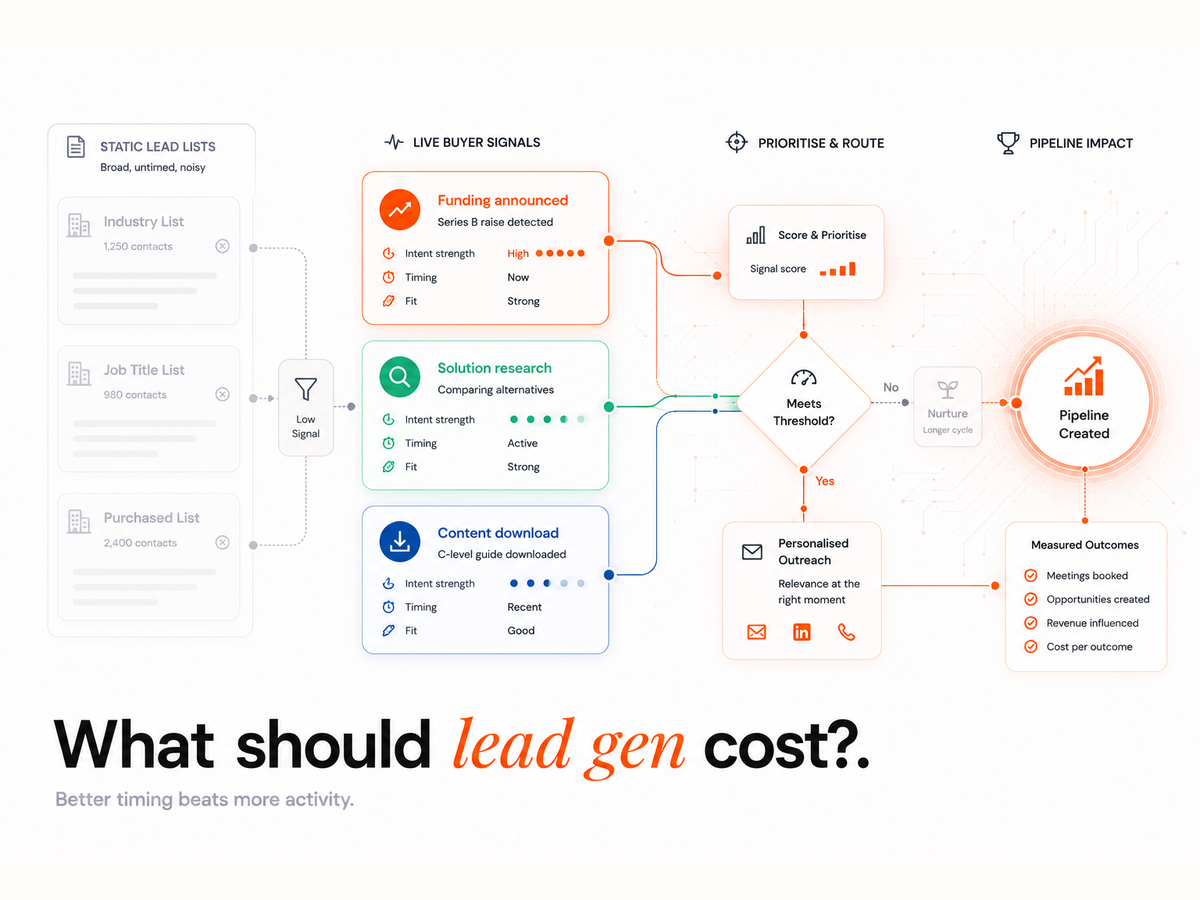
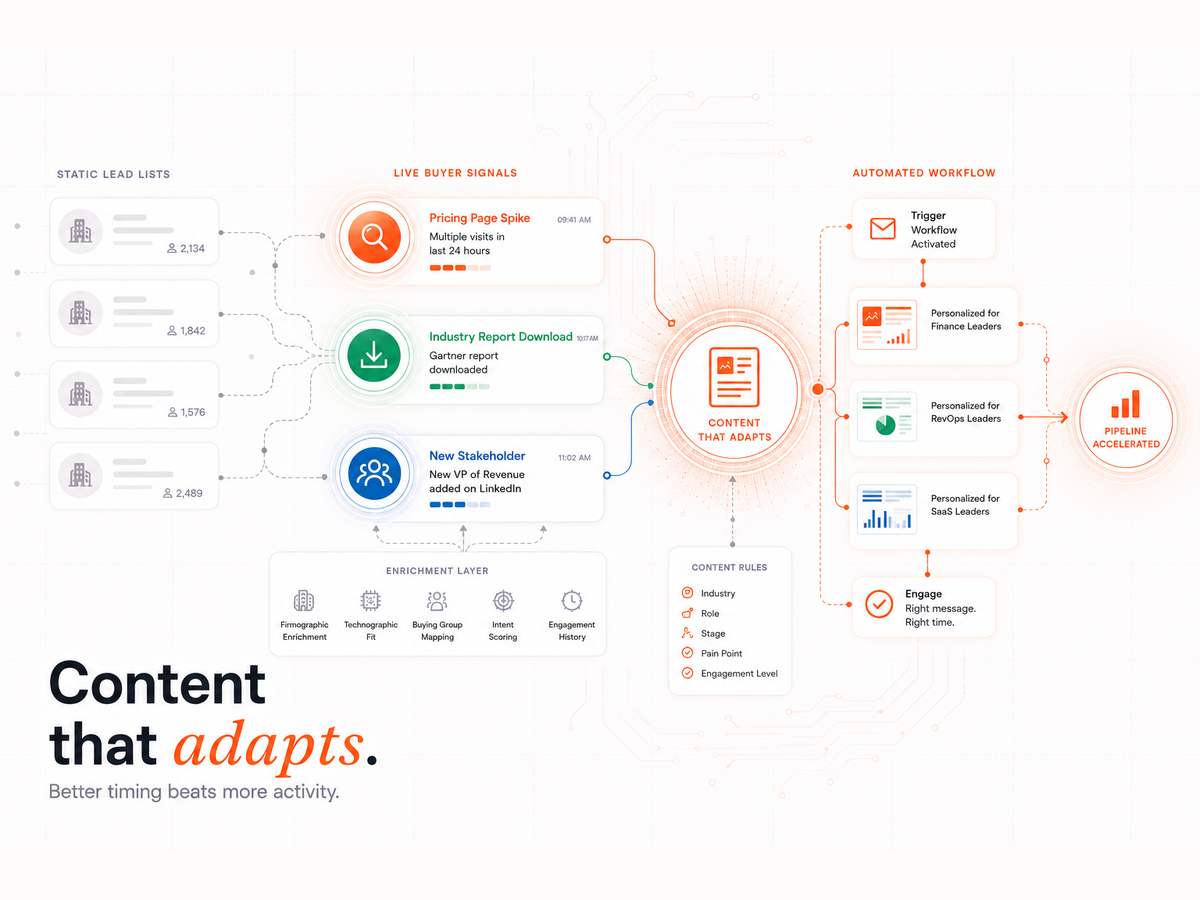
Signal-led automation reads the live state of the market: funding rounds posted on Crunchbase, leadership hires announced on LinkedIn, new technologies installed on a target's website, hiring spikes in roles that signal scaling. Each detected signal fires a workflow in Clay or n8n that enriches the account, scores it against the ICP, and routes the lead into HubSpot for SDR review. The buying signals that map most reliably to pipelines are funding events, hiring patterns, and tech-stack changes.
This is different from "signal-based" automation, which usually means a workflow fires on any inbound trigger such as a form fill or a content download. Signal-led automation only fires when a verified external buying signal is present, therefore SDRs only see leads who have a real buying window open.
How Does AI Lead Scoring Actually Work in 2026?
AI lead scoring in 2026 reads website activity, CRM history, email interactions, firmographic patterns, and intent data, then assigns a score that updates in real time. The score recalculates the moment a new signal fires, replacing static scorecards that decay daily and route the wrong leads to the wrong SDRs.
What inputs feed an AI scoring model?
A modern AI scoring model in 2026 reads at least five streams in parallel:
- website activity captured by HubSpot or Segment
- CRM history including past deals, lost reasons, and engagement gaps
- email opens, clicks, and replies across SmartLead and HubSpot Sequences
- firmographic patterns (industry, employee count, revenue band) enriched by Clay
- intent data from third-party tools that detect category research at the account level
Clay pushes the enriched record into HubSpot continuously. Each new datapoint reshapes the score, therefore the lead's priority changes the moment a new behaviour fires.
How do real-time scores beat static scorecards?
Static scorecards assign points once and decay daily. A buyer who downloaded a guide six months ago may still carry a 75-point score even though they have switched jobs and the company they joined has nothing to do with the offer. The score is wrong, but the workflow does not know.
Real-time scoring rewrites the score every time a new signal arrives. Salesforce's 6th State of Sales report found that sales teams using AI are 1.3x more likely to see revenue growth than teams without AI, because the timing layer reaches buyers when they are ready, not when a campaign is scheduled. This is why integrating Clay, HubSpot, and SmartLead into a single signal layer matters more than picking any one tool.
When we built this layer for a SaaS client serving Australian education in late 2025, score recalculation moved from a quarterly batch job to a live update whenever Clay returned new enrichment data, resulting in a 17% lift in SQL creation within 90 days.
Which Tools Power a Signal-Led Lead Generation Stack?
A signal-led lead generation stack in 2026 combines four layers: Clay for enrichment and signal triggers, HubSpot for CRM and signal-routed automation, SmartLead for adaptive outbound, and n8n for orchestration. AI is becoming the default starting point for seller research, with adoption set to reach 95% of workflows by 2027.
Clay: enrichment and signal triggers
Clay sources contact data, enriches accounts in real time, and fires triggers when a buying signal is detected. A funding event posted on Crunchbase, a job change tracked on LinkedIn, or a new technology installed on a prospect's website each fire a Clay workflow that updates the score and notifies HubSpot.
HubSpot: CRM and signal-routed automation
HubSpot stores the contact, the score, and the signal history. Workflows route the lead to the right SDR based on territory, ICP fit, and buying-window status. SmartLead picks up the email sequence when scoring crosses the threshold, therefore a Verified Buying Window triggers outbound automatically without an SDR having to assign the lead manually.
SmartLead: adaptive outbound
SmartLead handles deliverability, sending volume, and warm-up sequencing across multiple inboxes. The platform adjusts send pace based on reply rates and bounce rates, resulting in higher inbox placement than a single-domain sender.
n8n: the orchestration layer
n8n connects Clay, HubSpot, SmartLead, Slack, and any other tool the client uses. By 2027, 95% of seller research workflows will begin with AI, up from less than 20% in 2024, according to Cirrus Insight's research index citing Gartner. The teams that have not built this orchestration layer by then will be running every prospecting cycle behind the ones that have, which is why automated B2B lead generation with Clay and n8n replaces the manual list-building step entirely.
How Should Lead Automation Map to Team Capacity?
Lead automation must mirror real SDR capacity to avoid burying reps in unactioned leads. Automation should handle enrichment, scoring, and routing, with humans engaging only when a Verified Buying Window opens. The goal is a clean split between volume tasks (machine) and revenue conversations (human), not full replacement of SDRs.
When automation handles the work
Automation should handle five repeated tasks that SDRs currently do manually:
- enriching new contacts from a domain or LinkedIn URL
- scoring leads against the ICP as new behaviour arrives
- nurturing top-funnel accounts with intent-mapped content
- routing accounts the moment a buying signal crosses the threshold
- pulling reply data back into HubSpot for funnel reporting
Which buyer-intent signals matter most depends on the ICP, but funding events, hiring spikes, and tech-stack installs consistently produce the highest reply rates.
When humans must engage
Humans engage at three points:
- when a buyer enters bottom-funnel behaviour (pricing, demo request, repeat product views)
- when pricing or technical scoping requires bespoke discussion
- when a buyer prefers human contact, which Harvard Business Review's 2023 buyer research piece found is true for 74% of B2B customers when solving a real problem
This split keeps automation working on volume tasks and reps working on revenue tasks. Demand Gen Report's 2024 buyer journey analysis found that B2B buyers are nearly 70% through their purchasing process before engaging with sellers, therefore the SDR conversation must add value at a late stage rather than introduce concepts the buyer has already researched.
What Did a Signal-Led Funnel Actually Deliver in 2026?
A signal-led funnel installed by Intelligent Resourcing for an Australian SaaS company in late 2025 lifted reply rates from 4.1% to 9.3%, cut SDR admin by 28% to 35%, increased SQL creation by 17%, and dropped median follow-up time from 18 hours to 55 minutes within the first three months.
The 3-stage funnel we installed
A mid-sized SaaS company serving the Australian education sector rebuilt their funnel in late 2025 using intent-based automation. We installed a signal layer in three stages.
Stage 1
Top-funnel signal capture. Clay sourced and enriched accounts weekly, pushing them into HubSpot. Repeat visits and engagement with educational resources moved leads into nurture sequences.
Stage 2
Mid-funnel scoring. HubSpot triggered sequences aligned with content themes. Buyers who watched a full walkthrough video were flagged for SDR review.
Stage 3
Bottom-funnel outbound. SmartLead triggered compliant outreach when buyers viewed pricing or comparison content twice in 48 hours. SDRs were notified instantly, therefore follow-up moved from "next morning" to "within the hour".
Outcomes after three months
Results within 90 days:
- SDR manual admin reduced by 28% to 35%
- reply rates increased from 4.1% to 9.3%
- SQL creation improved by 17%
- median follow-up time dropped from 18 hours to 55 minutes
These are first-party Intelligent Resourcing metrics from the engagement, not industry benchmarks. The lift came primarily from the timing layer: outreach fired the moment a Verified Buying Window opened, rather than the next time a campaign was scheduled.
Where Does Signal-Led Automation Fall Short?
Signal-led automation falls short in three scenarios: tightly-bounded ABM where every account needs hand-built research, brand-awareness campaigns where the goal is broad reach, and very early-stage companies whose ICP is still shifting. In these cases, manual prospecting or paid demand generation produces better outcomes.
In tightly-bounded ABM with 10 to 50 named accounts, the value comes from bespoke research and personalised messaging, not from signal triggers. A 10-account list does not produce enough signal volume to justify a full automation build, therefore manual selling delivers better economics.
In brand-awareness campaigns, the goal is to reach a broad audience, not pipeline conversion. Paid social, content marketing, and PR produce better outcomes for awareness, because signal-led automation only fires on accounts already showing buying behaviour.
For very early-stage companies, ICP is still shifting and historical signal data is thin. Signal-led automation works once 50+ accounts have moved through the funnel and the system can learn what predicts conversion. Before that point, founder-led sales builds the pattern faster than any automated layer.
Intelligent Resourcing is not the right partner for any of these scenarios. The Revenue Operations Studio model fits B2B companies past product-market fit, with a defined ICP, looking to scale pipeline without proportional headcount growth.
Lead Generation
In 2026, the B2B teams that win stop treating outbound as a numbers game and start treating it as a timing problem. At Intelligent Resourcing, we install signal-led revenue systems that detect funding events, leadership changes, and tech-stack installs in real time, then route Verified Buying Windows directly to your SDRs. Your reps stop chasing cold lists. They start engaging accounts that are already ready to buy.
FAQs
What is the difference between signal-based and signal-led automation?
Signal-based automation usually means a workflow fires on any inbound trigger, such as a form fill or content download. Signal-led automation only fires when a verified external buying signal is present, such as a funding round, a hiring spike in revenue roles, or a new technology installed on the prospect's site. Signal-led is more selective and produces a higher reply rate because the buyer is already moving.
How long does it take to install a signal-led lead generation system?
A standard install of Clay, HubSpot, n8n, and SmartLead with one ICP, two signal types, and live routing typically takes 4 to 6 weeks. More complex installs with multiple ICPs, bespoke enrichment logic, and custom CRM mapping run 8 to 12 weeks. The system runs without ongoing build work once installed because the client owns it permanently.
Can a small B2B team run signal-led automation without a dedicated GTM Engineer?
Yes, once the system is installed. The build phase requires a GTM Engineer to design the signal architecture, but the running system is operated by the client's existing team using HubSpot, Clay, and SmartLead dashboards. Most clients have one revenue operations manager touching the system for 4 to 6 hours per week.
Does signal-led automation replace SDRs?
No. Automation handles enrichment, scoring, and routing, therefore SDRs focus on the conversations that close revenue. The signal layer expands SDR capacity without replacing the human at the point of decision. Most teams add headcount once the system is producing more Verified Buying Windows than current reps can take.
How does the system stay GDPR and Australian Privacy Act compliant?
Every workflow honours contact consent records, double opt-in where required, and region-specific suppression rules for EU, UK, and Australian prospects. Clay and HubSpot both support these controls natively. The system logs every send and signal trigger for audit, which means a compliance review can trace every outreach event back to its source.