
Why does traditional B2B lead generation break in 2026?
Traditional services chase volume, not outcomes. The buyer who agreed to be on a list last quarter has moved jobs, switched stacks, or stopped buying. The cost shows up as bad CRM hygiene, low reply rates, and burnt sender reputation. Scaling that model just scales the waste.
Data decays faster than most teams refresh
The ZeroBounce list decay report (11+ billion verified addresses in 2025) puts annual email list decay at 23%. Year on year the rate has fluctuated between 22% and 28%. A "clean" list at the start of the year has lost a quarter of its value by December, and a typical list bought from a broker has often decayed before it arrives.
Operational waste is hidden, not absent
Bad records create downstream cost the spreadsheet never shows:
- Duplicate records assigned to multiple SDRs.
- Missing fields that break routing rules.
- Sequences firing before enrichment finishes.
- Lower-quality enrichment overwriting higher-quality CRM data.
Volume without timing does not earn replies
The Woodpecker cold email benchmark (1,000+ customers, 52 countries, 2 years, 20 million sales emails) shows the gap clearly: personalised campaigns reply at 17%, non-personalised at 7%. Send to 1 to 200 prospects and reply rates run around 19%; send to 1,000+ and they fall to roughly 9%. Scale alone is a drag on response, not a lever for it.
The real problem is not that companies need more leads. The real problem is wasting time, money, and sales effort on the wrong ones.
What does signal-led lead generation actually mean?
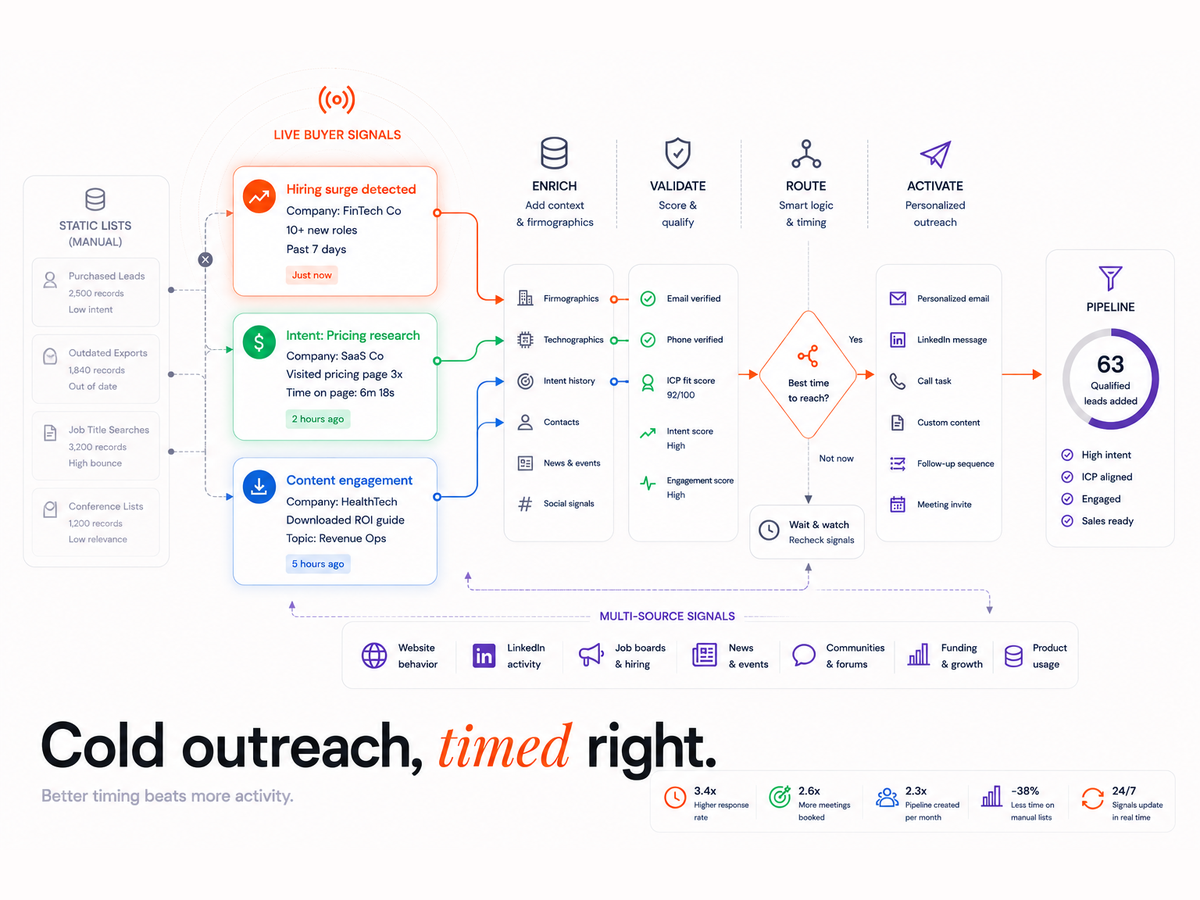
A signal is a real-world change that opens a buying window. It is evidence, not a guess. Signal-led lead generation means outreach activates only when an account moves, not when a quota dictates. Hiring spikes, funding events, stack changes, and behavioural intent are the most common.
The signals worth gating outreach on
- Hiring spikes: roles your solution serves (RevOps, Data, Security, GTM Engineering).
- Funding or M&A: budget unlocks and priority shifts that compress evaluation cycles.
- Tech stack changes: installs, removals, or migrations that flag readiness for complementary tools.
- Behavioural intent: repeat visits to pricing, comparison, or integration pages.
- Buyer movement: economic buyers changing companies, often dragging the buying preference with them.
How to read a signal correctly
- 1 signal: curiosity. Track it. Wait for more.
- 2 to 3 aligned signals in a short window: a Verified Buying Window. Assign to sales. Run targeted outreach.
Why this matters: the 6sense 2025 Buyer Experience Report (about 4,000 B2B buyers, NA / APAC / EMEA, median deal size $200K to $400K) finds the eventual winning vendor is already on the Day One shortlist 95% of the time. Static lists cannot put you on Day One. Signals can.
What are the 4 layers of an automated B2B workflow?
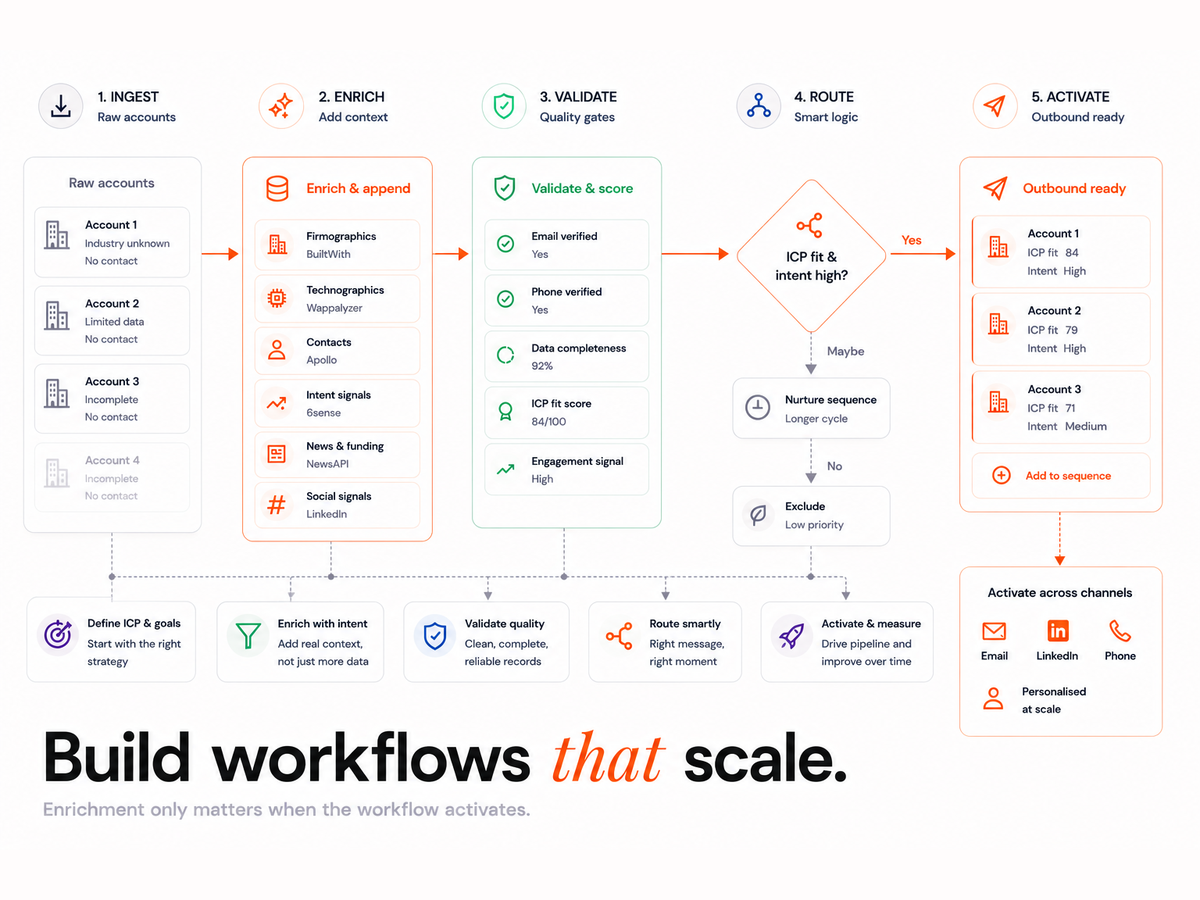
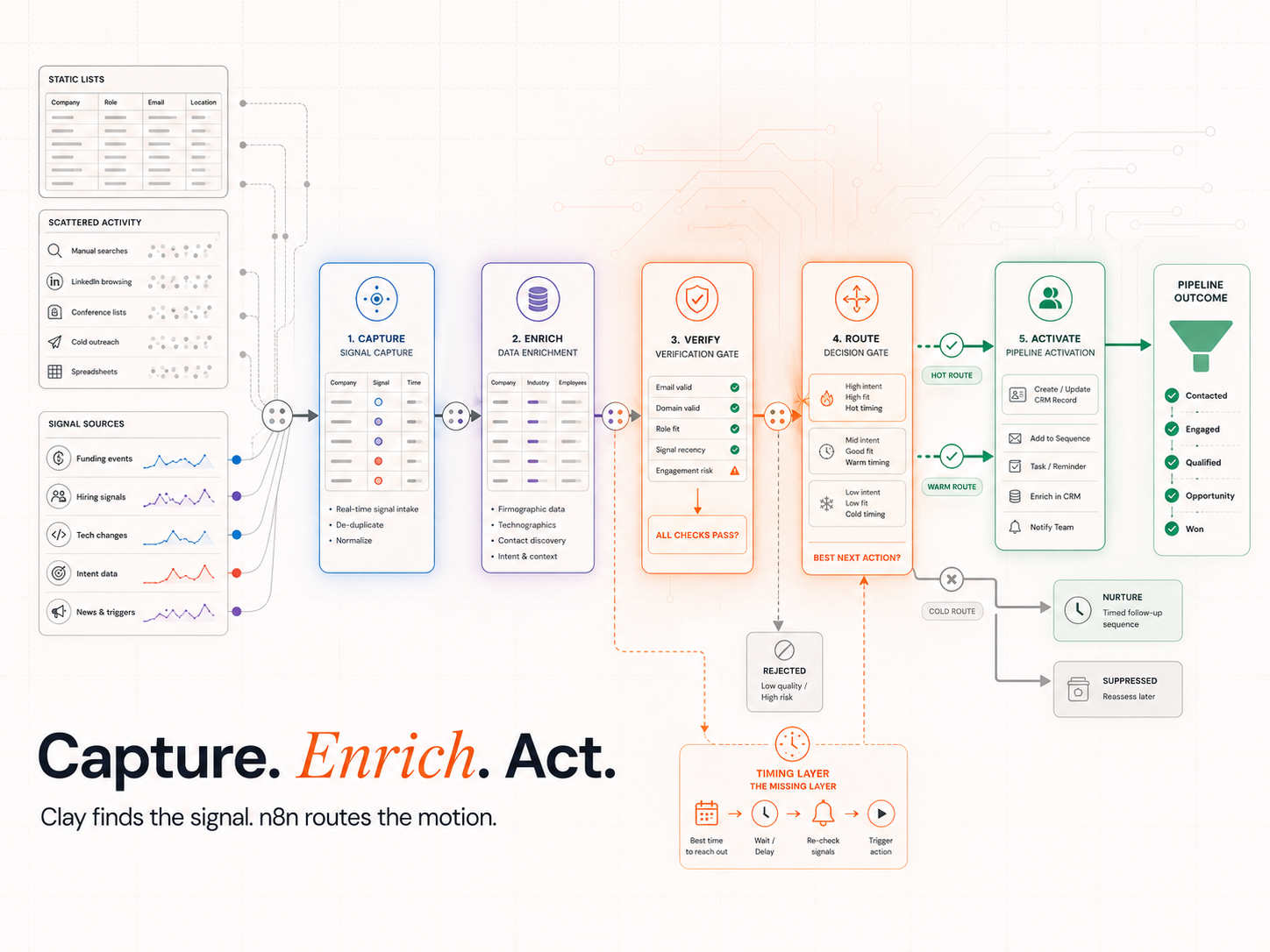
Automated B2B lead generation is a continuous system, not a single tool. The same 4 layers run on every reliable Clay + n8n implementation we ship. Skip a layer and the workflow leaks somewhere downstream.
1. Signal capture
Detect real-world changes that indicate buying intent. Hiring feeds, funding APIs, intent data, behavioural webhooks, news monitoring. The first layer is broad on purpose; the gates come later.
2. Enrichment and identity resolution
Add verified company and contact context to make a signal actionable. Without this layer, signals are noise. Records pass a confidence threshold, are deduped against the CRM, and reject records that fall short of the gate.
3. Decision logic
Score the signal-plus-record against your ICP and routing rules. Tier the response: rep alert for high fit, nurture for medium, suppress for low. The decision layer is what stops "we have 3 definitions of an MQL" from showing up at month-end.
4. Action
Trigger the next step: a Slack alert to the SDR, a Smartlead sequence, a CRM update, a calendar prompt. Without action, the previous three layers are an analysis exercise.
Why every layer matters
- Signals without enrichment produce false positives and wasted send.
- Enrichment without decision logic produces analysis paralysis.
- Decision logic without action recreates the manual bottleneck you started with.
How do Clay and n8n actually work together?
Clay aggregates signals and enriches records across 150+ databases using a waterfall approach. n8n orchestrates the flow: retries, branching, deduplication, alerts, and dead-letter queues. Clay answers "what just changed and who is this?". n8n answers "what do we do next, and how do we guarantee it happens?".
Clay: signals and enrichment you can trust
Clay sits at the data foundation. It aggregates signals and runs a waterfall enrichment across 150+ providers, which removes the "one tool missed it, so we buy another" cycle. The discipline that makes Clay reliable, rather than another data sink, is gated:
- Confidence thresholds: only pass records when key fields hit a minimum confidence.
- Do-not-enrich-twice rule: never overwrite a higher-quality CRM field with a lower-quality update.
- Dedupe inputs: normalise company domains and LinkedIn URLs before enrichment fires.
n8n: orchestration and control
n8n is the operational layer. It coordinates the workflow, filters noise into signals, controls timing and rate limits, retries on failure, and routes dead-letter records to a manual queue. Without n8n, Clay becomes a manual table that never quite makes it into the CRM.
When should you build, buy, or use an outsourced service?
The trade-off at a Revenue Operations Studio is control versus speed versus compounding value. The enemy is waste. Time and money processing low-quality demand, outdated lists, and burnt sender reputation. Three patterns recur.
When an outsourced service is the right call
- Need immediate volume for a short-term campaign.
- Testing a new market quickly with no operations team.
- Lacking internal operations capacity to govern Clay or n8n.
Relying on an agency permanently produces noisy lists, disconnected CRM data, and lost institutional knowledge. The model delivers activity, not a compounding system.
When DIY or basic in-house workflows fall short
Small technical teams using Zapier, Make, or ad hoc scripts can run lighter routing well. They tend to crack as branching logic, verification, retries, and dead-letter handling become daily fires. The workflow works until it does not, and the failure is silent.
When the in-house Clay + n8n model wins
If your goal is predictable, signal-led workflows with clean CRM operations, GTM Engineering at the Revenue Operations Studio is the better lever. We design, implement, and maintain Clay + n8n workflows with a reliability layer so operations:
- Run consistently with repeatable pipelines.
- Keep data clean inside the CRM.
- Target the right accounts at the right time.
- Keep institutional knowledge fully in-house.
The difference: agencies and DIY tools generate volume temporarily. GTM Engineering at the Revenue Operations Studio builds a system that compounds value month over month while minimising waste.
What should you measure to keep the automation reliable?
Reliable automation is a measurement discipline, not a tool boast. The metrics below expose where the workflow leaks pipeline, so you can fix the layer that is failing rather than blaming the channel that received the bad record.
- Signal-to-Qualified Rate: the percentage of captured signals that pass your qualification gates.
- Enrichment Coverage: the percentage of records with all required fields populated before activation.
- Bounce and Complaint Rates: early indicators of deliverability damage from verification gaps.
- Time-to-First-Touch: time elapsed from signal capture to first human engagement.
- Meetings per 100 Qualified Signals: the truest read on workflow quality versus volume.
- Recovered Failure Rate: the percentage of workflow errors successfully retried or pulled from the dead-letter queue.
A workflow that cannot tell you where leads were lost is not yet reliable. These 6 metrics give the visibility needed to keep accuracy high, throughput predictable, and pipeline durable.
How does signal-led automation support your revenue operations?
Signal-led automation sits underneath several core RevOps activities. It does not replace human judgment; it removes the manual sorting that drags judgment down.
- Inbound lead routing: records route automatically to the correct owner by territory, fit, and qualification.
- Outbound prioritisation: accounts showing aligned signals are surfaced first, so reps work the most relevant opportunities.
- Execution support: external SDR teams receive verified accounts, validated contacts, and a clear qualification rationale.
- Performance reporting: signals, enrichment, outreach, and meetings are tracked end to end, so you measure what produced pipeline.
Outreach is triggered by verified signals and qualification rules, not by static lists or manual selection. Same team. Cleaner inputs. Compounding output.
Clay Workflows
If your team is still working a list, you are losing 23% of it every year. The fix is not a bigger list. It is a Clay + n8n workflow that activates outreach when a Verified Buying Window opens. The Revenue Operations Studio at Intelligent Resourcing designs, ships, and embeds operators to keep it running.
FAQs
What signals are most useful for B2B?
Start with signals that map to budget and urgency: hiring for relevant roles, funding or M&A events, tech stack changes, and repeated engagement with pricing or comparison content. One signal is curiosity; 2 to 3 aligned signals inside a short window is a Verified Buying Window and worth a rep alert.
Does Clay replace a CRM?
No. Clay is best as an enrichment and orchestration workspace. The CRM remains the system of record. Clay improves what gets written into the CRM, then steps back.
Do I need n8n if I already use Zapier or Make?
If you need production-grade reliability (retries, branching, logs, recovery patterns, dead-letter queues), n8n is the better fit. Lighter tools work for simple routing, but they tend to crack as workflow complexity rises.
How long does it take to get a Clay + n8n workflow working?
A minimum reliable workflow can be built quickly. Reliability comes from tuning and guardrails over the first 4 to 6 weeks. The fastest path is to start small, stabilise the layers, then expand signals and channels.
How does signal-led automation protect deliverability?
Records pass a verification gate (format, domain, MX, catch-all flag) before any activation. Confidence thresholds block low-certainty records from triggering sends. Failures route to a manual review queue instead of the sequencer.
Where does Intelligent Resourcing fit in this picture?
We design and operate the Clay + n8n layer for the client. The system stays installed after the engagement ends, so institutional knowledge stays in-house rather than evaporating when the agency contract closes.