
B2B buying signals are the clues a buyer leaves before they ever fill in a form: a pricing-page visit, a job change, a new tool in their stack. Read them well and you reach the account while the need is live. Miss them and you arrive after the shortlist is already set. The catch is that not every signal means the same thing, and treating them all as buying intent wastes outreach and erodes trust. This guide breaks down the four types of B2B buying signals, how they map to each stage of the journey, and how to score and act on them in 2026.
The four types of B2B buying signals
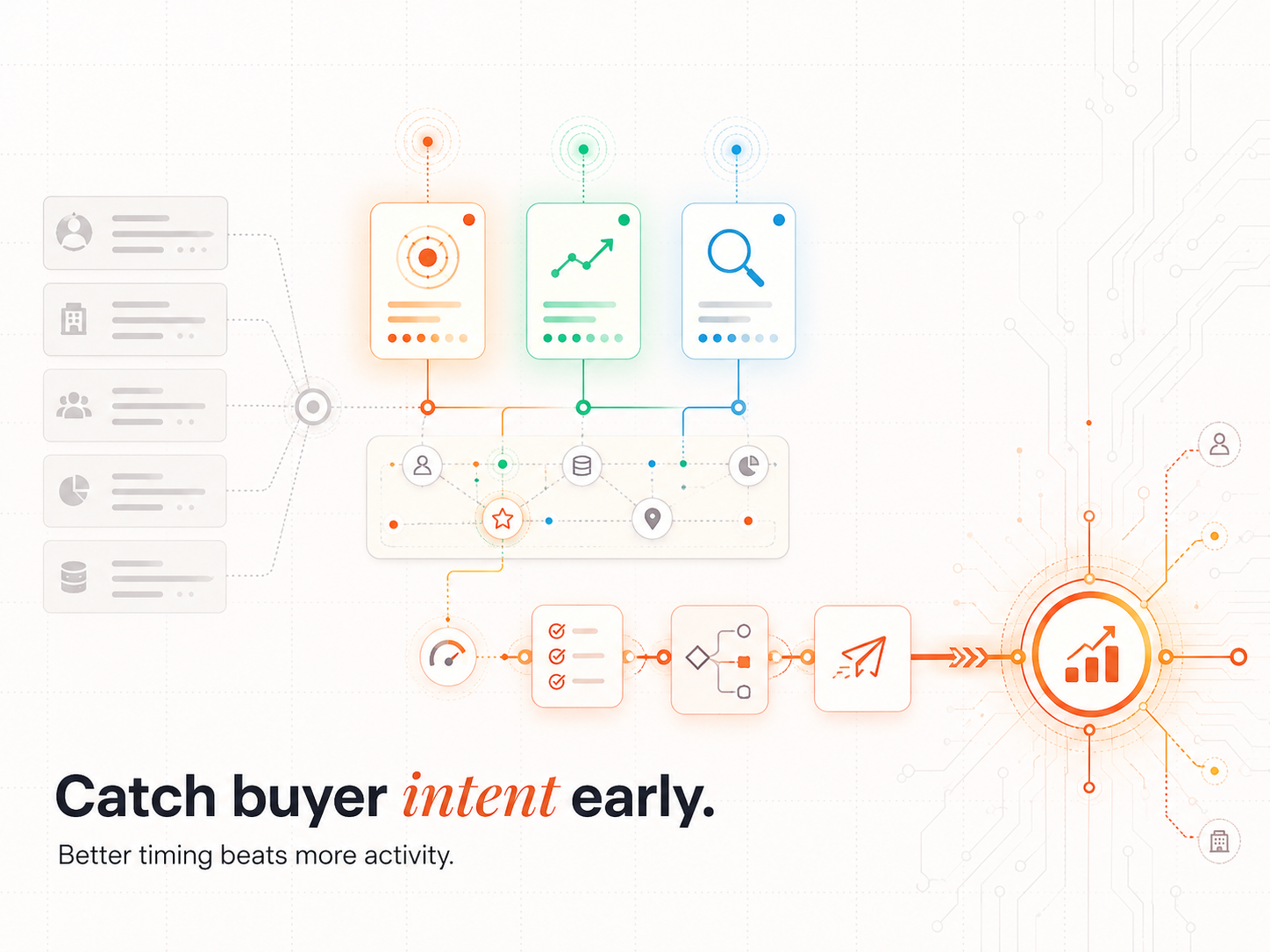
Every buyer action is evidence, but not all evidence is equal. Signals fall into four groups, and the strongest reads come when several line up at once. A single signal rarely justifies a sales call; a cluster does.
| Signal type | What it looks like | What it tells you |
|---|---|---|
| Behavioural | Repeat pricing or comparison views, return visits | The account is actively evaluating |
| Contextual | Hiring for a role, funding round, expansion | A trigger event has created a new need |
| Technographic | New tool adopted, legacy system replaced | A gap or a switch in the stack |
| Engagement | Replies across channels, not just a form fill | Rising interest you can act on |
Reading these clusters, rather than reacting to one click, is the foundation of any signal-based marketing system, and it is what separates timely outreach from noise. A funding round on its own is context; a funding round plus repeat pricing-page views is a buying window. The job is to spot the combination, not the single event, and to know which combinations have historically preceded a deal.
Early-stage signals: win the shortlist before research starts
The decision often starts before the research does. TrustRadius's 2024 B2B Buying Disconnect Report found 78% of buyers shortlist products they had already heard of before they began researching, rising to 86% among enterprise buyers, and 71% then choose their first pick. Early signals like a job change, a newsletter sign-up, or a first content view carry low intent, but they are your chance to become the name a buyer already trusts.
Peer proof reinforces it: G2's 2024 Buyer Behavior Report names public review sites the single most-consulted source for 31% of buyers, up from 23% a year earlier. The play: stay visible where buyers learn, and respond to early signals with education, not a pitch.
Watch out for mistaking familiarity for readiness. An early signal earns a helpful touch, not a sales call, and pushing too hard here removes you from the shortlist rather than adding you to it.
Mid-stage signals: detect accounts that are actively researching
Mid-stage signals show an account weighing options: repeat product-page views, case-study downloads, comparison searches. The problem is volume, because only a small share of your market is in-market at any time, and the rest is noise. Intent data exists to find that minority. Bombora's co-op tracks 4.8 million domains across 17.6 billion interactions a month, the kind of footprint needed to separate genuine research from background traffic.
The play: when intent signals cluster on an account, route a relevant SDR touch through a mutual connection or send content that maps to what they viewed. Reference the research, not your roadmap. This is where a documented automation workflow earns its keep, because mid-stage volume is too high to work by hand.
Watch out for chasing surface-level intent. A spike in topic activity is a starting point, not proof; corroborate it with first-party behaviour on your own properties before you escalate an account to sales.
Late-stage signals: act before the form fill
By the time a buyer raises a hand, the committee has usually grown. Ebsta and Pavilion's 2024 B2B Sales Benchmarks, across 4.2 million opportunities, found successful deals involve nine engaged contacts by the solution stage, while lost deals average just two. Repeat pricing-page views, new buying-committee members on gated content, and return high-intent sessions are your last clear window to reach that whole group.
The play: treat late signals as urgent and multi-threaded. A tailored proposal, a live demo, and direct outreach to every stakeholder, not a generic follow-up to one contact, are what convert at this stage.
Watch out for single-threading the deal. Late signals often come from new stakeholders joining the evaluation, so map the committee and reach the people who quietly decide rather than only your original contact.
| Buying stage | Signals you will see | The right response |
|---|---|---|
| Early | Newsletter sign-up, job change, a single content view | Educational nurture and retargeting, no sales pitch |
| Mid | Repeat product or comparison views, case-study downloads, review-site visits | A relevant SDR touch and tailored content |
| Late | Repeat pricing-page views, new buying-committee members, return high-intent sessions | Direct outreach, a tailored proposal, and a live demo |
Score your signals so the strongest rise
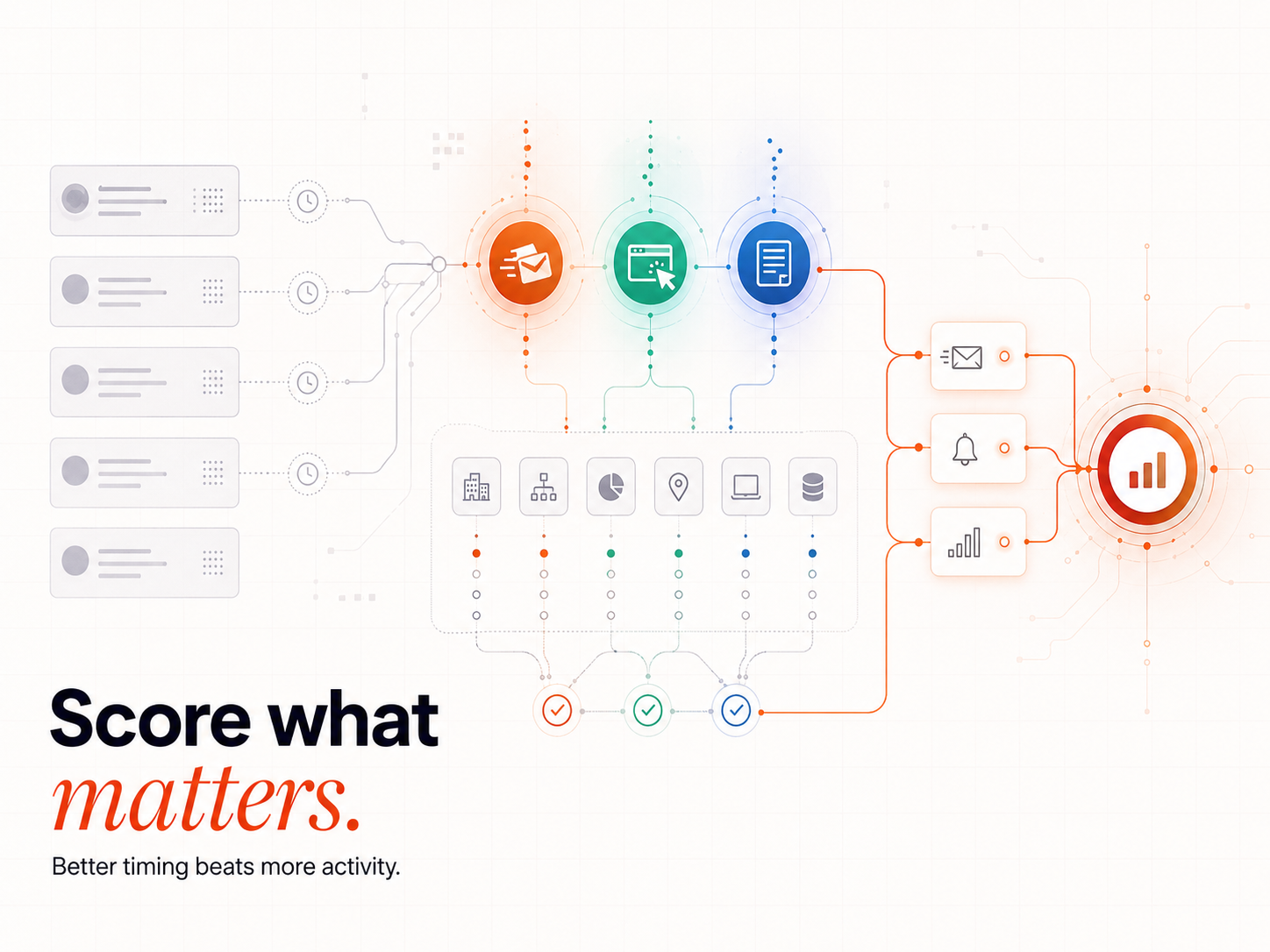
Signals only become useful when they feed a score. Assign points that rise with intent, so a light action ranks low and a strong buying signal ranks high, and your team always knows who to work first.
| Signal | Example | Score |
|---|---|---|
| Light engagement | Newsletter sign-up or single blog view | 10 |
| Trigger event | Target persona changes job, funding announced | 20 |
| Active research | Case-study download or product-page visit | 30 |
| Comparison intent | Brand-versus-competitor search or review-site visit | 45 |
| Buying intent | Repeat pricing-page views inside a week | 60 |
Set a clear threshold for the hand-off, so an account only reaches sales once its combined score crosses the line you have agreed together. Below it, the account stays in nurture; above it, it becomes a priority. Feed the total into stage-aware workflows so an early signal opens a nurture track while a high score alerts sales the same day, and keep a living list of the signals that actually matter to your buyer. Review the weights against closed-won data each quarter, because the right thresholds shift as your market does.
Respond inside the window or lose it
A signal decays fast, and acting on it well is what converts. Cognism's State of Cold Calling 2024, across more than 55,000 dials, found the average success rate doubled to 4.82% when teams reached the right contact with quality data and timing. The lesson generalises: a fresh signal worked quickly and accurately beats volume worked late.
The play: route and schedule high-scoring signals fast so a person, or a booked meeting, lands while the intent is still hot, and pair the speed with a message that names what the buyer just did.
Measure the journey, not the click
You cannot improve what one touchpoint cannot see. A modern B2B deal spans dozens of interactions across channels and weeks, so judging signals on opens and meetings booked misreads the journey and rewards activity over revenue. The signals that look busiest are rarely the ones that move pipeline.
The play: instrument the full path and measure whether your signal model lifts qualified pipeline, stage progression, and win rate. Tie every signal back to revenue, or stop tracking it.
Common mistakes to avoid
The most common failure is treating every signal as buying intent, which floods sales with weak leads and trains reps to ignore the score. The second is acting on a single signal in isolation rather than waiting for a cluster. The third is scoring once and never revisiting the weights, so the model drifts out of step with how buyers actually behave.
When we build these systems for clients, the first win is usually subtraction: switching off the alerts that fire on weak signals. Fewer, sharper triggers beat a long list of maybes, and they rebuild the sales team's trust in the score. For the full system view, see how this connects to signal-based selling.
Key takeaways
- Read clusters, not clicks: act when several signals align, not on one action
- Win the shortlist early: most buyers pick a name they already knew, so be visible before research starts
- Map signals to stages: an early signal earns nurture, a late one earns a proposal
- Score and respond fast: weight signals by intent and answer high scores the same day
- Measure against pipeline: keep only the signals that move revenue
Buyer Intent
Map the right triggers to the right actions. We'll help you build stage-aware workflows that respect the buyer's pace and lift conversion.