
Signal-based selling replaces bought lists with timing. Instead of working a static list, you read the live signals a buyer leaves, score them, and act on the strongest one through the right channel at the right moment. It works because the buyer has already moved long before sales hears from them, so the team that reads intent earliest wins the shortlist. This guide sets out seven signal-based selling strategies for 2026, each with the data behind it and the play to run, plus how to score signals and measure what actually moves pipeline.
What signal-based selling means in 2026
Signal-based selling treats every buyer action as evidence, not noise. A signal is any behavioural or contextual data point that shows an account is moving towards a decision, and its value compounds when several align at once. The discipline is simple to state and harder to run: read the signals, score them, and let them decide who you contact, when, and how. It sits inside a wider signal-based marketing system rather than running as a standalone tactic.
The signals worth tracking fall into four groups:
- Behavioural: repeat content views, pricing and comparison pages
- Contextual: hiring for relevant roles, funding rounds, market expansion
- Technographic: new tools adopted, legacy systems replaced
- Engagement: cross-channel responses, not just form submissions
The economics favour the shift. A bought list pays the same whether a contact is in-market or not, so most of the spend chases people who will never buy. Signal-based selling concentrates the same budget on accounts already showing intent, which lifts the return on every hour your team spends. The table below shows where the two models part ways.
It fits some teams more than others. If your deals are considered purchases with a real buying committee and a sales cycle measured in weeks or months, signal-based selling pays off, because timing and relevance decide those deals. If your motion is high-volume and transactional with a short cycle, a simpler list-and-sequence approach can still be the cleaner choice. The strategies below assume the former.
| What you're comparing | Lead-list selling | Signal-based selling |
|---|---|---|
| Trigger | A list is bought or a form is filled | A live signal fires (pricing visit, job change, funding, tech install) |
| Targeting | Fixed ICP, set once | Dynamic ICP that updates as accounts show intent |
| Timing | One sequence for everyone, regardless of readiness | Outreach activates only when fit and timing line up |
| Measurement | Leads delivered, opens, meetings booked | Qualified pipeline, stage progression, win rate |
| Typical outcome | Volume without relevance | Fewer, sharper conversations that convert |
Strategy 1: Start selling during the anonymous research phase
The biggest shift in B2B buying is that most of it now happens before you are invited in. 6sense's 2025 B2B Buyer Experience Report found buyers complete about 61% of their journey before they contact a vendor, and around four in five deals go to the first vendor they reach out to. Because the shortlist forms in the dark, waiting for a form fill means arriving after the decision is half made.
The play: surface where buyers actually research, through review sites, communities, search, and peers, and use intent signals to spot in-market accounts before they raise a hand. Being useful during the anonymous phase is what earns a place on the day-one shortlist.
Watch out for treating a single anonymous visit as buying intent. One pricing-page view from an unknown account is a weak signal on its own; it earns a light, helpful touch, not a sales call.
Strategy 2: Match the channel to the signal
In 2026 the sharpest teams stop asking which channel is best and ask which channel fits the signal in front of them. The channel follows the intent. Coordinated channels also compound: Factors.ai's 2026 B2B benchmark, across more than 100 companies, found ICP accounts convert 46% better in paid search after seeing LinkedIn ads, and SDR meeting-to-deal conversion rises 43% when accounts have already seen those ads.
The play: map each signal to a stage, then layer channels so they reinforce each other. A funding announcement can trigger a LinkedIn ad and a connection request, then a referencing email once the account engages. Our guide to B2B lead generation automation shows how to wire those triggers without manual effort.
Strategy 3: Lead with relevance in every message
Relevance, not volume, earns the reply. Lavender's benchmark data puts the average sales-email reply rate at 20.5%, and messages that reference a real, observed signal clear that bar because they prove you paid attention. A generic template aimed at a cold list does the opposite: it tells the buyer you did not.
The play: open every message with the signal you saw, not your pitch. A pricing-page visit, a new role, a funding round, each gives you a reason to reach out that the buyer recognises as their own context. Keep the ask small and singular, because one clear next step converts better than a list of options.
Strategy 4: Multi-thread the buying committee
One contact cannot buy on their own. Gong's analysis of more than a million executive sales cycles found a $50K to $250K deal typically involves at least 10 stakeholders, and win rates climb when executives are engaged around the third touchpoint rather than the first. Single-threaded deals stall the moment your one champion goes quiet.
The play: earn a strong champion first, then widen. Map the committee, learn what each function loses if nothing changes, and give your champion the proof to carry the case internally.
Watch out for going wide too early. Reaching ten contacts before you have a champion reads as spray, not coverage, and puts the buyer on guard rather than building trust.
Strategy 5: Equip the hidden buyers who stall deals
Most deals are not lost to a competitor; they are lost to inaction inside the buying group. The 2025 Edelman-LinkedIn B2B Thought Leadership Impact Report, drawing on nearly 2,000 professionals, found more than 40% of B2B deals stall because of internal misalignment. The people who decide your fate often never speak to you.
The play: build assets that travel without you, such as a short business case, a clear ROI summary, and answers to the objections finance and legal will raise. Arm the champion to sell internally when you are not in the room.
Watch out for assets that only sell features. Hidden buyers in finance, legal, and procurement respond to cost, risk, and proof, so give them the numbers and safeguards their role cares about.
Strategy 6: Respond inside the buying window
A signal decays fast, and most teams waste it. A 2024 RevenueHero study of 1,000 B2B SaaS companies found 63.5% never responded to a demo request at all, and among those that did, the median reply took more than a day. By then the buyer has moved on to a vendor that answered.
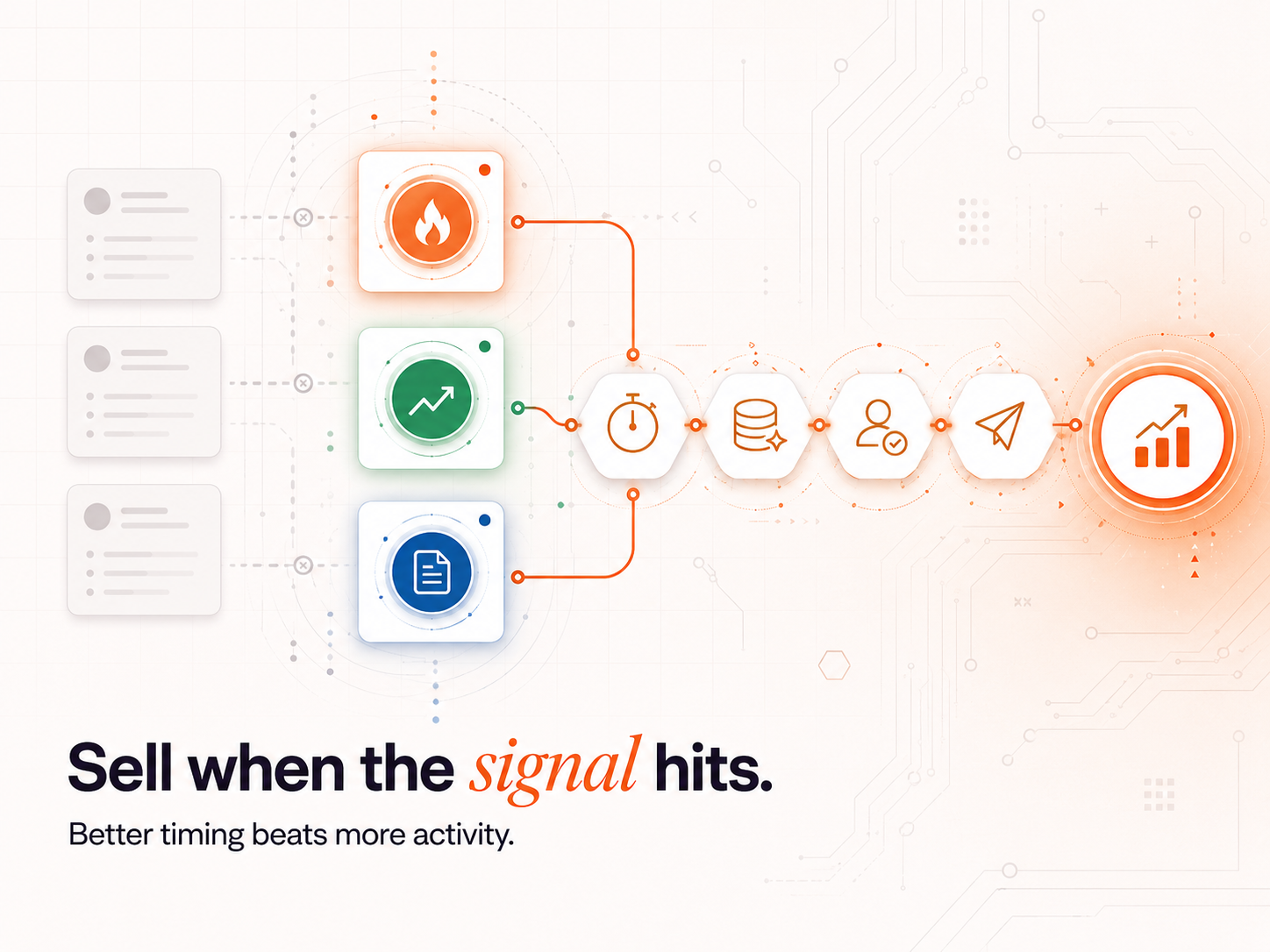
The play: route and schedule high-intent signals instantly so a person, or a booked meeting, lands the same day. Speed turns a fresh signal into a conversation while the intent is still hot.
Watch out for fast but generic. A same-day reply that ignores the signal that triggered it wastes the speed advantage, so pair quick routing with a message that names what the buyer just did.
Strategy 7: Measure pipeline by touchpoints, not activity
You cannot improve what a single touchpoint cannot see. HockeyStack Labs, mapping real B2B journeys, found larger deals accumulate hundreds of interactions, around 417 for deals above US$100K, long before anyone speaks to sales. Counting opens and meetings booked misreads that journey and rewards activity over revenue.
The play: instrument the full journey and judge the system on qualified pipeline, stage progression, and win rate. Map each signal to a buying stage so the response always fits where the account actually is.
Watch out for vanity dashboards. If a metric cannot be tied back to pipeline or revenue, it does not belong on the board, however good it looks in a weekly update.
| Buying stage | Signals you will see | The right response |
|---|---|---|
| Aware | Newsletter sign-up, job change, light content views | Educational nurture and retargeting, no sales pitch |
| Active | Repeat product-page visits, case-study downloads, brand-versus-competitor searches | A relevant SDR touch through a mutual connection or tailored content |
| In-market | Repeat pricing-page views, new buying-committee members on gated content | Direct outreach, a tailored proposal, and a live demo |
Where signal-based selling is harder than it sounds
Signal-based selling is not a switch you flip. It needs clean data, a scoring model the whole team trusts, and the discipline to ignore weak signals. Teams that bolt intent data onto a list-buying habit usually get the worst of both: more noise, and a sales floor that still calls everyone. The signal layer only pays off once routing, scoring, and follow-up are wired together.
When we build these systems for clients, the first month rarely produces more meetings. It produces fewer, better ones, because the model is filtering out the accounts a list would have had reps chasing. The lift shows up in win rate and cycle time, not raw activity, so set that expectation before you start or the early numbers will look like a step backwards.
How to put signal-based selling to work
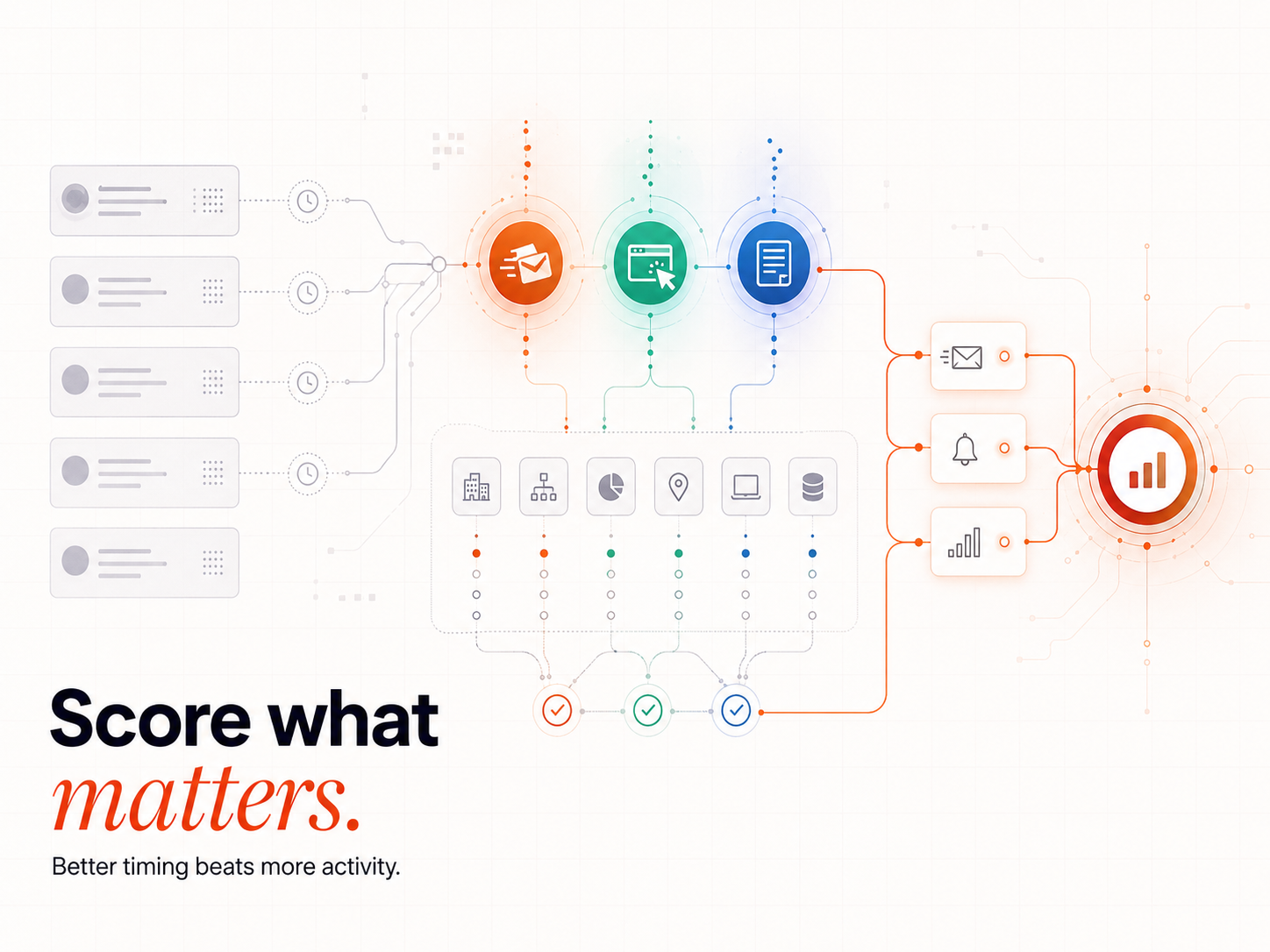
The seven strategies share one engine: a scoring model that turns scattered signals into a priority list. Assign points that rise with intent, so a light action scores low and a strong buying signal scores high.
| Signal | Example | Score |
|---|---|---|
| Light engagement | Newsletter sign-up or single blog view | 10 |
| Role or company change | Target persona changes job, funding round announced | 20 |
| Active research | Case-study download or product-page visit | 30 |
| Comparison intent | Brand-versus-competitor search or review-site visit | 45 |
| Buying intent | Repeat pricing-page views inside a week | 60 |
Rolling it out works best in sequence:
- Define the signals that map to your real buyer, and agree the score for each with sales and marketing together
- Connect the sources, so web, product, CRM, and intent data feed one place
- Set the thresholds that move an account from nurture to a sales alert
- Wire the routing so a high score reaches a person, or a booked meeting, the same day
- Review quarterly against closed-won data and adjust the weights
Feed the score into stage-aware workflows so an early signal opens a nurture track while a high score alerts sales to act the same day, and for the tooling, compare the best sales engagement platforms for your tech stack. The result is a measurable shift: outreach volume falls while win rates rise, because every touch is earned by intent rather than spent on a list.
Key takeaways
- Sell early: most of the journey is anonymous, so be useful before the form fill
- Read then route: pick the channel after the signal, and layer channels so they compound
- Lead with the signal: relevance, not volume, earns the reply
- Sell to the committee: multi-thread early and equip the hidden buyers who stall deals
- Move fast, then measure right: respond inside the window and judge the system on pipeline, not activity
Buyer Intent
We engineer GTM systems that detect buyer intent and trigger the right outreach at the right time. Stop buying lists. Start interpreting signals.