
What does each tool in the stack actually do?
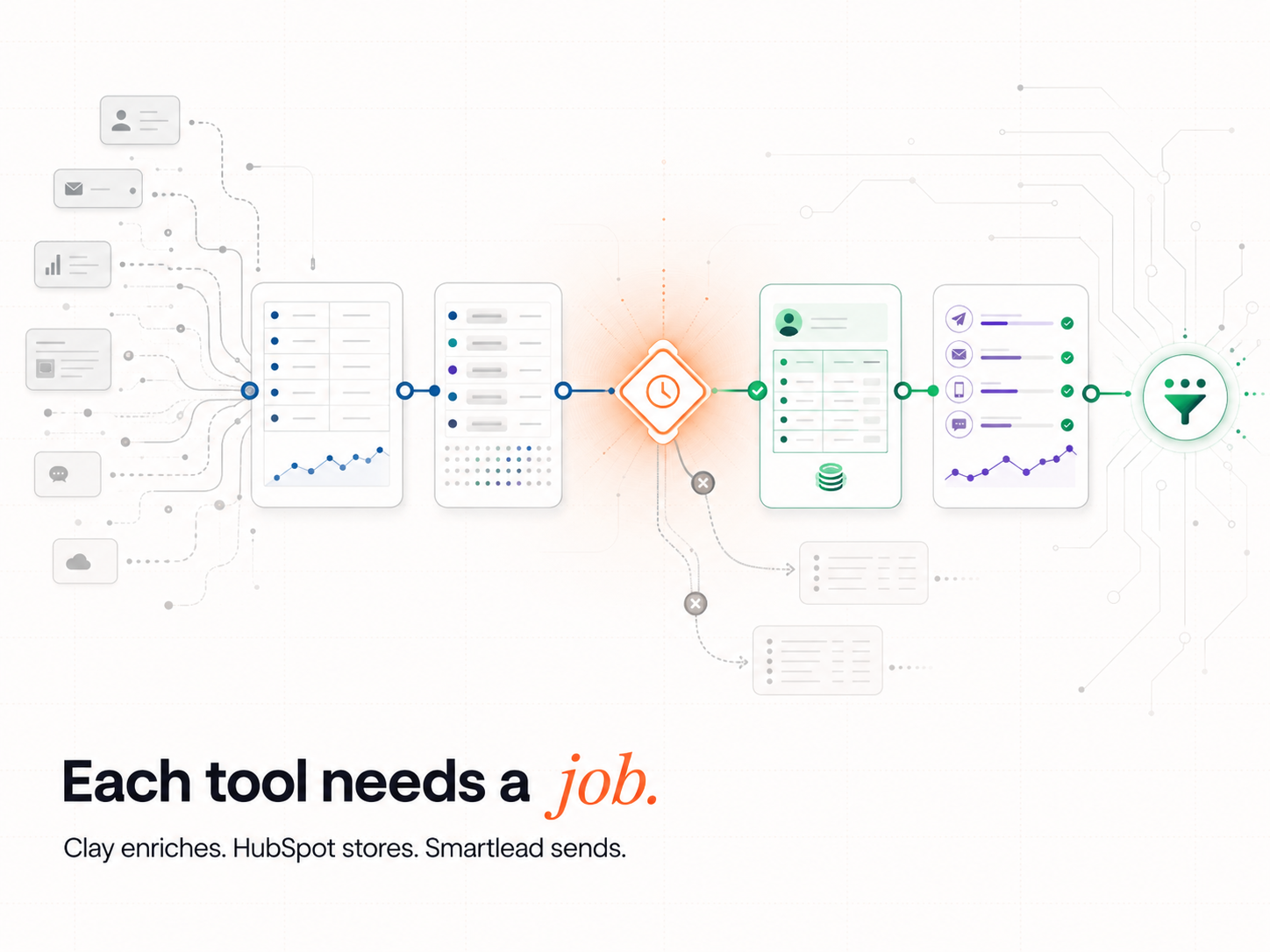
Each tool owns a distinct layer, and the single biggest mistake teams make is confusing those layers. Clay is the intelligence layer: it enriches and assembles signals. HubSpot is the system of record: CRM, lifecycle, reporting. Smartlead is the sending layer: warm-up, mailboxes, deliverability. An orchestration layer (n8n or Clay) connects them.
| Stack layer | Tool that owns it | What it does | Common mistake |
|---|---|---|---|
| Enrichment and signal assembly | Clay | Pull, dedupe, enrich, score raw data | Expecting Smartlead to enrich (it does not) |
| System of record and lifecycle | HubSpot | CRM, lifecycle stages, nurture, reporting | Using HubSpot as the enrichment engine |
| Outbound sending and deliverability | Smartlead | Warm-up, mailboxes, inbox rotation, reply tracking | Using HubSpot for cold sending (reputation risk) |
| Orchestration and routing | n8n / Clay | Connect the layers, fire Signal Response Protocols | Wiring tools point-to-point with no orchestration |
Why does integrating AI into the stack matter in 2026?
AI integration matters because adoption is no longer the differentiator: 88% of marketers already use AI day-to-day. The edge in 2026 comes from how the tools are wired together, not whether AI is present. A connected stack turns enrichment, scoring, and sending into one Signal-Led Growth motion; a disconnected one just spreads AI features across silos.
How does Clay handle AI-powered CRM enrichment?
Clay is the enrichment engine, not Smartlead. It pulls from 150+ data providers and runs Claygent AI research agents to add company size, job titles, tech stack, and intent before anything writes back to HubSpot. This matters because B2B data decays sharply each year, so enrichment has to run continuously. That continuous-hygiene model is what we call the Evergreen CRM. The clean handoff from Clay into HubSpot follows the field-mapping rules that keep the two systems in sync.
How does AI scoring and routing work across the stack?
AI scoring evaluates leads on real-time signals (site visits, opens, job changes) and routes the highest-fit, highest-intent records to sales immediately. Speed is the point: across 1,000 B2B sites tested, the average response took over a day, and most never replied at all. A Signal Response Protocol closes that gap by firing the moment a Verified Buying Window opens, rather than waiting for a manual review. Real-time lead scoring is what makes that routing trustworthy.
How do you protect brand voice when AI generates the outreach?
Protect voice upstream, at message assembly in Clay, before anything reaches Smartlead for sending. Voice rules applied at the enrichment-and-drafting stage are cheaper and more reliable than fixing tone after send. Consistency is a trust asset: Edelman found trust rises when a brand authentically reflects culture. Generic, off-voice AI output erodes that trust and forfeits AI Source Inclusion, the citations that engines like ChatGPT and Perplexity give to consistent, authoritative content.
How does Smartlead handle sending and deliverability?
Smartlead is the sending layer. It provides unlimited mailboxes, automated warm-up, and a unified Master Inbox that consolidates replies across channels. It does not enrich data and it is not a CRM. Once Clay has assembled and verified the records and HubSpot holds the lifecycle, Smartlead sends the outbound and protects sender reputation. Sending cold email from HubSpot instead is a deliverability mistake. The Clay-to-Smartlead handoff is where enrichment becomes outbound without buying lists.
How does HubSpot tie the stack together?
HubSpot is the system of record. Its Breeze AI layer now spans agents across marketing, sales, and service, but its core job in this stack is lifecycle and reporting, not enrichment or cold sending. Clay writes enriched records in, Smartlead reports sending activity back, and HubSpot holds the single source of truth. Done well, automated flows out of HubSpot are high-leverage: Omnisend found automated emails drove 37% of sales from just 2% of email volume.
RevOps Tools
Clay enriches, HubSpot stores, Smartlead sends. The pipeline comes from connecting them. The Revenue Operations Studio at Intelligent Resourcing assigns each tool its correct layer, adds the orchestration that fires Signal Response Protocols, and keeps the data clean with an Evergreen CRM.
FAQs
Does Smartlead enrich CRM data?
No. Smartlead is a cold-email sending and deliverability tool. It manages mailboxes, warm-up, and reply tracking. Data enrichment is Clay's job. Confusing the two is the most common mistake teams make when building this stack, and it leads to buying the wrong tool for the wrong layer.
What does each tool own in a Clay, HubSpot, Smartlead stack?
Clay owns enrichment and signal assembly. HubSpot owns the CRM, lifecycle, and reporting as the system of record. Smartlead owns outbound sending and deliverability. An orchestration layer such as n8n connects them so a signal flows from enrichment through to outreach automatically.
Do I need an orchestration tool as well?
For anything beyond a basic setup, yes. Clay, HubSpot, and Smartlead each do their job well, but a signal only becomes pipeline when something routes it between them. n8n or Clay itself acts as that orchestration layer, applying rules and firing the next step without manual handoffs.
Will AI-generated outreach hurt my brand voice?
Only if voice is left unmanaged. Apply voice rules upstream at message assembly, not after sending, and keep a human review checkpoint. Consistency builds trust, so treating voice as a structured asset protects both reputation and the citations AI engines give to consistent content.
Is a best-of-breed stack better than an all-in-one platform?
It depends on capacity. Best-of-breed (Clay, HubSpot, Smartlead) gives deeper enrichment and stronger deliverability but needs wiring. An all-in-one platform is faster to stand up and better for a tiny team with no operations capacity. Choose based on whether you can run an orchestration layer.
How long does it take to wire this stack?
A working version takes a few weeks: define the layers, connect Clay to HubSpot, route through to Smartlead, and add orchestration rules. The longer work is the operating model, deciding which signals trigger which actions, which is where most of the pipeline value is created.