
What are you really buying from a B2B lead gen agency in 2026?
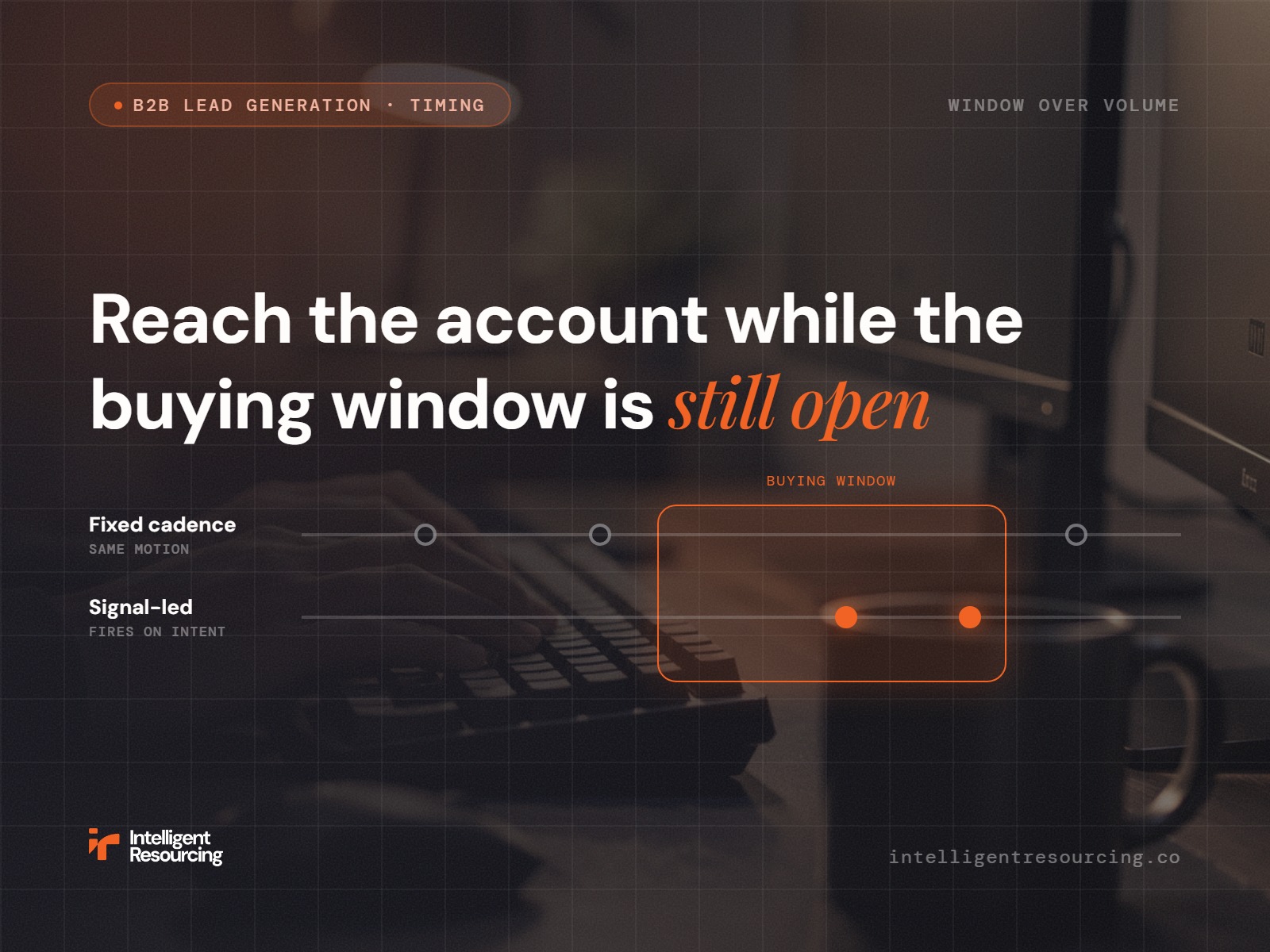
If you are comparing lead generation services, you are probably trying to book more meetings at the lowest cost per meeting. In 2026, the better filter is whether a partner runs signal-led growth: capturing real buying signals, verifying intent, then activating outreach when timing aligns with buyer readiness, not when a campaign schedule fires.
Start here if you want the services lens first: lead generation services, then move to the modern model: signal-led growth.
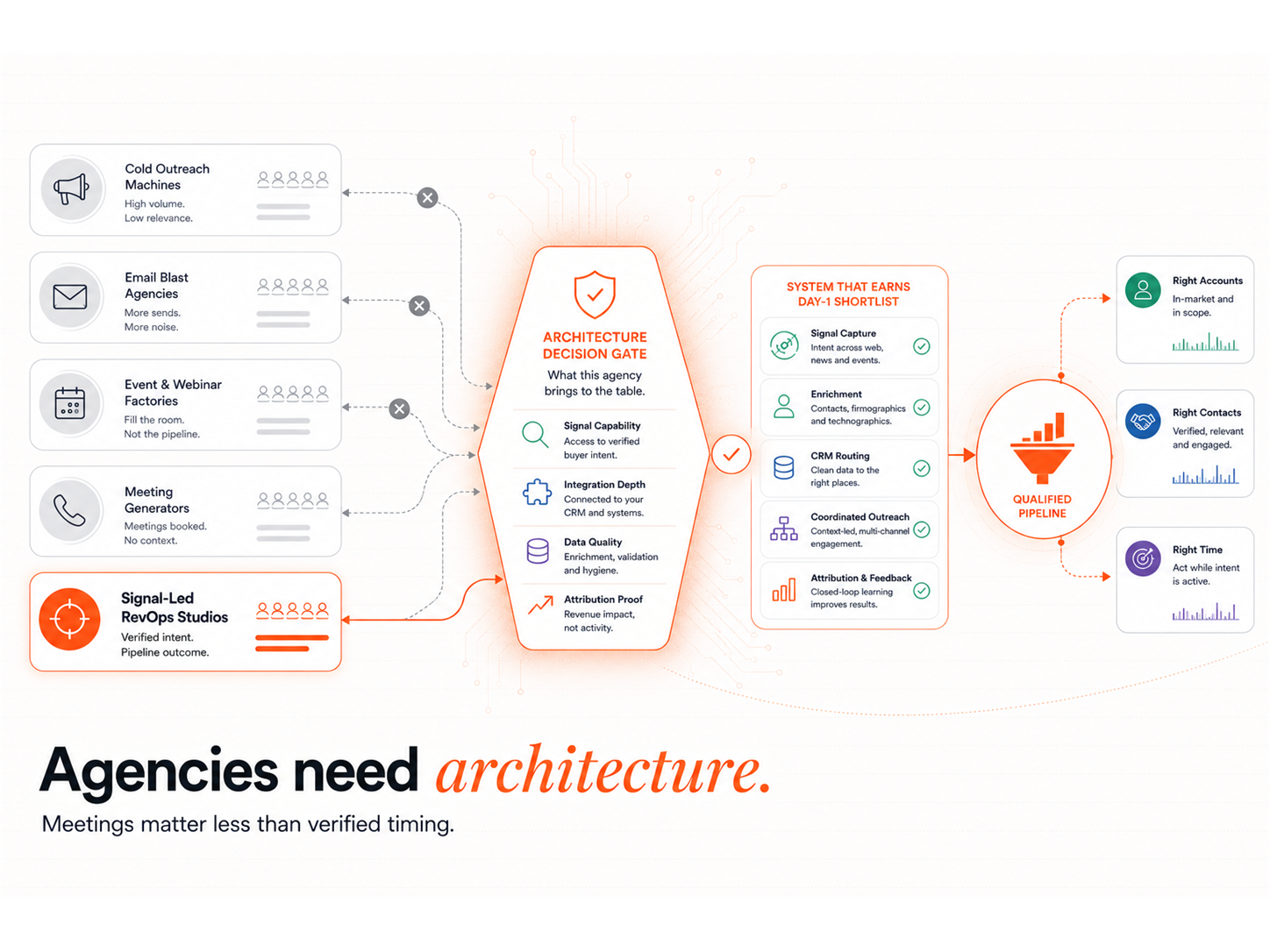
Many companies still hire a lead generation agency for high volume. But if you want a predictable pipeline and high-converting leads, you need a Revenue Operations Studio approach that connects signals, scoring, routing, CRM hygiene, and sequencing into one system.
Why do traditional agency metrics miss what buyers actually do?
Traditional agency metrics (meetings booked, MQLs generated, emails sent) measure what agencies control, not what buyers do. Two consistent research findings challenge those metrics: buyers are non-linear in how they decide, and MQL volume does not proxy for buying intent. The agencies that acknowledge both perform differently from those that ignore them.
Two core principles when evaluating agencies:
"Our workflows taught us linearity; our buyers taught us chaos." (Andrew Haussegger)
Traditional sales and marketing workflows often assume a linear path where buyers progress step-by-step. In reality, buyer behaviour is messy, multi-touch, and unpredictable, not linear.
"If MQLs are your north star, you're navigating by a dim bulb." (Kerry Cunningham)
Focusing on MQLs as the key metric is misleading. MQLs represent a single point in the buyer journey and do not account for the complexity of modern buyer behaviour or buying intent. Agencies relying solely on MQLs fail to understand the full context of engagement.
Translation: Buyer behaviour is complex, and traditional metrics do not capture the full picture. The right agency tracks the right signals and guides accounts to conversion, not form fills.
Why do old agency selection criteria fail in 2026?
Three structural shifts have made the classic agency shortlist (database size, monthly meeting targets, sequence template quality) irrelevant as primary selection criteria. Buyers now operate across more channels, contact data decays faster than any static list refreshes, and deal outcomes are decided before most outreach starts.
1. Buying is a committee, not a contact.
Gong's analysis of more than a million executive sales cycles found a $50K to $250K deal typically involves at least 10 stakeholders. An agency that runs cold email to a single contact never reaches the group that actually decides.
2. Contact data decays fast.
Validity's 2024 State of CRM Data Management report found 24% of teams say less than half their CRM data is accurate, and 31% lose at least 20% of revenue to poor data. Static lists target the wrong people before the first sequence runs.
3. Most deals are decided before the meeting.
TrustRadius's 2024 B2B Buying Disconnect report found 78% of buyers shortlist a product they had already heard of before research even began, and 71% go on to choose their first pick. The question is not "Can they book meetings?" It is "Can they help you earn the shortlist before contact begins?"
What are the core failures of traditional lead generation services?
Traditional lead generation services were designed for a simpler buying world: capture a contact, pass it to sales, repeat. Five structural failures make that model unreliable for high-value B2B in 2026: intent is absent, fit is mistaken for readiness, ICP definitions go stale, channels operate in silos, and activity replaces revenue as the success metric.
1. Leads ≠ intent. A contact record does not tell you whether there is a verified buying window.
2. Fit is mistaken for intent. Leads are pushed into the pipeline because they match the ICP, not because there is evidence they are actively buying.
3. Static targeting. ICPs are defined once, then ignored while the market shifts.
4. Channel silos. Email, LinkedIn, ads, and web intent are run independently, so timing signals never compound.
5. False efficiency. Activity metrics replace revenue outcomes, so the programme looks busy while pipeline quality drops.
What does signal-led growth mean for agency evaluation?
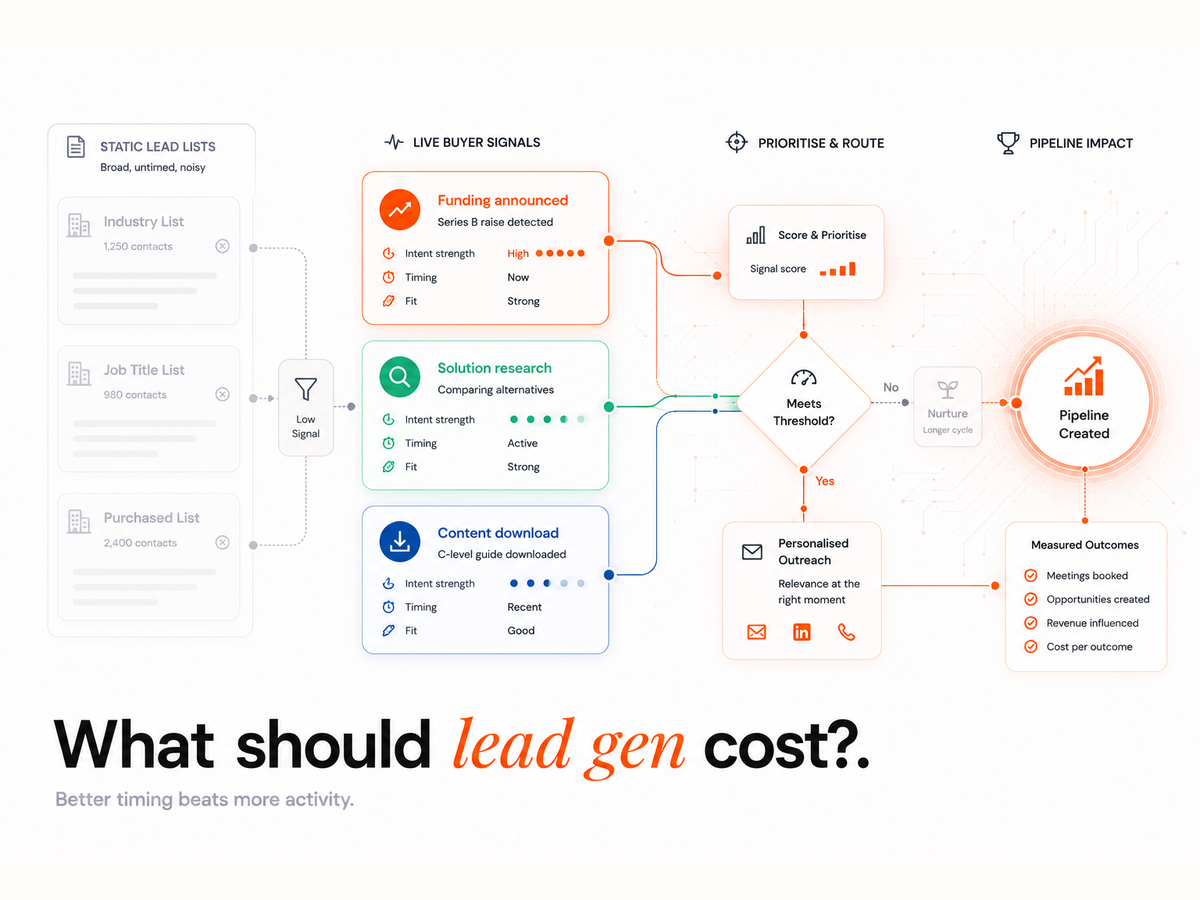
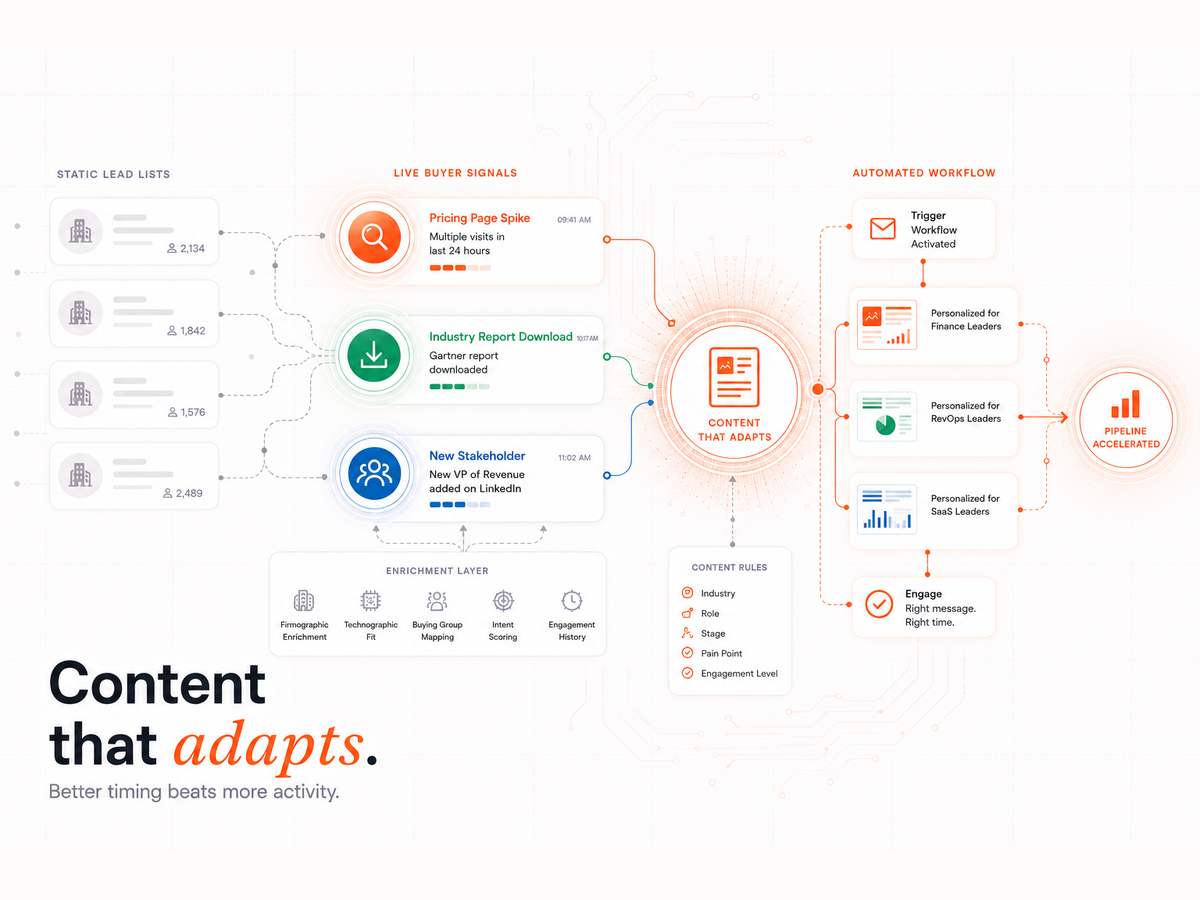
Signal-led growth replaces "lead capture" with intent interpretation. A signal is any behavioural or contextual data point indicating an account is moving closer to a buying decision, especially when multiple signals align.
Common B2B buying signals include:
- Behavioural: Repeated content consumption, pricing and comparison visits
- Contextual: Hiring for relevant roles, funding, expansion
- Technographic: Tool adoption, migrations, legacy replacements
- Engagement: Cross-channel responses, not just form fills
Signals matter because they decay quickly (timing matters), stack cumulatively (patterns beat one-off actions), and indicate buying momentum rather than just activity. A 2024 RevenueHero study of 1,000 B2B SaaS companies found 63.5% never responded to a demo request at all, and the median responder took over a day. The agencies that win act on a fresh signal the same day, not on a campaign calendar.
To make this concrete, outbound targeting improves reply rates when driven by signal-based marketing. This approach identifies and acts on signals that indicate when buyers are ready to engage.
What is the 2026 scorecard for evaluating lead generation capability?
Credentials, case studies, and client logos do not answer the questions that predict whether an agency builds your pipeline or fills your calendar. The 2026 scorecard evaluates four operational capabilities: signal capture and verification, system integration depth, operating model cadence, and compliance governance. Each reveals how an agency performs under real conditions.
1. Signals and data
Ask:
- Which signals do you capture? First-party (site/product/CRM) and third-party (hiring, funding, technographics)?
- How do you verify intent? What is the minimum signal threshold before outreach starts?
- How do you maintain an Evergreen CRM? A system that continuously updates contact information so engagement stays relevant and accurate.
A strong answer sounds like a documented system. A weak answer sounds like "we have a big database." To understand how a system reduces wasted outreach, see signal-based automation.
2. Systems and integration
Ask to see a simplified workflow diagram. You want proof they understand:
- enrichment → scoring → routing → sequencing → attribution
- CRM source of truth rules (what field wins, what gets overwritten, what gets locked)
- reply handling, suppression, and hand-off logic
If you are comparing partners on technical capability, this is where GTM engineering becomes the differentiator.
For stack-fit conversations, review the right GTM engineering tools to ensure the partner integrates with systems you already use.
3. Operating model
Ask:
- Who manages QA and deliverability?
- Who owns experimentation, QA, and deliverability?
- What is the weekly cadence (hypothesis → test → review → change)?
- What gets improved every week: targeting, messaging, routing, scoring, offers?
A strong agency shows an iteration loop. A weak one sells "set-and-forget sequences."
4. Risk and compliance
Ask how they handle:
- Regional privacy and anti-spam compliance (AU Spam Act, CAN-SPAM) enforced in workflows
- Suppression lists, unsubscribes, and reply classification
- Data provenance: where each contact came from and when it was last verified
What questions should you ask a lead gen agency before signing?
Four questions separate signal-led agencies from list-led agencies in every sales conversation. The difference is not in the questions themselves but in what the answers reveal: whether the agency has a documented system or a polished pitch, and whether their success metric is your pipeline or their activity report.
1. "Show me your workflow from signal to sequence."
- Green flag: they show verification gates and routing logic.
- Red flag: they show a sequence template and call it a system.
2. "What do you do when signals conflict?"
- Green flag: they downgrade, delay, or switch channels based on evidence.
- Red flag: they blast anyway to "hit activity targets."
3. "How do you attribute pipeline impact across channels?"
- Green flag: they track influence across touches and report conversion and velocity.
- Red flag: they only report meetings booked.
4. "What will you stop doing if results dip?"
- Green flag: they can name kill-switch rules (pause segments, re-verify data, rotate offers).
- Red flag: they increase volume.
What red flags identify an SDR-heavy shop over a signal-led partner?
Five observable patterns in a discovery call or proposal review reveal whether a prospective agency operates on activity metrics or revenue outcomes. None require a technical audit. They surface in how the agency talks about success, what they measure, and what they do when results drop.
- They promise fixed numbers. They guarantee meetings without discussing signals or verification.
- They ignore CRM governance. They cannot explain how fields are managed, producing a messy database.
- They measure activity only. Success equals emails sent rather than pipeline quality.
- They lack QA processes. They cannot show a process for messaging and deliverability review.
- They avoid the "What breaks?" question. They operate without guardrails or documented kill-switch rules.
What is the difference between a lead generation agency and a Revenue Operations Studio?
The second decision you are actually making when choosing a lead generation partner is not which agency to hire. It is which operating model to install. A traditional agency delivers outsourced execution. A Revenue Operations Studio installs a permanent revenue system. The trade-offs are real and the right choice depends on your growth stage and ACV.
| You hire a... | You get... | The trade-off |
|---|---|---|
| Lead generation agency | Outsourced execution | Faster activity: weaker system learning |
| Revenue Operations Studio | Installed revenue system | Slower start: stronger compounding |
For practical implementation, see how to automate your pipeline with a signal-led workflow.
What does a 30-day signal-led implementation look like?
The 30-day mark is where a signal-led implementation separates itself from a traditional agency retainer. In the first 30 days, the system is built and activated: ICP fields locked, signals defined, verification gates in place, CRM and sequencing connected, and one controlled activation running per segment.
Week 1-2: Build the operating system
- Lock ICP fields and exclusions
- Define signals and thresholds
- Implement verification gates
- Integrate CRM, enrichment, sequencing, and attribution
Week 3-4: Run controlled activation
- Activate one sequence family per segment
- Monitor deliverability and reply quality
- Iterate messaging based on signal tier
- Report outcomes that matter: conversion and pipeline movement
Use the what a B2B lead generation agency does to compare providers on delivery model and integration depth before selecting a partner for this build.
Lead Generation
In 2026 the agency choice is outsourced activity versus installed revenue operations. Intelligent Resourcing runs a signal-led Revenue Operations Studio, so you can audit signals, workflows, deliverability, and pipeline movement in a 30-day pilot before committing.
FAQs
What KPIs matter most: pipeline velocity or lead volume?
Velocity and conversion matter more because they reflect revenue movement. Volume metrics increase while pipeline quality drops, especially when data decay and poor timing inflate noise.
How do you know if an agency is "signal-led" or just list-led?
Signal-led partners name their signal sources, show verification gates, and explain why outreach starts when multiple signals align. List-led partners talk about database size and activity targets.
Should you hire an agency or build an internal signal-led system?
Build internally when ownership and long-term system control matter most and your team has RevOps capacity. Partner with a Revenue Operations Studio when speed matters and you need the system built and running while your team transfers capability through a pilot. The 30-day pilot is the fastest way to evaluate either path.
What tools should a modern partner integrate with?
At minimum: CRM, enrichment, sales engagement, routing, and attribution. The integration logic matters more than the logo list. Use the outbound tools guide as a reference point.