
Most GTM teams do not have a tools problem, they have an orchestration problem. The market is happy to sell you software for every task, and the result is a drawer full of disconnected point tools that each do one thing and none of which talk to each other. The teams that win pick a focused set of tools and wire them into one system. This guide lists the GTM engineering tools that actually matter, grouped by the job they do, and shows how to orchestrate them into a lean stack that scales pipeline. Build the system before you scale the motion.
Why your GTM stack needs orchestration, not more tools
The temptation to over-buy is real. The martech landscape reached 14,106 products in 2024, up 27.8% in a year, so there is a shiny tool for every micro-task. But a tool only adds value when its output feeds the next step cleanly. A great prospecting tool that dumps messy records into your CRM creates more work than it saves. The job of GTM engineering is to make a small set of tools behave as one connected system.
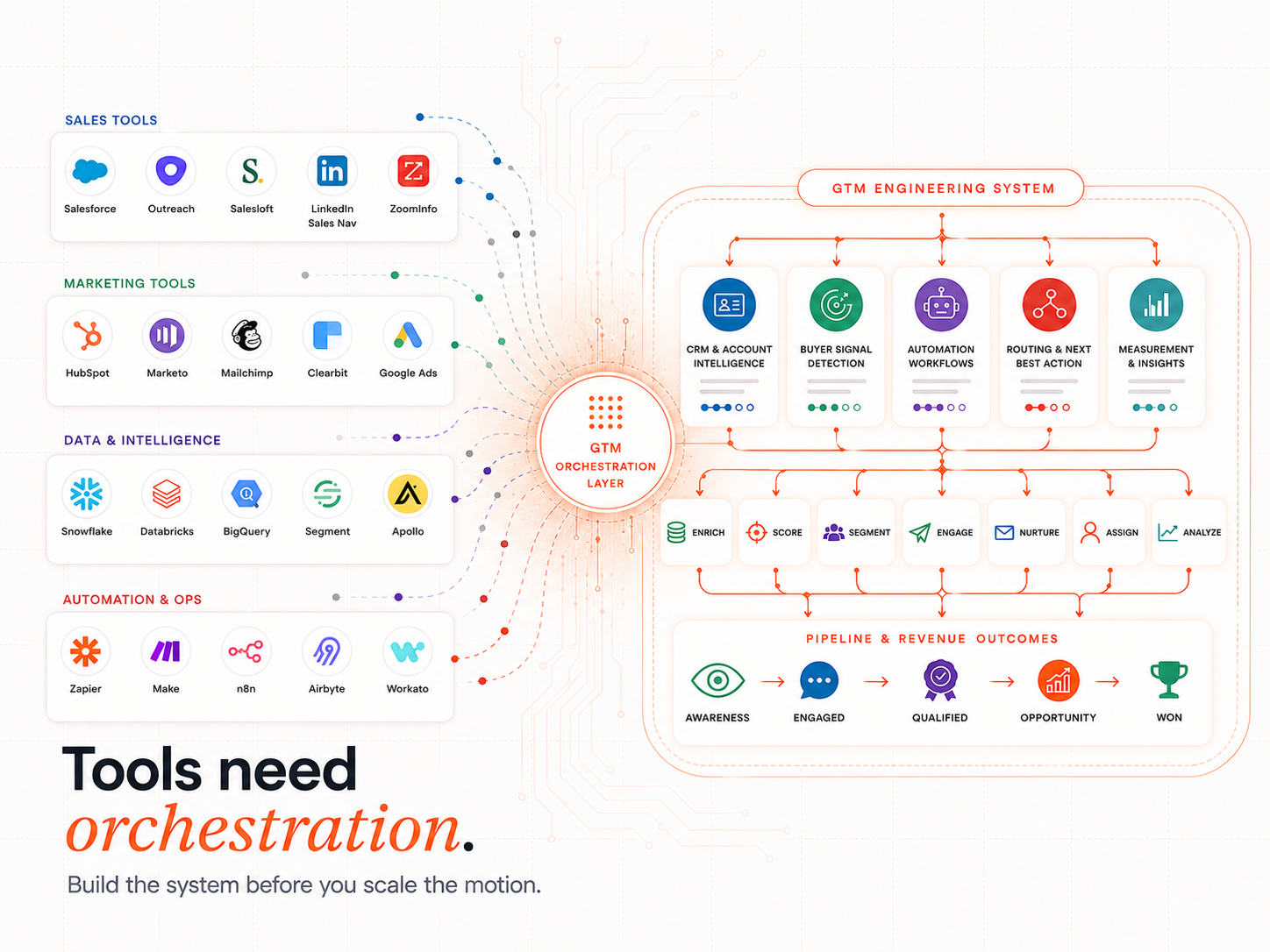
The categories below map a complete GTM stack: the sales, marketing, data, and automation tools that do the work, and the orchestration layer that ties them together. You will not need every tool listed; you need one or two per job that integrate well.
Sales tools
Sales tools own the relationship and the pipeline: where reps work deals, run outreach, and find the people on the buying committee. The CRM is the anchor everything else writes to.
| Tool | What it does | Best for |
|---|---|---|
| Salesforce | CRM and system of record | Owning accounts, pipeline, and reporting |
| Outreach | Sales engagement and sequences | Running rep cadences at scale |
| Salesloft | Sales engagement and coaching | Multi-touch outreach with call recording |
| LinkedIn Sales Navigator | Social prospecting | Finding and tracking buying-committee members |
| ZoomInfo | Contact and company database | Sourcing firmographic and direct-dial data |
The common mistake here is running two sales-engagement tools at once. Pick one cadence platform, point it at scored signals rather than cold lists, and let the CRM stay the single source of truth.
Marketing tools
Marketing tools generate and nurture demand, then hand the ready accounts to sales. The split is usually one automation platform for lifecycle and nurture, plus enrichment and paid tools that feed it.
| Tool | What it does | Best for |
|---|---|---|
| HubSpot | CRM plus marketing automation | Lifecycle nurture and inbound in one place |
| Marketo | Enterprise marketing automation | Complex nurture and lead scoring |
| Mailchimp | Email marketing | Lighter campaigns and newsletters |
| Clearbit | Data enrichment | Appending firmographic data to records |
| Google Ads | Paid acquisition | Capturing and retargeting active demand |
Whichever automation platform you choose, it should share a definition of a qualified account with sales, so a lead does not get handed over on a single click. That alignment is what a signal-based marketing system is built on.
Data and intelligence tools
This layer is the foundation: it stores your data, unifies behaviour across tools, and tells you which accounts are actually in-market. Get it right and every other tool runs on trustworthy inputs.
| Tool | What it does | Best for |
|---|---|---|
| Snowflake | Cloud data warehouse | A single store for all GTM data |
| Databricks | Data and AI platform | Modelling and large-scale analysis |
| BigQuery | Cloud data warehouse | Querying GTM data at scale |
| Segment | Customer data platform (CDP) | Unifying behavioural events across tools |
| Apollo | Prospecting and enrichment database | Building and enriching target lists |
Intent data belongs here too. Bombora's co-op tracks 4.8 million domains across 17.6 billion interactions a month, the kind of footprint needed to separate a genuine in-market account from background noise. Feed that intent into your warehouse or CDP and it sharpens every segment downstream.
Watch out for treating a warehouse like Snowflake or BigQuery as a nice-to-have. Once your GTM data lives in one place, scoring, segmentation, and attribution all get easier; without it, every tool keeps its own partial version of the truth.
Automation and operations tools
Automation is the connective tissue. These tools move data between systems, fire triggers, and update scores so the stack runs without anyone copying records by hand. The payoff is measurable: Nucleus Research found marketing automation delivers a 14.5% increase in sales productivity and a 12.2% reduction in marketing overhead.
| Tool | What it does | Best for |
|---|---|---|
| Zapier | No-code automation | Quick app-to-app connections |
| Make | Visual automation builder | Multi-step workflows with logic |
| n8n | Open-source automation | Custom, self-hostable workflows |
| Airbyte | Data integration (ELT) | Moving data between systems reliably |
| Workato | Enterprise automation | Governed integrations at scale |
The play: choose one orchestration layer as the backbone, rather than wiring dozens of point-to-point integrations that break silently. Build the logic as documented stage-aware workflows you own, so the system is auditable and not locked in one person's head.
The orchestration layer that ties it together
Tools are the hardware; orchestration is the operating system. The GTM orchestration layer takes a raw signal and moves it through seven steps, so the right action fires automatically at the right moment. This is where a stack stops being a list of subscriptions and starts being a system.
| Step | What happens | Example tools |
|---|---|---|
| Enrich | Fill in firmographic, technographic, and contact data | Clearbit, Apollo, ZoomInfo, Bombora |
| Score | Rank accounts by fit and live intent | Clay, HubSpot, Marketo |
| Segment | Group accounts by behaviour and stage | Segment, your CDP |
| Engage | Trigger the right outreach on the right channel | Outreach, Salesloft, Smartlead |
| Nurture | Keep not-yet-ready accounts warm | HubSpot, Marketo, Mailchimp |
| Assign | Route the qualified to the right rep, fast | CRM plus automation layer |
| Analyze | Measure what actually drove the pipeline | Snowflake, BigQuery, dashboards |
Read top to bottom, that is a buyer's journey running on autopilot: an account is enriched, scored against your ICP and live intent, placed in a segment, engaged on the channel that fits, nurtured if it is not ready, assigned to a rep when it is, and analysed so you learn what worked. The same logic underpins how to integrate prospecting tools with your CRM without corrupting the data.
Outreach: pick tools that earn replies and connects
Outreach tools only work when a real signal triggers them, so judge them on relevance, not volume. On email, Lavender's benchmark data puts the average sales-email reply rate at 20.5%, and signal-referencing messages beat that because they prove you paid attention. On the phone, Cognism's State of Cold Calling 2024, across 55,000+ dials, found the average success rate doubled to 4.82% when teams reached the right contact with good data and timing.
The lesson for tool choice: a cadence or dialler is only as good as the data and signals feeding it. Spend on the enrichment and intent layer first, then the outreach tool amplifies quality instead of scaling noise.
How to build a lean stack
Add tools in sequence, proving each layer before the next depends on it:
- Foundation (weeks 1-2): a CRM as source of truth, one enrichment tool, and one automation layer with a first scoring model
- Expansion (weeks 3-6): add an intent source and one outreach tool, triggered by the score
- Intelligence (weeks 6-10): pipe everything into a warehouse or CDP so segmentation and attribution work
- Optimisation (ongoing): review scoring against closed-won data and cut redundant tools every quarter
Before scaling, make sure the foundations hold: a clear ICP, agreed scoring rules, a single source of truth, and a team that can run the automation logic.
Common mistakes to avoid
The biggest mistake is buying tools to solve process problems; a platform on top of a broken workflow just adds cost. The second is overlap, where two tools enrich the same field and corrupt each other. The third is measuring the stack on activity, such as emails sent, rather than qualified pipeline.
When we build stacks for clients, the first move is usually subtraction: auditing what is already there and cutting the redundant tools before adding anything. A lean, well-orchestrated stack of six tools beats a sprawling one of sixteen, because the value is in how cleanly they connect, not how many you own. That orchestration is the job of the GTM engineer.
Key takeaways
- Orchestration beats accumulation: with 14,000+ tools available, the winners connect a focused set
- Cover four categories: sales, marketing, data and intelligence, and automation and ops
- The orchestration layer is the system: enrich, score, segment, engage, nurture, assign, analyse
- Fund the data layer first: outreach tools amplify whatever quality you feed them
- Build in phases and prune: prove each layer, then cut redundant tools each quarter
GTM Engineering
GTM Engineering helps you automate outreach, accelerate pipeline, and cut CAC — without burning through budget. Let's show you how the right tools and strategy can do more with less.