
What does a modern inbound B2B lead generation model look like?
Most teams still describe inbound as: publish content, drive traffic, capture leads, pass to sales. That model is outdated. Buyers research, compare, and evaluate vendors largely on their own. Understanding what replaced the traditional model is the starting point for building a system that actually converts.
This approach is outdated. Buyers now research, compare, and evaluate vendors largely on their own. MarketOne's 2025 B2B Buyer Study found 61% of B2B buyers globally complete their journey before contacting any vendor. This means most decisions are made before sales even sees a lead, so focusing only on form fills or traffic gives a false view of performance.
A modern inbound system works differently:
- Content captures signals, not leads: it shows what buyers are interested in
- Behaviour shows readiness, not forms: patterns over time indicate when buyers are ready to buy
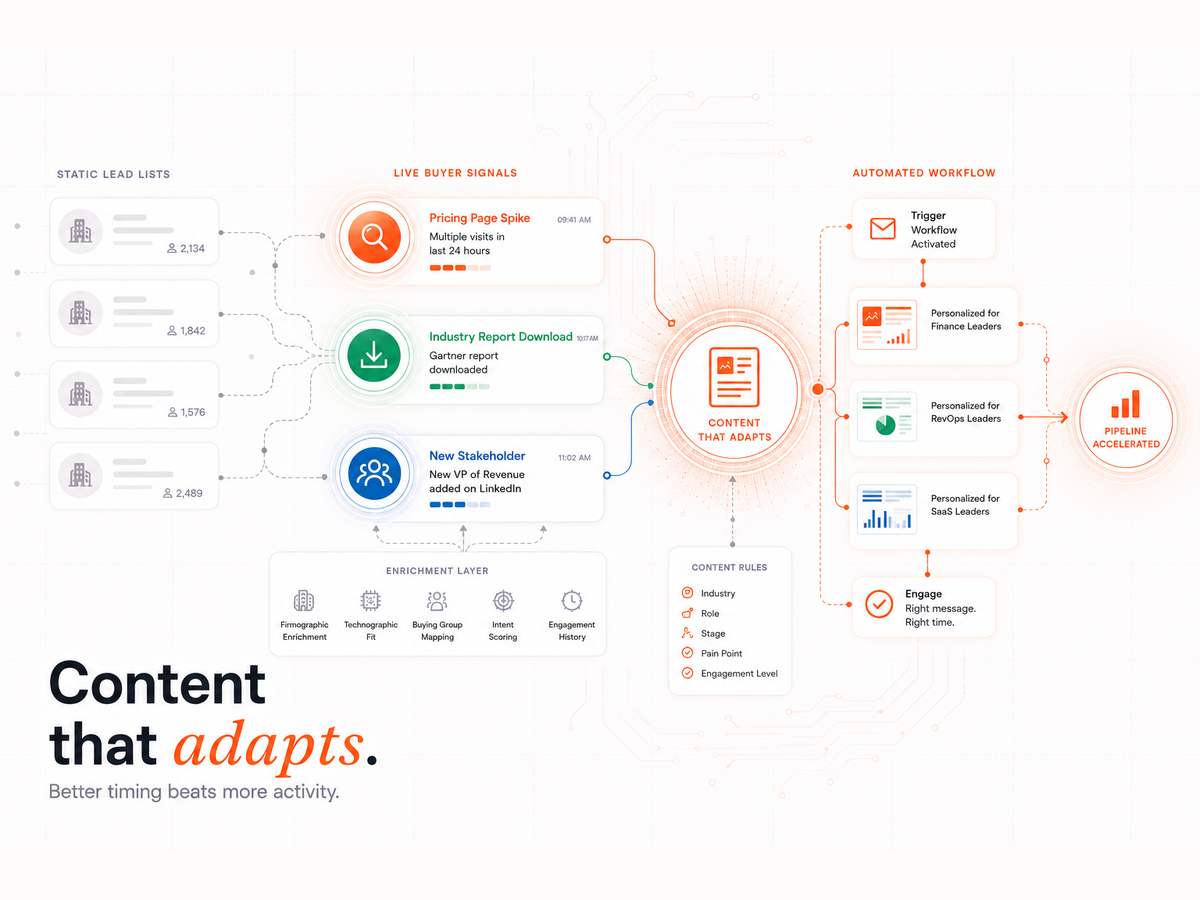
- Nurture follows intent, not personas: messages adapt to what buyers are doing (real-time behaviour and intent signals), not just who they are
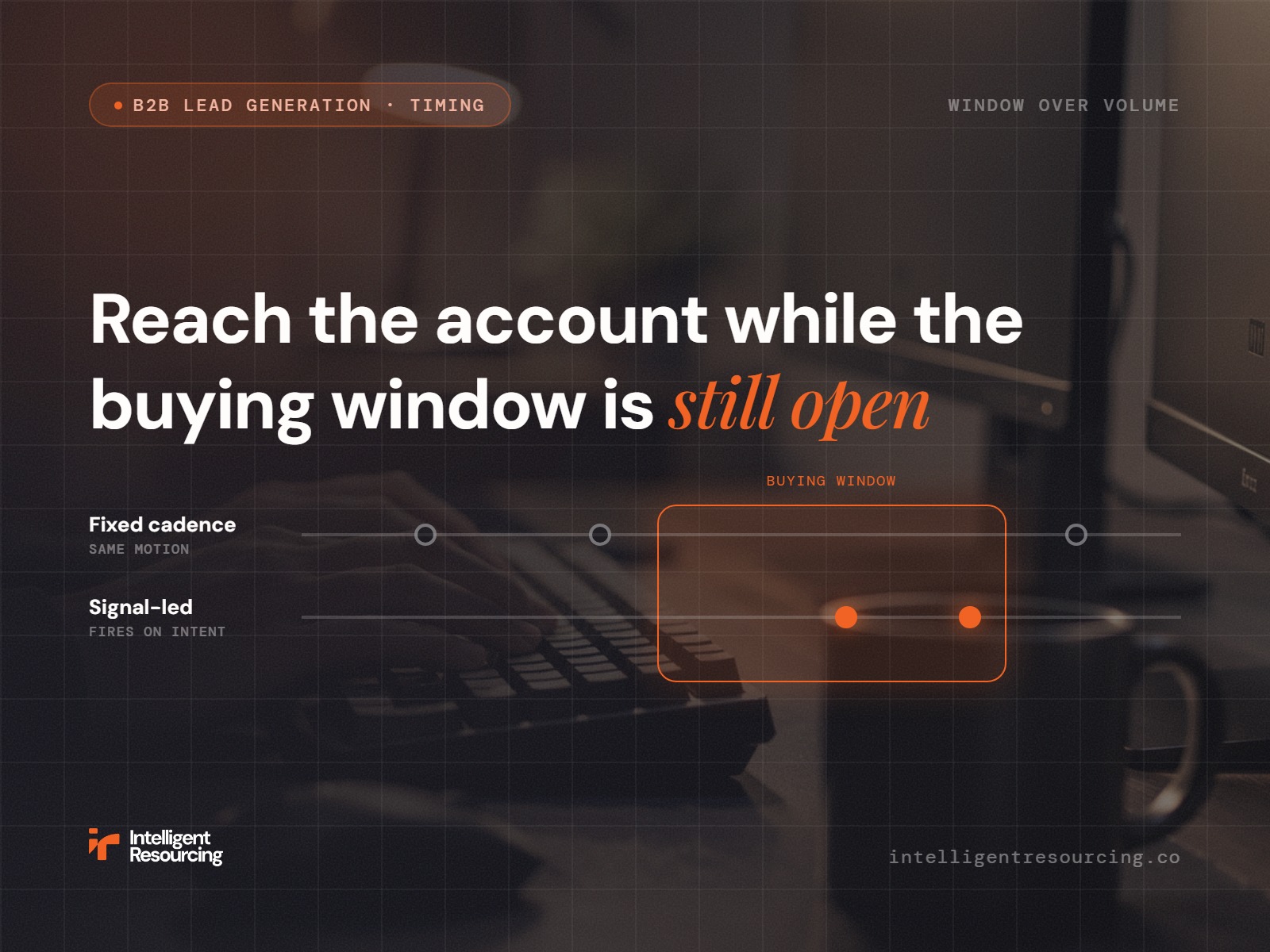
- Sales and outbound act on timing, not traffic: engagement happens when buyers are ready, not on a schedule
Inbound does not create demand. It detects interest, qualifies intent, and routes opportunities to the next step at the right time.
Why do specialists say lead volume is the wrong inbound metric?
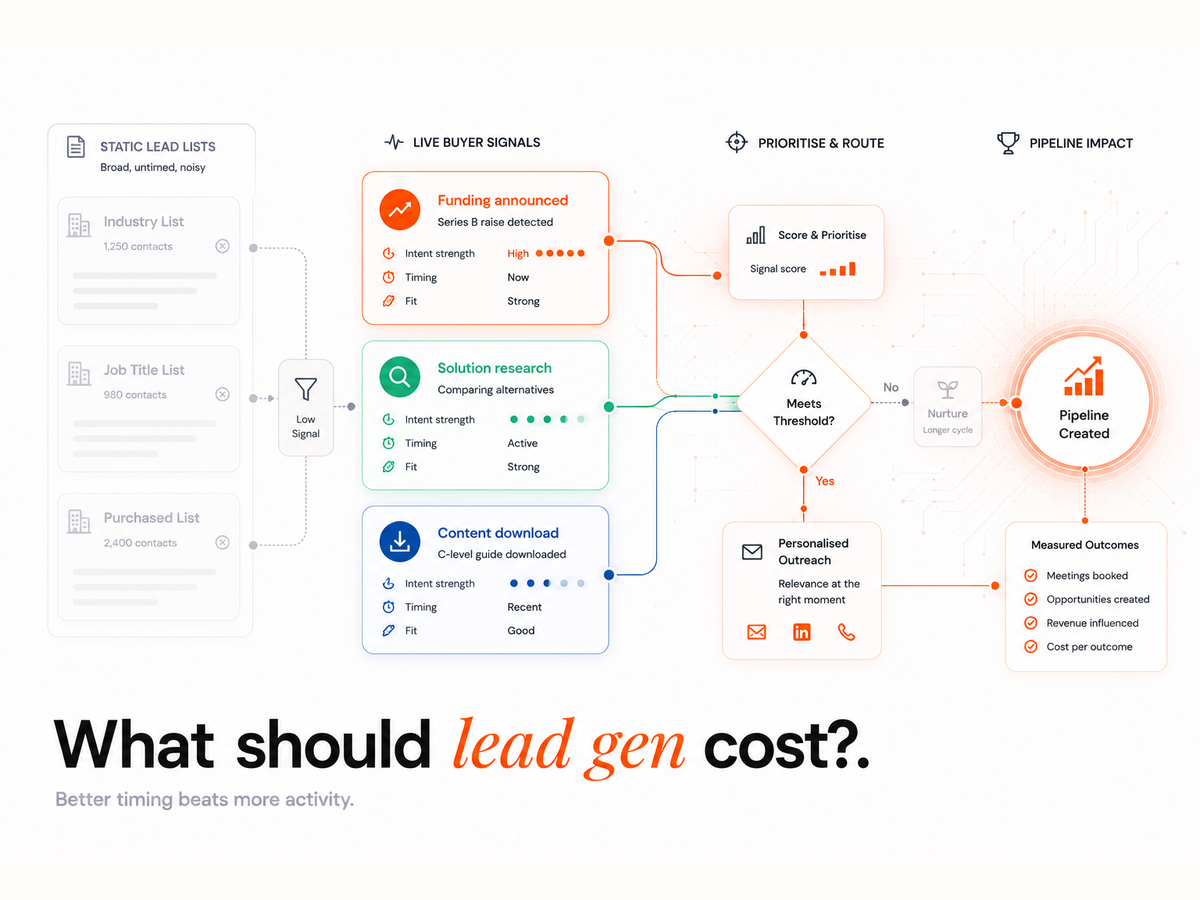
Raw lead counts measure the output of your programme. They do not measure whether you are influencing the right accounts at the right time. Specialists who study B2B buyer behaviour consistently return to the same conclusion: shortlist placement and win rate are the metrics that matter, not volume.
For inbound-focused programmes, raw lead counts are an inadequate measure of success. Performance should be evaluated based on the ability to identify the right accounts and influence their vendor shortlist, rather than on volume alone. As Kerry Cunningham, Head of Research and Thought Leadership at 6sense, observes:
"Measure success by shortlist placement and win rate, not raw lead counts."
What is inbound B2B lead generation in 2026?
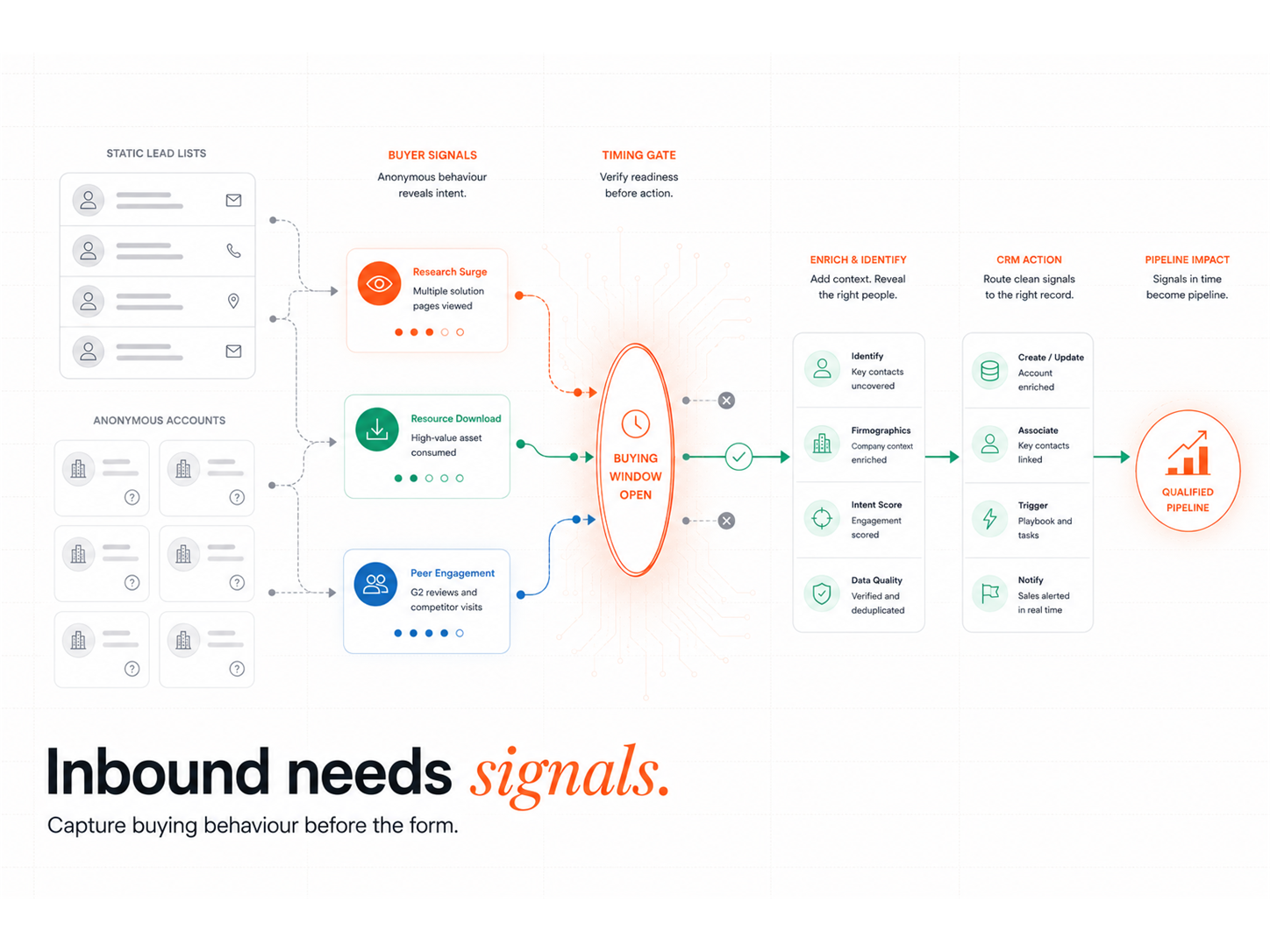
Inbound B2B lead generation is a system that captures demand and turns buyer behaviour into actionable insights. It answers two questions at every stage: what does buyer engagement reveal about where they are in their decision process, and what should happen next based on that evidence?
In this model:
- Leads are outputs, not inputs. They appear as a result of understanding behaviour, not just from filling out a form.
- Timing comes from signals. A single click is not enough; patterns across sessions reveal buying momentum.
- Inbound and outbound share the same evidence. All buyer actions, online or offline, inform what to do next.
Tracking only explicit conversions misses most of the buying process. Buyers take action before engaging with sales, so signals from multiple sessions matter more than single events.
Effective inbound requires infrastructure that tracks behaviour across multiple sessions, understands engagement at the account level (not just individual contacts), and triggers actions based on cumulative signals.
This is where GTM engineering helps: it turns scattered buyer activity into routing logic, shared context, and faster action.
How does content work as a signal engine rather than a lead factory?
In scalable inbound systems, content is designed to reveal intent, not force conversion. Every asset produces a signal: what the buyer read, how long they stayed, which page they went to next, and whether they returned. Demandbase's ABM research shows intent-triggered campaigns convert to pipeline at 22.33% vs 4.7% for untriggered sends, confirming that acting on signal patterns consistently outperforms scheduled outreach.
What behaviour actually tells you
| Signal tier | Example behaviours | What it means | Next action |
|---|---|---|---|
| Problem awareness | Definitions, trend pieces, "why it matters", risk framing | Early research, low urgency | Light nurture, category education |
| Solution exploration | "How it works", implementation, use-case pages | Evaluating approaches | Introduce frameworks, stakeholder content |
| Vendor comparison | Case studies, security, integrations, competitor pages | Shortlist forming | Accelerate nurture, remove friction |
| Commercial intent | Pricing, procurement, ROI, "talk to us" | Verified Buying Window forming | Trigger sales or targeted outbound |
One page view tells you little. Real buyer intent shows up in patterns over time. Signal-based workflows let teams track behaviour across sessions and turn it into clear, actionable insights.
How does inbound content work across organic SEO, AI discovery, and AI referral channels?
Most B2B buyers now research independently through organic search, AI tools, and digital channels before they ever contact sales. Modern inbound does not rely on a single traffic source. An inbound system that captures only one of these channels misses the majority of buyer research activity.
Organic SEO
Organic SEO performs best when content is built around specific, high-intent searches that closely match a buyer's problem, use case, or integration need. Effective inbound teams focus on narrow pages tied to real buyer problems: services, integrations, workflows, or industry pain points.
These pages help visitors understand whether the solution fits their needs by showing relevance, practical outcomes, and clear use cases. The role of organic SEO is to bring the right buyer to the right page at the moment they are actively searching for a solution.
AI Discovery
Many buyers now begin their research inside AI tools before visiting any website. AI discovery happens when someone asks platforms like ChatGPT about a category, problem, or solution while exploring options.
To appear in this stage, companies publish educational content that answers common buyer questions, explains processes, and outlines key trade-offs. This builds subject-matter authority and strengthens position within the category.
AI Referral
AI referral occurs when a buyer clicks a link from an AI-generated answer that cites a page from your website. Pages that provide clear, structured answers are easier for AI systems to interpret and reference, increasing the likelihood of citation. This is where answer engine optimisation supports inbound content built for AI-assisted research.
Why this matters
Strong inbound performance now comes from multiple channels working together:
- Organic SEO captures buyers actively searching
- AI discovery builds awareness earlier in the research process
- AI referral sends ready-to-buy visitors directly to your site
Together, these channels reveal buyer intent, show readiness, and help sales engage at the right time.
Which behavioural patterns indicate genuine buying readiness?
Not all buyer activity carries equal signal weight. One page view tells you almost nothing. Buying readiness shows up in four observable patterns: depth of engagement, frequency of return visits, progression from educational to commercial content, and spread across multiple stakeholders from the same account. When all four stack, outreach is warranted.
Focus on these four signal types as your baseline:
1. Depth: Long reads, multi-page sessions, technical pages visited.
2. Frequency: Returning sessions in a compressed period.
3. Progression: Moving from education to proof to commercial pages.
4. Stakeholder spread: Multiple people from the same account engaging.
The pattern is consistent: buyers frequently initiate engagement, but their decision criteria are largely set before formal contact, which is why influencing the vendor shortlist early matters so much. By monitoring these behavioural patterns, marketing and sales teams guide the buying journey proactively rather than reacting once the shortlist has closed.
When those patterns stack, Clay lead scoring workflows can trigger routing and alerts without waiting for a form fill.
Lead Generation
Inbound works when it runs as a system: content reveals behaviour, workflows score it, and sales engages on timing. Intelligent Resourcing builds that signal-led layer as a Revenue Operations Studio so inbound activity becomes qualified pipeline.
FAQs
What is inbound B2B lead generation in 2026?
A signal-led demand capture system that turns anonymous behaviour into qualified buying intent, then activates sales only when patterns prove a Verified Buying Window has opened.
Why doesn't inbound convert despite high traffic?
Because traffic measures attention, not readiness. Buyers do most of their journey before vendor contact, so forms and first-touch conversions arrive late and mis-time sales engagement.
Do forms still matter?
Yes, but as supporting signals, not proof of readiness. A form fill is one data point that should be interpreted in the context of progression, recency, and stakeholder spread.
What signals should trigger sales outreach?
Escalate when you see a compressed cluster of high-intent behaviours (proof + comparison + commercial) and either multi-stakeholder engagement or repeat commercial intent within 72 hours.
How does AI search change inbound strategy?
It increases the value of answer-led, verifiable pages that can be cited, because buyers are encountering AI summaries and clicking cited sources to validate claims before any vendor contact.