
Why Are B2B Sales Teams Rethinking Cold Email and LinkedIn Automation in 2026?
B2B sales teams are rethinking cold email and LinkedIn automation because declining response rates and AI-driven personalisation have changed what works. Ascend2's 2024 survey, cited by Marketing Dive, found that 57% of marketers at companies with 500 or more employees now use AI for email campaigns, making AI personalisation the baseline, not the differentiator.
The shift from manual prospecting to automated outreach is now near-universal in B2B. The strategic question is no longer whether to automate, but which channel justifies the investment given buyer profile, compliance obligations, and GTM motion.
Cold email tools have moved beyond simple drip campaigns. Platforms like Smartlead and Instantly now support inbox rotation, domain warmup, intent-based sequencing, and direct integrations with enrichment tools. LinkedIn automation has evolved alongside tighter platform enforcement, with tools like Expandi simulating human timing to stay within daily limits while still supporting conditional follow-up logic.
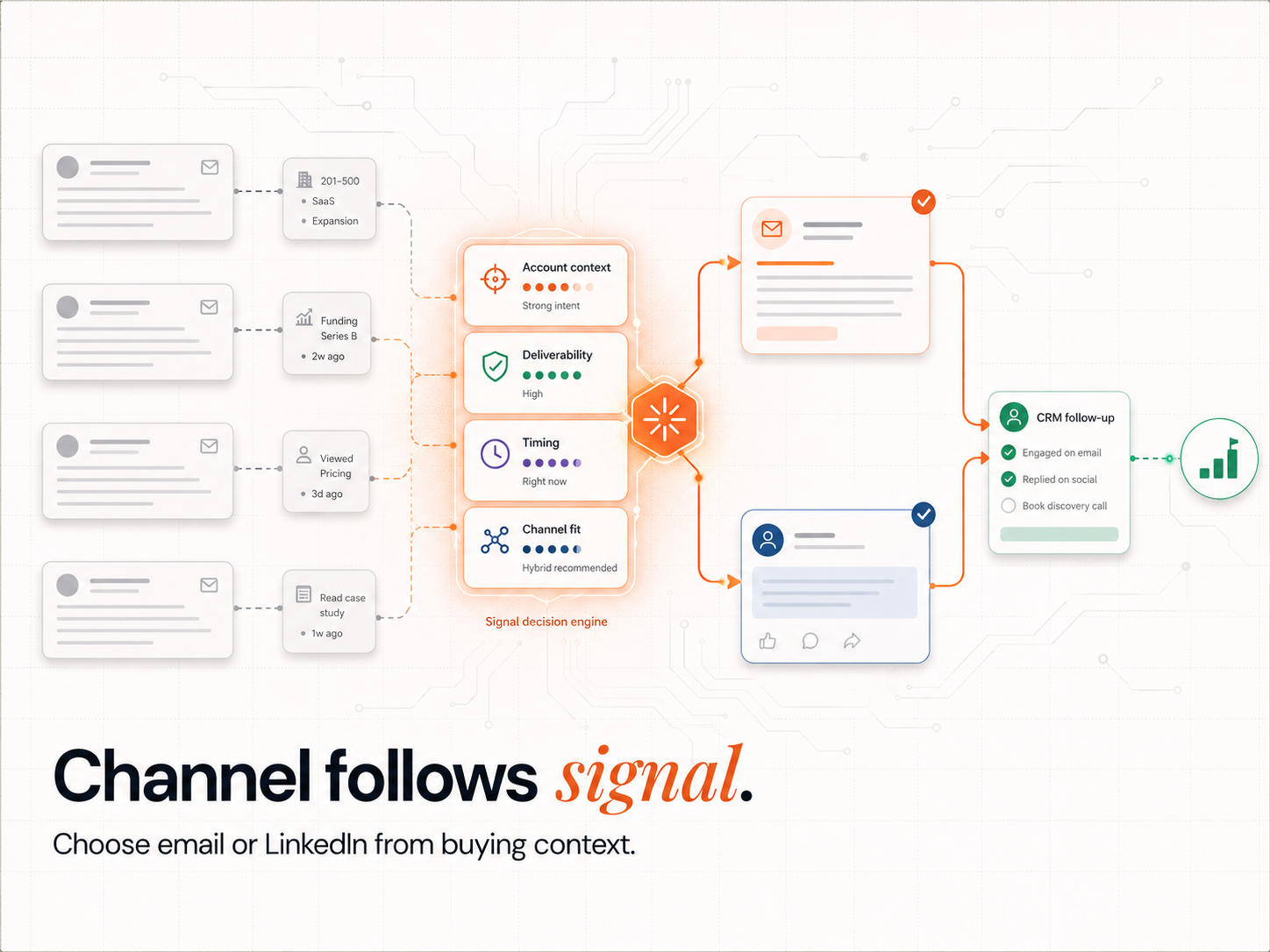
The distinction between the two channels is not deliverability versus visibility. It is volume versus trust. Cold email scales outbound volume efficiently. LinkedIn builds the social proof and peer visibility that high-trust buyers use to validate a decision. The right channel depends on where in that spectrum your buyers sit, and the right answer is frequently both.
What Are the Best Cold Email Automation Tools for B2B Teams in 2026?
Instantly, Smartlead, and Lemlist lead cold email automation for B2B teams in 2026. Instantly specialises in unlimited inbox rotation and AI-based deliverability scoring. Smartlead offers built-in domain warmup, multi-channel sequencing, and direct Clay integration for signal-triggered campaigns. Lemlist focuses on dynamic visuals and human-like messaging with strong CRM connections for SDR-led outbound motions.
How Do Inbox Rotation and Domain Warmup Improve Deliverability?
Deliverability is the primary variable in cold email performance. Platforms like Smartlead and Instantly provide domain warmup, inbox ramping, and automated spam-checking to maintain inbox placement rates at scale. Campaign Monitor found that personalised subject lines are 26% more likely to be opened, making personalisation a direct deliverability lever, not just a response rate optimisation.
Inbox rotation distributes outbound volume across 10–15 mailboxes, preserving domain reputation while scaling send volume. This is now standard practice for SDR-led campaigns targeting more than 200 contacts per week. Without it, a single domain sending at scale triggers spam filters within days.
What Do Cold Email Benchmarks Show for 2026?
Martal's B2B Cold Email Statistics 2026 found the industry average reply rate sits at 5.1%, with open rates at 27.7%. Targeted campaigns under 50 recipients achieve a 5.8% reply rate, confirming that list quality and ICP precision matter more than send volume. Well-targeted campaigns with strong personalisation reach 10–15% reply rates. For teams integrating cold email with Clay-enriched data, Intelligent Resourcing's Clay and Smartlead integration guide covers the full workflow for routing enrichment signals directly into Smartlead sequences.
What Are the Best LinkedIn Automation Tools for B2B Teams in 2026?
Expandi, Waalaxy, and Zopto lead LinkedIn automation for B2B teams in 2026. Expandi specialises in safe scraping and dynamic message sequences with cloud-based sending. Waalaxy combines email and LinkedIn steps, suited to solo reps or smaller teams. Zopto provides analytics, campaign tracking, and custom workflow builders for teams that require reporting alongside outreach.
What Are the Safe Operating Limits on LinkedIn in April 2026?
LinkedIn's enforcement of its automation policy has tightened. Tools must operate within daily thresholds and avoid browser extensions, which LinkedIn's machine learning detects through timing consistency, device fingerprint analysis, and behaviour patterns. As of April 2026, safe operating thresholds sit at approximately 20–30 connection requests per day and under 20 messages per day for new outreach on free accounts, based on observed platform behaviour from December 2025. Sales Navigator users operate within higher but still enforced limits.
Violations result in temporary blocks, permanent bans, or reduced content visibility without formal notice. Any tool using a browser extension rather than cloud-based IP rotation carries higher detection risk.
Why LinkedIn still earns its place in B2B outbound
LinkedIn's own marketing data shows the platform generates 80% of B2B social media leads, a figure that reflects the platform's professional network density rather than advertising performance alone. For outbound prospecting targeting VPs, founders, or senior buyers where relationship signals carry weight, LinkedIn's social proof layer, including profile views, content reactions, and mutual connections, produces trust that cold email cannot replicate at first touch.
How Does AI Personalisation Perform Across Cold Email and LinkedIn in 2026?
AI personalisation raises reply rates on both channels, but the mechanism differs. Cold email tools embed AI-generated first lines and dynamic variable fields from enrichment data. LinkedIn tools pull context from profile headlines, recent posts, and mutual connections. Built For B2B's 2025 B2B Cold Email Benchmarks found that intent-anchored campaigns achieve 3–5x higher reply rates than template-based outreach.
How Does Cold Email Personalisation Work?
Cold email platforms like Smartlead and Instantly integrate with GPT-based engines to generate custom first lines, adjust tone, and reference recent prospect activity. Variable fields draw from enrichment platforms: company size, tech stack, funding round, or recent hire. This makes cold email better suited to programmatic personalisation at scale, where hundreds of contacts receive contextually relevant opening lines without manual input. Intelligent Resourcing's guide to personalised outreach with Clay covers the full workflow from signal capture to personalised copy delivery.
How Does LinkedIn Personalisation Work?
LinkedIn tools like Expandi pull from profile headlines, recent posts, and mutual group memberships. This produces more social context and less structured data: the personalisation is warmer but harder to automate at volume. The result is better suited to consultative selling where the opening line references something the prospect publicly said or shared.
What Limits AI Personalisation Effectiveness on Both Channels?
AI personalisation is only as good as the data feeding it. For signal-based selling, signal quality determines copy quality. Enrichment tools that pull live signals, including job changes, funding announcements, and tech stack installs, give AI enough specific context to produce a first line a prospect recognises as relevant. Generic CRM data produces generic copy, regardless of the AI model generating it.
How Should B2B Teams Integrate Cold Email and LinkedIn Tools Into Their GTM Stack?
Cold email and LinkedIn tools connect to CRMs through native integrations or webhook triggers. Smartlead and Instantly both support HubSpot and Salesforce syncs, logging replies, opens, and contact stage updates automatically. Clay acts as the enrichment and orchestration layer, routing live signals into the correct sequence across both channels without manual data movement.
How Clay and n8n do the integration layer
For B2B teams running signal-driven outbound, Clay integrates with n8n to create a full orchestration pipeline: Clay enriches the contact record from live signals, n8n routes the enriched record to the correct tool (Smartlead for cold email, Expandi for LinkedIn), and HubSpot records every touchpoint automatically. No manual transfer. No data loss between platforms.
How Does Intelligent Resourcing Build Signal-Driven Cold Email Stacks?
When Intelligent Resourcing builds cold email stacks for clients, the first configuration decision is always enrichment-to-sequence routing. In a typical Clay and Smartlead implementation, a contact triggering a job change signal moves from raw signal to enriched record to personalised email sequence within four hours. Without that routing architecture, the same contact sits in a static list for weeks before a rep manually actions it. The GTM engineering approach replaces list management with signal management.
How Match Outreach Tools to Sales Structure?
Cold email campaigns require technical setup: domain configuration, warmup schedules, sequence logic, and enrichment integration. LinkedIn automation requires profile management, content oversight, and daily limit monitoring. For teams where SDRs own email and founders or senior sellers own LinkedIn, the resourcing split maps naturally to the tool split. For lean teams where one person manages both, a unified orchestration layer through Clay and n8n reduces overhead significantly.
When Does a Hybrid Cold Email and LinkedIn Sequence Outperform Either Channel Alone?
A hybrid sequence outperforms single-channel outbound when the buyer profile spans both email and social behaviour. Belkins' 2025 analysis of 16.5 million cold emails found that a single well-crafted email achieves the highest reply rate at 8.4%, and sequences of five or more emails cut reply rates by more than half. A LinkedIn touchpoint after no reply extends reach without stacking more email sends.
Why adding LinkedIn after email works
Stacking more cold emails after no reply degrades domain reputation and accelerates unsubscribe rates. A LinkedIn connection request or profile view after a cold email creates a second impression in a different channel without the compliance risk of sending another email. If the prospect has already seen the email and ignored it, a LinkedIn touchpoint introduces a social proof signal: the sender exists, has a profile, and is connected to the prospect's professional world.
When to trigger the LinkedIn touchpoint
Timing the LinkedIn step to a Verified Buying Window signal produces the strongest results. When a prospect triggers a job change, a funding announcement, or a technology stack install, that signal defines the window when outreach is most likely to receive a response. Signal-based lead generation covers how to identify and route these signals. A cold email sent within 48 hours of a job change signal, followed by a LinkedIn connection request 72 hours later if no reply, produces a contextually timed sequence rather than a volume play. Built For B2B's 2025 benchmarks confirm that signal-anchored outreach achieves 3–5x higher reply rates than template-based outreach regardless of channel.
Key selection factors
- Compliance: Cold email must follow the Australian Spam Act 2003; LinkedIn automation violates platform terms when detected as non-native
- Scale: Cold email supports volume; LinkedIn caps throughput at the platform level
- Intent: LinkedIn is stronger for context-rich engagement; cold email is better for triggered outbound at scale
- Resourcing: Cold email needs technical setup and domain management; LinkedIn needs profile alignment and content oversight
For a full audit of your current outreach stack against these criteria, the Intelligent Resourcing lead generation services team assesses channel fit, signal coverage, and workflow architecture as part of its GTM engineering programme.
Comparisons
Cold email scales reach, LinkedIn builds trust, but pipeline comes from firing the right channel at the right moment. The Revenue Operations Studio at Intelligent Resourcing builds signal-led hybrid sequences wired to the Verified Buying Window.
FAQs
What is the average cold email response rate in B2B?
The industry average cold email reply rate is 5.1%, with open rates at 27.7%, based on Martal's B2B Cold Email Statistics 2026. Targeted campaigns sent to under 50 recipients average 5.8%. Well-constructed campaigns anchored to intent signals, including job changes, funding rounds, or tech stack triggers, consistently achieve 10–15% reply rates.
What are the compliance risks of LinkedIn automation in 2026?
LinkedIn's terms of service prohibit non-native automation. As of April 2026, detected automation results in temporary blocks, permanent account bans, or reduced content visibility without formal notice. Safe daily thresholds are approximately 20–30 connection requests and under 20 messages for new outreach on free accounts. Browser extension-based tools carry higher detection risk than cloud-based platforms.
Which cold email tools are best for B2B teams in 2026?
Instantly, Smartlead, and Lemlist lead the category. Instantly is strongest for deliverability and inbox rotation at high volume. Smartlead is the best choice for teams integrating with Clay, as the native connection routes enrichment data directly into sequence logic. Lemlist suits teams prioritising human-like dynamic visuals and CRM-connected outbound. Tool selection should follow tech stack compatibility, not feature comparison alone.
Does AI personalisation improve cold email reply rates?
Yes, when the AI has quality signal data to draw from. Campaign Monitor found that personalised subject lines are 26% more likely to be opened. Built For B2B's 2025 benchmarks found that intent-anchored campaigns, where personalisation is built on live signals rather than static CRM fields, achieve 3–5x higher reply rates than template-based outreach. Generic AI copy built on poor data does not outperform templates.
When should a B2B team use LinkedIn automation instead of cold email?
LinkedIn automation is the stronger choice for high-trust, relationship-driven sales targeting C-suite buyers, founders, or senior decision-makers where social proof and peer visibility influence decisions. It is also better for smaller deal volumes at high ticket values and for brands building long-term authority through content and commentary. For volume-based SDR outbound or signal-triggered ICP targeting, cold email delivers better throughput and faster iteration.
How do cold email and LinkedIn automation integrate with HubSpot or Salesforce?
Most cold email platforms, including Smartlead and Instantly, support native HubSpot and Salesforce integrations, syncing replies, opens, and contact stage updates automatically. LinkedIn tools like Expandi and Waalaxy support webhook-based triggers for CRM updates. For teams running Clay as an enrichment layer, the full integration connects Clay to Smartlead for sequence routing and HubSpot for CRM recording, with n8n handling orchestration between tools.