
Why do AI lead generation services in Australia often disappoint?
AI lead generation services in Australia disappoint when they sell list volume and outbound activity instead of signal-led workflows. Static lists produce irrelevant outreach, which drives low reply rates, complaint risk, wasted SDR time, and Spam Act exposure. The fix is not more activity. It is better timing, intent, and scoring.
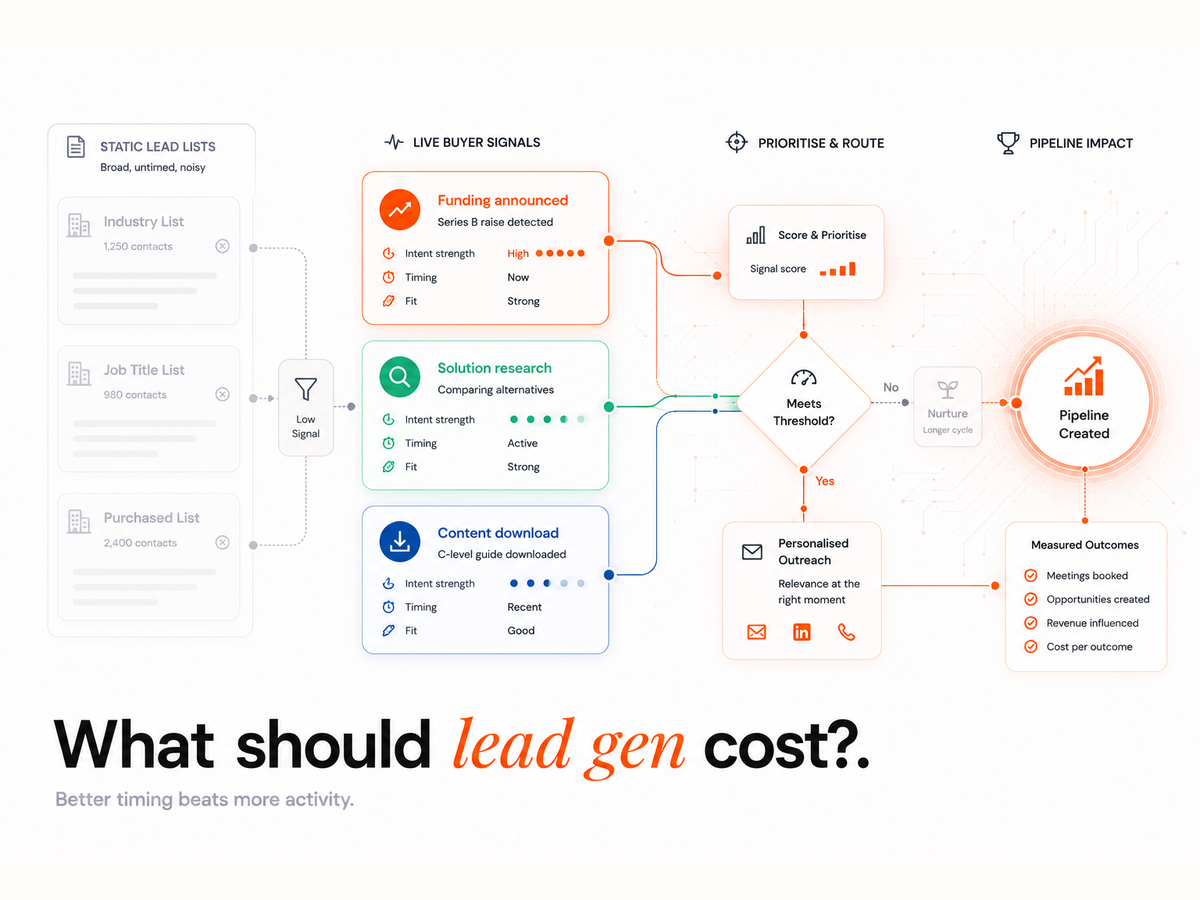
The disappointing version of "AI lead gen" sells lists, outbound volume, and activity reporting. The list is static the moment it is built, which means the outreach is irrelevant by the time it lands, which produces low replies, complaint risk, wasted SDR time, and Australian regulatory exposure when consent or unsubscribe is mishandled.
ACMA is clear that even when a third-party sender runs the campaign, the business named in the outreach remains responsible for compliance. Vendor oversight cannot be outsourced. That is why "AI lead gen service" buyers need to interrogate the system behind the meetings, not just the meeting count.
A Revenue Operations Studio model fixes the gap because it routes outreach against verified buying signals, not against a list that was correct three months ago.
What should AI lead generation actually mean in 2026?
AI lead generation in 2026 should mean signal-led outreach to accounts showing fit, intent, and timing, with enrichment, scoring, AI-drafted messaging, and human-led conversion working as one system. Replace the question "who can we email?" with "who is most likely to care now?" The shift changes both targeting and tooling.
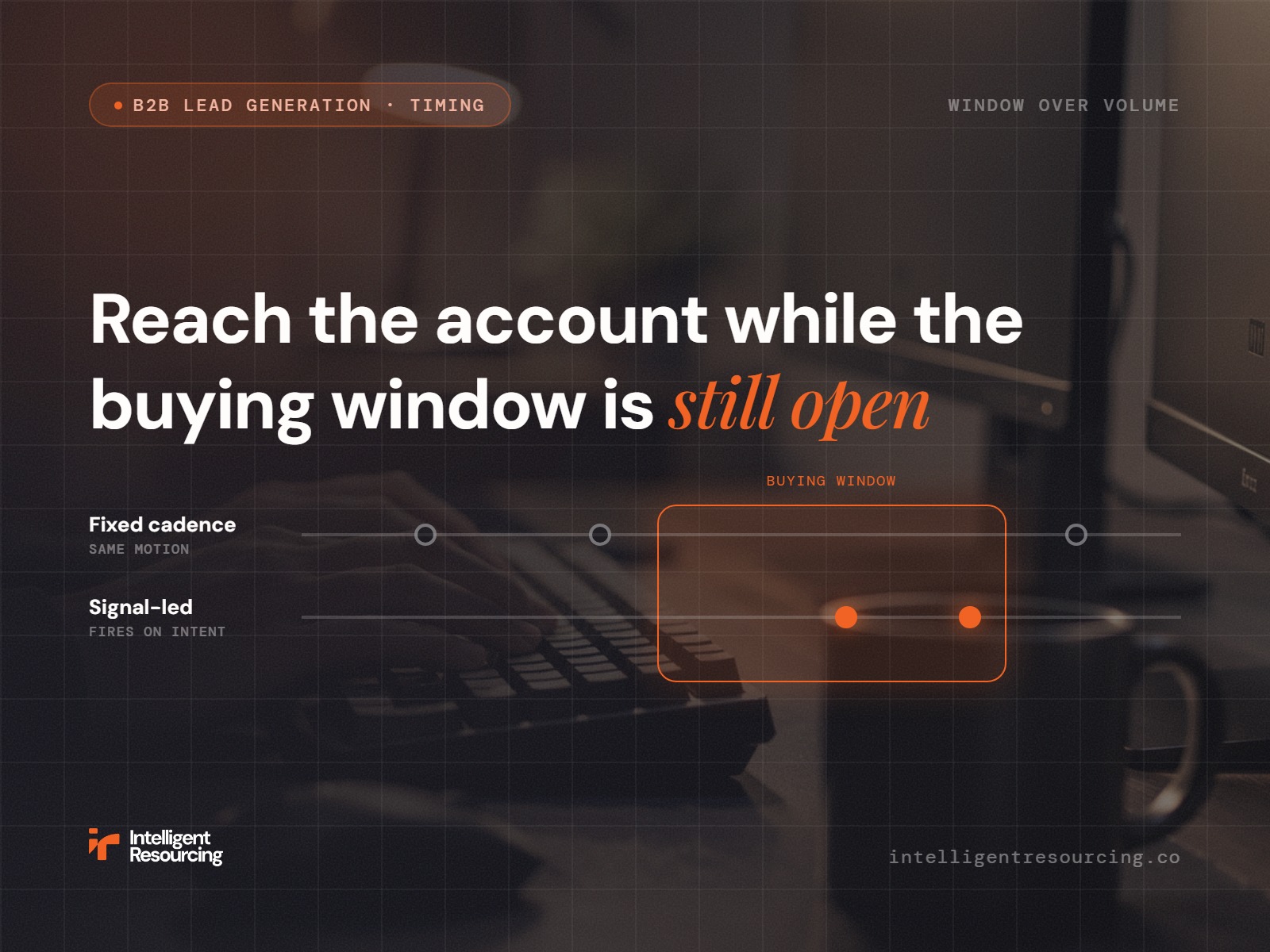
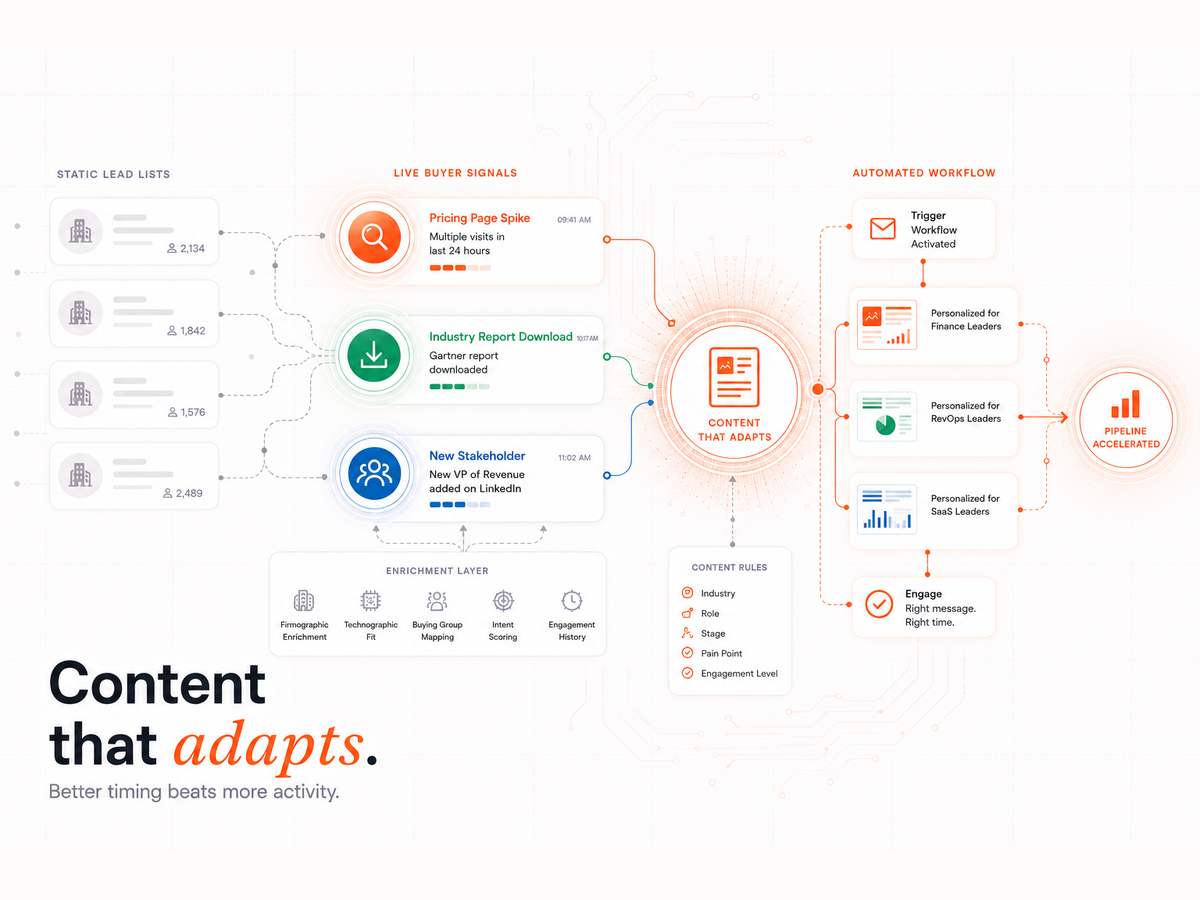
Signal-Led Growth flips the prospecting question. Instead of starting with a list, the system starts with buying signals (funding events, leadership changes, tech-stack installs, pricing-page visits at target accounts) and then enriches, scores, and personalises the outreach when a Verified Buying Window opens.
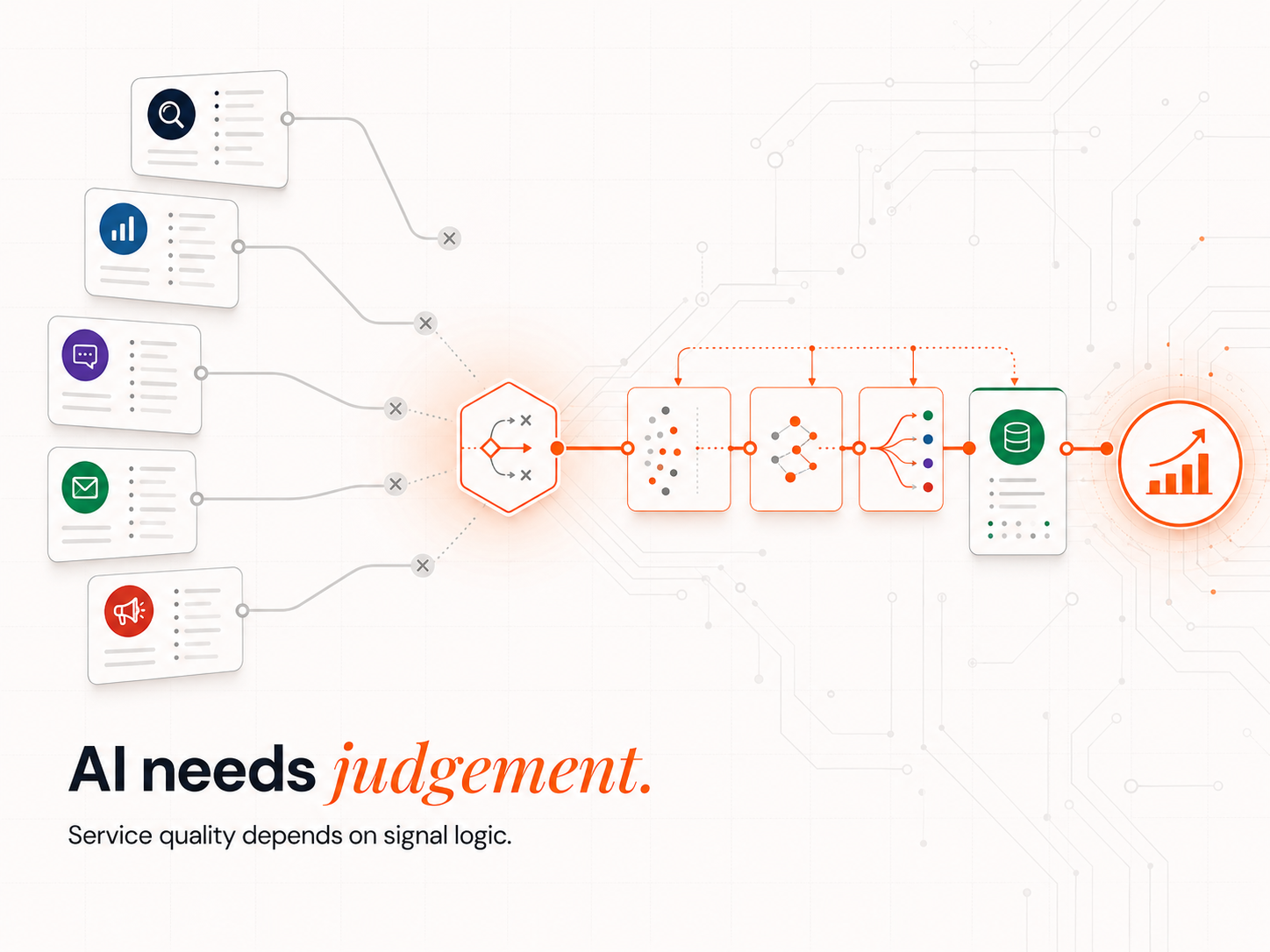
The Intelligent Resourcing Signal-Led Growth stack has six layers:
- Signals (fit plus intent plus timing detected continuously)
- Scoring plus prioritisation (who gets contacted first)
- Enrichment plus verification (clean data before sending)
- Personalised messaging tied to the signal (the "why now" angle)
- Routing plus follow-up via Signal Response Protocols (human-led conversion at the right moment)
- Evergreen CRM (hygiene so the system compounds rather than decays)
AI Source Inclusion and GEO sit on top of this stack on the discovery side, ensuring the brand is cited in ChatGPT, Gemini, and Perplexity when buyers are evaluating vendors before they ever fill in a form.
What does a real AI lead generation service in Australia include?
A real AI lead generation service in Australia includes four operational components: targeting and ICP calibration, data enrichment and verification, AI-assisted research and messaging, and routing with CRM hygiene. Each layer is observable, measurable, and connected to the next. If the provider cannot show the architecture, they sell activity instead.
A legitimate service shows you architecture, not just a copy deck. AI lead generation for Australian businesses requires four operational components to compound over time.
Targeting and ICP calibration
- ICP slices (industry, size, tech stack, geography)
- Exclusion rules (who not to contact)
- Weekly feedback loop from replies and objections into targeting
Data enrichment and verification
- Company plus contact enrichment via Clay waterfalls
- Email verification gates before any send
- De-dupe and suppression lists (including opt-outs)
AI-assisted research and messaging
- First-draft emails and LinkedIn message variants
- Personalisation tied to a specific trigger ("why now?")
- Messaging libraries by segment and role
Routing and CRM hygiene via Signal Response Protocols
- Lead scoring updates the moment new behaviour fires
- Auto-enrichment into CRM fields
- Sales alerts and next-step tasks routed automatically
For more on the workflow layer, see how Clay-HubSpot integration in practice connects enrichment, scoring, and routing inside HubSpot, and automating your sales pipeline workflow maps the broader pipeline stack.
How should AI prospecting and human SDRs work together?
AI prospecting and human SDRs work together when AI handles the volume tasks (research, enrichment, drafting, scoring) and humans handle the conversion moments (discovery, objections, qualification judgement). Treat AI as capacity creation, not people replacement, because the leverage compounds when each side does what it does best.
AI prospecting is best understood as capacity creation, because the leverage compounds when AI handles research and humans handle qualification.
What AI does well (high leverage)
- Drafting at scale. Noy and Zhang's 2023 Science study found writing task time decreased by 40% and quality rose by 18% when participants used ChatGPT for mid-level professional writing.
- Productivity for less experienced workers. Brynjolfsson, Li, and Raymond's 2023 NBER paper found generative AI increased productivity by 14% on average across customer support agents, with the largest gains concentrated among newer workers.
- Standardising operations: repeatable enrichment, scoring, routing, and follow-ups across thousands of contacts without quality drift.
What humans still do better (conversion moments)
- Discovery: understanding nuance, constraints, and buying committees
- Objections: handling "why you, why now?" in real dialogue
- Qualification judgement: knowing when to disqualify fast
The practical model
Use AI to produce a Verified Buying Window shortlist (signal plus scoring), then SDRs and AEs run discovery, qualification, and conversion. The Signal Response Protocol fires the meeting request only when the signal layer confirms an active buying window, not on a calendar.
Why does Clay plus GPT beat traditional scraping?
Clay plus GPT beats traditional scraping because enrichment waterfalls, verification gates, and signal-tied messaging produce cleaner data and better timing than raw scraping plus generic personalisation tokens. Scraping at scale produces stale records and noise. Clay-style workflows produce a clean shortlist routed against a Verified Buying Window.
Why scraping breaks
Raw scraping at scale produces:
- stale contact details that bounce
- role-based inboxes and catch-alls that never reach a human
- duplicated records that fragment reporting
- unverifiable "personalisation" that is actually template noise
For deeper context on the wider stack alternatives, see top outbound agencies in 2026 and how their service models compare.
Why Clay plus GPT workflows scale better
Clay positions itself as a credit-based platform that combines access to over 100 data providers, web scraping, and AI message drafting in one place. The workflow runs in five steps:
- Start with a clean account list (target accounts, not "everyone")
- Run enrichment waterfalls (multiple providers, stop when confident)
- Verify and score (only proceed when data is "safe enough" to send)
- Draft messaging with AI tied to signal categories (not generic prompts)
- Route to CRM with fields that support follow-up (pain hypothesis, trigger, next step)
This is how signal-led prospecting produces a shortlist rather than a list. The shortlist is what SDRs work; the list is what scraping produces.
What ROI should you expect from AI-first lead generation workflows?
ROI from AI-first lead generation workflows comes from three levers: time saved on research and admin, conversion lift from better targeting and timing, and reduced waste from cleaner data and routing. Expect time and data quality gains in the first 30 days, conversion gains by day 90, and compounding playbooks beyond.
The three ROI levers
- Time saved: less manual prospect research and admin, more selling time
- Conversion lift: better timing and fit means fewer "wrong person, wrong time" replies
- Reduced waste: fewer duplicates, fewer bounces, cleaner routing and follow-up paths
A simple ROI model (use this in procurement)
ROI = (Hours saved × fully-loaded hourly cost) + (Incremental opps × win rate × ACV) minus (tool credits + service fees)
Run a 30 to 60 day pilot on one segment, then scale.
What "good" looks like in 30, 60, 90 days
- Day 30: baseline metrics, clean data gates, signal scoring live, first sequences sending
- Day 60: ICP calibration from replies, stronger segmentation, better routing and follow-up
- Day 90: stable reporting (positive replies, meetings, opp conversion), compounding playbooks
If the provider cannot show you what changes between day 30 and day 90, they sell activity, not a system. Read more about the GTM Engineering Plans that build this layer.
How should you choose an AI lead generation provider in Australia?
Choose an AI lead generation provider in Australia by demanding a workflow diagram, quality gates, ICP calibration process, and reporting that ties to the pipeline rather than send volume. A good provider can show you a working system, not just a promise. Ask to see the architecture before signing a retainer.
A real provider answers five questions on the first call:
- Workflow diagram plus stack list: where signals enter, where scoring happens, where data is verified, where the handoff to sales lives
- Quality gates: what stops bad records from reaching your sender or CRM
- ICP calibration process: weekly review cadence and how learnings change targeting next week
- Reporting that matters: positive reply rate, meetings booked, meeting to opportunity conversion, CRM hygiene metrics
If you want a signal-led workflow built for Australia (tools plus tactics plus compliance guardrails), start with a blueprint and cost it properly.
Lead Generation
In 2026, the B2B teams that win in Australia stop renting meetings and start owning the signal layer. At Intelligent Resourcing, we install Revenue Operations Studio systems that connect Clay enrichment, HubSpot routing, SmartLead outbound, and n8n orchestration into one Signal Response Protocol stack, with AI Source Inclusion and GEO running on top so buyers find you in AI search before they ever fill in a form.
FAQs
Are AI lead generation services legal in Australia?
Yes, provided the outreach complies with the Spam Act (consent, sender identification, unsubscribe) and APP 7 opt-out rules for direct marketing. The named business is responsible for compliance even when a third-party service runs the campaign, so vendor oversight is not optional.
Do you need consent for B2B cold email in Australia?
Australian commercial electronic message rules require consent before sending marketing emails and a functional unsubscribe facility in every message. Consent can be expressed or inferred depending on the relationship. Always consult a lawyer for your specific situation, especially when sending across multiple Australian states or industries.
What is better: AI prospecting or human SDRs?
Both, used together. AI handles research, enrichment, scoring, and first-draft messaging at scale. Humans handle discovery, objections, and qualification judgement at the conversion moment. Recent productivity research shows generative AI lifts output most for less experienced workers, which makes the AI-plus-SDR pairing the strongest model.
Is Clay worth it compared to scraping?
For B2B teams that care about deliverability and CRM hygiene, yes. Clay combines enrichment, verification, scoring, and AI drafting in one workflow, which produces a clean shortlist rather than the noisy list that scraping at scale produces. The cost of clean data is lower than the cost of bounced sends and damaged sender reputation.
What ROI should I expect in 90 days?
Expect time saved and data quality gains in the first 30 days, ICP calibration and segmentation gains by day 60, and stable conversion reporting (positive replies, meetings, opportunity conversion) by day 90. Track meetings to opportunity conversion, not send volume.