
What an Automated Sales Funnel Looks Like in 2026
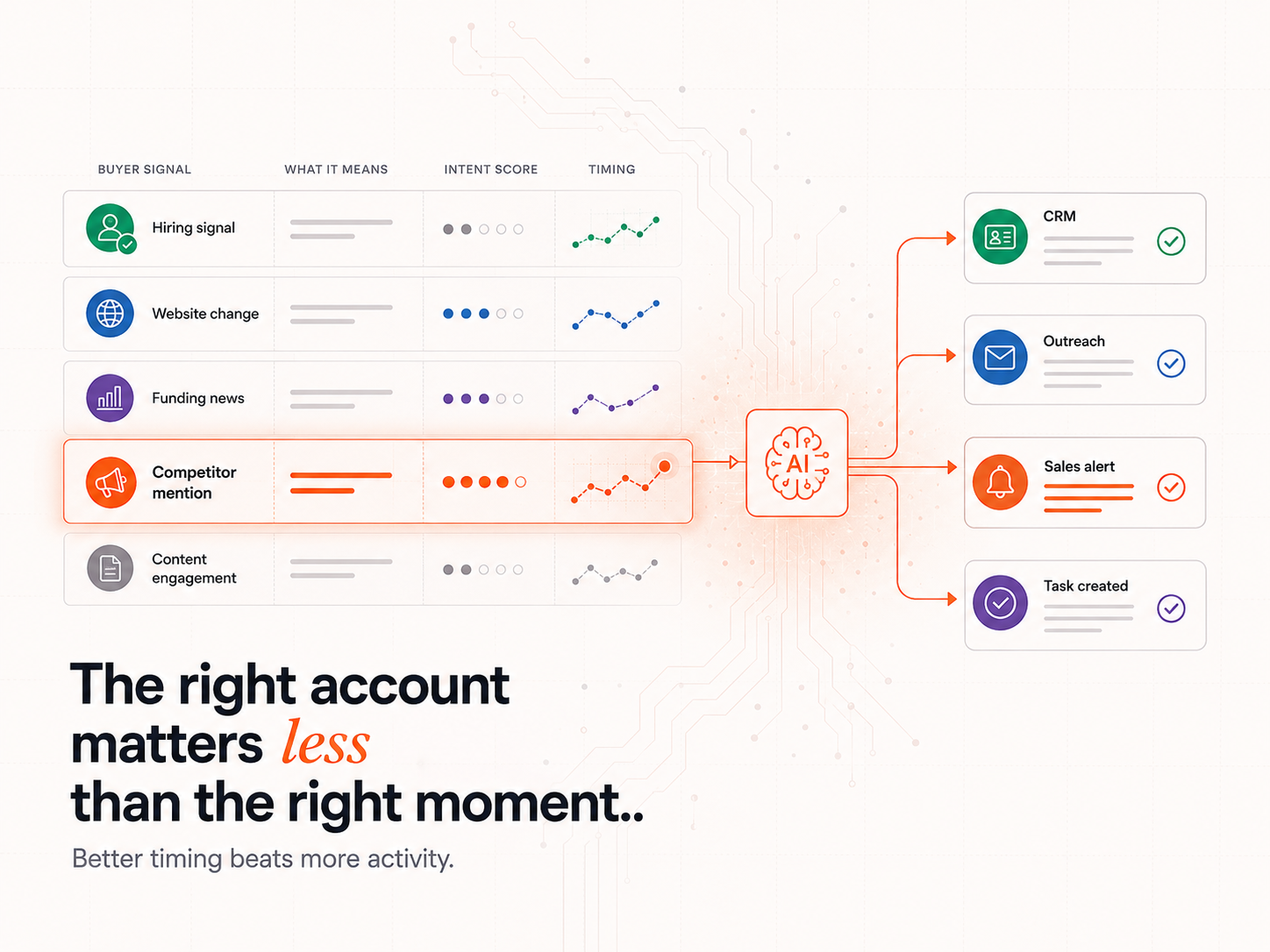
A 2026 automated sales funnel is not a drip sequence. It is a signal-detection system that tracks buyer behaviour across channels, scores intent in real time and routes contacts to the right action without manual intervention. The trigger is behaviour, not time and the handoff is conditional, not scheduled.
Why static funnels no longer match buyer behaviour
Static funnels treat every contact the same regardless of where they are in an actual buying process. A prospect who visited your pricing page three times in a week and changed job title last month occupies a fundamentally different position from someone who opened one cold email. A static sequence cannot distinguish between them. An AI-governed funnel can, and the difference shows up in conversion rates.
Salesforce’s eighth State of Marketing report found that 86% of high-performing marketers engage customers in real time, compared with 46% of underperformers. That is the real automation gap: high performers react to live signals, while weaker teams keep pushing the same scheduled message to buyers with completely different levels of intent.
Role of AI in modern funnel design
AI plays 3 distinct roles in a modern funnel. First, it scores leads by processing multiple signals simultaneously rather than relying on a single behavioural trigger. Second, it enriches records at the point of entry, so CRM data is current when a contact moves stages. Third, it determines routing: which contacts go to an SDR immediately, which enter a nurture sequence and which are suppressed because they do not yet meet minimum qualification thresholds.
The result is a funnel that responds to real buying behaviour rather than executing on a schedule someone built 6 months ago.
Funnel Stages and Automation Logic
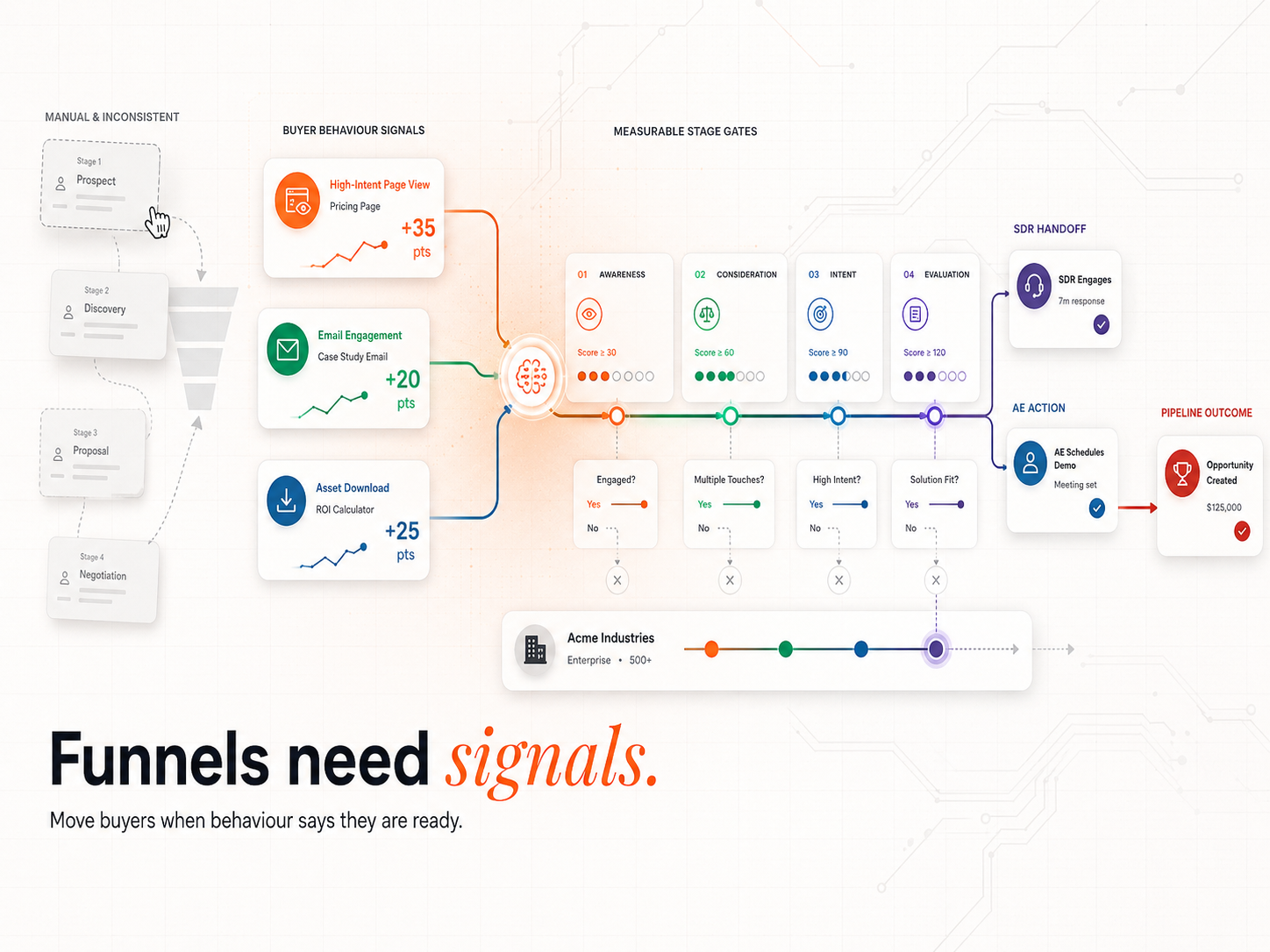
Each funnel stage requires different automation logic. Awareness triggers fire on content engagement or intent data. Consideration logic runs enrichment and scoring. Evaluation triggers SDR outreach only when specific conversion signals are confirmed. Collapsing these 3 stages into a single sequence is the most common funnel design error.
Stage 1: Awareness (top of funnel)
At the awareness stage, automation captures signals and begins qualification without human involvement. Triggers include:
- Organic traffic from target account domains
- Content downloads or high-intent page visits
- LinkedIn profile activity from ICP-matched contacts
- Third-party intent data indicating active category research
The goal at this stage is not to sell. It is to identify which contacts are worth enriching and scoring. Automation enriches the record, appends firmographic data and assigns an initial score. Contacts that do not reach a minimum threshold are suppressed or placed in a low-priority sequence rather than forwarded to an SDR.
Stage 2: Consideration (mid-funnel)
At the consideration stage, automation personalises outreach based on what the contact has already engaged with. Content delivery adjusts to the buyer's apparent area of interest. Scoring updates based on continued engagement.
Mid-funnel sequences built generically, without adjusting to accumulated behavioural signals, produce the highest drop-off rates in the funnel. A contact who has read 4 articles on CRM integration should receive different content from one who visited the pricing page twice without reading any product content.
HubSpot research cites figures showing marketing automation configured to respond to signal patterns can increase qualified leads by 451% compared to static nurture sequences. The mechanism is simple: contacts only advance when their behaviour justifies it.
Stage 3: Evaluation (bottom of funnel)
At the evaluation stage, automation triggers SDR engagement when a specific combination of conditions is met: verified contact data, confirmed ICP fit, intent signal above threshold and no active deal in the CRM. Only contacts that meet all conditions enter the SDR queue.
MarketingSherpa research shows the handoff problem clearly: 61% of B2B marketers send all leads directly to Sales, yet only 27% are qualified at that point. That means most leads are passed before they are ready. The bottleneck is not lead volume. It is timing, qualification and whether nurture logic moves buyers forward before the buying window closes.
Lead Handoff and Scoring Models
AI scoring models assess multiple signals simultaneously: page behaviour, email engagement, intent data, firmographic fit and CRM history. The score determines which stage a contact occupies and when a handoff to an SDR is triggered. Without a scoring model, handoffs happen on a schedule rather than on evidence, and SDR time is spent on contacts who are not ready.
Using AI scoring to determine movement between stages
A well-configured scoring model assigns weighted values to specific behaviours. Pricing page visits score higher than blog reads. Repeat visits from the same domain within 7 days score higher than a single session. A job title change at a target account in the past 30 days scores higher than static firmographic data.
The model runs continuously in the background. When a contact crosses a threshold, the workflow fires the corresponding action: advance to the next stage, trigger enrichment, notify an SDR or update the CRM record. The SDR receives a contact with a score, a signal history and a reason for the handoff.
SLA triggers for SDR engagement
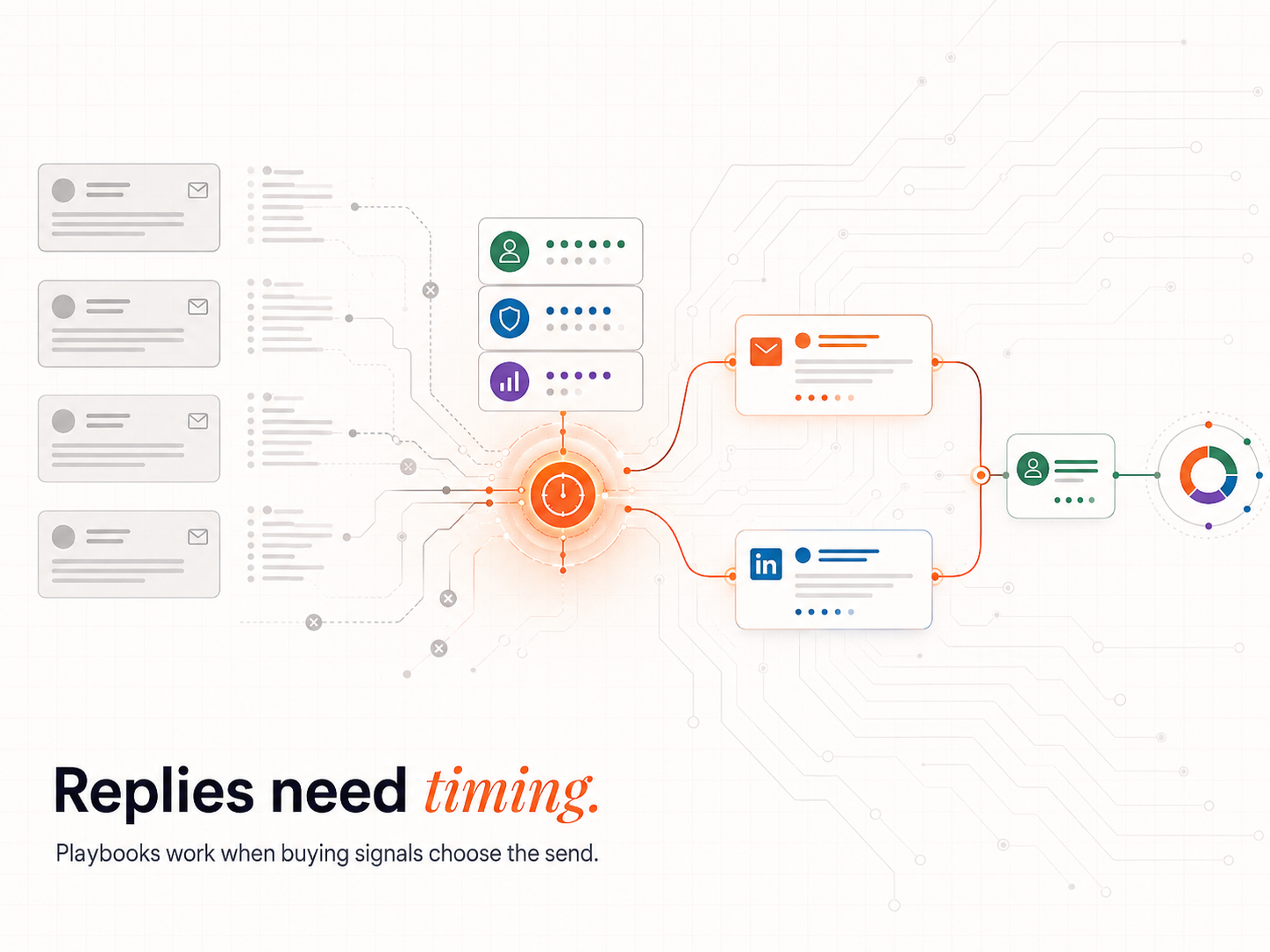
Insidesales.com research found that leads contacted within 5 minutes of showing a high-intent signal are 9 times more likely to convert than those contacted later. Automation makes the 5-minute window achievable at scale. An SLA trigger fires when a contact crosses the evaluation threshold, assigns the lead to the available SDR with the lowest current load and logs the timestamp for attribution.
Without an automated SLA trigger, this window closes before a rep has had time to review the notification, find the contact in the CRM and prepare an opening message.
When not to automate
Not every contact should move through an automated handoff. Suppress automation and route to manual review when:
- The contact has an active deal in the CRM at any stage
- The contact has previously unsubscribed or marked communications as unwanted
- The contact is an existing customer whose engagement is likely post-sale behaviour
- Firmographic data is incomplete or confidence below threshold
Automating these contacts produces noise in the pipeline and erodes SDR trust in the system.
Workflow Automation Templates for B2B Teams
Templates reduce the configuration time required to build governed automation workflows. The 3 templates below cover intent-triggered nurturing, automated routing with enrichment and a bottom-funnel conversion sequence. Each is designed to be adapted to a specific ICP, CRM and data source combination.
Template 1: Intent-triggered nurturing flow
Trigger: Contact from a target account domain visits a high-intent page (pricing, case studies, comparison pages) more than twice in 7 days.
Actions:
- Enrich contact record with current job title, department and company firmographics via Clay.
- Score against ICP criteria. If below threshold, route to mid-funnel nurture sequence.
- If above threshold, assign to bottom-funnel sequence and notify SDR with signal context.
- Log trigger timestamp and signal source in CRM for attribution.
Template 2: Automated routing and enrichment
Trigger: New inbound lead from any source enters the CRM.
Actions:
- Deduplicate against existing CRM records using domain-based and email-based matching.
- Enrich with firmographic data from 3 sources. Flag if confidence below threshold.
- Score based on ICP fit and initial engagement signal.
- Route to appropriate sequence based on score: top-funnel nurture, mid-funnel consideration or SDR notification.
- Write enriched values to custom CRM fields. Do not overwrite core fields until the confidence threshold is met.
For a detailed walkthrough of how HubSpot and n8n connect inside this routing architecture, see how HubSpot and n8n work together to automate sales and marketing.
Template 3: Bottom-funnel conversion sequence
Trigger: Contact reaches evaluation stage score threshold with confirmed ICP fit and no active CRM deal.
Actions:
- Assign to SDR with lowest current lead load.
- Fire automated first-touch message within 5 minutes of trigger.
- Enrich with latest job change and intent data before SDR follow-up.
- If no response after 3 touches over 7 days, move to a lower-cadence nurture sequence.
- Log all touches and outcomes in CRM for pipeline attribution.
AI-Driven Content Delivery Inside the Funnel
Content delivery inside a funnel should change based on what the buyer has already seen and what stage they currently occupy. Static content sequences treat all contacts the same regardless of behaviour. AI-driven delivery adjusts message, timing and format based on real CRM and engagement signals.
Dynamic content based on buyer stage
At the awareness stage, content addresses category problems rather than specific solutions. At consideration, content addresses how the category problem is typically solved and where standard approaches fall short. At evaluation, content addresses the specific decision: why this solution, why now and what the implementation looks like.
A contact who has moved from awareness to consideration by engaging with 3 top-funnel assets should not receive the same awareness-stage content again. The sequence should advance. Most automation setups do not configure this progression because it requires CRM signals to feed back into the content delivery logic. Setting up that feedback loop is the technical step most teams skip.
Personalisation through CRM signals
CRM signals that should inform content delivery include: last page visited, last email opened, current lead score, industry vertical, company size and any custom fields populated by enrichment. A contact from a 50-person SaaS company who visited the integration documentation page should receive different content from a contact at a 500-person logistics company who visited the pricing page.
Litmus research confirms that email marketing delivers an average ROI of 36:1. That return depends heavily on relevance. Generic sequences sent to unsegmented lists produce the lowest end of that range. Signal-driven sequences sent to appropriately staged contacts produce the highest.
AI agent involvement
AI agents can personalise message content at the individual level without manual copywriting for each contact. The agent receives the contact's signal history, CRM data and stage, then generates a message variant aligned to those inputs. A human reviews high-value variants before sending. The agent handles volume; the human handles judgment at the top of the pipeline.
Sales Capacity Planning With Automation
Automation scales lead volume. It does not replace SDR judgment at the bottom of the funnel. Capacity planning determines how many enriched leads one SDR can handle per month and how automation should be configured to prevent volume overwhelming the human layer it is designed to support.
Mapping SDR bandwidth to funnel automation
Salesforce research found that sales reps spend just 28% of their working week actually selling. The remainder is consumed by administrative work, data entry, CRM updates and internal meetings. Automation reclaims some of that time by handling CRM data entry, lead routing and initial outreach. The practical result is that an SDR working within a governed automation system can handle approximately 400-500 enriched leads per month compared to far fewer without it.
The capacity calculation matters for funnel design. If a 3-person SDR team can collectively handle 1,200-1,500 enriched leads per month, the funnel's scoring threshold should be set to pass through no more than that volume at the evaluation stage. Leads above that threshold require either a tighter ICP filter or additional SDR capacity.
Avoiding volume overwhelm
The teams that fail to plan capacity discover the problem the same way: SDRs stop engaging with automation-sourced leads because the volume exceeds what they can meaningfully action. When SDRs begin ignoring leads, the funnel has broken at the handoff point regardless of how well the upstream automation is configured.
Set volume caps per SDR. Build suppression logic for contacts below threshold. Do not default to passing everything through. A funnel that passes 2,000 leads per month to a team of 2 SDRs is not a high-performance funnel. It is a noise machine.
Measuring funnel health
Funnel health metrics to track on a weekly basis:
- Lead-to-MQL rate: what percentage of top-funnel entries reach scoring threshold
- MQL-to-SQL rate: what percentage of scored leads receive SDR engagement
- SQL-to-opportunity rate: what percentage of SDR-engaged contacts convert to active pipeline
- Stage duration: how long contacts spend in each stage before advancing or dropping out
- Handoff response time: how quickly SDRs engage after an automated notification
If any rate falls below baseline for 2 consecutive weeks, audit the automation logic at that stage before changing content or SDR behaviour.
How to Turn Buyer Signals Into Automated, Always-On Sales Funnels
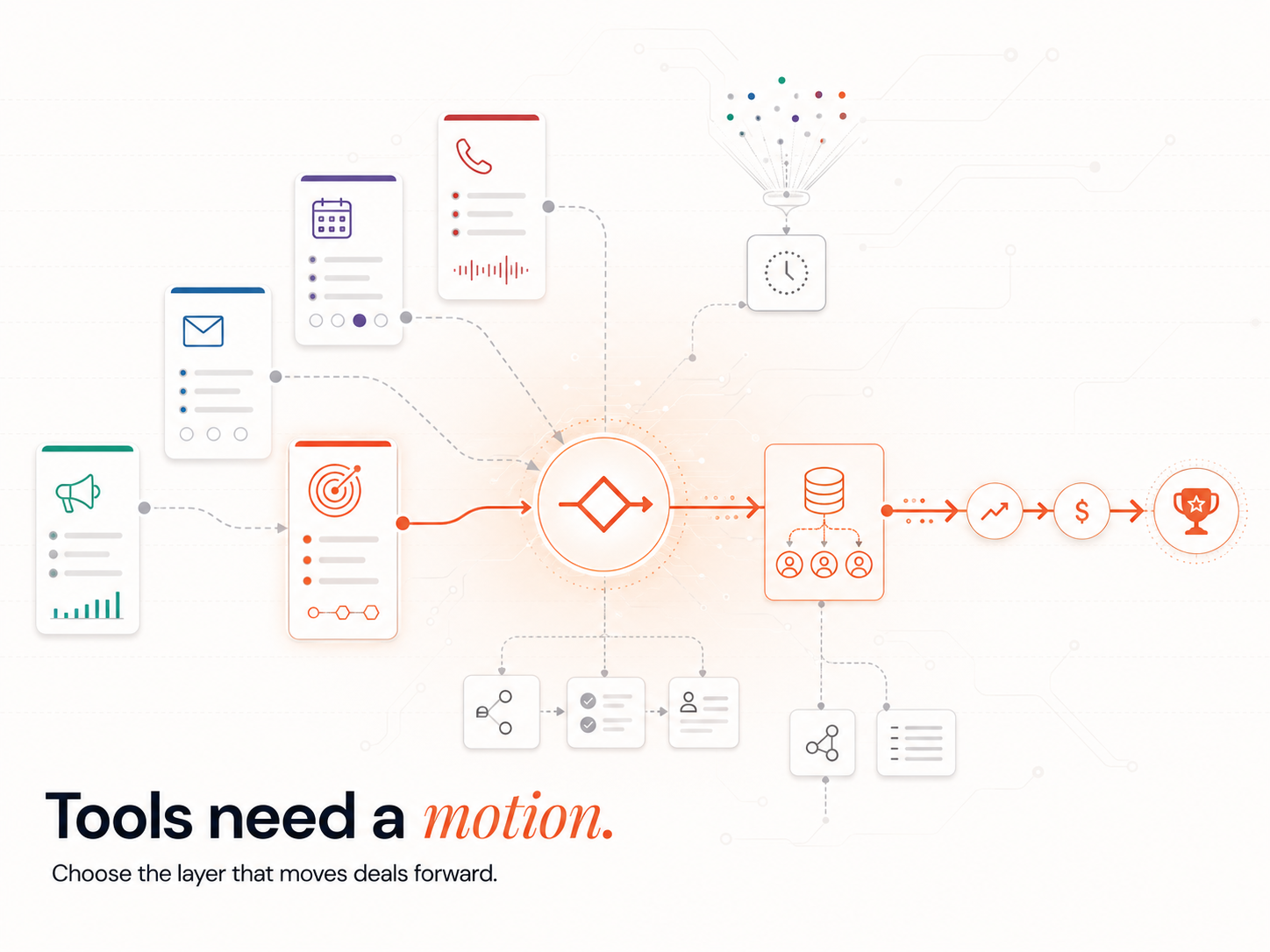
A well-built automated funnel is not a set of tools. It is a system that detects when a buyer is ready, qualifies the signal before routing it and connects every handoff to a record your team can act on. The tools (Clay, HubSpot, n8n, Salesforce) are interchangeable. The logic that governs when signals trigger actions, when enrichment runs and when humans are involved is what determines whether the funnel produces pipeline or noise.
The teams that build this correctly do not spend their time managing lead lists. They spend it on the conversations the funnel has already identified as worth having. That is the output a governed, signal-triggered funnel is designed to produce.
For teams that want to see what AI-powered lead generation service is capable of and how signal detection connects to outbound execution.
For teams ready to build the system, see Intelligent Resourcing's GTM engineering service.
Prospecting
A well-built funnel detects when a buyer is in-market and acts before a competitor does. The Revenue Operations Studio at Intelligent Resourcing builds the signal-detection, scoring, and handoff system on Clay, HubSpot, n8n, and SmartLead, owned by your team.
FAQs
What is an automated sales funnel?
An automated sales funnel is a system that moves contacts through awareness, consideration and evaluation stages based on behavioural signals and AI scoring rather than manual rep activity. Automation handles enrichment, scoring, content delivery and routing. SDRs engage only when conversion conditions are met.
Which tools do you need to build an automated sales funnel?
The core stack for a B2B automated funnel is a signal source (intent data, LinkedIn activity or web tracking), an enrichment and orchestration layer (Clay), a CRM (HubSpot or Salesforce) and a workflow automation tool (n8n or Make). Each layer has a specific role. The enrichment layer should never write directly to core CRM fields without a confidence threshold.
How long does it take to build an automated sales funnel?
A basic 3-stage funnel with intent triggers, enrichment routing and SDR handoff can be configured in 2-4 weeks with the right tooling in place. A full-depth system with multi-model scoring, conditional sync to a CRM and per-stage attribution takes 6-10 weeks depending on data source complexity and CRM history.
What is the biggest mistake teams make when building automated funnels?
The most common mistake is treating automation as a volume solution rather than a qualification solution. Teams configure automation to pass more leads to SDRs faster, without implementing scoring thresholds or deduplication logic. The result is SDRs receiving unqualified contacts at high volume, losing trust in the system and eventually ignoring it. The fix is to treat the handoff threshold as a hard gate, not a soft suggestion.
How does AI scoring work in a B2B sales funnel?
AI scoring assigns weighted values to multiple signals: page behaviour, email engagement, firmographic fit, intent data and CRM history. Contacts accumulate a score as they engage. When the score crosses a predefined threshold, the workflow routes the contact to the corresponding stage or triggers an SDR notification. The model is calibrated against historical conversion data and adjusted as new outcomes are recorded.