


What a Cross-Engine AI Citation Audit Is
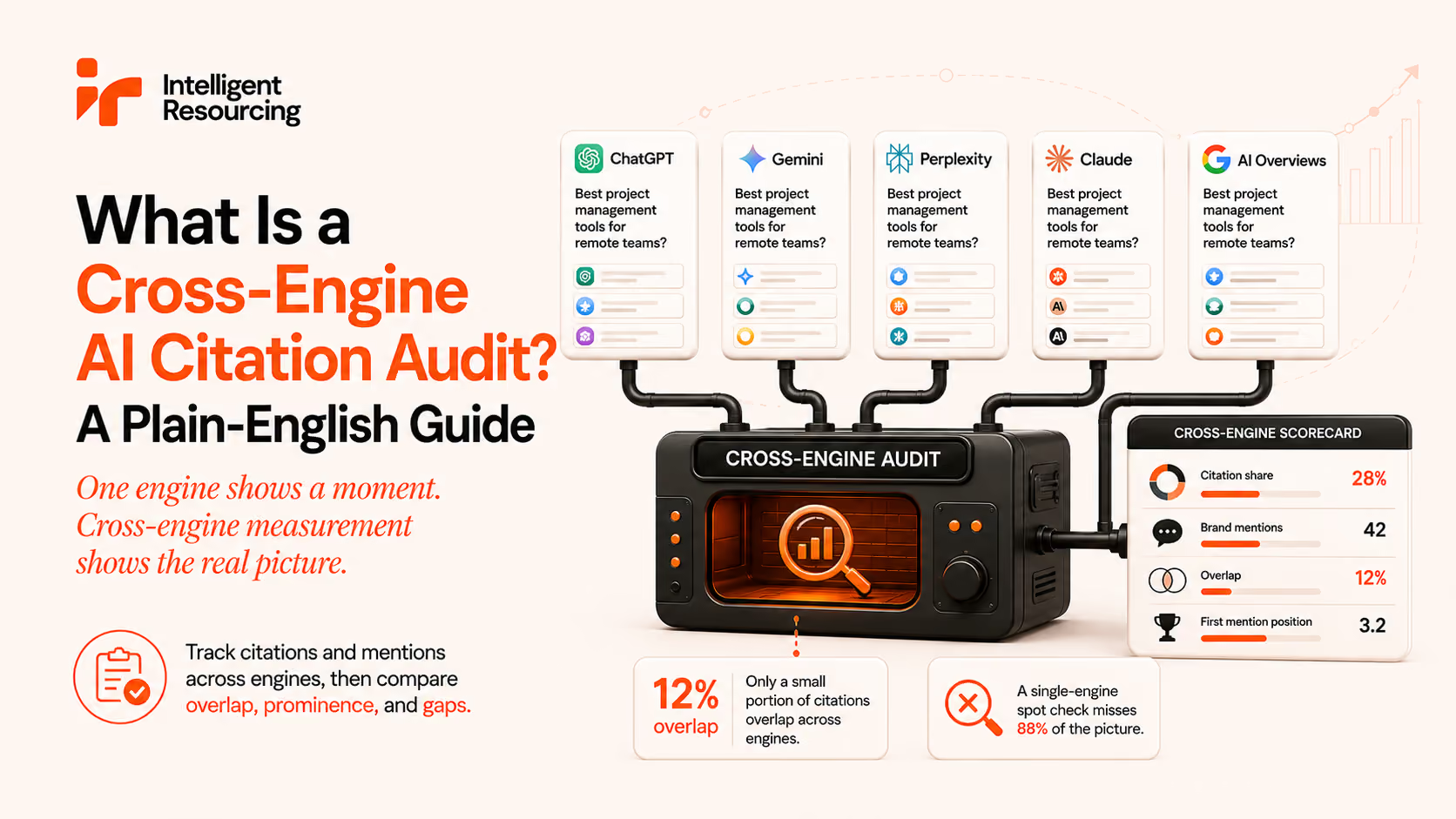
A cross-engine AI citation audit is a structured, repeatable measurement of how often and how prominently a brand is cited and mentioned across ChatGPT, Google Gemini and AI Overviews, Perplexity, and Claude for the same buyer questions. It is a measurement discipline, not a one-off screenshot, and "cross-engine" is what separates it from an ad-hoc check.
That right-hand column of the matrix above is the difference between an anecdote and evidence, which means you act on a trend rather than a lucky screenshot.
A Plain-English Definition
It measures whether AI engines point buyers to your brand, and how prominently, over time. A citation means your URL is used as a source; a mention means your brand is named in the answer text.
The Engines It Covers
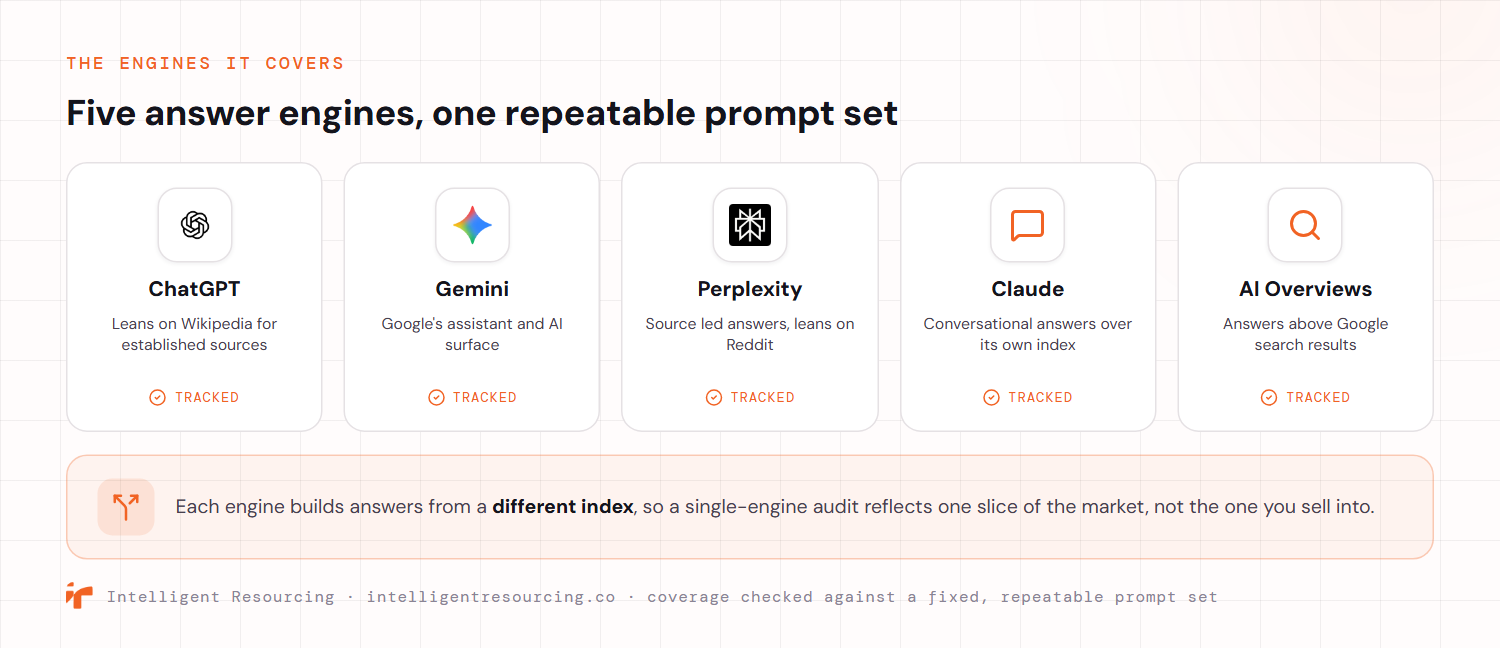
A credible audit spans the engines your buyers use: ChatGPT, Gemini and AI Overviews, Perplexity, and Claude. Coverage matters because each engine builds answers from a different index, so a single-engine audit reflects one slice of the market, not the one you sell into.
Why It Is Not a ChatGPT Screenshot
A screenshot is a demonstration, not a measurement: one answer, one engine, one moment, no baseline. A cross-engine audit runs the same queries across all engines on a schedule, so this month compares with last.
Why a Single-Engine Audit Misses Most of the Picture
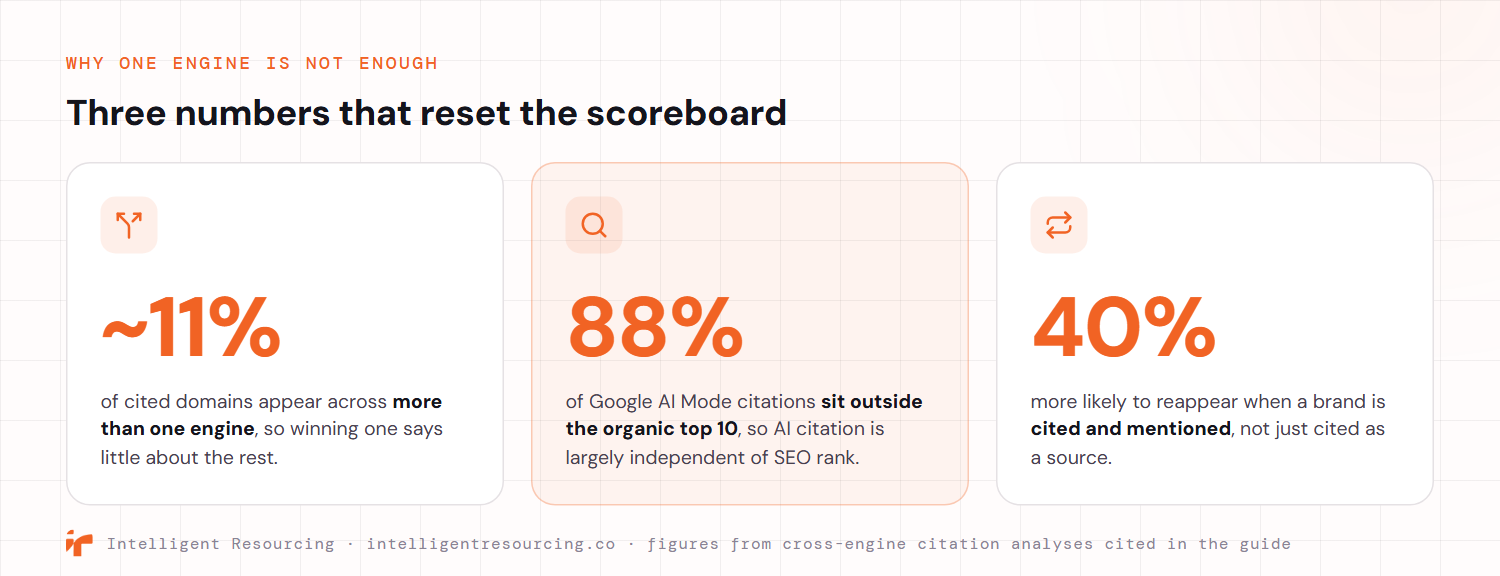
Single-engine AI search visibility is not representative and should not be extrapolated to the engines you did not check, which is why "cross-engine" is the load-bearing word. A 118,000-answer analysis found only about 11 percent of cited domains appear across more than one engine, making a single-engine audit a blind spot by construction.
The pattern holds for brands: in one cross-engine study, only 5.4 percent of prompts returned the same top-ranked brand across ChatGPT, Perplexity, and Google AI Overviews. Winning one engine tells you almost nothing about the others, the core problem for anyone tracking AI search visibility from a single tab.
| Engine | Most-cited source class |
|---|---|
| ChatGPT | Wikipedia |
| Perplexity | |
| Google AI Overviews |
Those mixes come from platform data showing ChatGPT leans on Wikipedia while Perplexity leans on Reddit, so the same query pulls from different corners of the web depending on where it runs.
The Overlap Problem
If only about 11 percent of cited domains are shared, the overwhelming majority of what an engine cites is unique to it. Winning ChatGPT does not carry over to Perplexity or Gemini, because each draws on a different index, which means budget spent optimising one engine on the assumption the gain transfers is largely wasted.
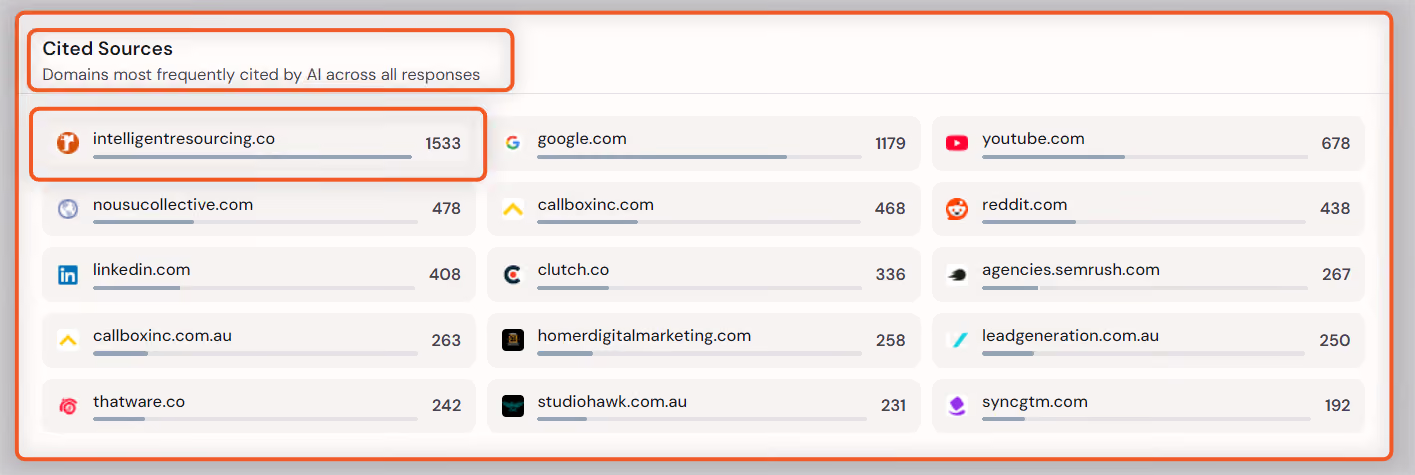
Intelligent Resourcing's own cross-engine tracker illustrates why. Across 152 tracked prompts as of July 16, 2026, run across ChatGPT, Perplexity, Gemini, and Google AI Overviews, the most-cited domains are intelligentresourcing.co with 1,533 instances, YouTube with 678, Reddit with 438, and Callbox with 263.
Those sources do not have equal presence across all four engines. YouTube and Reddit dominate Perplexity's retrieval. Callbox and structured B2B comparison content appear more heavily in ChatGPT's answer set. A check run only on ChatGPT shows Intelligent Resourcing's own domain performing well. The same check run on Perplexity surfaces Reddit and YouTube as the dominant citation sources, a completely different picture. The divergence is not a data glitch. It is the product of each engine drawing from a different index, exactly the overlap problem the research describes.
Why Engines Diverge on Brands and Sources
Each engine pulls from a different source mix and retrieval index, so the same question yields different cited URLs and named brands. An engine weighting Wikipedia surfaces established brands; one weighting Reddit surfaces whatever communities discuss.
The Core Components of a Cross-Engine AI Citation Audit
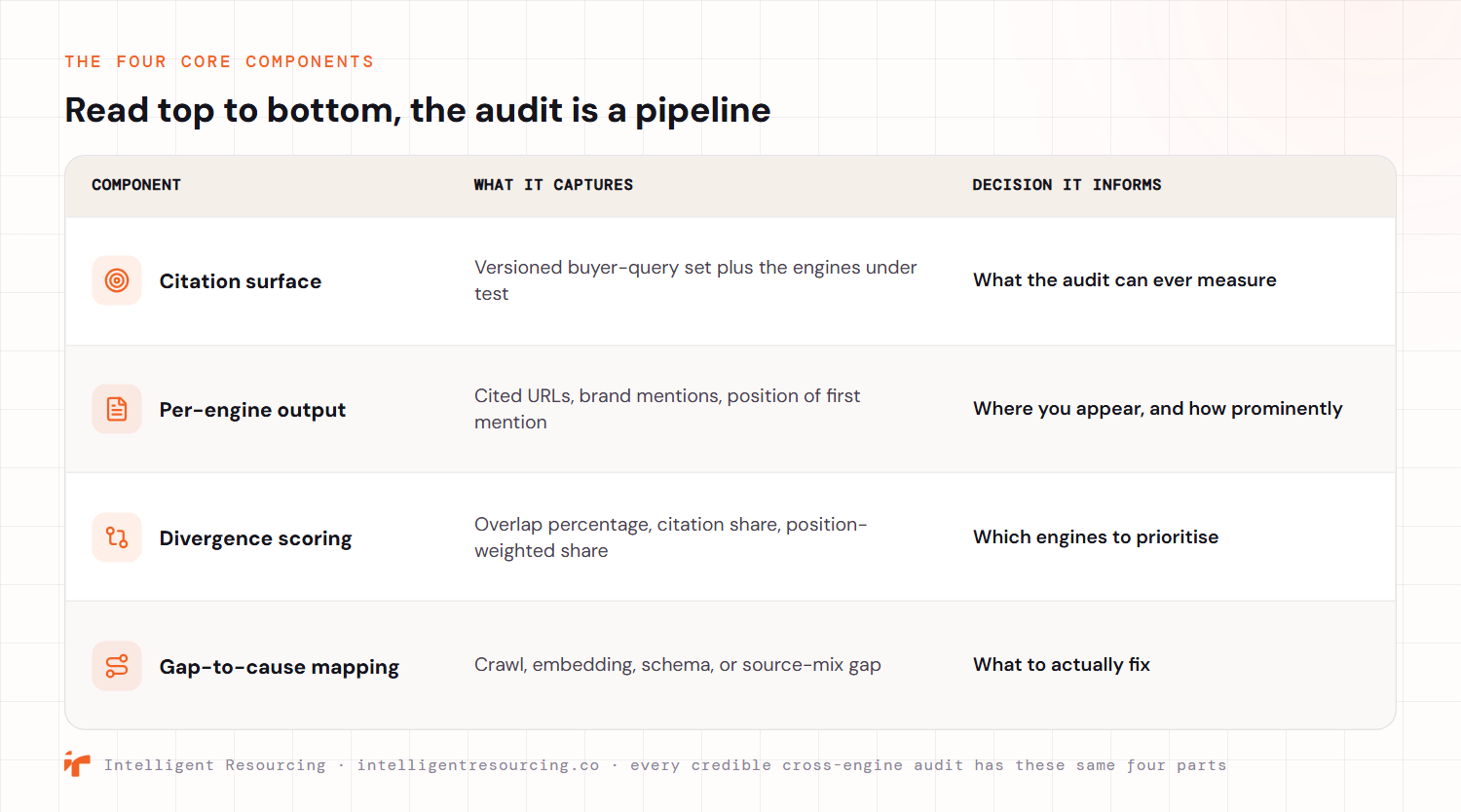
Every credible audit has the same four parts, and knowing them tells you what the exercise can and cannot deliver.
| Component | What it captures | Decision it informs |
|---|---|---|
| Citation surface | Versioned buyer-query set plus engines under test | What the audit can ever measure |
| Per-engine output | Cited URLs, brand mentions, position of first mention | Where you appear, and how prominently |
| Divergence scoring | Overlap percentage, citation share, position-weighted share | Which engines to prioritise |
| Gap-to-cause mapping | Crawl, embedding, schema, or source-mix gap | What to actually fix |
Read top to bottom, the table is a pipeline: define what you measure, capture it per engine, score the differences, then trace each gap to its cause so the fix targets the real problem, not a symptom.
The Citation Surface
The citation surface is the versioned set of real buyer questions, plus the engines and cadence you test. Query selection is the step that matters most, because the questions you choose determine everything the audit can see, so use buyer language, not internal jargon.
Per-Engine Citation Output
For each engine, an audit logs the cited URLs, the brand mentions in the answer text, and the position of the first mention. A normalised schema makes engines comparable; position of first mention is what separates a lead answer from a footnote.
Divergence Scoring and Gap-to-Cause Mapping
Three metrics describe divergence: overlap percentage, citation share, and position-weighted share. Each gap is then mapped to a cause, whether crawl coverage, embedding eligibility, schema, or source mix, which turns a scorecard into a work list.
Cited vs Mentioned: What the Audit Actually Measures
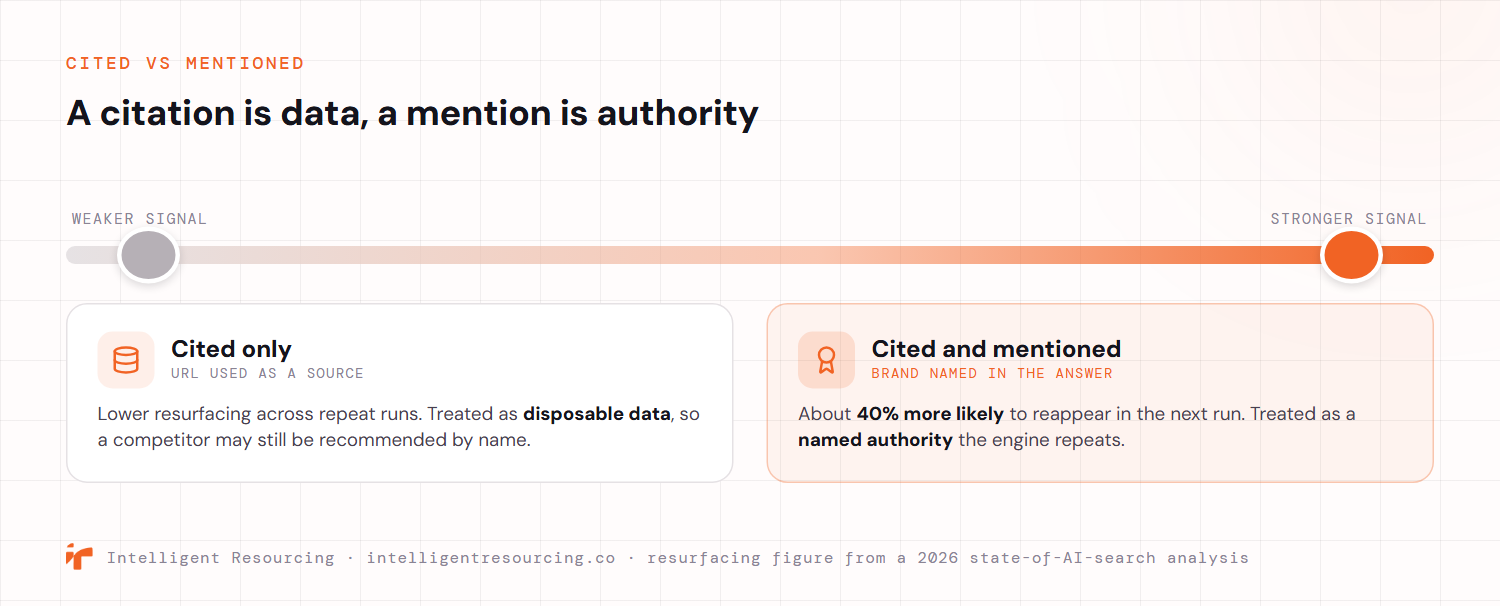
The most useful distinction an audit draws is between being cited and being mentioned. A cross-platform AI brand mention audit overlaps with a citation audit but is not identical: one tracks named authority, the other tracks links, and a full audit tracks both, plus how durable each is across repeat runs.
| Status | Resurfacing behaviour | What it signals |
|---|---|---|
| Cited only (URL as source) | Lower resurfacing across repeat runs | Treated as data, not a recommendation |
| Cited and mentioned (named) | About 40 percent more likely to reappear | Treated as a named authority |
Those figures come from AirOps research finding cited-and-mentioned brands were about 40 percent more likely to reappear in the next run of the same query, which means a named brand is treated as an authority the model repeats, while a bare citation is disposable data.
Cited vs Mentioned
Cited means your URL is used as a source; mentioned means your brand is named in the answer. The gap between them is the most useful thing an audit surfaces, because a brand cited but never named is doing the research for a competitor who gets recommended by name.
Citation Share and Position-Weighted Share
Citation share measures footprint: the proportion of answers that include you at all. Position-weighted share measures prominence: lead answer or also-ran. Both are needed, because a large footprint of low-position mentions loses to a small footprint of lead answers whenever a buyer stops after the first recommendation.
Durability and Resurfacing Rate
AI answers rebuild on every query, so a result you saw last month may not appear this month. Durability, how often you reappear across repeat runs, is therefore a metric a good audit tracks, not a one-time snapshot.
What a Cross-Engine AI Citation Audit Tells You About SEO and Brand Authority
AI citation is largely independent of classic SEO rank, the finding most likely to surprise a marketer reading a traditional dashboard. Moz's 40,000-query study found 88 percent of Google AI Mode citations do not appear in the organic top 10, and the signals that do correlate are not the classic ones. This is where answer engine optimisation diverges from ordinary SEO.
| Signal | Relationship to AI visibility |
|---|---|
| Brand web mentions | Strong |
| Backlinks | Weak |
| Top-10 organic rank | Largely independent; most AI Mode citations sit outside it |
Independent analysis of tens of thousands of brands has found that earned brand mentions correlate far more strongly with AI visibility than backlinks do, so earned, third-party presence moves the needle more than link-building.
Why AI Citations Are Largely Independent of SEO Rank
An engine assembles an answer from what it has ingested and trusts, not from a live ranking of ten blue links. Because most AI Mode citations sit outside the organic top 10, a dashboard showing you first can sit alongside near-total absence from AI answers, so read rank and citation as two separate scoreboards.
The Coverage Trap and the Earned-Media Signal
The coverage trap is assuming broad, high-volume content earns citation. In practice, generic breadth gets synthesised without attribution, because there is nothing distinctive to name. What moves a brand from cited to recommended is earned, third-party presence: independent mentions, reviews, and coverage the engine reads as external validation.
How to Run (or Commission) a Cross-Engine AI Citation Audit
Getting an audit done is not intimidating once the workflow is clear: six steps, run on a schedule, with three ways to resource it. Teams taking the first route can follow our walkthrough of a do-it-yourself citation gap audit.
The High-Level Workflow
The workflow is six plain steps a non-technical reader can follow; the engineering only appears in how you automate capture.
- Define the citation surface: buyer queries, engines, and cadence.
- Run paired prompts across every engine on the same day, so timing does not skew the comparison.
- Capture and normalise the cited URLs and brand mentions into one schema.
- Score cross-engine divergence using overlap, citation share, and position-weighted share.
- Map each gap to its cause, whether crawl, embedding, schema, or source mix.
- Prioritise the closeable fixes and park the rest.
The steps most often skipped are structural, so it helps to read how to structure content for AI citation and confirm schema markup for AI supports eligibility before you start.
How Often to Run It
Run monthly captures with a quarterly deep-dive. Monthly tracking catches changes early, while quarterly reviews reveal wider trends and help reset priorities. A one-off audit shows current visibility but cannot show whether performance is improving or declining.
For the 17 June to 16 July reporting period, Intelligent Resourcing's tracker recorded 3,358 query runs for a client across five platforms: Google AI Overviews, ChatGPT, Gemini, Grok and Perplexity. Gemini delivered the highest mention rate at 45.6 percent and citation rate at 66.2 percent.
The client's own domain was cited 2,801 times, followed by the National Heavy Vehicle Regulator at 1,382, YouTube at 595 and Capterra at 530. This shows why recurring cross-platform audits matter: they reveal both performance changes and the third-party sources shaping a client's AI visibility.
DIY vs Platform vs Managed Service
Three routes, each suited to a different team.
| Delivery option | Best fit | Trade-off |
|---|---|---|
| DIY scripts | In-house engineering capacity | Build and maintenance time |
| Paid platform | Marketing-led teams | Subscription cost, fixed schema |
| Managed service | Teams wanting it done for them | Vendor dependency |
DIY suits teams with spare engineering capacity; a paid platform suits marketing-led teams who want a dashboard without building one; a managed service suits teams who want the whole thing run for them, the option we provide.
Turn Audit Findings Into AI Visibility
AI visibility is now a cross-engine presence, not a single rank, and that is the number one idea to carry out of this guide. Because engines diverge so sharply on sources and brands, the practical move is to run or commission a cross-engine audit before you brief new content, so the brief targets the gaps that actually exist rather than the ones you assume. The next step in the cluster is to turn that into a plan: answer engine optimisation shows how the pieces fit together.
If you would rather have the audit run for you, book a call and we will measure your cross-engine presence and hand back a prioritised list of the gaps worth closing.
Content Creation
Intelligent Resourcing runs the audit for you across ChatGPT, Gemini, Perplexity, Claude and Google AI Overviews, then hands back a prioritised list of the gaps worth closing.
FAQs
What is a cross-engine AI citation audit?
It is a scheduled measurement of how a brand is cited and mentioned across multiple AI engines, such as ChatGPT, Gemini, Perplexity, and Claude, for the same buyer questions. Instead of a single screenshot, it produces a logged, comparable scorecard you can track over time.
How is it different from a single-engine check?
A single-engine check looks at one tool, usually ChatGPT, on one day. Because only about 11 percent of cited domains overlap across engines, that check covers a small slice of the cross-engine reality and is not representative of the whole market.
Which AI engines should the audit cover?
The working baseline is four engines: ChatGPT, Gemini, Perplexity, and Claude, plus Google AI Overviews. Those cover the bulk of buyer usage today. Extend to others only where your buyers actually use them, because adding engines your market ignores adds noise, not insight.
What is the difference between being cited and being mentioned?
Being cited means your URL is used as a source behind an answer. Being mentioned means your brand is named in the answer text. Mentioned is the stronger signal, because a named brand is treated as an authority the engine repeats, while a bare citation is disposable data a competitor may be recommended over.
How often should you run an AI citation audit?
Run monthly captures to catch movement while it is actionable, with a quarterly deep-dive to read the trend and re-prioritise. Add an event-driven run after a major engine update or brand change. One-off audits reveal no trend, which is the thing worth managing.
Does traditional SEO ranking predict AI citations?
Largely no. Most AI citations sit outside the organic top 10, and brand web mentions correlate far more strongly with AI visibility than backlinks do. Ranking first on Google is helpful but not sufficient, because an engine builds answers from what it has ingested and trusts.