

What Makes AI Recognise a Brand as an Entity?
AI systems do not read a brand the way a person does. They build an entity, a bundled identity made of attributes, relationships and category membership. That entity is what gets matched to a query, not the website behind it. A page can rank well and still fail to register as a coherent entity if the signals pointing to it are thin or inconsistent.
An engine deciding whether to name a brand asks a narrower question than overall domain authority. It asks whether this specific entity, mapped to this specific category, is confident enough to state out loud. Entity SEO for AI citation is the discipline of building the signals that answer that question deliberately, rather than hoping general authority covers it.
The Five Entity Signals That Make AI Name Your Brand
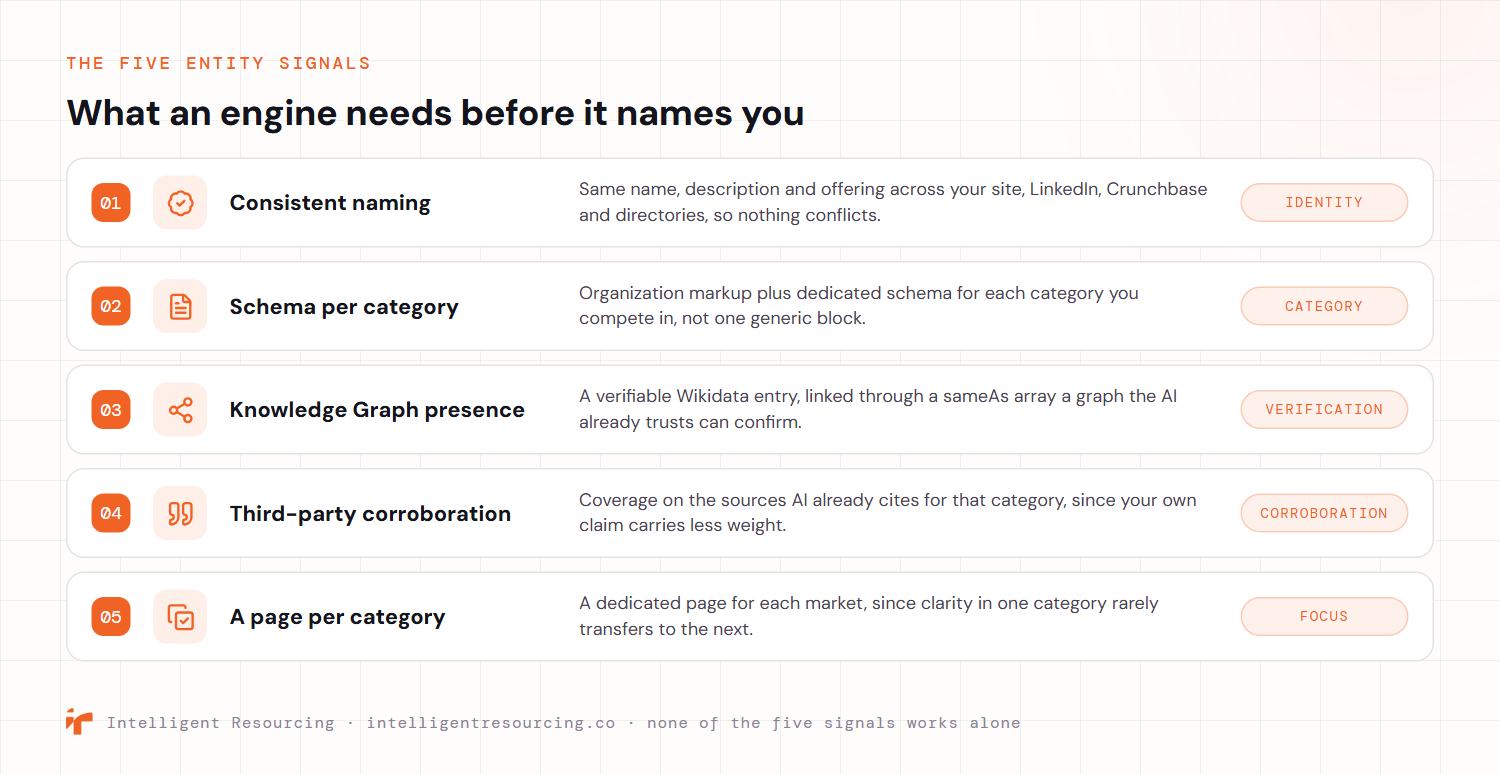
Five signals decide whether an engine has enough to name a brand in a given category. None of them works alone.
- Keep naming consistent everywhere. Same name, description and offering across the website, LinkedIn, Crunchbase and directories, so nothing conflicts.
- Add schema per category. Organization markup on the homepage, plus dedicated schema for each category the brand competes in, not one generic block.
- Build Knowledge Graph and Wikidata presence. A verifiable Wikidata entry, linked through a sameAs array, that a knowledge graph an AI already trusts can confirm.
- Earn third-party corroboration. Coverage on the specific sources AI already cites for that category, since a brand's own claim alone carries less weight.
- Build a dedicated page per category. Not one shared page covering every market, since clarity in one category rarely transfers to the next.
A minimal Organization schema block covers the first signal, following Google's Organization schema. A visitor never reads it. It sits in the page's HTML, invisible to a human but readable to an AI crawler as a structured statement of who the brand is and where it can be verified.
The sameAs array is the corroboration part, and it is how AI recognises your brand as a stable entity rather than a claim it has to verify every time. Each URL inside it points to an external profile where the same identity already exists, so an engine reading the code can cross-check the claim rather than take the page's word for it: { "@context": "https://schema.org", "@type": "Organization", "name": "Your Company", "url": "https://yourcompany.com", "sameAs": [ "https://www.linkedin.com/company/yourcompany", "https://www.crunchbase.com/organization/yourcompany", "https://www.wikidata.org/wiki/Q000000" ] }
None of the five signals work in isolation. A Wikidata entry with inconsistent naming still leaves an engine reconciling conflicting descriptions. Category-specific schema on a page nobody else references reads as a self-description, not a corroborated fact. Build order matters less than making sure all five exist for the category that needs recognition. Entity work is one layer of getting cited by AI engines.
Why Categorisation Beats Authority for AI Citation
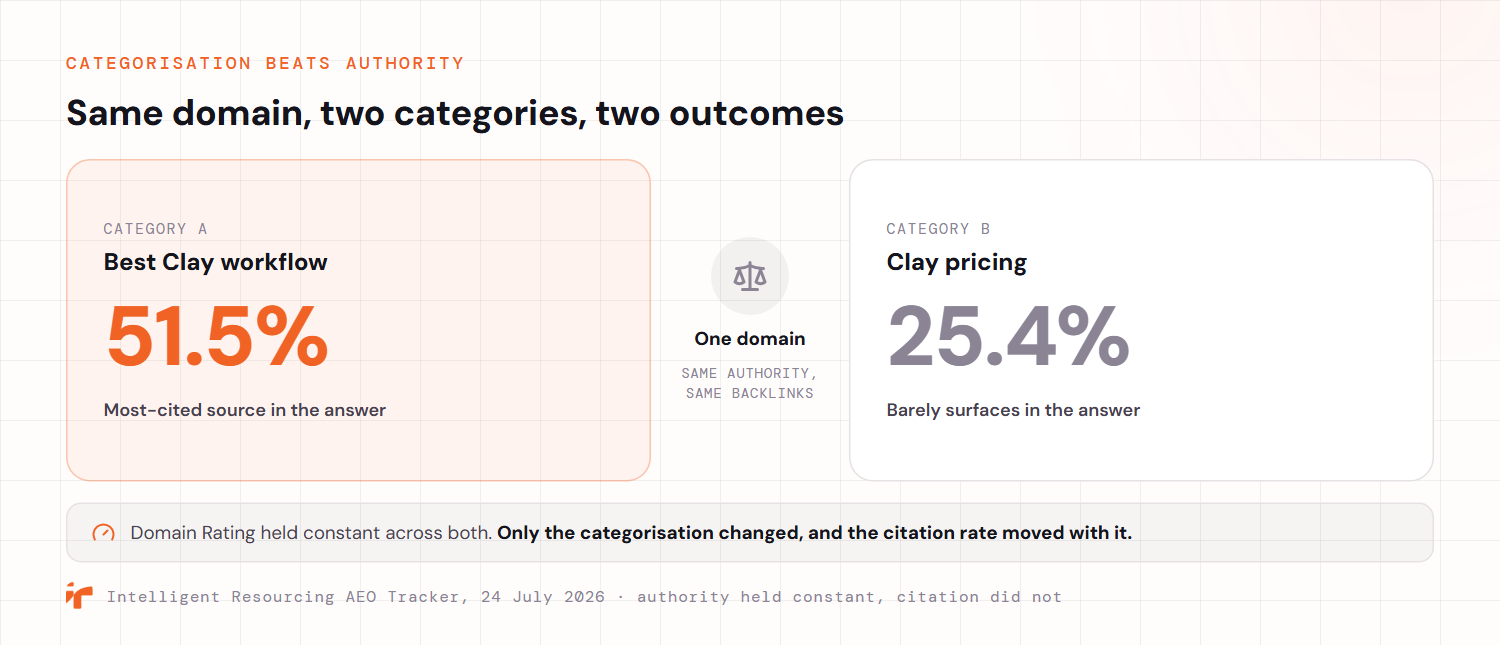
The clearest proof is a single brand tested across two categories. The same site, backlink profile and Domain Rating can be the most-cited source in one category and invisible in the next. Authority stayed constant. Only categorisation changed.
Ahrefs' 2025 study of 75,000 brands points the same way at scale: branded web mentions are a far stronger predictor of AI Overview visibility than Domain Rating is, and brands in the top quartile for mentions earned many times more AI Overview appearances than the quartile just below them.
Intelligent Resourcing's own tracker shows the same pattern on a single domain: 51.5% citation on "Best - Clay Workflow" and 25.4% on the adjacent "Pricing - Clay" category, same domain, same authority (source: Intelligent Resourcing AEO Tracker, 24 July 2026).

Domain Rating did not change between the two categories. The citation rate did. That gap is the clearest evidence that categorisation, not authority, decides the outcome.
| Common response | What it assumes | What it actually does |
|---|---|---|
| Publish more content | The gap is a volume or authority problem | Adds pages, does not clarify categorisation |
| Build more backlinks | Domain Rating drives citation | A weak lever, since branded mentions correlate far more strongly with AI citation |
| Fix category-specific entity signals | The gap is a categorisation mismatch | Directly closes the gap the diagnosis found |
Most teams respond to a citation gap by publishing more content, on the assumption that more pages signal more authority. That is the wrong diagnosis. If a brand is recognised in one category and absent in the next, the fix is clarifying the entity for the category where recognition is missing, not adding volume.
How Do You Test Whether AI Recognises Your Entity?
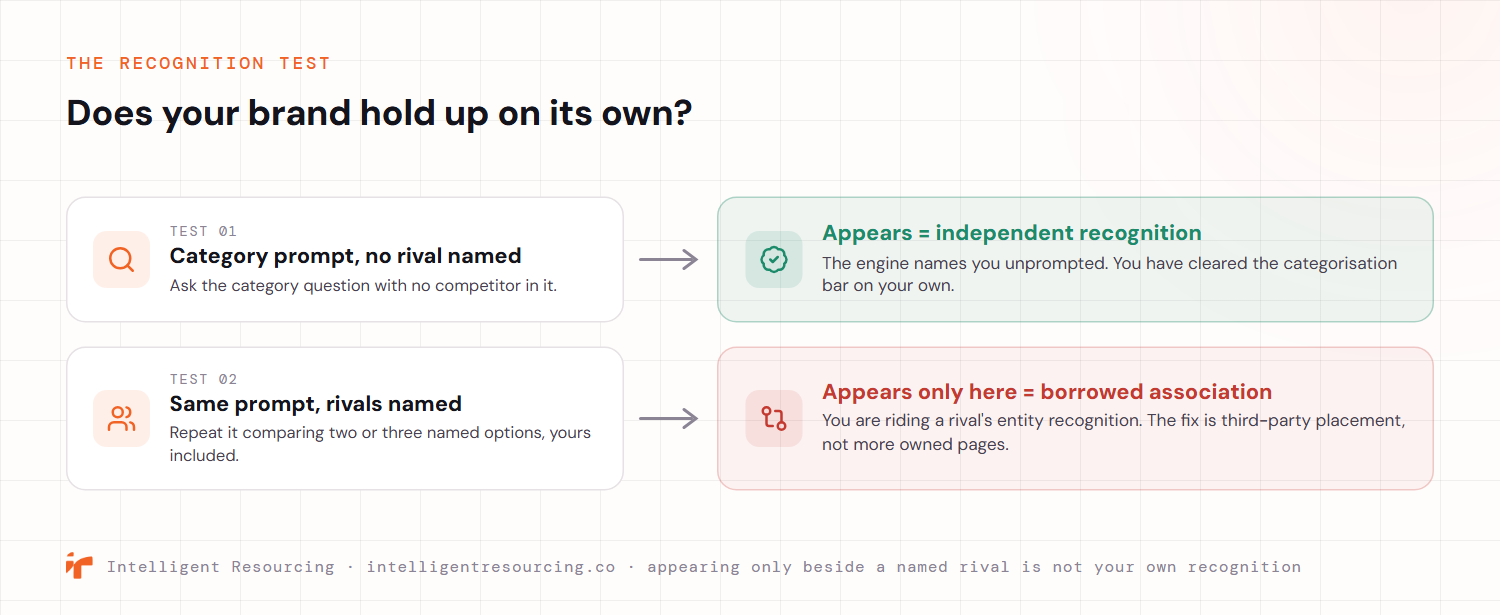
This test separates real entity recognition from borrowed association.
- Run a category prompt with no competitor named, and note whether the brand appears at all.
- Run the same prompt again, this time comparing two or three named options including the brand.
A brand that appears only in the second version is riding on a rival's entity recognition, not its own. A brand that appears in both has cleared the categorisation bar independently.
A brand that only shows up next to a named rival needs third-party placement, not more owned content. The sources already carrying the rival's entity need to carry this brand too. A new page on the brand's own site cannot fix an association problem living on someone else's domain. The wider reasons competitors get cited in AI search follow the same pattern.
Consider a mid-market software brand in two adjacent categories, project management and resource planning. It gets named consistently for project management, with or without a competitor in the prompt. For resource planning, it only appears when a rival is already named.
This gap is fixable, not a general visibility problem. The resource planning entity has no schema, no third-party coverage, and no dedicated page, so the engine has nothing to confirm it against beyond the rival's position. The fix is building that entity on its own terms.
The Ghost-Citation Problem

Most cited domains are not named in the answer they support, according to Growth Memo's ghost-citation study, and the pattern runs in opposite directions by engine. ChatGPT cites a wide set of sources but names comparatively few of them by brand. Gemini does the reverse. It names brands more freely while formally citing far fewer of the pages behind those names.
A brand can sit inside the source material an engine drew from and still read as absent to anyone measuring only named mentions. This is the ghost-citation problem, and it cuts both ways depending on which engine a team happens to check first.
A brand checking only ChatGPT might conclude its content is used but never credited, and respond by chasing more prominent placement. A brand checking only Gemini might see its name mentioned with no confirmed source page, and assume the content is working when the citation trail is actually thin. The engine-specific steps for getting cited in Google Gemini differ from the ChatGPT path.
Market Blindness Is Why Category Gaps Go Unnoticed
Most brands do not track visibility by category. They run a handful of prompts, get a mixed picture, and average it into one impression of how AI treats them. That average hides the exact pattern that would tell them where to fix it.
The fix is structural. Build category-specific entity signals deliberately, and test prompts per category rather than as one blended score. Intelligent Resourcing's LLM SEO work treats entity consistency as its own layer for this reason, since a brand categorised clearly in one place and left vague in another reads as two different entities to an AI engine, and only one of them gets named.
That category-level diagnosis is also where generative engine optimisation starts, rather than a blanket content push, because the diagnosis decides whether the fix is content, schema, or third-party placement, and guessing wrong wastes the budget meant to close the gap.
Fit Check
Best for
- Brands competing in more than one category or market, where citation may vary between them without anyone noticing.
- Teams that have already done general SEO and authority work but still see a citation gap in a specific category.
- Marketers who want to diagnose the actual cause of a gap before committing budget to a fix.
Not for
- Brands operating in one narrow category, where a single blended score is already an accurate picture.
- Teams with no entity signals built anywhere yet, since the basics come before a category-by-category diagnosis.
- Brands with no AI citation presence at all, where the priority is baseline entity work, not this level of diagnosis.
The trade-off: diagnosing category by category takes more upfront work than reading one blended visibility score. What it buys is knowing exactly which category needs fixing, and whether the fix is content, schema, or third-party placement, instead of guessing. Two categories on the same domain can score completely differently, and averaging them together hides which one needs the work. Book a call to map your entity signals category by category.
Content Creation
Intelligent Resourcing's Content Strategy team maps your AI visibility category by category, finds the categories missing their entity signals, and builds the schema, dedicated pages and third-party corroboration that get your brand named. Book a call to see where you are cited and where you are invisible.
FAQs
What is an entity signal in AI search?
An entity signal is any evidence that helps an AI system confirm what a brand is, what category it belongs to and who vouches for it. Schema markup, Knowledge Graph presence, consistent third-party profiles and category-specific content all function as entity signals.
Why does my brand get cited in one category but not another?
Because AI citation is a categorisation match, not a general authority score. The same site with the same backlink profile can be clearly categorised for one query and thin or inconsistent for an adjacent one.
Is a brand mention the same as being recognised as an entity?
Not always. A brand can be named only because a competitor was named in the same prompt, which signals association rather than independent recognition.
Do different AI engines treat entity citations differently?
Yes. ChatGPT tends to cite a wide set of sources while naming relatively few by brand. Gemini names brands more often while formally citing fewer of the underlying pages.
How do I fix a category-specific entity gap?
Test the category prompt with and without a named rival to confirm the gap is real. If it is, the fix is category-specific schema, a dedicated page, and third-party placement, not more general content on the main site.