

What Is Generative Engine Optimisation for B2B SaaS?
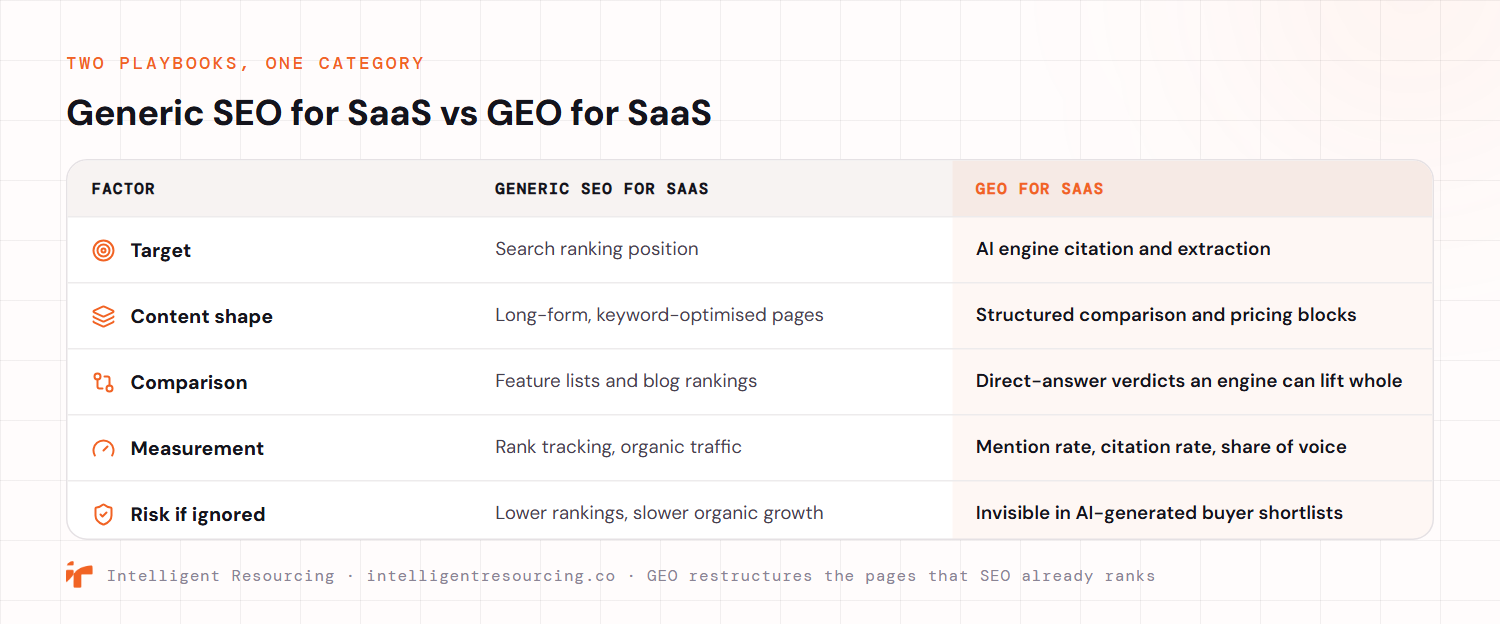
GEO for B2B SaaS means structuring product pages, comparison content and pricing information so AI engines like ChatGPT, Gemini and Perplexity can extract it directly into a buyer's answer. It differs from general GEO in one specific way: SaaS buying involves a comparison stage, a free trial evaluation and a technical fit check, each generating a distinct AI search query.
A buyer asking an AI engine "which project management tool integrates with Salesforce" is running a SaaS-specific query with a specific answer shape: a short list, a named winner, a reason tied to the integration.
Intelligent Resourcing applies this same structure through its GEO service. SaaS execution narrows it further to the specific comparison and integration questions buyers actually ask rather than a generic best-practices template. That narrower focus turns generic GEO advice into content an AI engine can match to a real buyer question.
Most B2B categories sell through a single evaluation call rather than a self-serve comparison, so general GEO work centres on service pages and case studies. SaaS buyers behave differently. They compare tools side by side before ever speaking to sales, often across multiple tabs and multiple AI queries in the same session. Content built for a single-call sales motion misses the multi-tool comparison stage entirely.
The SaaS Content Gap in AI Search
Most AI visibility tracking, including Intelligent Resourcing's own, measures broad categories: best-in-industry rankings, tool comparisons, pricing questions, named alternatives. None of the categories tracked across Intelligent Resourcing's 153-prompt, 21-topic AI search visibility set include a dedicated SaaS category (source: Intelligent Resourcing AEO Tracker, live data, 8 July 2026).
| What's Tracked | What's Missing |
|---|---|
| Best-in-industry rankings | SaaS-specific comparison queries |
| Named alternatives | SaaS-specific pricing queries |
| General AEO/GEO agency queries | SaaS integration and fit queries |
No brand competing in the SaaS space, including established players, currently has visibility into who AI engines actually cite for SaaS-specific queries. The category is open precisely because nobody is measuring it yet.
How Do SaaS Buyers Use AI Search?

SaaS buyers increasingly start vendor research inside an AI engine rather than a traditional search bar, asking direct comparison and fit questions instead of browsing category listicles. The decisive content moment is no longer the tenth blog post a buyer reads. It is the single AI-generated summary that names three vendors and explains why. The general rules for getting cited by AI engines sit underneath the SaaS specifics.
Around half of B2B software buyers now start their vendor research with an AI chatbot as often as, or more than, a traditional search engine, according to 2026 buyer research. That adoption curve includes the buyers researching SaaS purchases specifically, and the trend was still climbing at last measurement, not settling.
Whoever structures their content to answer these questions earns the citation. AI visibility works differently from ranking for SaaS vendors. A comparison page built to rank and a comparison page an AI engine can extract are not automatically the same document. One earns a position. The other earns a mention. SaaS buyers generate three distinct query shapes. Comparison queries ask "X vs Y." Fit queries ask "does X integrate with Z." Pricing queries ask "what does X cost at our team size." A single generic page rarely answers all three well, and one that also covers pricing usually buries the answer too deep to extract cleanly. Restructuring those pages is the core of our generative engine optimisation service.
Common Citation Gaps in SaaS Content
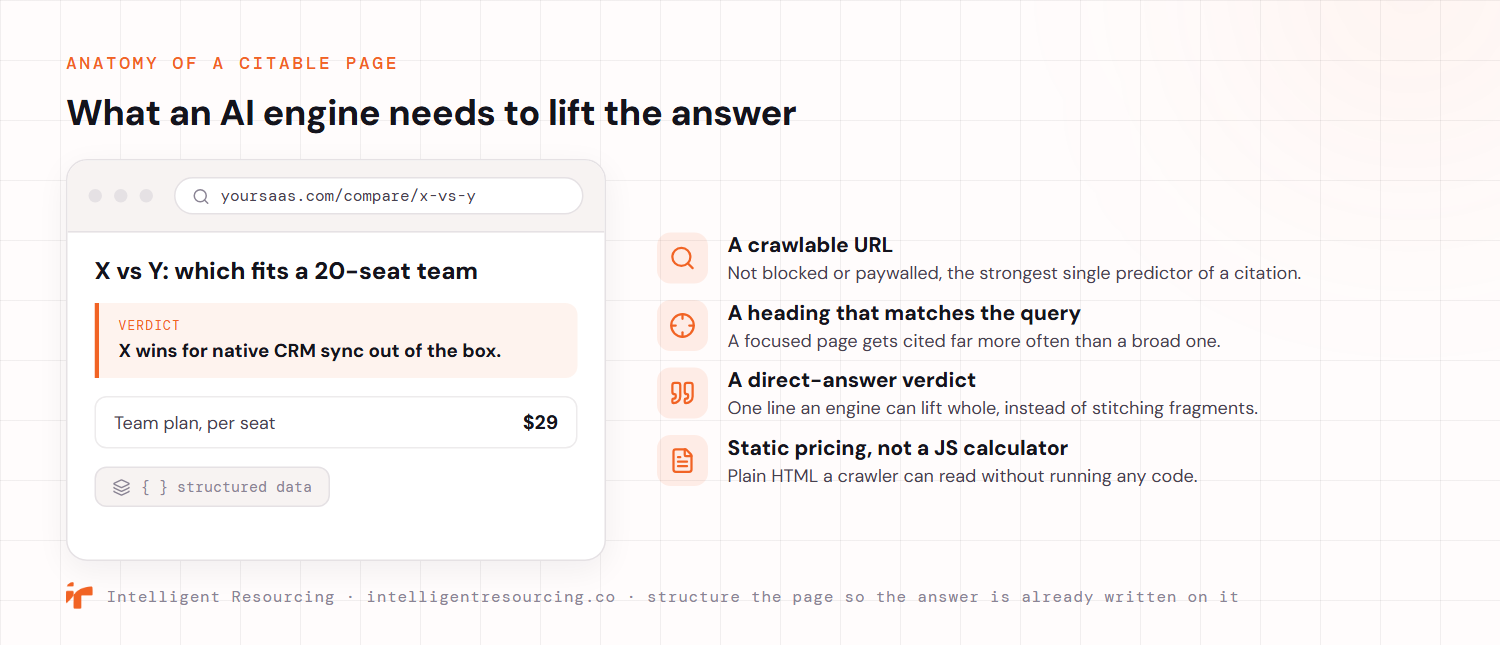
SaaS content usually has enough features listed. What it lacks is structure. Zyppy's citation ranking factors study found URL accessibility is the strongest single predictor of AI citation. A page has to be crawlable, not blocked or paywalled, before an engine can cite it at all. Google AI Overviews apply the same gate, so getting cited in AI Overviews starts there too.
A separate AirOps study of 16,851 queries found focused pages beat broad ones, with a strong heading-query match cited 41% of the time versus around 29% for weaker matches. SaaS content often misses that match because of how it gets built.
- Feature comparisons spread across long pages force an AI engine to extract fragments instead of a clean answer, lowering citation likelihood even when the information is accurate.
- Interactive pricing calculators requiring JavaScript often cannot be parsed by AI crawlers, so a pricing question gets answered from a third-party review site instead.
- Integration pages buried in documentation rather than marketing content miss the exact query an AI engine is trying to resolve.
- Free trial and onboarding details scattered across support articles leave a common evaluation question with no single page an engine can cite confidently: what happens after the trial ends.
Crawlable pages, clean structure and machine-readable content are the mechanical baseline here. The SaaS-specific work is applying those mechanics to comparison tables, pricing tiers and integration pages specifically, not general blog content. None of these fixes require new content. They require restructuring what already exists.
What Should SaaS Companies Prioritise First?
Comparison and alternatives content should come before general educational content, since that is where a SaaS buyer's AI search query is most likely to land during active evaluation. A well-structured "Us vs Competitor" page answers the exact question an AI engine is trying to resolve. The monthly shape of that work is set out in our comparison of a GEO retainer and SEO retainer.
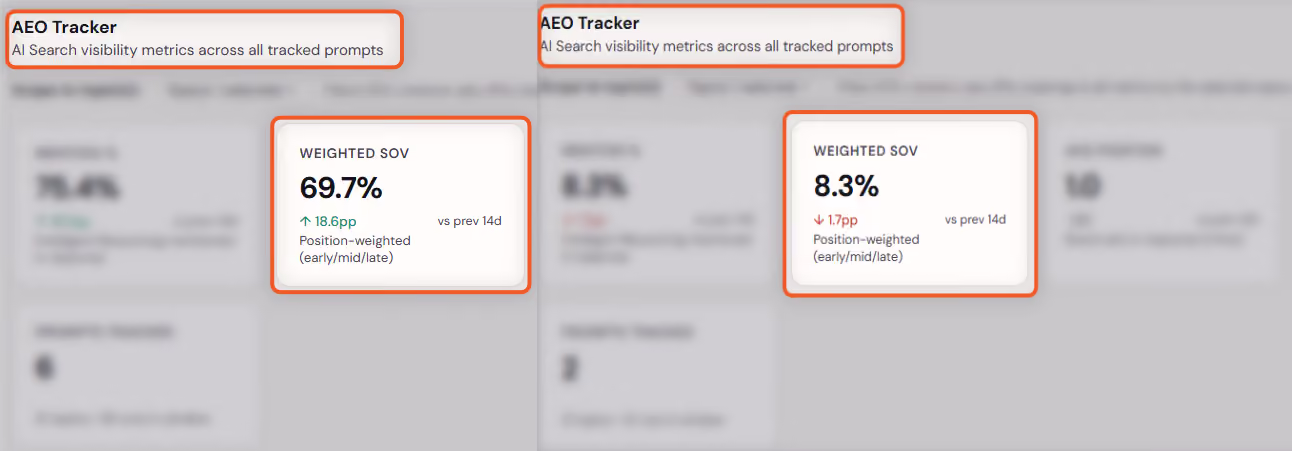
Intelligent Resourcing holds a 69.7% weighted share of voice in its tracked "Best - Clay Workflow" category, and 8.3% in the related "Pricing - Clay" category (source: Intelligent Resourcing AEO Tracker, 24 July 2026), the only brand with any tracked visibility there at all. That came from treating one category as ownable, the same approach a SaaS company should apply to its own comparison and integration queries.
A project management SaaS company with 40 blog posts and one comparison page illustrates the mismatch. The 40 posts cover general productivity topics an AI engine has thousands of other sources to draw from. The single comparison page answers a question with only a handful of credible sources, its own product against two named competitors on a specific integration.
A SaaS-Specific GEO Checklist
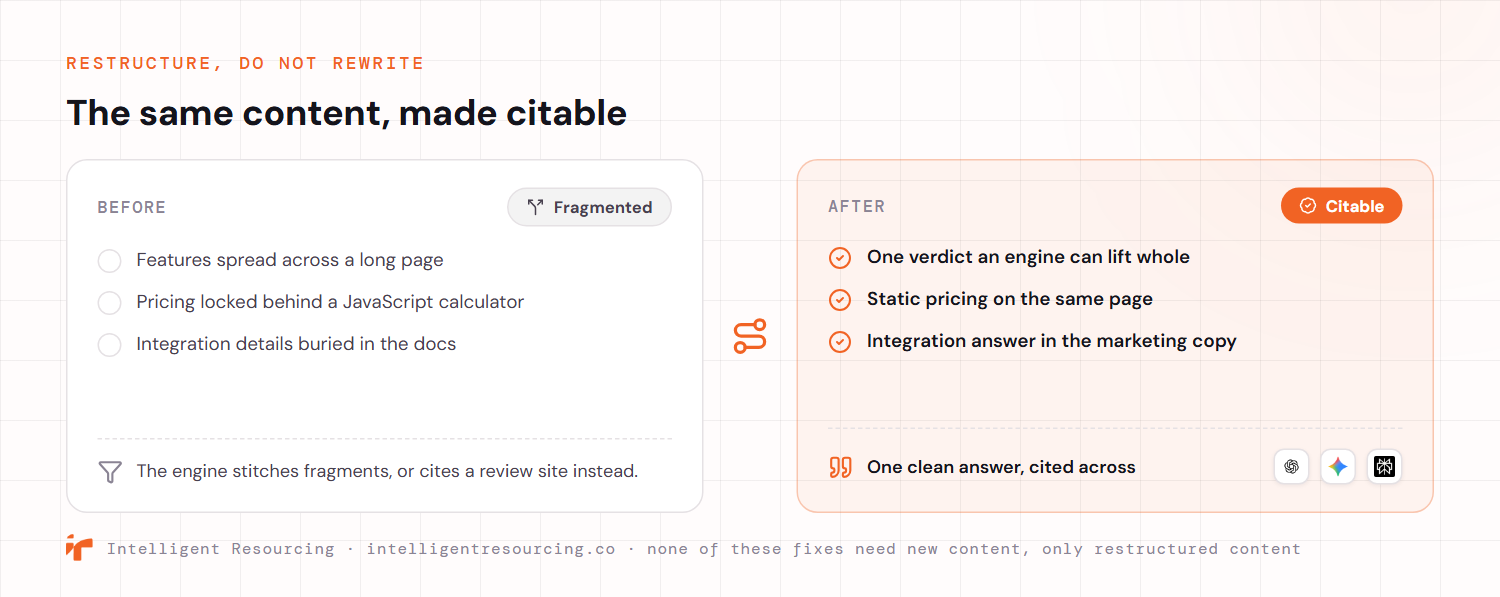
Building GEO into an existing SaaS content library starts with the highest-intent pages, then works outward.
- Audit comparison and alternatives pages first, since these carry the highest-intent SaaS queries and the smallest pool of competing sources.
- Convert pricing tables and calculators into static, crawlable HTML alongside any interactive version, so a crawler has a plain-text answer even if it cannot run the calculator.
- Apply structured content and schema to comparison verdicts specifically, not just blog posts, since verdicts are what gets lifted into an answer.
- Check citation performance per engine, since getting cited in ChatGPT and getting cited in other engines do not move at the same rate.
- Track a SaaS-specific topic set even without an external benchmark, since an internal baseline beats no measurement at all.
Which GEO Fix Comes First This Quarter?
Fix the top three comparison pages first. Structure each as a single verdict an engine can extract whole, keep the pricing answer on the same page instead of behind a calculator, and check citation performance per engine before touching the rest of the library.
That order is significant because comparison pages carry the highest-intent SaaS queries against the smallest pool of competing sources. That is the fastest realistic path to a first citation. It also matches what the underlying research shows: structuring content with citations, quotations and statistics measurably lifts a source's visibility in generative engine answers, according to the original GEO research from Princeton and Georgia Tech. Structure, not volume, is the highest-return lever available. Book a call to review your top three comparison pages.
Content Creation
Intelligent Resourcing audits your comparison, pricing and integration pages, then rebuilds the highest-intent ones so AI engines can extract and cite them. Book a call to map where your SaaS citations are landing and the fixes that close the gap.
FAQs
What is generative engine optimisation for B2B SaaS?
It is the practice of structuring SaaS comparison, pricing and feature content so AI search engines can extract and cite it directly during a buyer's evaluation process.
How is GEO for SaaS different from general GEO?
SaaS buying involves a distinct comparison and integration research stage that generates specific query types, like tool-vs-tool and pricing questions, that general GEO advice does not address directly.
Do SaaS companies need a different content strategy for each AI engine?
Citation behaviour varies by engine, so a comparison page performing well in one engine's answers is not guaranteed to perform the same in another.
Is there existing data on how SaaS companies perform in AI search?
Not yet as a standalone tracked category, as of 8 July 2026. This is a genuine measurement gap across the industry, not just for any one brand.
Should a SaaS company restructure every page for AI citation at once?
No. Comparison and alternatives pages carry the highest-intent queries and the smallest source pool, so they earn a citation faster than general educational content. Start there before touching the rest of the library.