


Backlinks as an Entry Gate
Backlinks and citation are two separate jobs that a lot of SEO advice still treats as one. A link's oldest job is earning organic rank. Its newer job is helping a page reach the pool an AI engine retrieves from before it writes an answer. The first job is well understood. The second is where most teams still guess.
Referring domains still do real work here. They help a page reach the candidate pool an engine draws from before it composes an answer, which makes them a strong predictor of whether a page is even in the running. That is the entry gate. What it does not settle is which page wins the citation once several pages clear that same bar. Confusing the two is why "build more links" keeps getting repeated as AI-citation advice, when the actual lever sits one step further along.
Domain Authority Does Not Predict Which Page Gets Cited
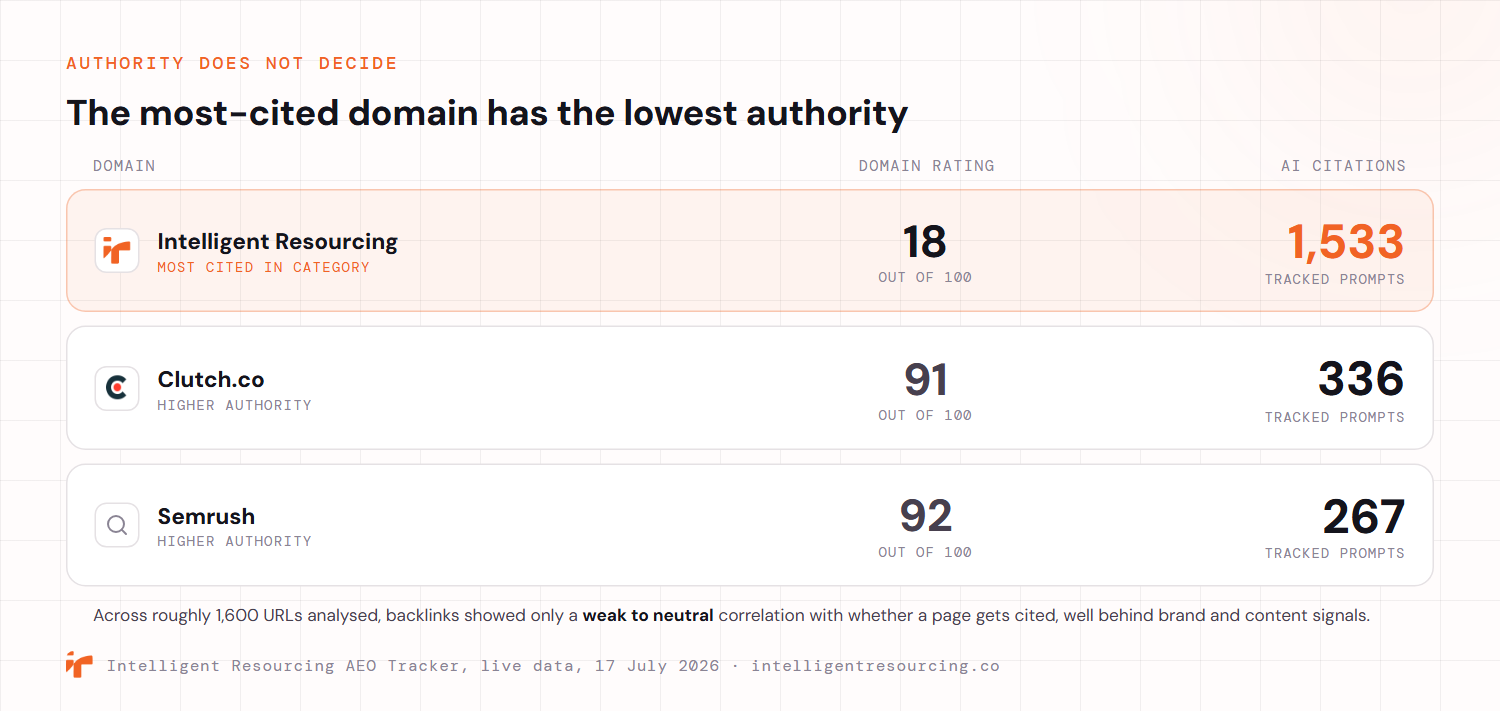
Once a page is inside the candidate pool, domain authority stops being the deciding factor. Intelligent Resourcing sits at a domain rating of 18, while Clutch.co and Semrush sit far above it at 91 and 92 on the same scale. Despite that gap, Intelligent Resourcing is the most-cited domain in its own tracked category, 1,533 citations across all tracked prompts, ahead of both (source: Intelligent Resourcing AEO Tracker, live data, 17 July 2026).
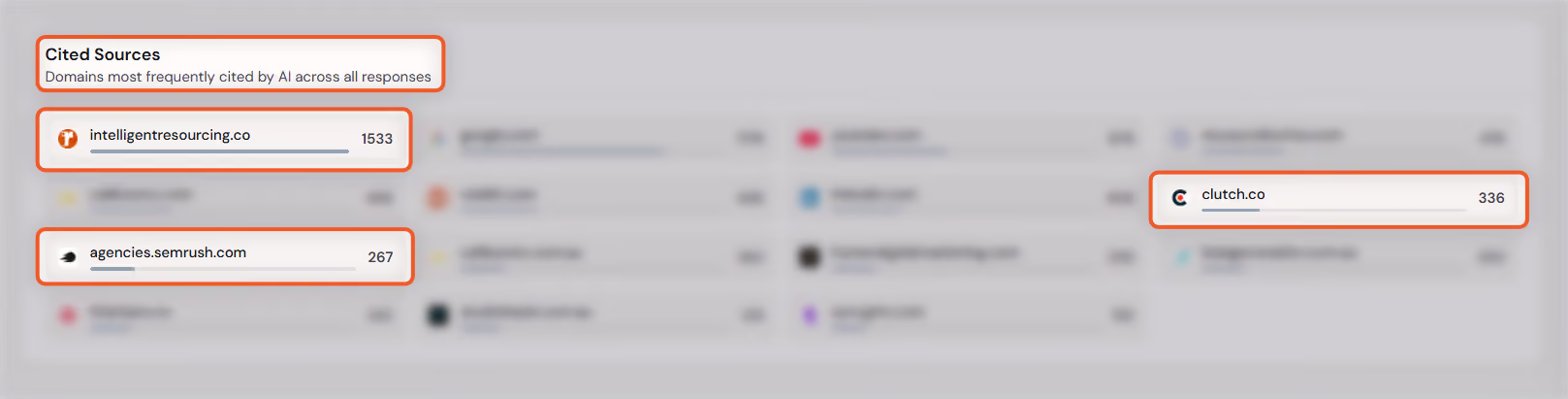
This is not an argument that authority does not matter at all. It is evidence that authority stops paying off past a certain point. Two pages can clear the same entry threshold and only one gets named, and the difference between them is rarely which one has more referring domains. It is usually which one states its claim more clearly, in language an engine can lift and quote without editing. One 2025 citation analysis of roughly 1,600 URLs found that backlinks showed a weak-to-neutral correlation with whether a page gets cited, well behind brand and content signals. Winning that second gate is the core of our generative engine optimisation service.
How Referring Domains Gate the AI Candidate Pool
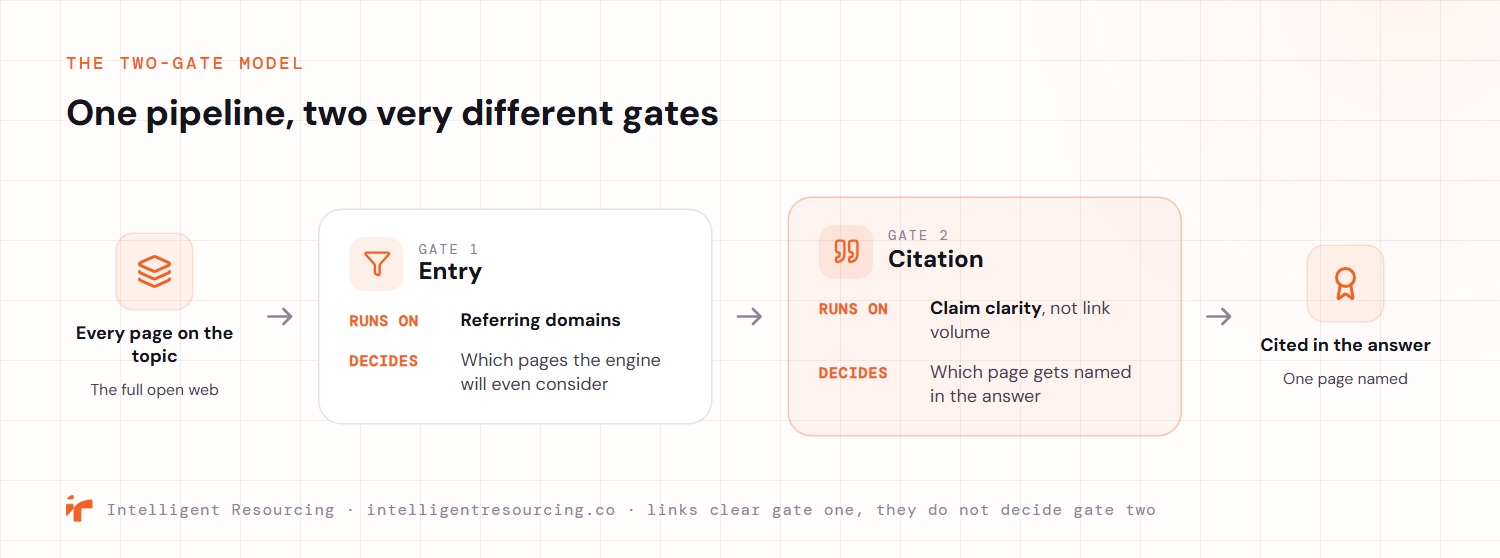
A useful way to picture the mechanism is two separate gates, not one continuous scoreboard.
- Gate one filters which pages an engine will even consider. Referring domains operate almost entirely here.
- Gate two picks the winner among whatever cleared gate one. This runs on a different signal: claim clarity, not link volume.
A team chasing more links past the point where they already clear gate one is spending budget on a gate they have already passed. Research on generative-engine optimisation found that citing external sources measurably lifts visibility for lower-ranked pages specifically, one concrete lever available past gate one, distinct from adding more referring domains to the page itself. Most link-building advice was written before gate two existed as a concept, so it keeps recommending the same fix regardless of which gate a page is actually stuck at. The wider AEO and SEO budget split follows the same logic.
Why a Clear Number Beats a Vague Claim

Picture two hypothetical pages on the same topic, both with a similar referring-domain profile, both sitting inside the same candidate pool an engine is considering.
Page A says: "Our approach helps businesses understand the cost of AI visibility work and make informed decisions about their marketing budget."
Page B says: "A cross-engine AI citation audit in Australia typically costs $1,500 to $5,000 for a one-off project, or $2,000 to $8,000 a month for ongoing support."
Both pages clear gate one equally well. Only Page B is written the way gate two rewards: a number, a scope and a currency an engine can lift directly into an answer without needing to interpret or rewrite anything first. Page A says something true and specific-sounding, but there is nothing in it an engine can quote without paraphrasing. That gap, not the referring-domain count behind either page, is what gate two measures.
Google AI Overviews Still Reward Backlinks More
Backlinks carry more weight inside Google AI Overviews than they do on other engines, because Overviews lean on existing rankings more heavily as an input. One 4,000-query analysis found that 97.3% of AI Overviews cited at least one page from the top 10 organic results, and a separate 2025 study found 52% of the organic citations inside AI Overviews came from top-10 pages. The mechanics of getting cited in Google AI Overviews follow from that ranking dependency.
That makes Google AI Overviews the one place in this guide where the old advice and the new advice mostly agree. Ranking still helps here, because ranking is close to the input the Overview reads first. It does not remove the second gate. A top-10 page still needs a clear, quotable answer to be one of the small number of sources an Overview actually names.
What the Two-Gate Model Means for Link-Building

The practical shift is where the marginal dollar goes once a page clears the entry threshold. Below that point, links are still the right lever, because the page is not yet in the pool an engine reads from. Above it, that same dollar spent on claim clarity, consistent entity data and a direct answer near the top of the page does more for citation odds, without removing backlinks from the plan or changing where they sit in the sequence. The order to fund each one is set out in our guide to AEO and SEO sequencing.
Best for:
- Teams with a reasonable link profile already, deciding where the next content dollar goes.
- Anyone treating "more backlinks" as the default answer to a flat AI-citation number.
Not for:
- Brand-new domains with almost no links yet. Clear the entry threshold first.
- Teams optimising purely for Google AI Overviews on high-competition commercial terms, where ranking still carries more weight than elsewhere.
The trade-off: chasing links past the entry threshold spends budget on a gate already cleared. Claim clarity is the lever that actually moves citation odds past that point.
Authority gets a page into the room. It does not get the page named once it is there. Book a call to find out which gate your pages are stuck at.
Content Creation
Intelligent Resourcing's Content Strategy team audits where your highest-intent pages sit against both citation gates, then rebuilds them for claim clarity and entity consistency and tracks share of model on a fixed prompt panel. Book a call to map the gaps and the fixes that close them.
FAQs
Do backlinks still help SEO rankings in 2026?
Yes. Backlinks remain a core Google ranking factor. That has not changed. What has changed is how much a link profile predicts AI citation once a page is already ranking.
Is domain authority the same thing as citation likelihood?
No. Domain authority helps a page clear the entry threshold into an AI engine's candidate pool. It does not reliably predict which page in that pool gets named in the final answer.
Do Google AI Overviews rely on backlinks more than ChatGPT or Perplexity?
Overviews lean more heavily on existing organic rankings as an input, so backlinks carry more indirect weight there than on engines that draw from a wider, less rank-dependent pool.
Should a low-authority site still try to get cited by AI engines?
Yes, once it clears a baseline entry threshold. A low-authority domain with a clear, well-structured answer can still out-cite a higher-authority page that states its claim less clearly.