

What's the Difference Between AEO and SEO for B2B?

SEO earns organic rankings; AEO earns citations inside AI answers from ChatGPT, Perplexity, and Google AI Overviews, and the two are not rivals. AEO is additive to SEO, built on the same indexed, authoritative pages: SEO gets you ranked, while AEO gets you quoted when buyers ask a machine instead of a search box.
The distinction matters because the underlying signals differ. SEO rewards backlinks, keyword coverage, and page authority. AEO rewards structured data, entity consistency, and a clean citation footprint. AI Overviews concentrate citations on a small set of trusted domains, with YouTube often topping the list, a pattern that comes down to AI engines leaning on sources they already trust, and trust starts with organic visibility.
So treat answer engine optimisation as a layer on top of SEO, not a swap for it, since the work overlaps more than it competes: structure each page answer-first, put the direct answer in the first 100 words, and keep your entity details consistent across the site, LinkedIn, and Crunchbase. A content lead writes the page while a developer adds the structured data. Done together, one page can rank in Google and earn a citation from ChatGPT in the same week.
Should a B2B Company Invest in AEO or SEO First?

Fund SEO foundations first for a low-authority domain, then layer AEO the moment you hold organic rankings. For any site with existing visibility, start AEO now, and go AEO-heavy when buyers already use AI to shortlist vendors. The rule is simple: build indexable authority first, because answer engines cite pages that already rank.
Three scenarios cover most B2B teams.
- Established SEO, new to AEO: shift incremental budget to AEO. A 60% SEO / 40% AEO starting split is reasonable. You already rank, so the structured-answer layer pays back quickly.
- Starting from scratch: build the SEO baseline and the AEO technical layer in parallel. Add schema and entity consistency early. Structure every page answer-first from day one.
- Buyers already using AI: go AEO-heavy now, measure AI-sourced pipeline directly, and defend the shortlist where your buyers actually are.
The logic holds across all three. AI Overviews still lean heavily on pages that already rank in Google, so a zero-visibility site gives a model nothing to pull. Build the SEO foundation first, then the AEO layer has something to amplify. The urgency is real: 51% of B2B buyers now start research with AI before Google, up from 29% eleven months earlier (G2, 2026).
How Does AEO vs SEO ROI Compare for B2B?

SEO and AEO pay back differently. SEO compounds; the median B2B programme returns strong multiples over three years. AEO wins on conversion quality, because AI-sourced visitors arrive pre-qualified by the model. Fund the compounding base, then capture the higher-converting AI traffic.
Putting numbers on it: median B2B SEO ROI reaches 748% over three years (First Page Sage, 2026), which is why the foundation compounds, building slowly before it accelerates. AEO changes the conversion maths, since AI search traffic converts at 14.2% versus 2.8% for Google organic, roughly a 5x advantage as of 2026 (Opollo, 2026). The reason is selection: a model only forwards a visitor after it has endorsed you as a source, so the click carries built-in trust.
Read it with Anchor-Claim-Delta: the baseline is 2.8%, the AI-sourced figure is 14.2%, and the delta is roughly five times the conversion rate, on a smaller but warmer stream of traffic. Separate the timeless principle from the dated figure: SEO compounding is structural and will hold, but the 14.2% gap is a 2026 snapshot and will move.
Why Does AEO Matter for B2B Lead Generation?
AEO matters because buyers now research with AI before they ever reach your site. They ask a model, read its synthesised answer, and build a shortlist from the sources it cites. If you are not cited, you are not considered. For committee-based B2B deals, that pre-sales shortlist decides who gets the meeting.
Search behaviour has been changing rapidly. 84% of B2B professionals now use AI for work, and 66% regularly use it to research vendors and solutions before contacting one (Semrush, 2026). AI chatbots are now a leading influence on which vendors make a B2B software shortlist, and 33% of buyers have bought from a vendor they were not previously familiar with, discovered entirely through an AI answer. That is pipeline created before a human ever spoke to your team.
Committee buying makes this sharper: five to ten people weigh in on a B2B purchase, each runs their own AI research, and the vendor cited across those sessions enters every shortlist. This is why B2B lead generation now starts inside the answer, not the ad. Win the citation and you reach the shortlist before competitors know the deal exists; miss it and your pipeline quietly shrinks, with no failed campaign to point at.
What Our Own AEO Tracking Shows
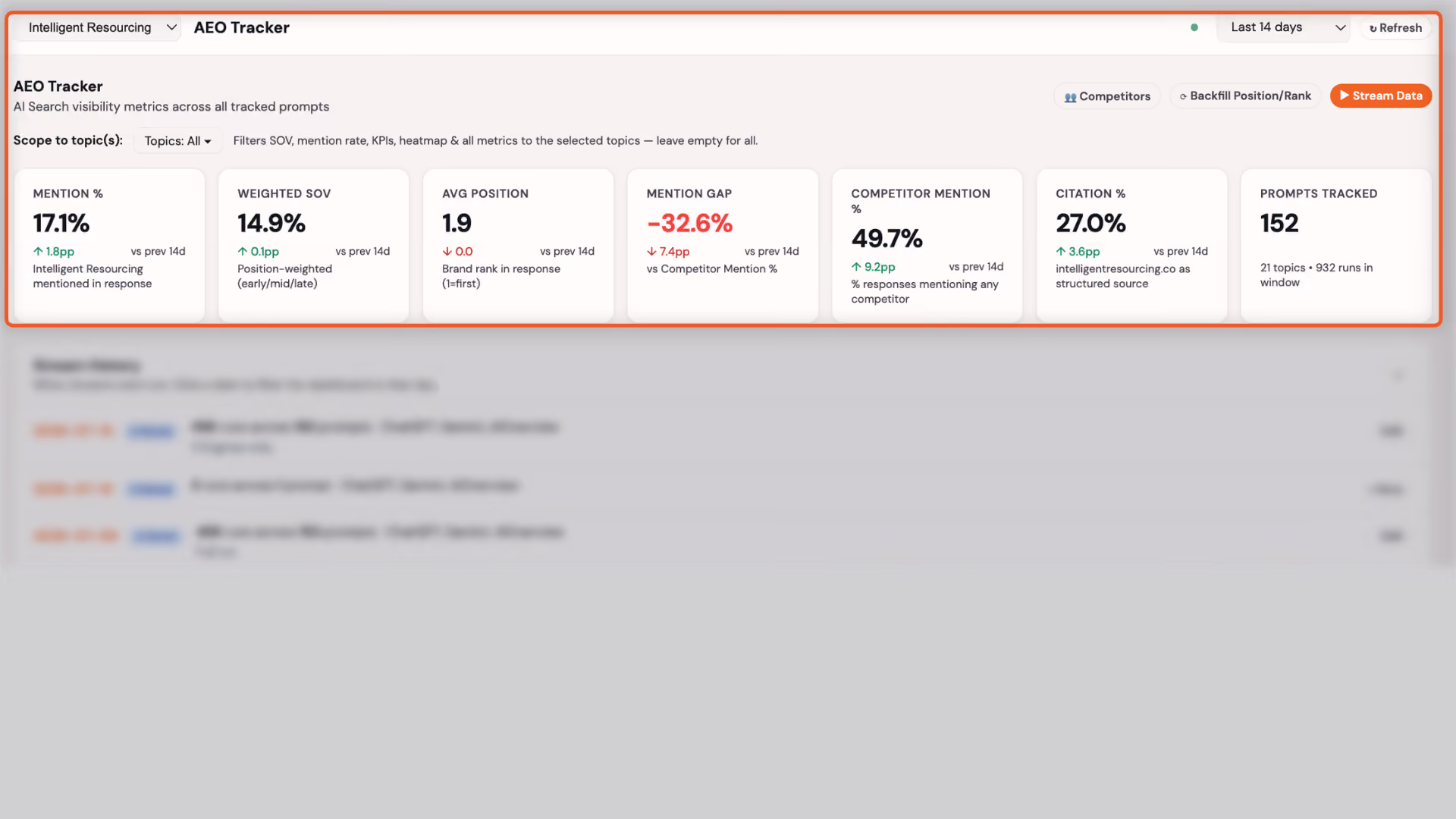
Our internal AEO dashboard tracks 152 B2B prompts across 21 topics on ChatGPT, Gemini and AI Overviews, with 932 runs logged in the last 14 days (Intelligent Resourcing AEO tracker, 16 July 2026). The pattern in our own data matches the argument above: citation and mention are not the same thing, and the gap between them is where most teams lose ground.
Our citation rate sits at 27.0%, meaning intelligentresourcing.co is used as a structured source in over a quarter of tracked responses, but our mention rate, where the model actually names Intelligent Resourcing outright, sits lower at 17.1%. The uncomfortable number sits right beside it: competitors get named in 49.7% of responses across the same window, more than twice our own mention rate, producing a mention gap of -32.6 percentage points. When we are named, though, we land at an average position of 1.9, close to the top of the answer, and weighted share of voice sits at 14.9%. That combination, a strong position when we appear against a wide gap in how often we appear, is the practical version of the point made earlier: ranking gets you into the pool of trusted sources, but structured, entity-consistent content is what turns a citation into a named mention.

On share of voice, looking across the tracker's full history rather than just the last 14 days, we track 56 domains across 292 prompts, 55 of them competitors. Intelligent Resourcing holds the top position at 15.68% of total citation mentions (624 of 3,980 tracked mentions), just ahead of Callbox at 14.05% (559 mentions). The margin is thinner than we would like at roughly 1.6 points, close enough that a soft content quarter could hand the top spot to a competitor.
Callbox's own numbers make the sequencing case sharper. Also looking at the full tracking history, Callbox's citation authority score sits at 6 out of 100, cited in just 38 of 3,614 tracked runs since the tracker went live, a 6.4% citation frequency. Against our own 27.0% citation rate over the most recent 14-day window, the underlying authority gap is wider than the headline share-of-voice numbers suggest. In our work, that combination, competitive share of voice plus a wide authority gap under the surface, only shows up on domains that already carry organic authority. It is the same sequencing logic this article argues for, measured against our own prompt set rather than a third-party report.
How Should B2B Teams Sequence AEO and SEO Investment?

Sequence by authority, not by trend: on a new domain, weight spend 70/30 toward SEO until pages index and rank. On an established programme, run 60/40 and move toward 50/50 within twelve months. Where buyers already shortlist with AI, flip to 40/60. Then refresh often, because AI engines favour fresh sources.
Cadence is the lever most teams miss: AI-cited URLs run 25.7% fresher than standard organic results (Ahrefs, 2026), so a stale page loses citations even while it still ranks. Schedule a substantive refresh every 60 to 90 days. Update the statistics, add new evidence, and tighten the direct answer, since a timestamp change alone does nothing.
Run this inside an Answer-First Content System, so every page carries a direct answer, schema, and consistent entities by default, putting the role and the mechanism in one place.
Now the failure mode: funding AEO structure on a zero-authority domain wastes budget, because LLMs rarely cite sites with no organic visibility. We have watched this play out. One client added textbook schema to a new domain and earned no AI citations for months, until the underlying pages finally ranked in organic search. You can add perfect schema to a page no model trusts and still get nothing back, so build the rankings first, then the AEO layer has a foundation to stand on.
Building Your AEO and SEO Content Strategy
The choice was never AEO or SEO; it is a sequence. Build the SEO foundation, then layer AEO so the same pages rank in Google and get cited by AI. The structural work serves both at once, which is why a layered programme beats an either-or bet.
This is the work Intelligent Resourcing does: answer-first content that ranks and gets cited. We build the SEO base, add the answer engine optimisation layer, and track share of model alongside organic traffic.
Content Creation
We map your budget split and sequence to your domain's authority, then show which pages can both rank in Google and get cited by AI. Want the numbers first? Estimate your return, then bring it to the call.
FAQs
Can a B2B company do AEO without SEO?
Technically yes, but it rarely works. The AEO technical layer still depends on an indexed, credible site. A zero-authority domain struggles to earn citations, because answer engines pull from sources they already trust. Without organic visibility, your schema and structured answers have nothing to amplify. Build the SEO base first, then layer AEO.
Does investing in AEO hurt SEO rankings?
No. The changes that improve AI visibility also improve SEO. Clearer structure, schema markup, and entity consistency are positive signals for both. A page built answer-first reads better for humans and ranks better in Google. AEO and SEO reinforce each other; investing in one strengthens the other rather than competing for budget.
How long until AEO or SEO shows ROI for B2B?
SEO typically takes 6 to 9 months to compound, then returns build for years. AEO tactical gains can appear within 1 to 3 months on an already-authoritative domain, because the model rewards fresh structure fast. On a new domain, AEO results lag until organic authority exists, so sequence accordingly and measure both.
What budget split between SEO and AEO should B2B start with?
A 60% SEO / 40% AEO split is a reasonable starting point for an established programme. Move toward 50/50 as you measure AI-sourced pipeline. New domains should start nearer 70/30 to build authority first. Teams whose buyers already shortlist with AI can run 40/60, but let measured pipeline, not hype, move the ratio.
Is AEO the same as GEO for B2B marketing?
Effectively yes. They describe the same discipline. AEO is the common industry term for earning citations in AI answers. GEO, generative engine optimisation, is the more academic label for how generative models select sources. Use whichever your team prefers. The work is identical: structured, credible content that AI engines trust enough to cite.