

AEO retainers often cost 15% to 30% more than the monthly fee shown in the proposal. Additional charges can include tracking platforms, reporting tools, Reddit or community seeding, content production, technical implementation and one-off setup fees. Intelligent Resourcing treats these costs as part of the total engagement model, so buyers can compare the true monthly and first-year cost before signing.
A marketing lead may agree to a $3,000 to $8,000 monthly AEO retainer, only to spend the next quarter approving separate invoices for tracking software, Reddit seeding and an implementation charge that was never highlighted during the pitch.
That gap between the quoted fee and the amount ultimately paid is the focus of this guide. The sections below map the hidden costs that commonly sit outside an AEO retainer and explain how to identify, question and price them before committing to an agency.
The evidence that these costs matter appears in agencies' own pricing guidance. Discovered Labs' 2025 breakdown states that commonly overlooked expenses can add 15% to 30% to the total cost of an engagement. If an AEO proposal presents only one monthly figure, it is unlikely to show the complete cost. The next sections explain what may be missing.
What the AEO retainer monthly fee actually buys

An AEO retainer usually pays for a defined monthly scope of content, technical optimisation, visibility tracking and reporting. It typically does not include the full cost of third-party tracking tools, community distribution, digital PR or other off-site work required to earn citations.
A credible answer engine optimisation retainer commonly includes:
- A fixed volume of answer-focused content
- Schema implementation and entity optimisation
- AI visibility tracking across major answer engines
- Monthly performance reporting
- Ongoing content and technical recommendations
AI Overviews now appear on a substantial and rising share of Google queries, reaching around one in six by late 2025, up from well under one in ten at the start of the year, which means tracking whether your brand appears inside those answers is core work. The fee covers the monitoring and the content; it rarely covers the tools that generate the monitoring, or the off-site work that earns the citations.
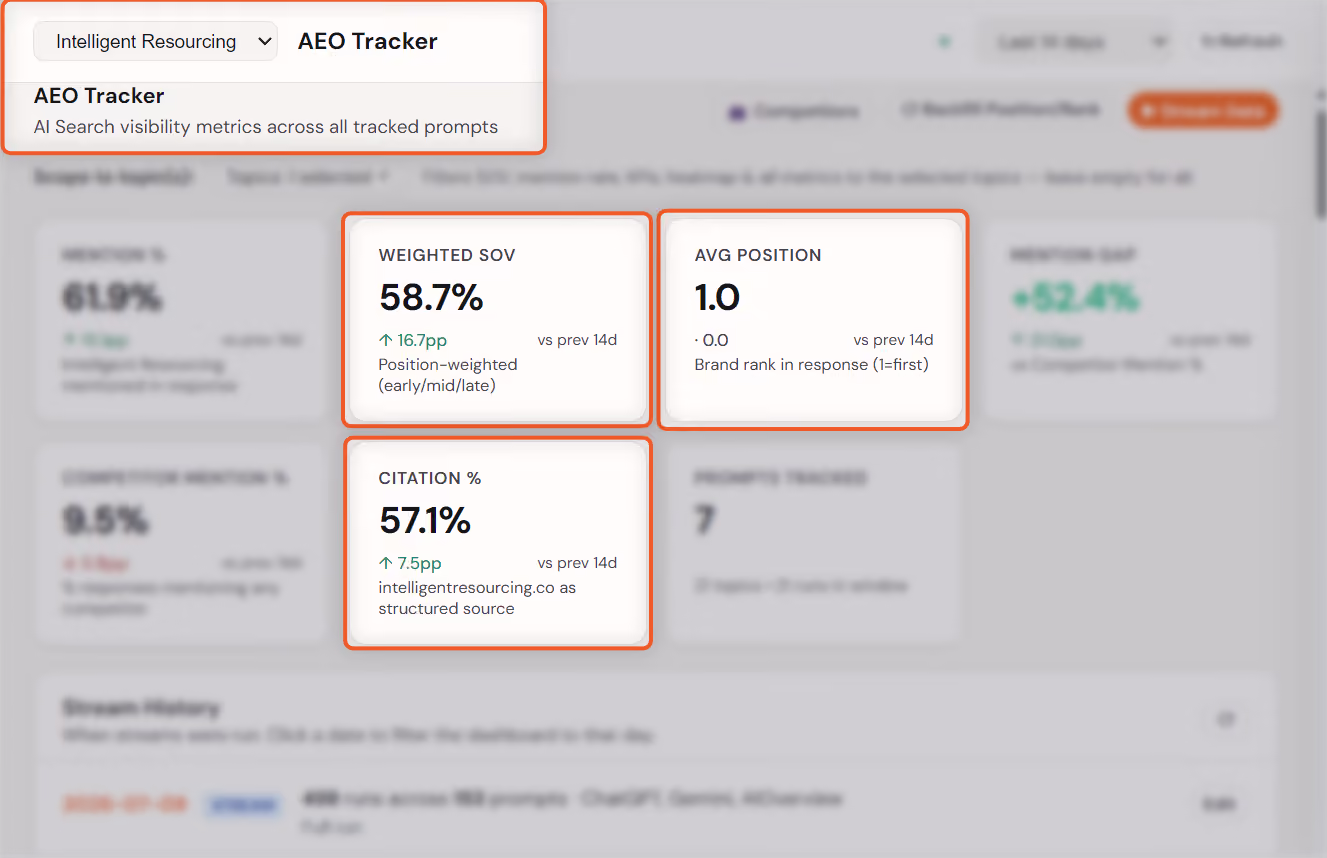
Intelligent Resourcing runs its own AI-visibility tracking as standard, not billed separately. The tracker covers intent-mapped prompts across different AI engines and produces a run-cycle output of: share of answer %, citation rate, average mention rank within the AI response, and a cited domain breakdown showing which third-party sources appear alongside the brand. Based on the 14-day tracking period from 1 July to 15 July 2026, Intelligent Resourcing achieved a 58.7% share of answers in the Best Clay Workflow cluster, ranking first among more than 50 tracked competitors. This shows the value of including AEO tracking within the retainer rather than charging for it as a separate SaaS cost.
Here is what the headline fee usually maps to across the market.
| Tier | Typical monthly fee | What is usually in scope |
|---|---|---|
| Entry | $1,000 to $2,500 | Basic AI-visibility tracking, foundational on-site optimisation |
| Mid-market | $3,000 to $8,000 | Tracking, competitive analysis, content, schema |
| Enterprise | $10,000 to $30,000+ | Multi-engine coverage, technical implementation, dedicated team |
The tiers look tidy, but the scope column is where two providers quoting the same fee diverge. One mid-market retainer at $5,000 might include competitive analysis and 20 pieces of content; another at the same price might cap content at 4 pieces and treat schema as an add-on. The fee tells you almost nothing until you read what sits behind it, which means two retainers at the same headline fee can differ by tens of thousands of dollars a year once you read the scope line by line.
AEO retainer costs vs SEO retainer costs
An AEO retainer typically costs 20% to 40% more than a comparable SEO retainer because it includes additional content, technical, off-site and monitoring work. The difference should be itemised so buyers can see which services are included, which costs sit outside the quoted fee and how the proposal compares with wider AEO pricing in Australia.
Stackmatix's 2026 cost analysis places AEO retainers 20% to 40% above equivalent SEO engagements. The additional cost is usually driven by four areas:
- Higher content production and update frequency
- Entity optimisation and schema implementation
- Off-site citation and mention building
- Visibility monitoring across multiple answer engines
Space & Story's 2026 pricing model describes a similar approach, with many agencies adding a 20% to 30% AEO surcharge to an existing SEO retainer.
The price difference is therefore linked to a broader scope of work. The issue is that agencies do not always show how the surcharge is allocated. Buyers may pay the premium without knowing how much relates to content, technical implementation, citation building or tracking.
This lack of itemisation makes AEO and SEO retainers difficult to compare. A useful cost comparison should separate the base SEO scope from each additional AEO service and show whether tools, off-site activity and implementation fees are included.
| Dimension | SEO retainer | AEO retainer |
|---|---|---|
| Typical monthly band (mid-market) | $5,000 to $18,000 | $8,000 to $25,000 |
| Content velocity | 4 to 8 pieces/month | 20+ pieces/month |
| Pricing model quirk | Standalone | Often sold as +20 to 30% surcharge on SEO |
| Core cost driver | Rankings + backlinks | Citation architecture + off-site validation |
The dimensions that drive the premium are the ones a headline fee hides. Content velocity roughly quintuples, and off-site validation replaces backlinks as the main lever, both of which cost real money to sustain. The monthly gap between the two models runs $3,000 to $7,000, which means a mid-market buyer moving from SEO to AEO should expect an extra $36,000 to $84,000 a year, and should ask the provider to name which cost driver justifies it rather than accepting the surcharge as a round number.
The recurring add-ons that never hit the retainer line

The add-ons are not extras bolted onto AEO; they are the work. A retainer that excludes tooling, off-site seeding, links and per-page copy is quoting a fraction of the job. Space & Story's 2026 breakdown prices AI-visibility tooling on its own at $29 to $499 a month, billed as a separate SaaS line the client often carries directly. On top of that sit off-site citation and Reddit or Quora seeding at $500 to $2,000 a month, plus digital PR and backlink work, and copywriting charged per page. Getting structured data for AI right and staying visible in engine answers both sit inside this layer, which is why sound AEO couples on-site work with off-site validation instead of treating either as optional.
Here is the add-on stack most buyers end up carrying, and how each line tends to reach the invoice.
| Add-on | Typical market price | Billed as |
|---|---|---|
| AI-visibility tracking tools | $29 to $499/mo | Separate SaaS line |
| Off-site citation / Reddit-Quora seeding | $500 to $2,000/mo | Add-on |
| Backlink / digital PR | $500 to $5,000/mo | Add-on |
| Copywriting | $300 to $750/page | Per-page |
Sum a realistic mid-market stack and the point lands hard. Tooling at $200, seeding at $1,000, digital PR at $1,500 and 6 pages of copy at $500 each adds roughly $5,700 a month, which can rival or exceed a $4,000 retainer before a single strategy call. Sustained AI visibility depends on this work continuing, not on a one-off push, which means the true monthly number for many buyers sits 50% to 100% above the quoted retainer, and a quote that omits the stack is describing half the job.
Setup, onboarding and contract lock-in

The costs that do the most damage to an AEO budget are the one-off and contractual ones, because they are easy to skim past in a pitch and expensive to exit. Setup and onboarding fees range from $500 to more than $12,000, while early-termination penalties can reach five figures.
Clear AEO agency contract terms should therefore define minimum commitments, renewal clauses, termination rights, asset ownership and handover obligations before work begins. Lock-in without performance clauses shifts the risk onto the buyer, while month-to-month or performance-tied terms signal a provider confident enough to earn the renewal.
On the contract side, AIVO's 2025 analysis finds early-termination penalties commonly landing between $10,000 and $15,000, sitting behind 6 to 12 month minimum terms and, in some agreements, asset or IP clawbacks that strip your content and off-site citations if you leave. Before you sign, insist on line-item transparency and work through six questions.
Questions to ask before you sign:
- Setup and onboarding: is there a fee, and what exactly does it cover?
- Contract term: what is the minimum commitment?
- Early-termination: what is the penalty if we leave early?
- Ownership: who owns the content and off-site citations if we leave?
- Pass-through: are tools and copywriting included or billed separately?
- Baseline: will you show me the starting measurement before work begins?
Question six is the one most buyers omit. A baseline taken before a single piece of content goes live is the only honest way to prove improvement later.
Intelligent Resourcing establishes a full baseline scorecard at the start of every engagement: GEO Score, share of answer %, citation rate, average mention rank, and cited domains, measured across all four engines before any work starts. Without that baseline, a 3-month review is a comparison of two numbers with nothing to anchor them to. Ask any prospective AEO agency to show you their baseline measurement protocol and to name which engines they track, how many prompts they run, and what the output looks like before you sign.
If your prospective provider cannot answer these six in writing, that is your signal to renegotiate the terms before the scope, not after the first surprise invoice. The sunk cost of a bad lock-in is 3 to 6 months of fees you cannot recover, plus the opportunity cost of not switching to a provider who would have shown results in that same window.
The internal costs no invoice shows
The cheapest retainer on paper can be the most expensive once you count the work your own team absorbs. AIVO's 2025 cost breakdown puts internal coordination and review at 10 to 15 hours a month, and layers a hidden-cost buffer on top of the headline fee: roughly 10% to 15% for agency engagements, 25% to 35% for in-house builds, and 15% to 20% for hybrids. Add the tools you already pay for, the Ahrefs or Semrush seats that overlap with the agency's stack, and the opportunity cost of a slow ramp, and the cheap option quietly becomes the dear one. None of this appears on an invoice, which is exactly why it gets left out of the comparison.
Coordination time is the line most teams underprice: 10 to 15 hours a month of a marketing manager's time is a real allocated cost, and it recurs whether or not the retainer delivers. Duplicate tool spend is easier to fix once you spot it, and the slow-ramp cost is the one that scales with how much of your pipeline AI search already influences. Translate the buffer into your own budget: on a $5,000 retainer, a 20% internal load is another $1,000 a month you are spending regardless of what the invoice says.
| Invisible cost | Who absorbs it | Rough monthly equivalent |
|---|---|---|
| Coordination / review time | Internal team | 10 to 15 hrs (allocated cost) |
| Duplicate tool spend | Internal budget | $100 to $500/mo |
| Slow-ramp opportunity cost | Pipeline | Varies with AI-influenced revenue share |
Which AEO cost structure fits your situation

The right cost structure is the one that fits your budget ceiling, internal capacity, urgency and tolerance for contract risk. Conductor's 2026 research finds that 94% of CMOs plan to increase their AEO and GEO investment, which means the question is no longer whether to buy but how to structure it. Four models dominate: a bundled all-in retainer, an add-on-priced retainer, a project or audit-first engagement, and a hybrid. Match the model to your situation rather than to the headline price.
- If your budget ceiling is fixed and add-ons are the risk, then choose a bundled, all-in retainer with tooling and copywriting included.
- If you have an internal SEO team with spare capacity, then a strategy-tier advisory engagement lowers your total cost.
- If you cannot commit before proof, then start with a one-time audit at $1,500 to $5,000 before any retainer.
- If contract risk is your main concern, then require month-to-month or performance-tied terms and written content ownership.
- If speed to AI visibility is critical, then a full-service retainer buys the fastest ramp, at the highest add-on exposure.
Find the line that matches your situation and treat its recommendation as your next move, not a menu to browse. One condition, one structure, one decision to take this quarter.
Get a straight answer on your AEO retainer costs
The monthly fee is the smallest number on an AEO invoice; the total cost of tools, add-ons, setup, contract exposure and internal load is the decision that actually shapes your budget.
Every vague scope you sign is a quarter of add-on invoices you did not budget for, and the time to catch that is before the contract, not after the first surprise line item. Read every quote as a scope document rather than a price, and price the layers this guide covered before you sign anything.
Content Creation
Book a call and we will map your AEO scope line by line, price the tooling, add-ons, setup and internal load, and give you a true monthly and first-year number before you sign anything.
FAQs
How much does an AEO retainer actually cost in 2026?
Mid-market AEO retainers sit at $3,000 to $8,000 a month, rising to around $25,000 for full-service coverage. The headline number is not the whole story: hidden add-ons such as tooling, off-site seeding and setup fees add roughly 15% to 40% on top, according to breakdowns from Discovered Labs and Stackmatix. Budget for the range, not the floor, and ask which line items are included before you compare two quotes.
Why do AEO retainers cost more than SEO retainers?
AEO retainers run roughly 20% to 40% higher than equivalent SEO retainers because they fund more moving parts: higher content velocity, entity and schema work, off-site citation building, and monitoring across several answer engines rather than one search index. Providers often sell the difference as a 20% to 30% surcharge on an existing SEO retainer, which means the premium is real but frequently under-explained on the invoice.
What hidden fees should I look for in an AEO consultancy contract?
The AEO consultancy hidden fees that catch buyers out are setup and onboarding charges, tool pass-through billed as separate SaaS lines, Reddit or PR seeding, scope-creep charges for work outside the original brief, early-termination penalties, and asset or IP clawbacks that strip your content and citations when you leave. Ask for each in writing before you sign, because a quote that omits them understates the true monthly cost.
Are setup and onboarding fees standard for AEO retainers?
They are common but not universal. Setup and onboarding fees typically run $500 to $12,000 or more, and some providers fold them into the retainer instead of billing them separately. Neither approach is wrong, but the difference can be thousands of dollars in the first quarter. Ask explicitly whether a setup fee applies, what it covers, and get the number in writing before committing.
How much should I budget on top of the monthly AEO fee?
Plan a buffer of 15% to 35% above the headline retainer to cover tooling, off-site add-ons and internal coordination time. On a $5,000 a month retainer, that means an all-in figure closer to $5,750 to $6,750 once the pass-through line items are counted. The buffer is not padding; it is the part of the job the monthly fee leaves out, so build it into the comparison from the start.
Can I avoid AEO retainer lock-in and long contracts?
Yes. Month-to-month and performance-tied terms exist, and a provider confident in its work will usually offer one. Weigh that flexibility against the ramp AEO genuinely needs: results typically take 3 to 4 months to show, so a rolling contract you abandon at month two rarely proves anything. The better protection is content and citation ownership written into the agreement, not just a short term.