

What Does AI Search Visibility Actually Cost a B2B SME in 2026?
For most Australian SMEs, AI search visibility costs approximately A$300 to A$4,000 per month as of July 2026. The final figure depends on the scope of content, technical optimisation, authority building and measurement required, with AEO pricing in Australia varying significantly between light-touch advisory work, fixed projects and full monthly retainers.
Seer Interactive found organic click-through rate fell 61% on searches where a Google AI Overview appears. Semrush found AI-referred visitors convert at 4.4 times the rate of traditional search. So clicks fall, but conversions climb.
You are investing in AI search visibility, not simply chasing higher rankings. B2B marketing teams now compete for citations as well as clicks. That requires a coordinated mix of owned content, earned media and structured data, each helping AI systems retrieve, verify and surface your brand. Ignore that work, and competitors are more likely to be cited instead.
The cost is real, but manageable. It should sit within your existing search budget rather than become a separate enterprise-scale expense. We call this allocation the AI Visibility Slice: a fixed proportion of search spend, sized to the needs and growth stage of the SME.
How Much of the Marketing Budget Should Go to AI Search Visibility?

Give AI search 15 to 30 percent of search spend and start with a clear benchmark. 2026 planning guidance recommends reallocating at least 15% of content or digital spend to AI search. Practitioners then keep 70 to 85% on core SEO and ring-fence 15 to 30% for AI search. As of July 2026, that split suits most Australian SMEs.
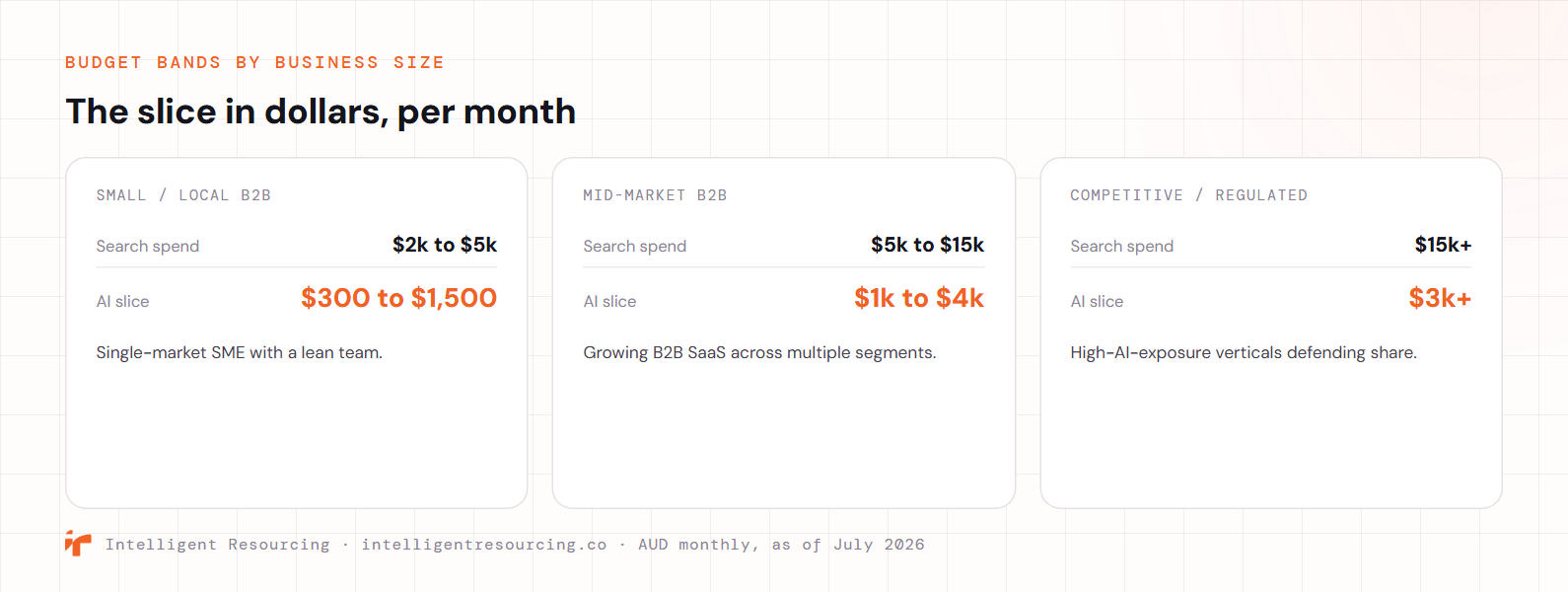
The Deloitte/Duke CMO Survey puts marketing budgets at 9.4% of company revenue, up from 7.7% the year before. Even with that increase, SME budgets stay tight relative to what AI visibility work actually needs, so the slice must be defined, not open-ended. The dollar bands below translate the percentages, as of July 2026.
| Business size | Monthly search spend (AUD) | AI search slice (15 to 30%) | Best fit |
|---|---|---|---|
| Small / local B2B | $2,000 to $5,000 | $300 to $1,500 | Single-market SME, lean team |
| Mid-market B2B | $5,000 to $15,000 | $1,000 to $4,000 | Growing B2B SaaS, multi-segment |
| Competitive / regulated | $15,000+ | $3,000+ | High-AI-exposure verticals |
For an SME with a strong SEO pipeline, it is safer to ring-fence additional budget rather than cut existing SEO spend. Reducing core SEO investment can weaken the topical authority that AI systems rely on, which is why AEO budget allocation for B2B teams should be treated as a balance between protecting existing search demand and building visibility inside AI-generated answers. New funding protects the organic base while supporting the content, authority and tracking needed to earn citations.
What Are the Budget Components of an SME AI Search Visibility Program?

An SME program has six components: answer-first content refreshes, earned media, entity and author authority, schema, original research, and citation tracking. Each earns citations for a specific reason. Costs run from 29 dollars monthly to 25,000 dollars per study. Together they form the AI Visibility Slice.
Muck Rack found 84% of AI-generated citations come from earned media, so digital PR earns the largest share of trust. Answer-first refreshes come next, at 500 to 2,000 dollars per page. They create the extractable passage AI lifts. We call that our Answer-First Refresh method.
Good schema markup for AI improves retrievability, so passages surface faster. You must also structure content for AI citation so each passage stands alone.
| Budget component | Indicative cost (AUD) | Why it earns citations |
|---|---|---|
| Answer-first content refreshes | $500 to $2,000 per page | Creates the 40 to 60 word passage AI systems extract |
| Earned media / digital PR | $1,200 to $3,000 per placement set | Earned media drives most AI citations |
| Entity and author authority | Low setup plus ongoing | Author schema and bios anchor E-E-A-T signals |
| Schema and structured data | $1,500 to $5,000 setup | Improves retrievability and on-page parity |
| Original data / research | $2,000 to $25,000 per study | Supplies information gain no competitor can copy |
| Citation-tracking tools | $29 to $99/month (SME tier) | Measures share of model and citation rate |
Should a B2B SME Pay for AI Search Ads in 2026?
Mostly no, not yet. Paid AI-search placements are early-stage for SMEs. As of July 2026, budget them as a small test line, not a core allocation. Earned and owned work still wins on ROI for lean teams.
Three formats are emerging: ChatGPT search ads began rolling out through 2025, Gemini is testing AI ad formats inside its answers, and Perplexity offers sponsored follow-up questions and citations. Public SME pricing stays limited, so avoid quoting exact rates you cannot verify.
Paid media still commands the largest single share of most marketing budgets, and the overwhelming majority of that sits in classic search and social, not AI ads. The AI ad market is too young for reliable SME benchmarks. Spend here buys learning, not a dependable pipeline yet.
An SME with a high-intent offer and a test budget can experiment, cap the spend, and measure citations against cost. For everyone else, earned and owned remain the default; that is the higher-ROI path as of July 2026.
How Should an SME Split Spend Across Owned, Earned, and Paid AI Search Work?
Split the AI Visibility Slice into clear proportions. Allocate the largest share to owned content, the second-largest to earned media, and the smallest to paid testing. Keep a fixed monthly allowance for tooling and measurement. This order reflects where AI citations are most consistently earned and sustained.
- Owned (answer-first refreshes plus FAQs): largest share; these are the assets AI cites.
- Earned (digital PR plus expert bylines): second share; the credibility layer that drives most citations.
- Paid (AI-search ad tests): smallest share; a capped experiment only.
- Tooling and measurement: a fixed monthly floor you never skip.
Owned assets give AI systems clear, extractable information, while earned media provides the third-party validation that strengthens trust. Together, they form the practical foundation of AI search marketing and a core part of effective LLM SEO.
How Do You Measure Return on AI Search Visibility Spend?

Track four KPIs together: citation rate, share of model, AI-driven conversions, and branded search lift.
- Citation rate: how often AI systems cite your brand.
- Share of model: your share of visibility across AI-generated answers.
- AI referral traffic: how many visits come from AI platforms.
- AI-attributed conversions: how that visibility contributes to pipeline and revenue.
Measure all four monthly from day one.
Intelligent Resourcing's AEO live tracker records citation rate, share of model, and average mention rank per engine per prompt. As of 13 July 2026, across 153 buyer-intent prompts over 30 days, spanning ChatGPT, Gemini, Google AI Overview, Perplexity, and Grok, Intelligent Resourcing holds 15.8% share of voice at position number 1, with a citation rate of 25.4%. That is what the measurement looks like in practice: a fixed prompt set, tracked monthly, so movement in share of model is visible before revenue impact arrives.

The commercial value comes from the full chain, not the citation alone. Earned authority improves the chance of being cited, citations create qualified referral traffic, and that traffic can convert into pipeline at a higher rate than traditional search visits.
| Process stage | What happens | Business impact |
|---|---|---|
| 1. Earned placement | Your brand is featured on a trusted third-party source. | Builds external authority and increases the chance of AI retrieval. |
| 2. AI citation | An answer engine cites your brand or content in a response. | Expands visibility across high-intent AI searches. |
| 3. Referral traffic | Users click through from the AI answer to your website. | Brings informed visitors with stronger purchase intent. |
| 4. Pipeline conversion | AI-referred visitors become leads and opportunities. | Semrush's reported 4.4x conversion premium helps explain the strong return. |
The 6sense 2025 Buyer Experience Report found that 94% of B2B buyers used generative AI during the purchasing process. That means citations can influence buyers while they are actively researching and comparing suppliers, making citation rate a meaningful pipeline indicator rather than a vanity metric.
Early citation gains can appear within 60 to 90 days, while branded search growth typically develops over four to six months. Consistent execution drives both outcomes. After ring-fencing an AI Visibility Slice for a 30-person Australian SaaS company, its share of model increased from 5% to 21% in 82 days.
Content Creation
We map your AI Visibility Slice to real dollar bands across owned content, earned media, paid tests, and measurement, sized to your SME's stage, so every dollar ties to a visible citation and pipeline outcome.
FAQs
What is the minimum a B2B SME should spend on AI search visibility in 2026?
A realistic floor is about 350 to 500 dollars monthly. That covers a starter tool stack plus one content refresh. Below this level, spend on foundational SEO first.
Is budgeting for AI search visibility different from SEO or GEO/AEO budgets?
No, it draws from the same pool. GEO and AEO are tasks inside the AI-search slice of total search spend. They are not a separate departmental budget.
Do B2B SMEs need to pay for ChatGPT, Gemini, or Perplexity ads?
No. Paid AI-search formats are optional and early-stage as of July 2026. Treat them as a capped test, not a requirement.
How much should go to earned media versus owned content?
Lean toward earned media, because it drives the majority of AI citations. Keep owned content as the extractable base that AI actually quotes.
How long before an AI search visibility budget shows results?
Expect first citation gains in 60 to 90 days. Branded search lift follows over four to six months, tied to consistent execution.