

An AEO agency contract should prove how the agency will increase your brand’s visibility and citations in AI-generated answers, not simply promise better rankings. Intelligent Resourcing uses this same accountability standard in its own AEO engagements, combining clearly defined deliverables with measurable citation tracking, prompt coverage and transparent reporting.
Many retainers still read like 2019 SEO contracts, using vague terms such as "visibility" without defining measurable AEO outcomes. Yet AEO focuses on whether your brand appears inside generated answers as buyers shift towards AI chatbots and virtual agents. That shift is measurable in behaviour: when a Google AI summary appears, users click through to a traditional search result in just 8% of visits, against 15% when no summary shows, according to the Pew Research Center (2025), so being cited inside the answer is fast becoming the visibility that counts.
This guide provides a 12-term checklist covering the KPIs, SLAs and legal clauses to redline before signing.
How an AEO agency contract differs from a traditional SEO contract
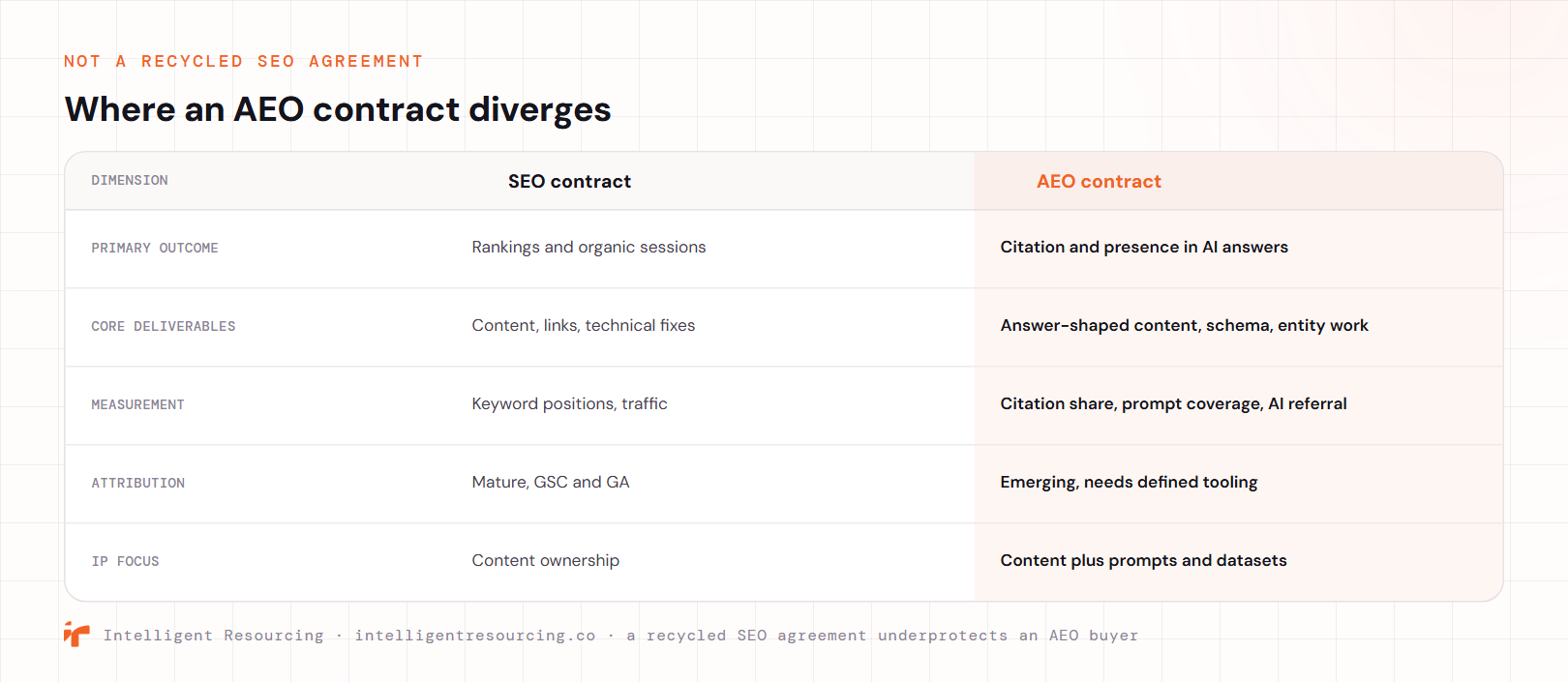
An AEO agency contract governs your brand's citation inside AI answers; an SEO contract governs your rank on a results page. That difference reshapes deliverables, measurement and ownership, so a recycled SEO agreement underprotects an AEO buyer. The table maps where the two diverge.
| Contract dimension | Traditional SEO contract | AEO agency contract |
|---|---|---|
| Primary outcome | Rankings and organic sessions | Citation and presence in AI answers (AI Overviews, ChatGPT, Perplexity, Gemini) |
| Core deliverables | Content, links, technical fixes | Answer-shaped content, schema, entity work, question mining |
| Measurement | Keyword positions, traffic | Citation share, prompt/answer coverage, AI referral traffic |
| Attribution | Mature (GSC/GA) | Emerging; needs defined tooling and caveats |
| IP focus | Content ownership | Content plus prompts, datasets and structured-data assets |
Because the outcome is a citation rather than a rank, ownership must cover prompts and datasets, not just published pages.
What an AEO contract is actually buying
An AEO contract buys presence in generated answers: when a buyer asks ChatGPT or Google AI Overviews for the best option in your category, you pay for whether your brand is cited, not for a page-one rank. This matters because competitors can earn AI citations through stronger corroboration and entity signals, even when their product or organic ranking is not stronger than yours.
Where AEO and SEO contracts diverge
A reused SEO contract covers content ownership but ignores citation-share measurement and who owns the prompts and structured-data assets, which is where the buyer's real risk sits.
The 12 terms to check in an AEO agency contract before you sign
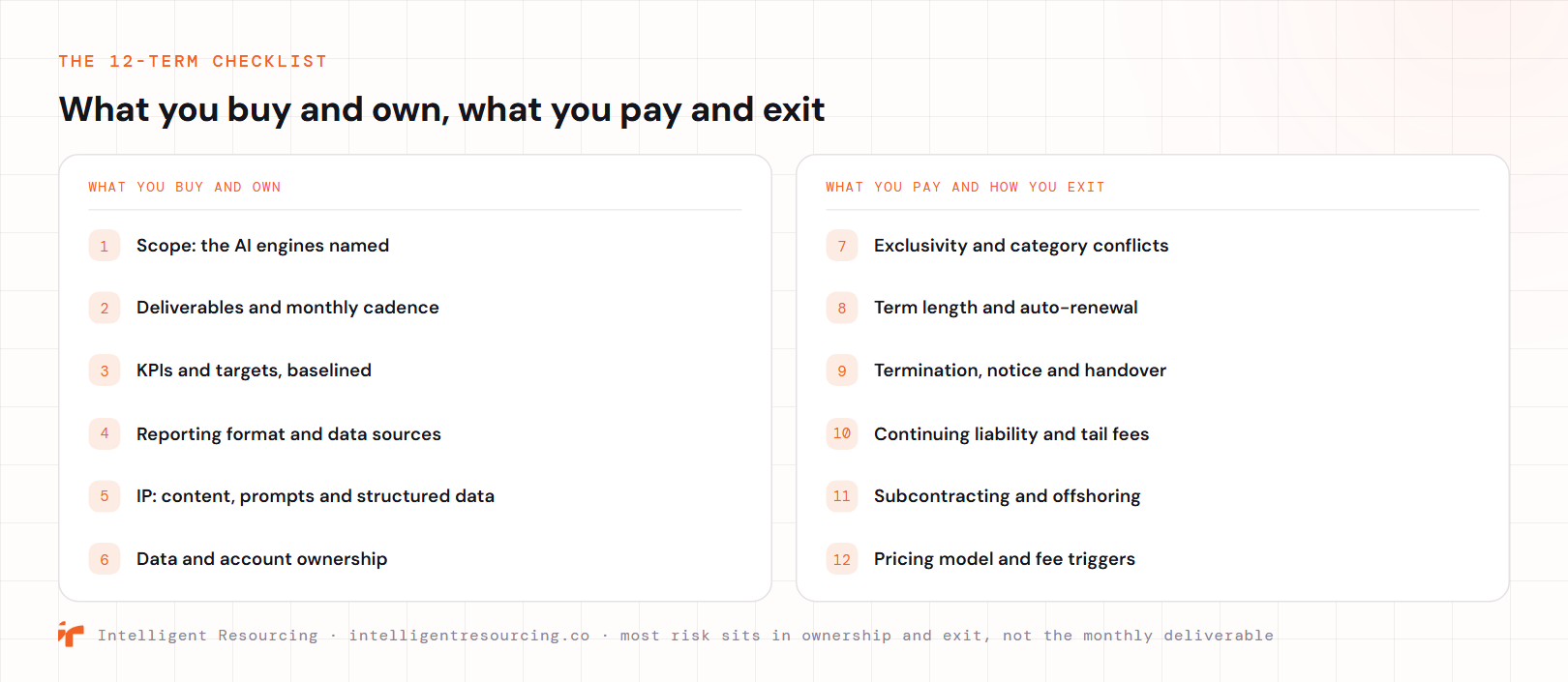
These 12 clauses decide whether your engagement is accountable or a black box, because an agency agreement becomes legally binding once signed, though you keep the right to negotiate its terms and fees first. The first six terms cover what you buy and own; the last six cover what you pay and how you exit.
| # | Term to check | What "good" looks like |
|---|---|---|
| 1 | Scope: AI surfaces covered | Names the engines (AI Overviews, ChatGPT, Perplexity, Gemini, Copilot), not just "AI search" |
| 2 | Deliverables and cadence | Specific monthly outputs: content, schema, entity work, question mining |
| 3 | KPIs and targets | Defined, measurable, baselined |
| 4 | Reporting | Frequency, format, data sources and tooling named |
| 5 | IP and content ownership | Buyer owns content, prompts and structured-data assets on payment |
| 6 | Data and account ownership | Buyer owns GSC, analytics, dashboards and any LLM logs |
| 7 | Exclusivity and category conflicts | No direct-competitor conflicts; disclosed if any |
| 8 | Term length and auto-renewal | Clear term; no silent auto-renewal |
| 9 | Termination and notice | Reasonable notice; defined offboarding and asset handover |
| 10 | Continuing liability / tail fees | No open-ended post-termination fees |
| 11 | Subcontracting and offshoring | Discloses who actually does the work |
| 12 | Pricing model and fee triggers | Retainer vs performance vs hybrid; what is billed extra |
Notice how many rows turn on ownership and exit rather than the monthly deliverable, which is where buyers quietly lose control.
Scope, deliverables and ownership
Insist that scope names the actual engines, that deliverables are specific monthly outputs, and that you own the content, prompts and structured-data assets on payment. What to look for: prompts and datasets are the assets buyers most often forget to claim.
Fees, term and termination
In Australian marketing and agency contracts, auto-renewal confusion is one of the most common drafting problems: a minimum term quietly resets and triggers fees the buyer did not expect, the kind of significant imbalance the unfair contract terms rules under Australian Consumer Law are designed to catch, while post-termination obligations such as confidentiality and handover support need to be spelled out rather than assumed.
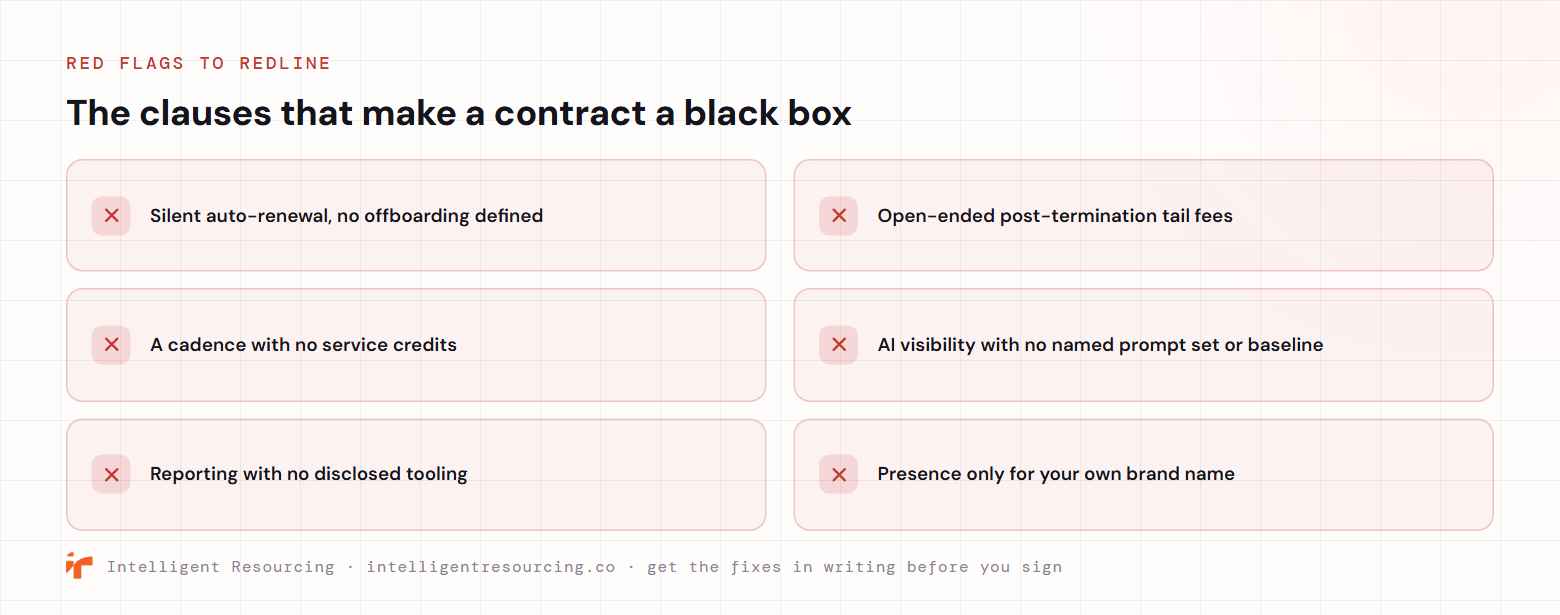
The same applies to AEO pricing in Australia, where retainers, project fees and performance triggers should be defined clearly before signing. The AEO equivalents of poor contract control are silent auto-renewal, unclear fee triggers and open-ended tail fees. Common mistake: a term that auto-renews with no defined offboarding.
AEO KPIs and reporting to lock into the contract

A serious AEO contract names the metrics and the tooling, because "AI visibility" is unmeasurable until someone defines it. Prefer share-of-voice and citation metrics over vanity volume, and require a baseline before work starts.
The output is measurable: research on generative engine optimisation shows structured, answer-shaped content can materially lift how often a source is cited inside AI-generated answers. Tie the KPIs to buyer intent through question mining for AI search.
| AEO KPI | What it measures | Why it belongs in the contract |
|---|---|---|
| AI citation share / share of answer | How often the brand is cited across a tracked prompt set | Primary progress signal |
| Prompt/answer coverage | % of target buyer questions where the brand appears | Ties work to buyer intent |
| Branded vs non-branded presence | Discovery vs defence | Prevents "we only show for our own name" |
| AI referral traffic and assisted conversions | Sessions/pipeline from AI surfaces | Connects AEO to revenue |
| Baseline snapshot | Starting position at contract start | Makes later claims verifiable |
The distinction that matters is branded versus non-branded presence, because an agency that only appears for your own name is defending ground you already held.
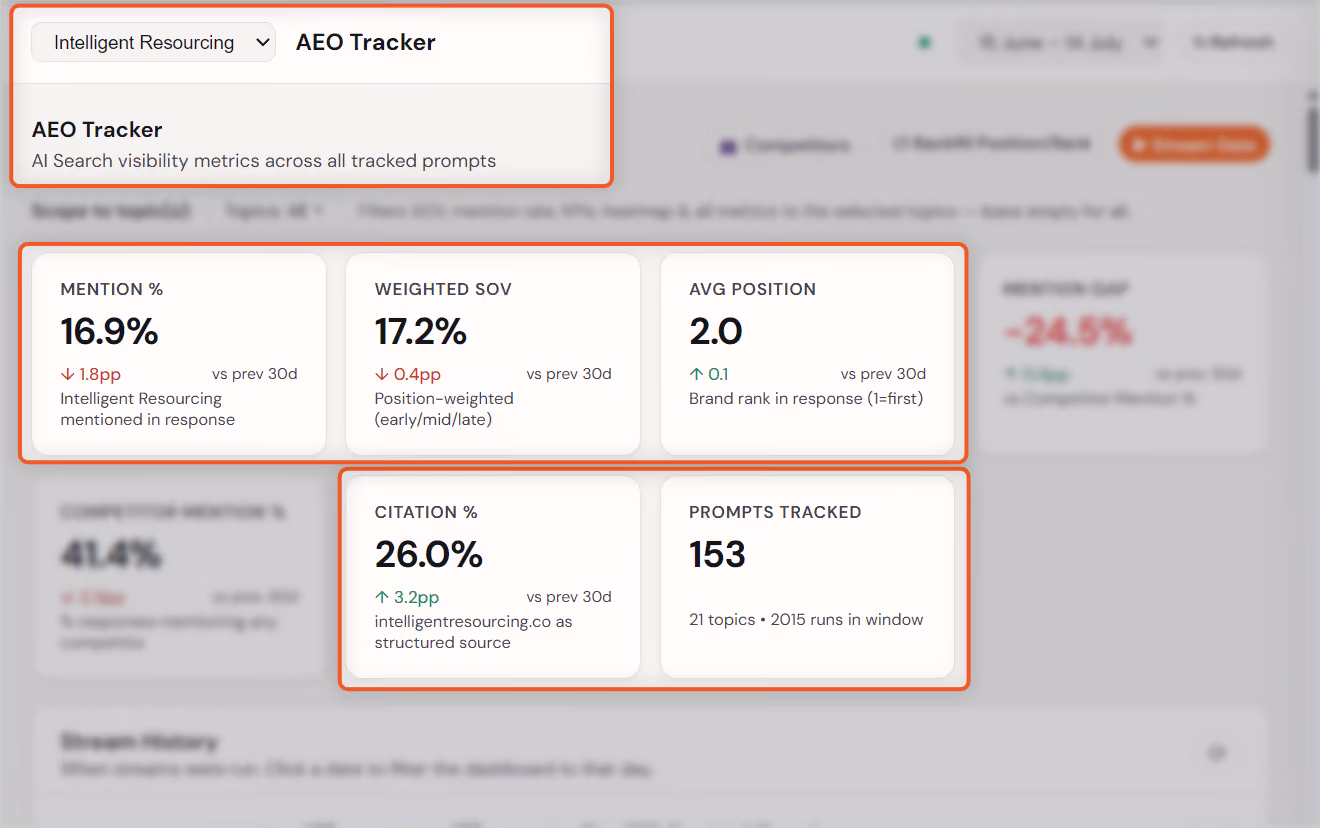
Intelligent Resourcing runs this reporting on its own account as standard: 153 prompts mapped to buying intent categories, tracked across ChatGPT, Perplexity, Gemini and Google AI Overview. As of July 14, 2026, the current output, share of voice 17.2%, citation rate 26%, average mention rank 2, 2,015 total runs, covers all five KPI rows in the table above. Every metric in that table has a number attached to it. If a prospective AEO agency cannot show you a dashboard with the same structure before you sign, the contract has no accountability layer.
Which AEO metrics actually signal progress
Citation share and answer coverage signal progress; raw volume does not. What to look for: a named prompt set, a starting baseline and an auditable reporting method.

A named prompt set is not a spreadsheet of keywords. Intelligent Resourcing's tracked set covers 153 prompts across 13 topic clusters: lead generation, GTM engineering, signal-led outreach, AEO/GEO, Clay workflow, pricing, buyer education and competitor comparisons, each mapped to a buying intent stage. That structure is what makes citation share meaningful: when the number moves, you know which cluster drove the change and which buying stage it affects. A prompt list with no cluster mapping is an auditing problem waiting to happen.
Reporting cadence and attribution caveats
AI referral attribution is still emerging, so a contract that promises precise attribution overpromises; ask for a monthly report, a live dashboard and named data sources.

A B2B management software and technology solutions provider tracked in the Intelligent Resourcing AEO Tracker shows what a live dashboard actually delivers. For the reporting period 15 June to 14 July, the client achieved a 17.9% share of answer, ranking first in its category, a 37.7% citation rate and an average mention rank of 1.8. Attribution caveats are documented alongside the data, not hidden in a footnote. If a prospective agency's monthly reporting is a slide deck with three numbers and no disclosed tooling, there is no audit trail.
What to look for in an AEO service level agreement
A service level agreement converts promises into obligations, so a serious AEO contract specifies commitments and remedies, not just intentions. These are the SLA components a buyer-protective contract should specify.
| SLA component | Buyer-protective standard |
|---|---|
| Deliverable cadence | Fixed monthly outputs with due dates |
| Response times | Named turnaround for requests and escalations |
| Reporting frequency | Monthly minimum, with a live dashboard |
| Remedies / service credits | Credits or make-good if commitments are missed |
| Review rights | Quarterly review and right to adjust scope |
| Continuity | Named team; notice on any offshoring or reassignment |
The component buyers most often omit is service credits, because without a remedy a missed deliverable costs the agency nothing.
Deliverable and response-time commitments
Specify fixed monthly outputs with due dates plus named turnaround times for requests and escalations. What to look for: a response-time clock that starts when you raise a request, not when the agency acknowledges it.
Remedies, service credits and review rights
Service credits give a missed deliverable a cost, and a quarterly review lets you redirect scope as AI surfaces change. Common mistake: a cadence with no remedy, so a chronically late agency faces no consequence.
Content Creation
We pressure-test your AEO agency contract against the 12 terms above, confirm the KPIs are baselined, and check that content, prompts and data transfer to you on payment before you commit.
FAQs
What is the difference between an AEO contract and an SEO contract?
An SEO contract commits the agency to rankings and organic traffic. An AEO contract commits it to citation inside AI answers such as AI Overviews, ChatGPT, Perplexity and Gemini, so the deliverables, measurement and IP terms all change.
What KPIs should an AEO agency commit to in the contract?
Ask for citation share, prompt or answer coverage, and AI referral traffic, each measured against a baseline taken before work starts. The baseline is what makes any later claim of improvement verifiable.
How long should an AEO agency contract run before I can exit?
Favour a short initial term with reasonable notice, such as a 3-month baseline-and-review break clause. Watch for silent auto-renewal and post-termination tail fees, and confirm offboarding and asset handover on exit.
Who owns the content and prompts an AEO agency creates?
You should own the content, prompts and structured-data assets, with ownership transferring on payment, not at a later milestone. State it in writing, because prompts and datasets are easy to forget and hard to rebuild.
What should an AEO service level agreement include?
It should specify deliverable cadence with due dates, named response times, monthly reporting with a live dashboard, service credits when commitments are missed, and quarterly review rights. The service credit is the piece buyers most often omit.
Should an AEO contract guarantee rankings or AI placements?
No. Treat a guaranteed AI-ranking or placement promise as a red flag: no agency controls how AI engines assemble answers, and under Australian Consumer Law an unsupported guarantee risks misleading-conduct scrutiny from the ACCC.