

The confusion is fair, since both retainers are monthly and both need content, links, and technical health. Both promise more qualified demand. The difference sits in the destination. One optimises for a ranked page. The other optimises for a cited answer. That single shift changes the work, the proof, and the reporting. Ignore AI answers and you vanish from new research. Ignore Google and you lose durable organic traffic.
A GEO Retainer Is the AI-Search Counterpart to a Standard SEO Retainer
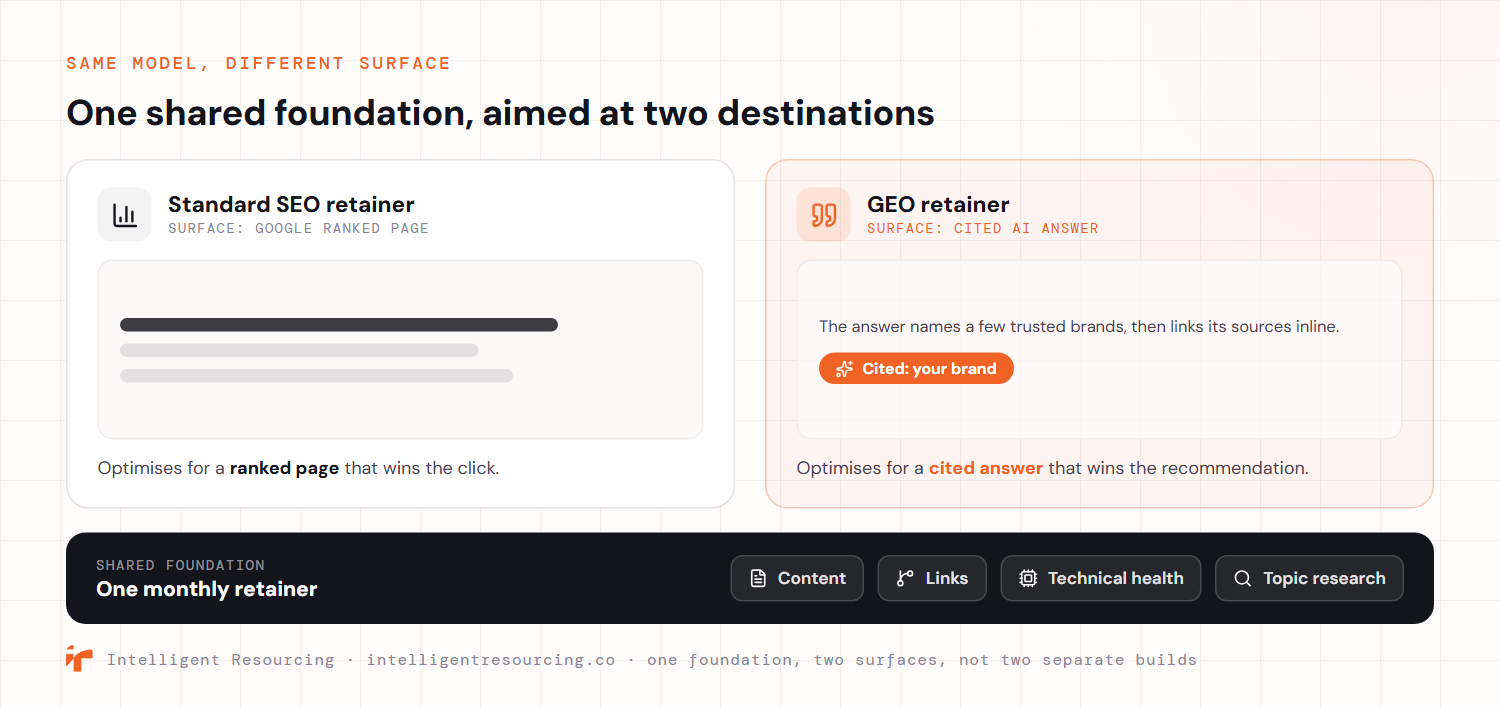
The retainer model does not change. The target surface does. A GEO retainer is a recurring monthly engagement that optimises a brand to be cited and recommended inside AI answer engines. Those engines include ChatGPT, Perplexity, Gemini, and Google AI Overviews. It is the AI-search counterpart to a standard SEO retainer, closely related to answer engine optimisation. It adds to that retainer; it does not rebrand it. The short answer, if you already run an SEO retainer and want to know what to stop paying twice for, is one engine, not two.
The shift is not hype, since it follows the buyers. 73% of B2B buyers now use AI tools like ChatGPT and Perplexity somewhere in their research process. So the first touch increasingly happens inside an answer. That answer either cites your brand or it does not.
This is why answer engine optimisation now sits beside classic SEO. GEO work targets the model's answer, not the ranked page. It clarifies your entity across owned and third-party sources. It ships schema that machines can parse. It structures content for passage extraction.
In Australia, this is already productised. Agencies now sell dedicated GEO as a monthly line item, at stated price points, and buyers are starting to compare pricing models rather than take the first quote. That signals a real market, not a trend piece.
Standard SEO Retainer vs GEO Retainer: What Actually Changes
The single biggest change is the target surface. It moves from ranked blue links to cited AI answers. The work, the proof, and the reporting all shift with it. Both retainers stay legitimate. One captures clicks from Google. The other captures citations inside AI answers. Goal, tactics, and cadence change accordingly.
Rankings still matter, but they capture a shrinking share of attention. 58.5% of US searches ended without a click in 2024. The click never happened, yet the buyer still got an answer. AI answers now absorb more of that intent. So a page can rank first and still be invisible in the answer.
The decision matrix sets out the working changes. The goal moves from clicks to citations. The surface moves from the Google SERP to AI engines. Core tactics move from keywords and links to entities, schema, and third-party signals. The primary metric moves from rankings to share of model.
Now the Steelman. A standard SEO retainer alone is still the right call sometimes. Local or low-competition demand often converts straight from the ranking. If your buyers do not research in AI, the citation adds little. Name that honestly before you pay for GEO. When buyers research in AI first, ranking alone misses the citation. That is when GEO earns its place.
How SEO and GEO Retainer Deliverables Differ
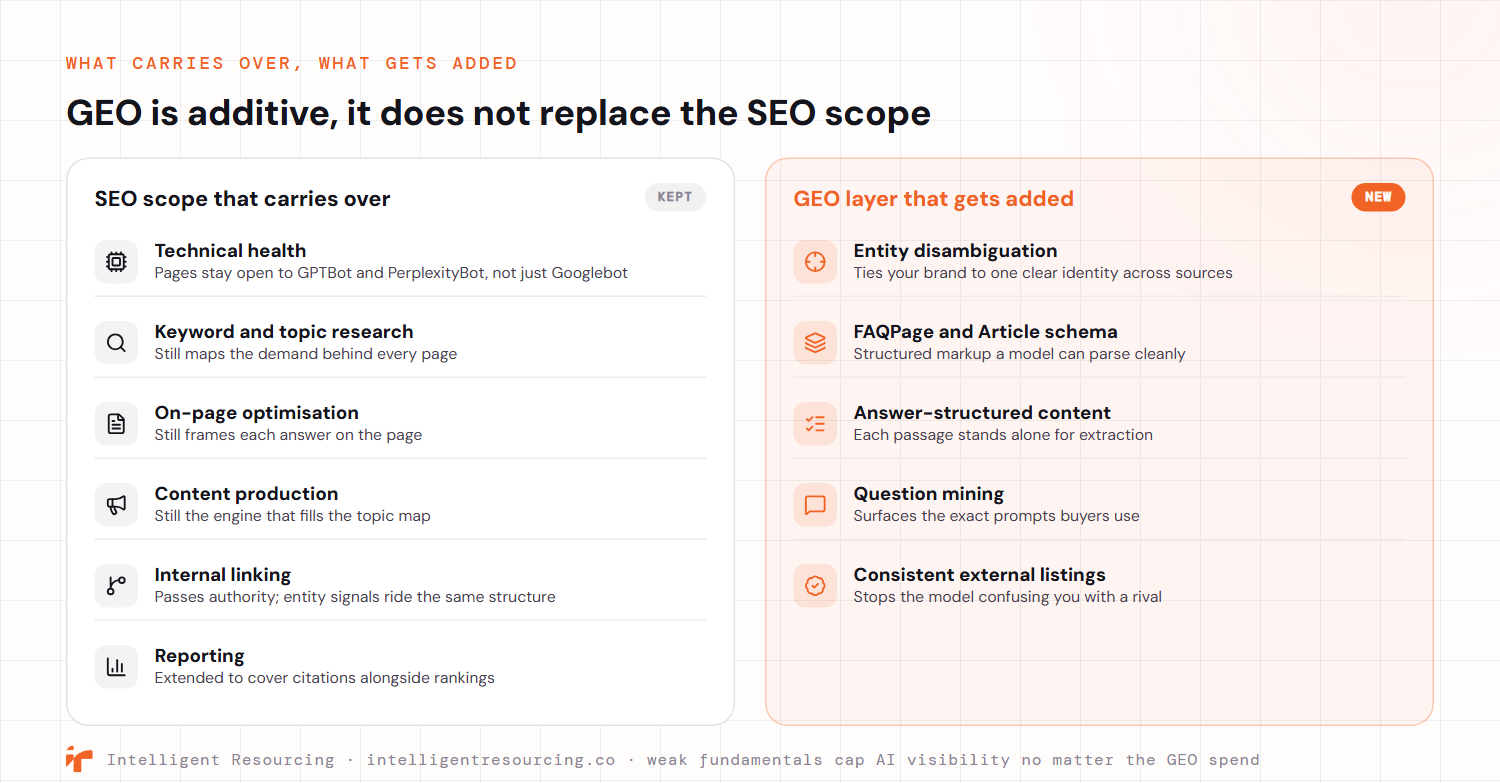
Most of the SEO retainer scope carries over. GEO adds a distinct layer; it does not replace it. Think Generative Engine Optimisation sitting on top of Search Engine Optimisation. The foundation stays. The extraction layer is new. In one 2026 benchmark, 56% of top SaaS sites failed AI search readiness, and that invisibility is what the GEO layer fixes.
SEO Retainer Deliverables That Carry Over
The shared foundation carries over almost intact. GEO depends on this SEO foundation, so GEO is additive, not a substitute. Weak fundamentals cap AI visibility no matter the GEO spend.
- Technical health. Keeps pages accessible to crawlers like GPTBot and PerplexityBot, not just Googlebot.
- Keyword and topic research. Still maps the demand; GEO layers question mining on top of it.
- On-page optimisation. Still frames each answer; GEO adds passage-level structure.
- Content production. Still the engine that fills the topic map.
- Internal linking. Still passes authority between pages; entity signals ride on the same structure.
- Reporting. Still tracks what works, extended to cover citations alongside rankings.
Consider why the foundation still rules. AI systems retrieve pages they already trust. A page with no organic visibility rarely gets cited. So topical authority and crawlability come first. None of this disappears under GEO; it becomes the platform the GEO layer stands on. That is why bolting GEO onto a broken foundation fails. Fix the fundamentals, then add the extraction layer.
GEO Retainer Deliverables That Get Added
The GEO layer adds five deliverables. Together they feed the model the signals it needs to cite you.
- Entity disambiguation. Ties your brand to one clear identity across owned and third-party profiles.
- FAQPage and Article schema. Ships structured markup a model can parse cleanly.
- Answer-structured content. Structures content for passage extraction so each section stands alone.
- Question mining. Surfaces the exact prompts buyers use, rather than guessing at keywords.
- Consistent external listings. Stops the model confusing you with a similarly named competitor.
Here the Trinity shows the mechanism. The role is a GEO specialist working across your CMS, your schema, and your third-party profiles. The verb is the connective tissue: schema markup for AI feeding a Google AI Overview citation through parsed structured data. That is the link between your page and the answer. None of this replaces your SEO work. It sits on top and points the foundation at the answer.
GEO Retainer vs SEO Retainer: KPIs and Reporting
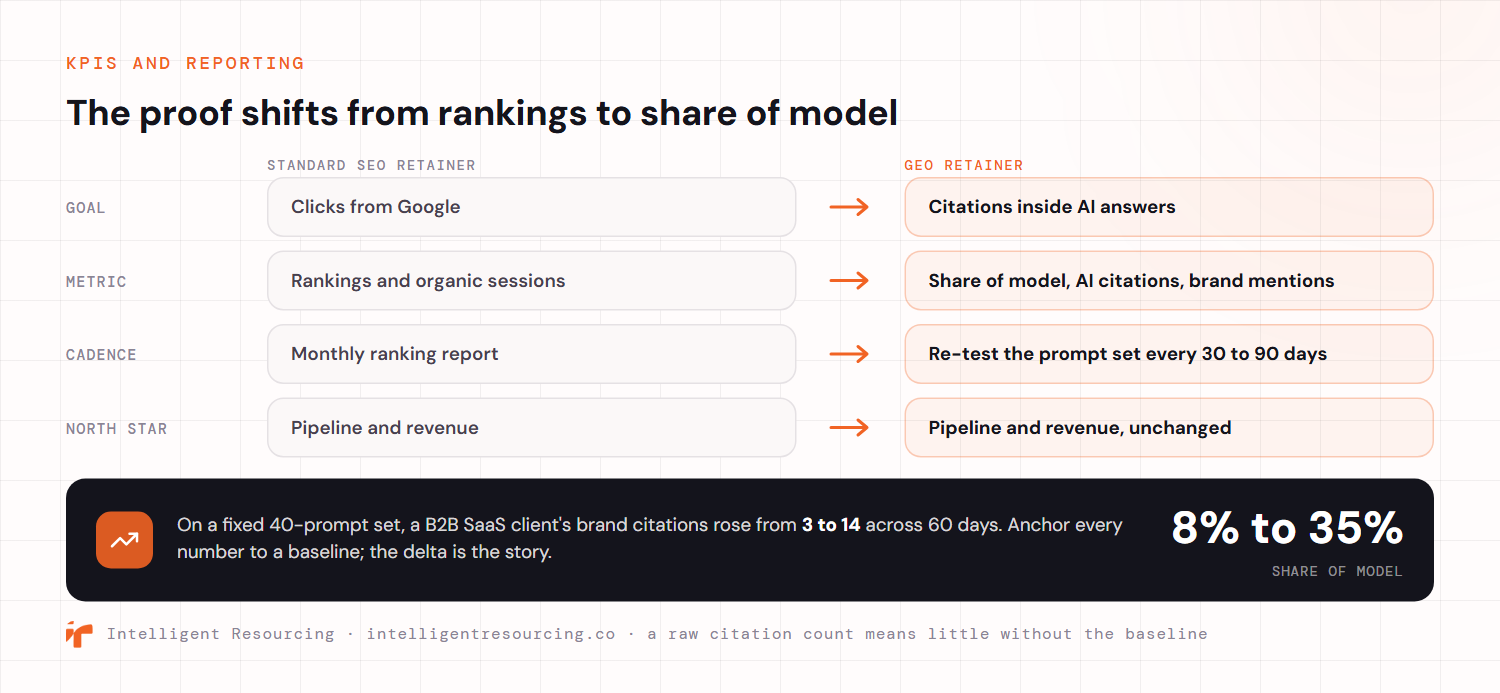
Reporting is where the retainer proves itself. It moves from rankings and sessions to share of model, AI citations, and brand mentions. But pipeline stays the shared North Star. Both retainers must tie back to revenue, because marketing leaders are under real pressure to justify every recurring line item, GEO included. If you are weighing a new GEO line against your existing SEO spend, our breakdown of what GEO costs per month is the place to start.
New GEO KPIs: Share of Model and AI Citations
Share of model is the core GEO metric, which refers to the percentage of relevant AI answers that cite or recommend your brand. Track it against a fixed prompt set and a baseline. The full GEO metric set is short.
- Share of model. Relevant AI answers that cite or recommend you, as a percentage.
- AI citation rate. Citations across ChatGPT, Perplexity, and Google AI Overviews.
- Brand mentions. Brand references on commercial, buying-intent prompts.
Anchor every number to a baseline. When we ran a fixed 40-prompt set for a B2B SaaS client, brand citations rose from 3 to 14 across 60 days. That is share of model moving from 8% to 35% on that set. A raw citation count means little without the baseline. The delta is the story.
How Reporting Cadence Changes
The cadence tightens under GEO, since AI answers mostly reward recently updated content. So GEO reporting runs faster than a classic SEO retainer. Re-test your prompt set every 30 to 90 days. Set the baseline in the first 30 days. Then attribute each move to a specific content action. Freshness is a ranking input for answers, not a nicety.
Perplexity shows the freshness pressure most clearly. It leans hard on recently updated sources. So high-intent pages need review on a tighter loop. A classic SEO retainer might report monthly on rankings. A GEO retainer re-runs the prompt set every 30 to 90 days. The first 30 days set the baseline and each later run measures movement against it.
This changes the operating rhythm. Content is not shipped and forgotten; it is refreshed with new evidence, then re-tested. A timestamp change alone proves nothing. The refresh must add or update real evidence. Otherwise the citation rate will not move.
Do You Need a Separate GEO Retainer or One Integrated Engine?
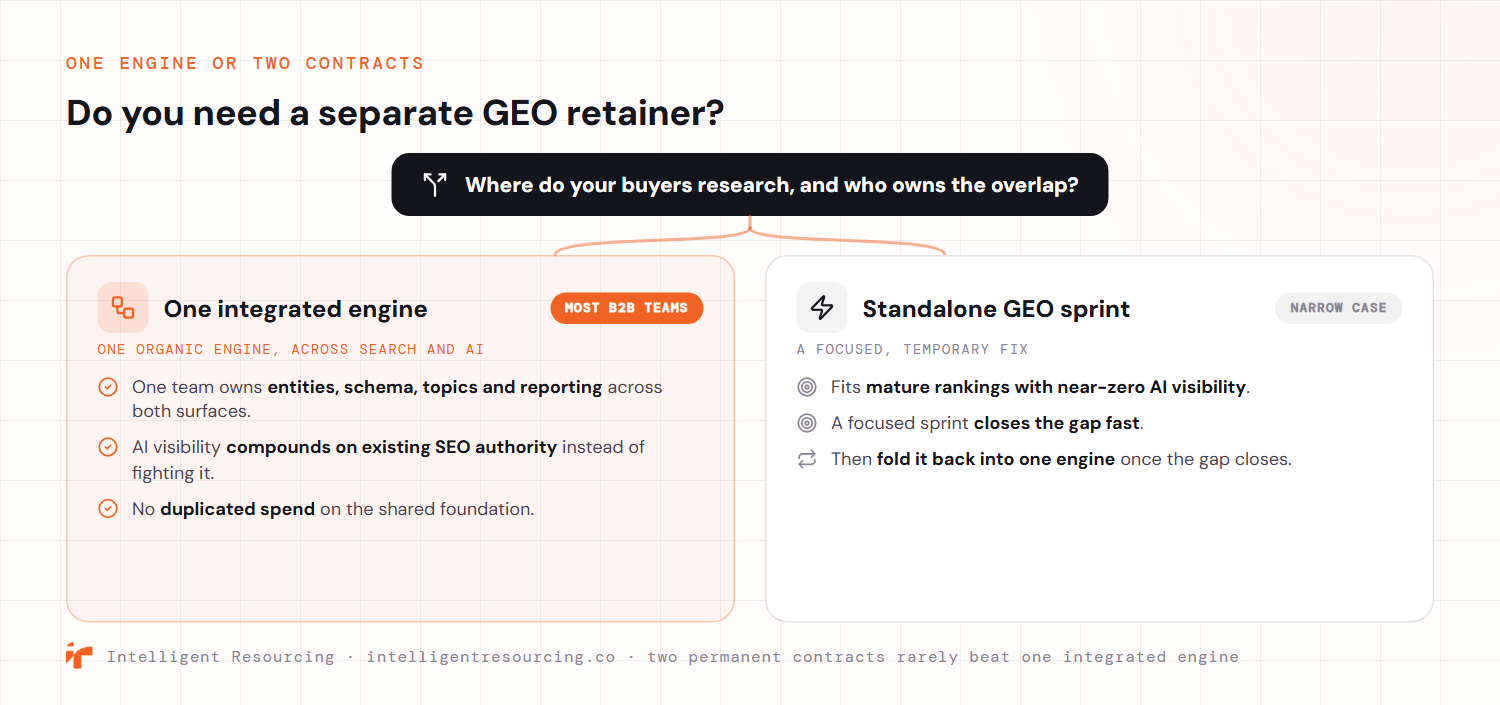
For most B2B teams, one integrated retainer wins. It should span search and AI in a single contract. SEO authority and GEO citation share the same entity, schema, and topic foundations. Two disconnected contracts split those foundations. One engine keeps them aligned. A standalone GEO retainer suits only a narrow case.
Run SEO and GEO as separate contracts and four things break. Topic universes drift apart across the two teams. Entity signals conflict when each team describes you differently. The overlap between them goes unowned. And spend gets duplicated on shared work, the exact hidden cost pattern buyers rarely see quoted upfront.
The economics make this worse. Most SEO providers bill on a monthly retainer that runs into the thousands each month. Pay two retainers and you pay twice for one foundation. One engine removes that overlap.
This is what we call One Organic Engine. One team at Intelligent Resourcing owns entities, schema, topics, and reporting across both surfaces. AI visibility then compounds on existing SEO authority instead of fighting it. If you are weighing the cost trade-off, model it first with our ROI calculator.
Now the Steelman, which is that a standalone GEO retainer can make sense. Picture a team with mature rankings but near-zero AI visibility. A focused GEO sprint fixes the gap fast. Even then, fold it back into one engine once the gap closes. Two permanent contracts rarely beat one.
Building One Organic Engine Across Search and AI
The retainer question has changed. It is no longer SEO or GEO. It is whether one engine covers both surfaces, and whether that engine answers the pipeline. Buyers now move between Google and AI answers freely. Your organic presence has to meet them on both.
One integrated engine does that. It shares entities, schema, topics, and reporting across search and AI. It removes duplicated spending. It keeps your signals consistent. And it ties every metric back to revenue.
If that is the model you want, book a call to scope an integrated search and AI retainer. We can map your answer engine optimisation layer onto your existing SEO. Weighing the cost first? Run the numbers with our ROI calculator.
Comparisons
Intelligent Resourcing builds and runs one integrated search and AI engine on your own stack, sharing entities, schema, topics, and reporting across Google and AI answers. Book a call to map your GEO layer onto your existing SEO and tie every metric back to pipeline.
FAQs
Which is better, an SEO retainer or a GEO retainer?
Neither wins in isolation. The right answer depends on where your buyers research. If they start in Google, ranking still matters most. If they start in ChatGPT or Perplexity, citation matters more. Increasingly they do both, so ranking and AI citation reinforce each other. Run them as one engine, not a contest.
Is SEO dead in 2026, or just changing?
SEO is evolving, not dying. Search intent persists; the surface splits. Some answers now form inside Google and AI engines. Some clicks still go to ranked pages, so the discipline widens to cover both. Zero-click behaviour is rising, but demand is not vanishing. It is moving to new surfaces you can still win.
How much does a GEO retainer cost in Australia?
As of 2026, dedicated GEO runs a defined range. Dedicated GEO in Australia costs roughly $2,500 to $5,000+ per month, with audits from about $1,500. Most agencies fold GEO into mid and premium retainers instead, so you rarely buy it as a standalone line. Budget for the layer, not a separate contract.
Can I add GEO to my existing SEO retainer?
Yes, but run it inside one integrated engine. Do not bolt it on as an undefined line item. GEO and SEO share the same entity, schema, and topic foundations. An integrated engine keeps those aligned and owned. A vague add-on goes unmeasured, because no one owns it. Define the scope, the metrics, and the owner first.
What KPIs prove a GEO retainer is working?
Four KPIs prove it. Track share of model on your prompt set. Track AI citation rate across ChatGPT, Perplexity, and Google AI Overviews. Track brand mentions on buying-intent prompts. Track pipeline sourced from AI answers. A timestamp-only update proves nothing. Movement on these four, against a baseline, is the proof.