


What Does an AEO Agency Actually Do?
An Answer Engine Optimisation agency gets a brand cited and accurately described inside AI answers. It works across ChatGPT, Perplexity, Gemini, and Google AI Overviews. Core work spans AI visibility audits, citation tracking, entity and schema optimisation, and off-site corroboration.
Buyers now research inside AI tools. Most B2B buyers have adopted generative AI, and now name it among their top sources of self-guided information at every phase of the buying process. Search behaviour reinforces the point. Per SparkToro, 68.01% of US Google searches in early 2026 ended without a click, so if AI describes your brand wrongly, many buyers never reach your site.
The GEO services market is projected to grow from US$886 million in 2024 to US$7.32 billion by 2031, according to Valuates Reports. As agencies rush to rebrand SEO as AEO, careful selection matters.
A real AEO agency delivers five things:
- AI visibility audits mapping where your brand appears across AI platforms today.
- Prompt-level monitoring and citation-rate tracking over time.
- Entity optimisation and schema markup built for extractability.
- Off-site corroboration across Reddit, review sites, industry media, and Wikipedia.
- Reporting on citation rate and share of voice, not rankings alone.
What Criteria Separate a Real AEO Agency From SEO in Disguise?

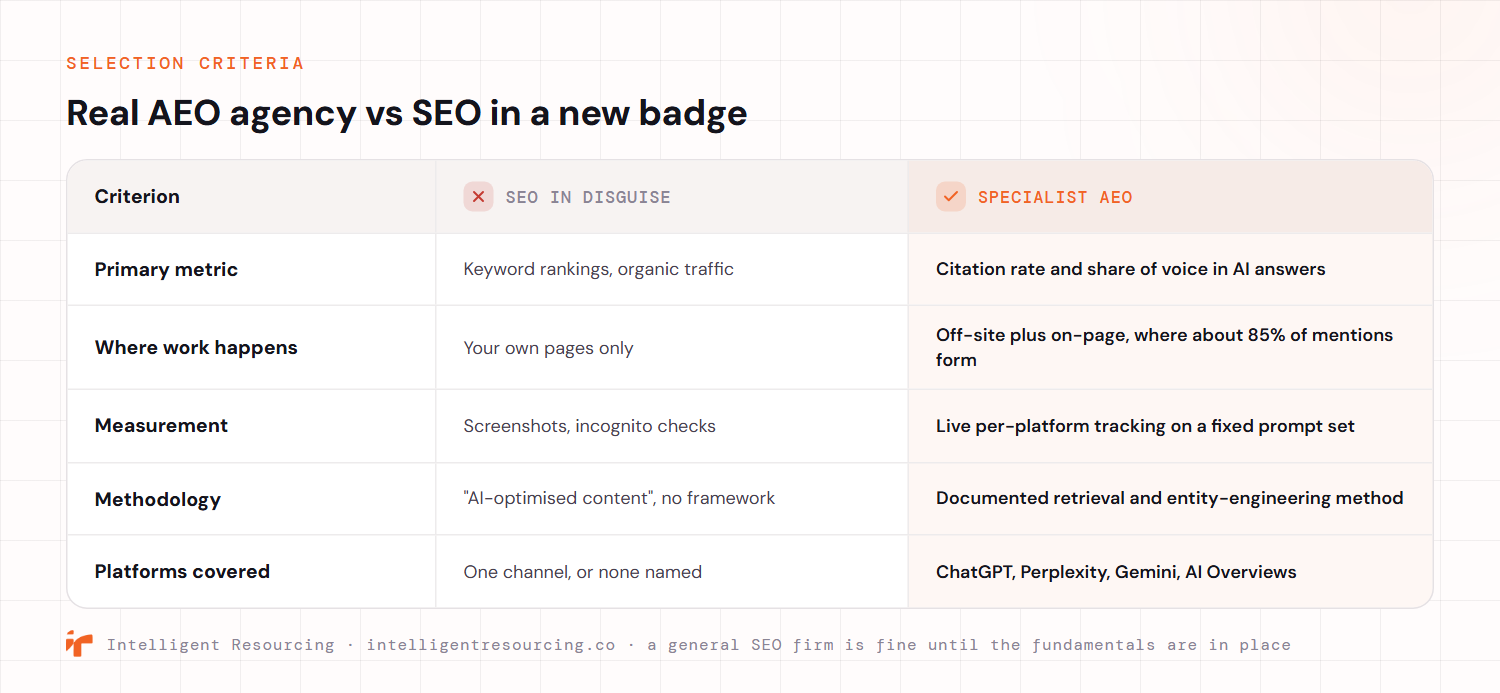
Three tests separate a real AEO agency from SEO in disguise:
- First, it measures citations in live AI answers, not rankings.
- Second, it works off-site, where most brand mentions form.
- Third, its method stands on real SEO fundamentals.
The market is flooded with SEO firms wearing AEO badges. Most agencies advertising AEO cannot prove a retrieval methodology end to end, so most "AEO" offers cannot substantiate the outcome they sell.
The three questions below are how you run each test on a real prospect.
Does It Measure AI Citations, Not Just Rankings?
Citation rate is the outcome; rankings and crawl activity are only inputs. A real AEO agency tracks how often ChatGPT, Perplexity, Gemini, Grok and Google AI Overviews cite you. Most B2B firms start at a 5 to 15% citation rate, while top performers reach 40 to 50%. If an agency reports only rankings, it is measuring the wrong thing.
When we baseline a new client, citation rate is the first number we pull. Most sit in that 5 to 15% band before any off-site work begins. Rankings can look healthy while AI barely mentions the brand. Because AI answers are generated, not ranked, the metric that matters is citation frequency across a sampled prompt set. Ask how many prompts they sample per platform, and how often. Monthly sampling on a fixed prompt set shows real movement. A moving prompt set hides it.

A real measurement system also tracks more than one number. There are three distinct visibility layers that a credible tracker separates:
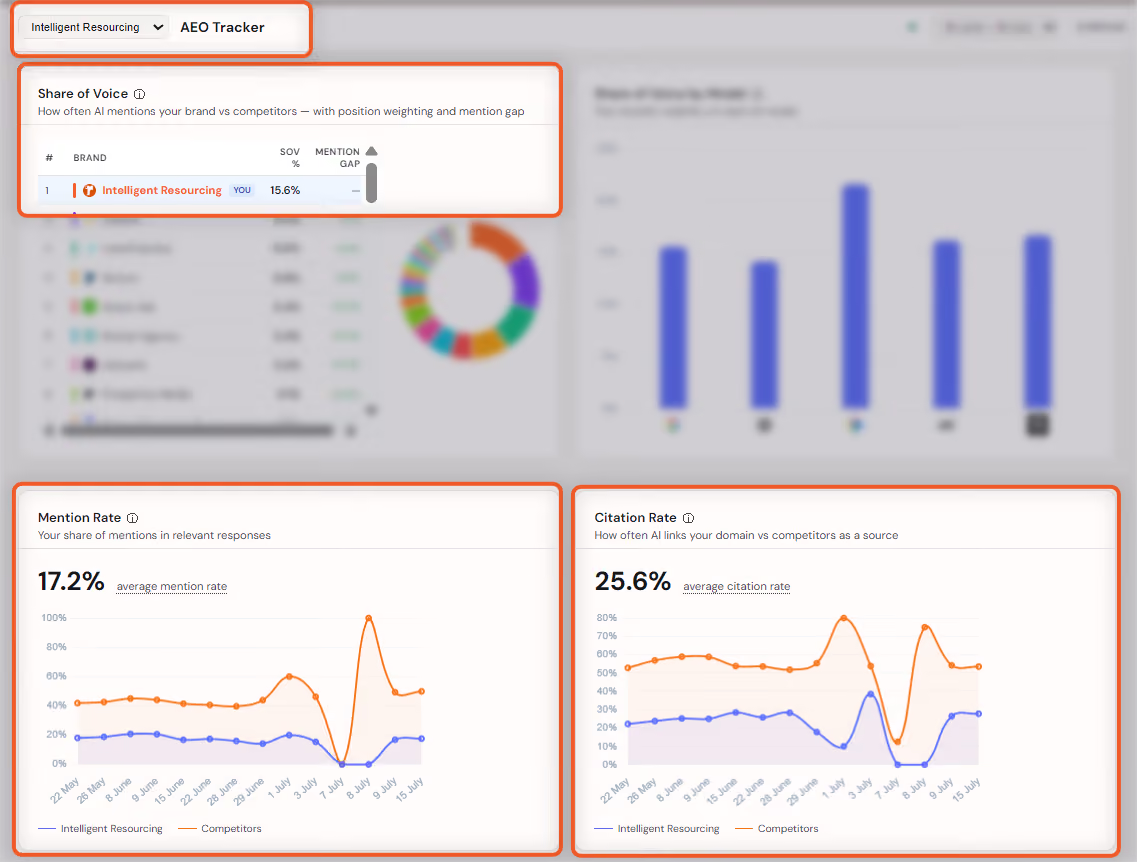
- Share of Voice: your brand's visibility compared to competitors in AI search results. In Intelligent Resourcing's own tracker, this sits at 15.6 across 1,847 total query runs from June 16 to July 16, 2026.
- Citation rate: the share where the brand is specifically named in attribution, not just linked. Intelligent Resourcing: 25.6%.
- Mention rate: the share of all AI responses where the brand appears anywhere in the answer text, including informal references. Intelligent Resourcing: 17.2%.
These three figures routinely diverge. An agency reporting only one is either measuring the easiest number or lacks the infrastructure to separate them. Ask which of the three they track and how they define each. The answer tells you immediately whether you are looking at a measurement system or a reporting document.
Does It Work Off-Site, Where Most AI Mentions Form?
Most of what AI says about your brand comes from third parties. Roughly 85% of AI brand mentions originate from off-site sources, per AirOps, leaving about 15% to your own website. So an on-page-only proposal addresses a fraction of the inputs. Good off-site work spans review sites, Reddit, industry media, and fact corroboration.
AI models synthesise across sources they trust, and that includes G2, Capterra, Reddit threads, industry media, and Wikipedia. If those sources describe you inaccurately, the model repeats the error. Good off-site work corrects the record where the model reads it. Ask which third-party sources matter for your category. A specialist names them; a generalist waves at "authority building". Off-site corroboration is slow, unglamorous, and where the citations are won.
Does Its AEO Stand on Real SEO Fundamentals?
Credible AEO is built on SEO fundamentals; chunking hacks and llms.txt files are not a strategy. Google states no special schema or AI-specific files are required to appear in AI Overviews beyond being indexed and snippet-eligible. If an agency leads with tricks, it usually lacks the fundamentals.
AI features read the open web, and they reward content that is indexed, structured, and trustworthy. That is standard technical SEO plus clear entity signals. Chunking your pages a certain way will not force a citation, and publishing an llms.txt file will not either. Google has been explicit that no AI-specific files are needed. Because fundamentals do the work, ask how the agency handles indexing, structure, and entity clarity. A team that opens with "SEO is dead" is selling a story, not a method.
What Are the Red Flags When Hiring an AEO Agency?
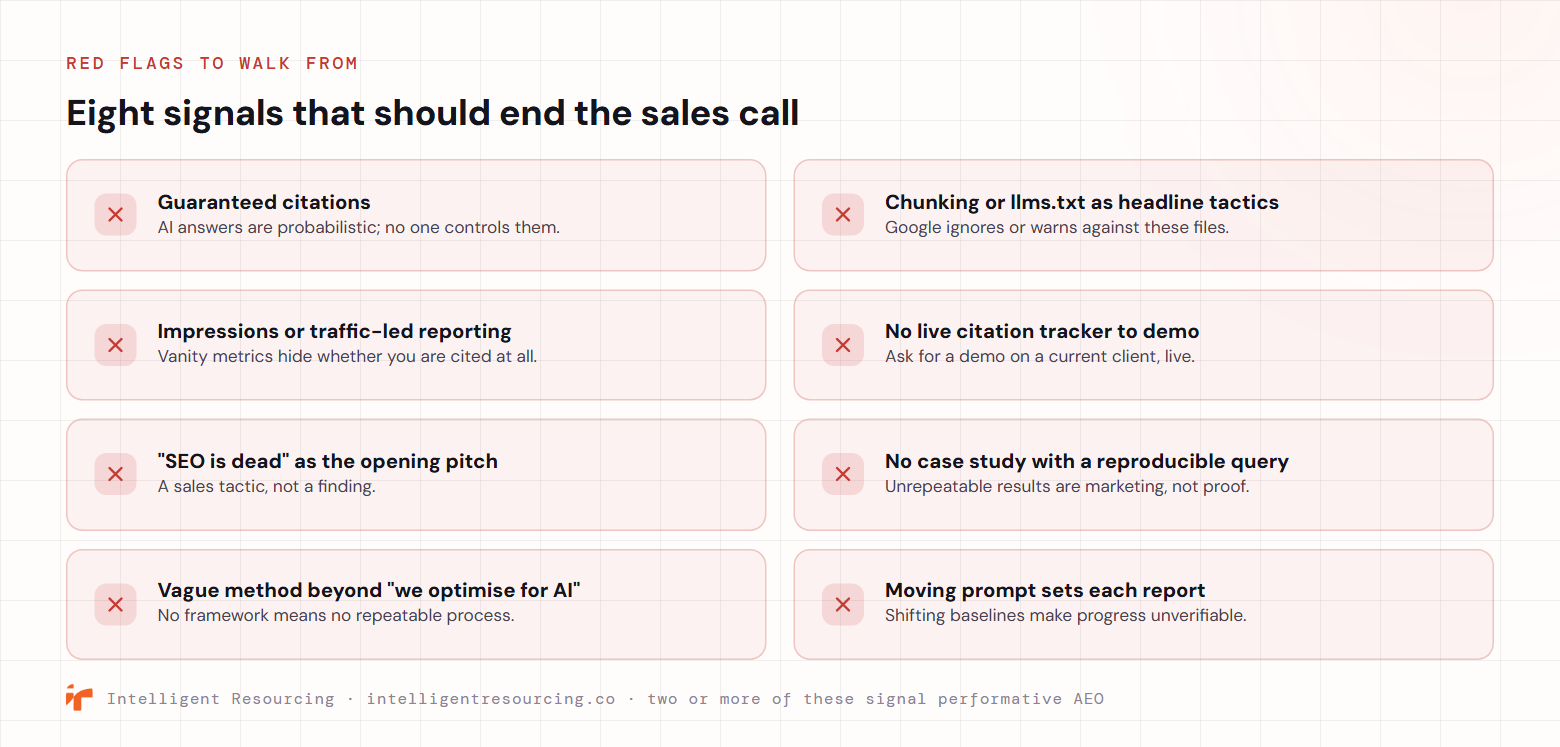
Red flags are conversation-enders, and the clearest ones are guaranteed citations, no live tracking tool, vanity-metric reporting, and generic SEO relabelled as AEO. The same diligence applies whether you call the provider a consultant, an agency, or a broker. The eight signals below should end most sales calls fast.
- Guaranteed citations or "we control what AI says". AI answers are probabilistic; no one controls them.
- Chunking or llms.txt sold as headline tactics. Google ignores or warns against these files.
- Impressions-led or traffic-led reporting. Vanity metrics hide whether you are cited at all.
- No live citation-tracking tool they can demo. Most AEO agencies run no live multi-platform citation tracking, so ask for a demo on a current client.
- "SEO is dead" as the opening pitch. That is a sales tactic, not a finding.
- No named case studies with a reproducible query. Unrepeatable results are marketing, not proof.
- Vague methodology beyond "we optimise for AI". No framework means no repeatable process.
- Moving prompt sets each report. Shifting baselines make progress impossible to verify.
When you get that demo, know what to look for: a real dashboard shows share of voice, citation rate, mention rate, and average mention rank, all calculated from a fixed prompt set run across all five engines. It also shows the underlying run volume, the total number of query executions those figures are built on.
What Questions Should You Ask Before You Sign?
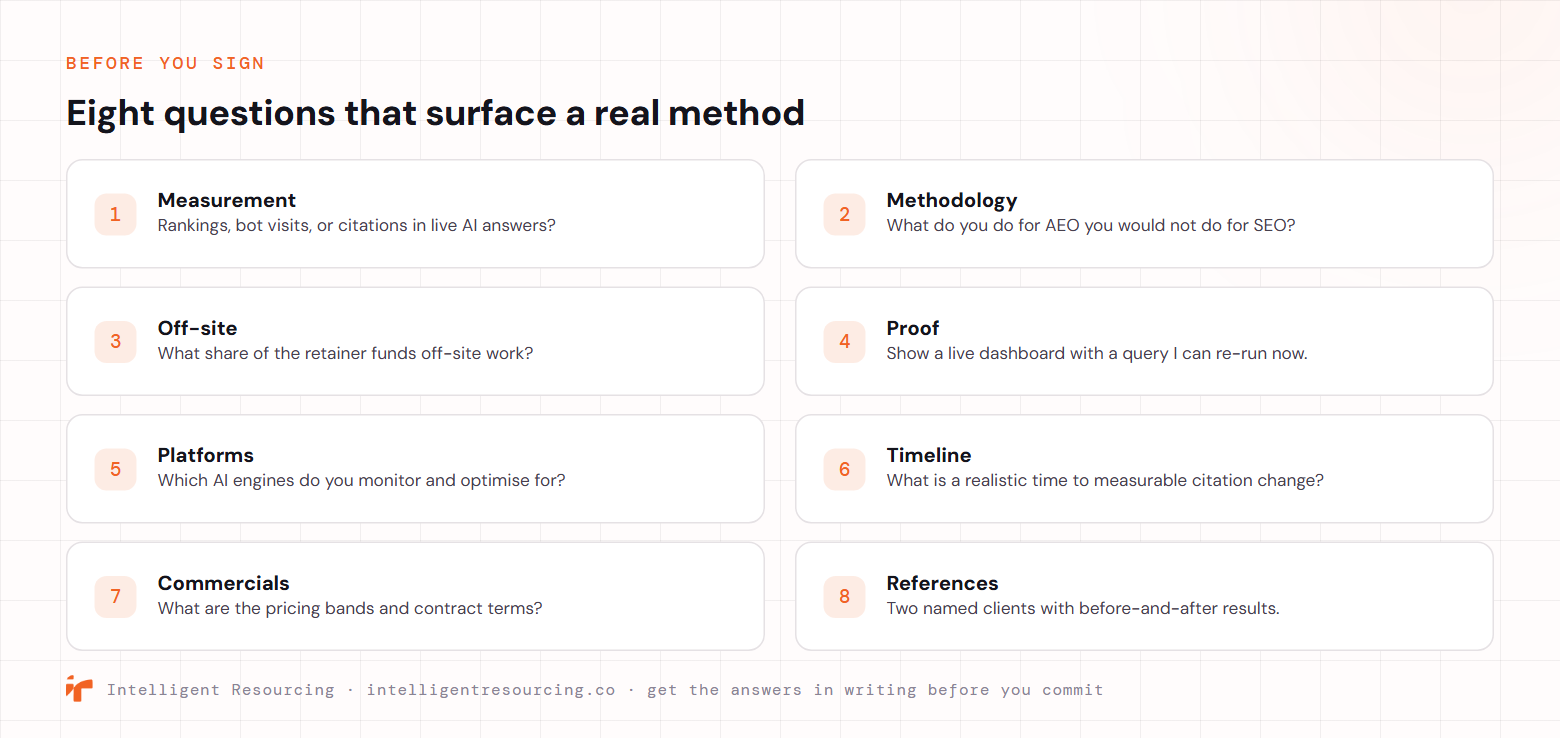
Ask what the agency measures, how often it samples prompts, and what proportion of the retainer funds off-site work. Ask for a live dashboard on a current client, then confirm the platforms, timelines, pricing and references included in the engagement. These questions also help buyers compare the best AEO agencies in Australia on evidence rather than positioning alone.
- Measurement: "What exactly do you measure: bot visits, rankings, or citations in live AI answers, and how often do you sample each prompt?"
- Methodology: "What do you do for AEO that you would not do for traditional SEO?"
- Off-site: "What share of the retainer goes to off-site work, and which sources matter for our category?"
- Proof: "Can you show a live citation dashboard on a current client, with a query I can re-run now?"
- Platforms: "Which AI platforms do you monitor and optimise for?"
- Timeline: "What is a realistic timeline to measurable citation change?"
- Commercials: "What are your pricing bands and contract terms, and what triggers scope changes?"
- References: "Can you share two named clients with before-and-after results?"
What Should You Pay, and When Is an Agency Worth It?
Price AEO on outcomes, not badges. As of mid-2026, dedicated AEO retainers commonly run from US$5,000 to US$20,000 or more per month internationally, while lighter fixed-scope audits sit below that range. Australian buyers should anchor spend to the value of recurring citations, and make sure the AEO agency contract defines deliverables, measurement, ownership, reporting and exit terms before signing. An agency becomes worthwhile once the SEO fundamentals are in place and stronger AI visibility can influence the pipeline.
AEO has no formal certification body, so reframe certification as a demonstrable, independently verifiable track record. That means named case studies, live dashboards, and reproducible queries. A proven specialist brings citation measurement, entity engineering, and off-site methods that general SEO firms rarely hold.
Then choose your operating model. A tool suits teams that can execute in-house. An agency suits teams without that capacity. A hybrid splits measurement and execution. In-house makes sense only with real content and technical resources behind it.
Some buyers should wait:
- No content base yet. Fix fundamentals first.
- Pre-product-market fit. Positioning is still shifting.
- Expecting results in four weeks. AEO compounds over quarters.
Choosing Your AEO Partner
Choosing an AEO partner comes down to three tests: citation measurement, off-site work, and honest attribution. Score every candidate on those three. The buyer who does avoids the most expensive mistake in AEO selection, paying for relabelled SEO. Lead with the evidence, not the pitch.
Comparisons
Book a call with our team to review your AI visibility across ChatGPT, Perplexity, Gemini, Grok and Google AI Overviews. We will map your current citation rate and show what moving it is worth.
FAQs
What is an AEO agency?
An AEO (Answer Engine Optimisation) agency gets a brand cited in AI-generated answers across ChatGPT, Perplexity, Gemini, and Google AI Overviews. It measures citation rate and share of voice, not rankings.
What are the benefits of a specialist AEO agency over a general SEO firm?
Specialists bring citation measurement, entity engineering, and off-site methodology that general SEO firms rarely have. They report on citations in live AI answers, not rankings. Since AEO has no formal certification body, treat "certified" as verifiable proof: named case studies, live dashboards, and reproducible queries. Proof beats badges every time.
How much does an AEO agency cost in Australia?
As of mid-2026, dedicated AEO retainers commonly run US$5,000 to US$20,000+ per month internationally, and Australian buyers should treat that as context. Anchor spend to contract value, not headcount. One-off audits and fixed-scope pilots exist below retainer level. Start small, prove citation movement, then scale the engagement.
What are the biggest red flags when hiring an AEO agency?
Watch for guaranteed citations, no live citation tracking, vanity-metric reporting, and generic SEO relabelled as AEO. Add chunking or llms.txt sold as headline tactics, and "SEO is dead" as the opening pitch. Two or more of these signal performative AEO. Walk away and keep your budget.
Should you hire an AEO agency or build the capability in-house?
It depends on your content base and internal execution capacity. Building in-house is typically several times more expensive in year one once you add salaries and tooling, while a specialist retainer starts faster. Most B2B teams start with an agency, then internalise once the method is proven.