


GEO and Traditional SEO Are Complementary Layers, Not Competitors
Traditional SEO optimises pages to rank and earn clicks. Generative Engine Optimisation optimises content to be cited inside AI answers. GEO extends SEO; it does not replace it. SEO targets the search results page directly. GEO targets the generated answer sitting above those results. Both pursue visibility through different surfaces.
The competition narrows sharply with GEO. Classic SEO fights for ten blue links. GEO fights for a much smaller citation set. LLMs surface only two to seven domains per answer. That scarcity raises the stakes for every brand. Fewer slots mean citation decides visibility, not ranking. Entity clarity and structured data now carry real weight. AI engines read your answers, then attribute them.
Consider how a buyer researches a problem today. They ask ChatGPT for the best approach. The model returns a synthesised answer with citations. Your brand appears there, or it stays invisible. Ranking on page two no longer guarantees consideration. This is why teams invest in generative engine optimisation. It structures content so models can quote it cleanly.
Think of GEO as SEO's distribution layer. SEO earns the authority; GEO converts it into citations. GEO still depends on SEO underneath, though. Engines lean on organic authority to choose citations. Therefore the two disciplines compound; they do not compete.
Which Moves B2B Pipeline Faster, GEO or SEO?
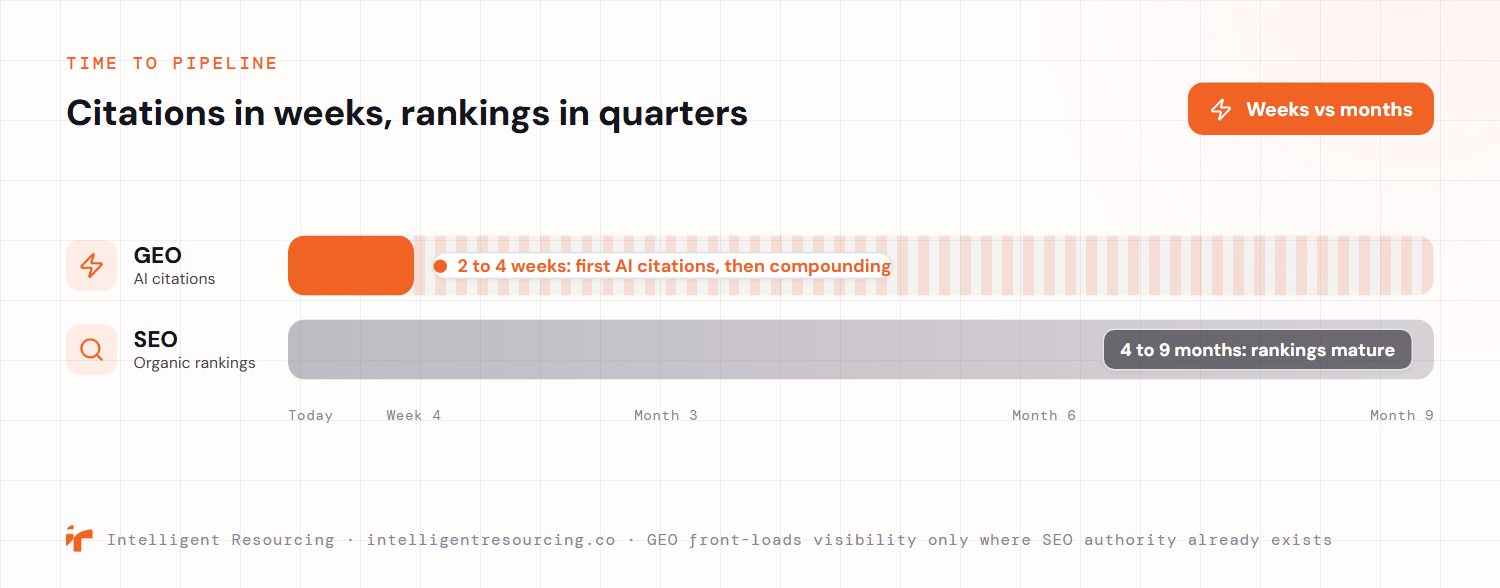
GEO moves B2B pipeline faster when SEO foundations already exist. Organic rankings take roughly four to nine months to mature. AI citations can appear within two to four weeks. That gap compresses time-to-visibility for problem-aware buyers. The speed holds only where indexing and authority are present. Remove that base, and the advantage disappears.
Start with the traditional SEO baseline. A new page takes months to rank. Then it must earn clicks and convert. Four to nine months is a realistic window. GEO changes the slope of that curve. Measurable AI citations can appear within two to four weeks. That is the faster pipeline signal. The delta is stark: months versus weeks. Therefore GEO front-loads visibility for early researchers.
The mechanism is buyer behaviour, not magic. Responsive's 2025 study found nearly two-thirds of B2B buyers now use generative AI as much as or more than traditional search when researching vendors. Because buyers ask AI first, citations reach them sooner. This results in earlier, higher-quality pipeline signals. We call this compounding effect Citation Velocity. It measures how fast authority converts into citations. For the budget-allocation side of this question, see our breakdown of where B2B should put budget first.
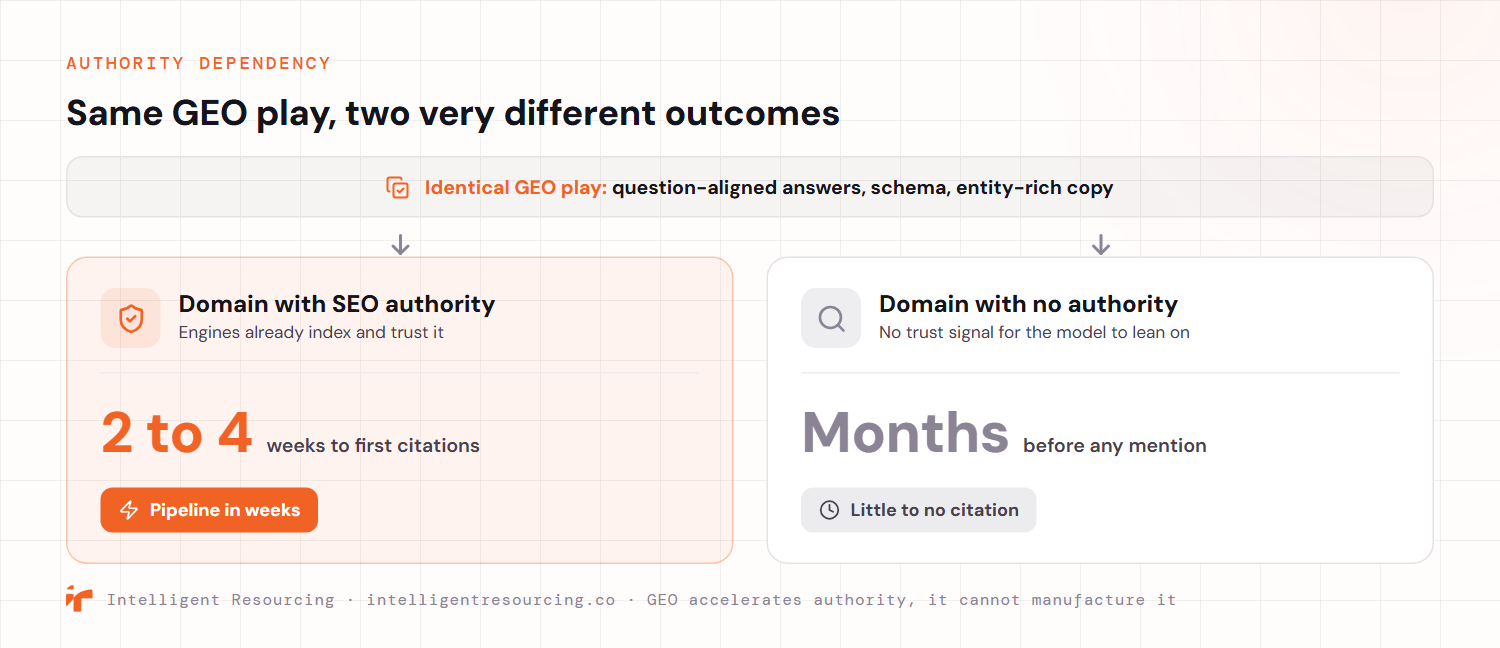
But the dependency is strict and non-negotiable. Speed holds only with SEO foundations in place. A well-indexed domain earns citations quickly. A weak domain earns almost none. Picture two domains running the same GEO play. The authoritative one gets cited within weeks. The unknown one waits months for any mention. Therefore GEO accelerates authority; it cannot manufacture it.
Do GEO Leads Convert Faster Than SEO Leads?
GEO leads convert faster because they arrive later in research. AI-referred buyers reach you already problem-aware and closer to a decision. 6sense's 2025 report found 83% of B2B buyers mostly define their requirements before ever speaking with sales. Traditional search visitors span early to mid research stages. Higher intent means fewer touches to reach pipeline.
| Metric | Traditional SEO | Generative Engine Optimisation |
|---|---|---|
| Visitor intent stage | Mixed; early to mid research | Later-stage, problem-aware |
| Relative conversion rate | Baseline | Higher, driven by later-stage intent |
| Typical time to pipeline | Longer nurture cycle | Shorter; fewer touches to qualified |
The mechanism is intent stage, not traffic volume. Organic search captures mixed research intent. Some visitors browse; others are ready to buy. AI referrals skew later in the journey. The buyer has already framed the problem. They asked a specific question and read cited answers. Therefore they arrive with sharper purchase intent. Fewer nurture touches move them to pipeline.
Separate the durable principle from any single figure. Higher-intent referrals keep converting faster in most B2B funnels. The exact multiple is still contested across studies and will shift as models change. This is why AI-referred demos often close sooner. Sales teams spend less time qualifying them.

The same pattern shows up in our own AEO tracker. On the branded comparison prompt "Intelligent Resourcing vs Green Hat for B2B marketing," we are cited in 100% of 32 tracked runs over the last 90 days (as of 22 July 2026), across Gemini, AI Overview, Perplexity, ChatGPT, and Grok. The buyer has already typed our name, so citation is close to automatic. That is the ceiling GEO reaches once the underlying authority already exists.
Build a GEO Workflow That Feeds Pipeline in Six Steps

Search clicks are shrinking fast. AI Overviews are sharply cutting clicks to even top-ranking results. So build the workflow for citations, not clicks. A content lead or GTM engineer runs it. They use a CMS plus an AI-visibility tracker.
- Map question-aligned H2s. Mine the exact questions buyers ask AI. Match each H2 to one query.
- Write 40 to 60 word answer blocks. Open every section with a standalone answer. Engines extract these chunks directly.
- Render pages server-side. AI crawlers skip most JavaScript. Server-side rendering keeps your answers readable.
- Add FAQPage and Article schema. Mirror the on-page answer text exactly. Use schema markup so AI can reinforce citations.
- Write entity-rich answers. Name tools, metrics, and sources in each block. Structure content so AI can cite it cleanly.
- Track citations across ChatGPT and Perplexity. Log every brand mention and source link. Refresh each page every 60 to 90 days.
We applied this workflow at Intelligent Resourcing for a client, a mid-market Australian SaaS brand. ChatGPT cited their pricing guide within three weeks. AI-referred demo requests rose 27% the next quarter. Their domain was already ranked, so citations compounded fast.
Traditional SEO Still Moves Pipeline Faster in Two Scenarios
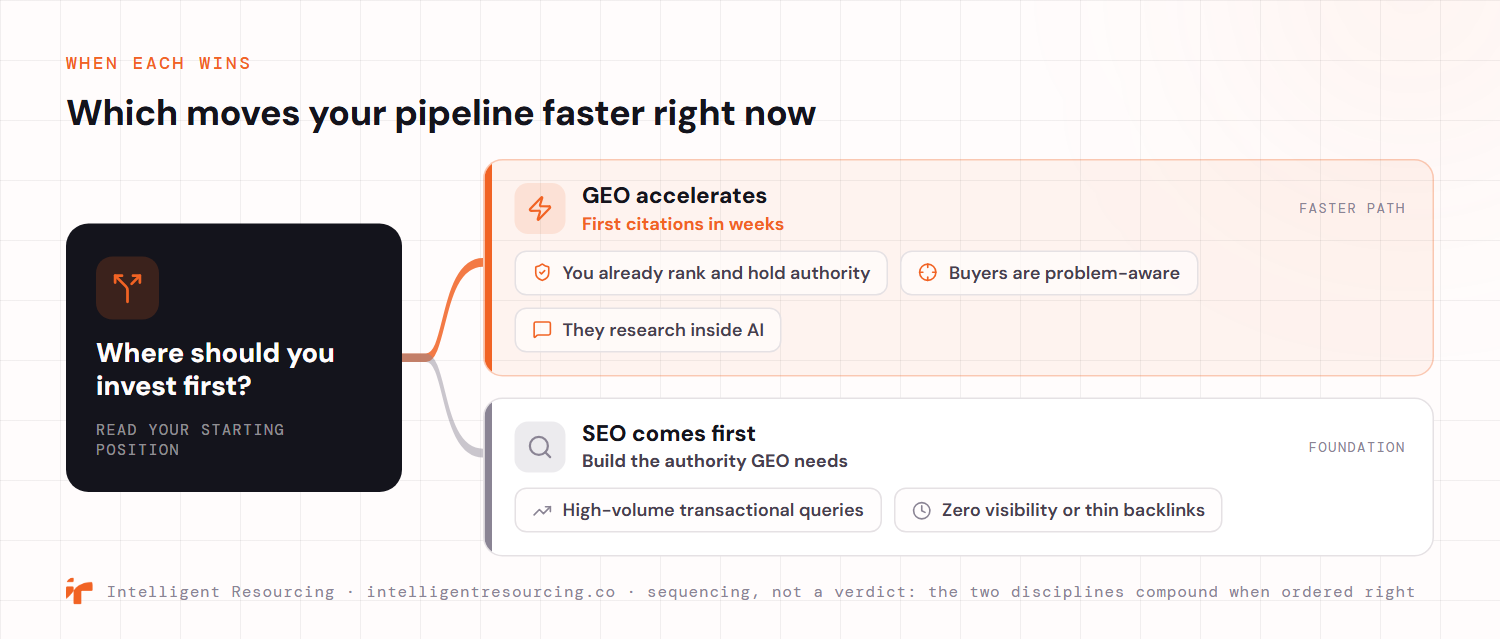
For high-volume transactional queries and zero-visibility domains, traditional SEO still moves pipeline faster. GEO citation depends on existing organic authority. Originality.AI's 2026 study found about 52% of AI Overview citations come from pages already ranking in the top-10 organic results. Without rankings, the model has little to cite. For organisations starting from zero visibility, SEO remains the faster path.
- High-volume transactional queries. A buyer ready to purchase wants a ranked page, not a synthesised answer. For commodity, bottom-funnel keywords, SEO still wins outright.
- Zero-authority domains. Run GEO on a low-authority domain and it yields minimal citations regardless of structure. Perfect schema cannot rescue an unknown domain, because the model has no authority signal to trust. A brand-new domain with no backlinks can publish perfectly structured GEO content and still get ignored by AI engines for months.
Therefore SEO must come first. For organisations with thin backlink profiles, rankings come first. Build organic authority, then layer GEO on top. This is sequencing, not a verdict against GEO. For the full sequencing model, see our guide on which to fund first. The two disciplines compound only when ordered correctly.
Move Your B2B Pipeline Faster with GEO
GEO compresses time-to-pipeline when layered on SEO foundations. AI citations can appear within weeks, not quarters. But the foundation must exist first. The sequencing is the whole strategy. If you want AI answers citing your brand before your competitors, book a call with Intelligent Resourcing. We structure citable, entity-rich answers across ChatGPT and Perplexity. Then we track citations and attribute pipeline, the same citation gap audit we run before any retainer starts. Start with the authority you already have.
Comparisons
Intelligent Resourcing structures your highest-intent pages for AI citation, then tracks share of voice on a fixed prompt panel and attributes pipeline. Book a call to map your citation gaps and the sequencing that closes them.
FAQs
Is GEO replacing traditional SEO?
No. GEO extends SEO rather than replacing it. AI engines still lean on organic authority to choose citations, and about half of AI Overview citations come from pages already ranking in the top-10 organic results. So the two operate as complementary layers. Strong rankings feed AI citations, and citations widen reach. Treat them as one connected system, not rivals.
How long does GEO take to show pipeline results?
Measurable AI citations can appear within two to four weeks where domain authority already exists. Structural gains follow over one to three months. Durable authority builds over three to six months. Speed depends on existing indexing and rankings. A strong domain sees citations first, then compounding pipeline signals across the following quarters.
Do I need SEO before I start GEO?
Yes. A zero-visibility domain sees minimal AI citation regardless of content quality. SEO foundations come first, because engines cite sources they already trust. Build rankings, indexing, and entity clarity, then layer GEO. Strengthening AI visibility starts with the organic base beneath it. Sequence the work; do not skip the foundation.
How do you measure GEO's pipeline impact?
Measure citation frequency, AI share of voice, and assisted conversions. Track how often AI answers cite your brand. Pair a how did you hear about us field with citation tracking. Together they attribute pipeline to AI referrals. Re-test the same prompt set every 30 to 90 days to log movement.
Does GEO work for B2B lead generation?
Yes. GEO suits problem-aware B2B buyers researching inside AI tools. They arrive later, with higher intent, and typically convert with fewer touches than early-stage organic visitors. That makes GEO a strong fit for B2B lead generation. Pair it with SEO foundations to capture both ranked demand and cited demand.