
What Is an AI Citation Gap Audit?
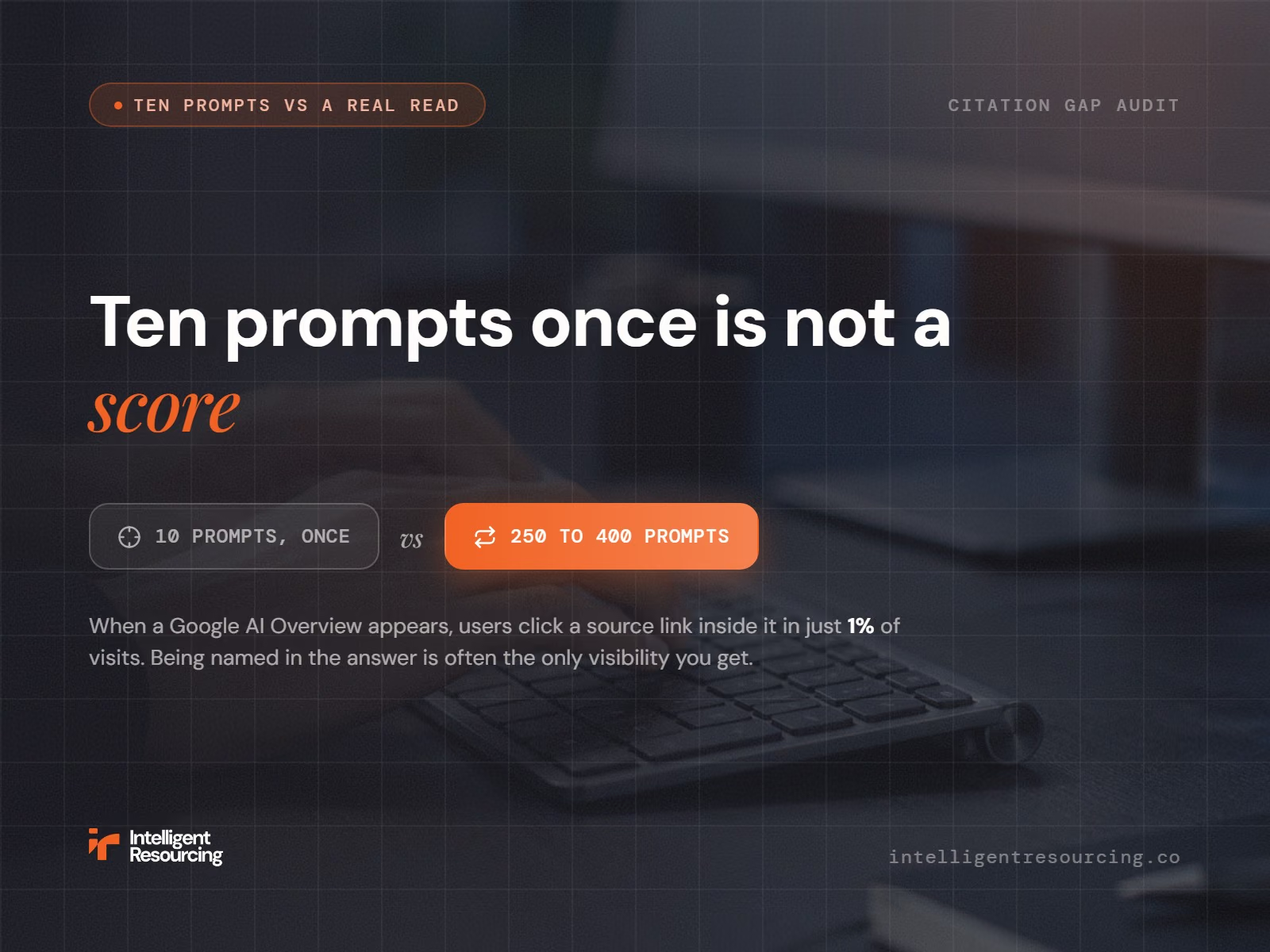
An AI citation gap audit measures whether AI engines name or cite a brand for the questions its buyers ask, across ChatGPT, Perplexity, Gemini and Google AI Overviews. It is not the same test as a traditional SEO audit. SEO audits check rankings, backlinks and crawl health, built around Google's ten blue links. A citation gap audit checks something else entirely: whether the AI answer itself includes the brand. That last point is where the stakes sit: when a Google AI Overview appears, users click a source link inside it in just 1% of visits, according to the Pew Research Center (2025), so being named in the answer is often the only visibility a brand gets.
Every result sorts into one of four states, and each one points to a different fix. Treating the whole gap as one problem is what wastes the budget meant to close it.
Mentions and citations are not the same result
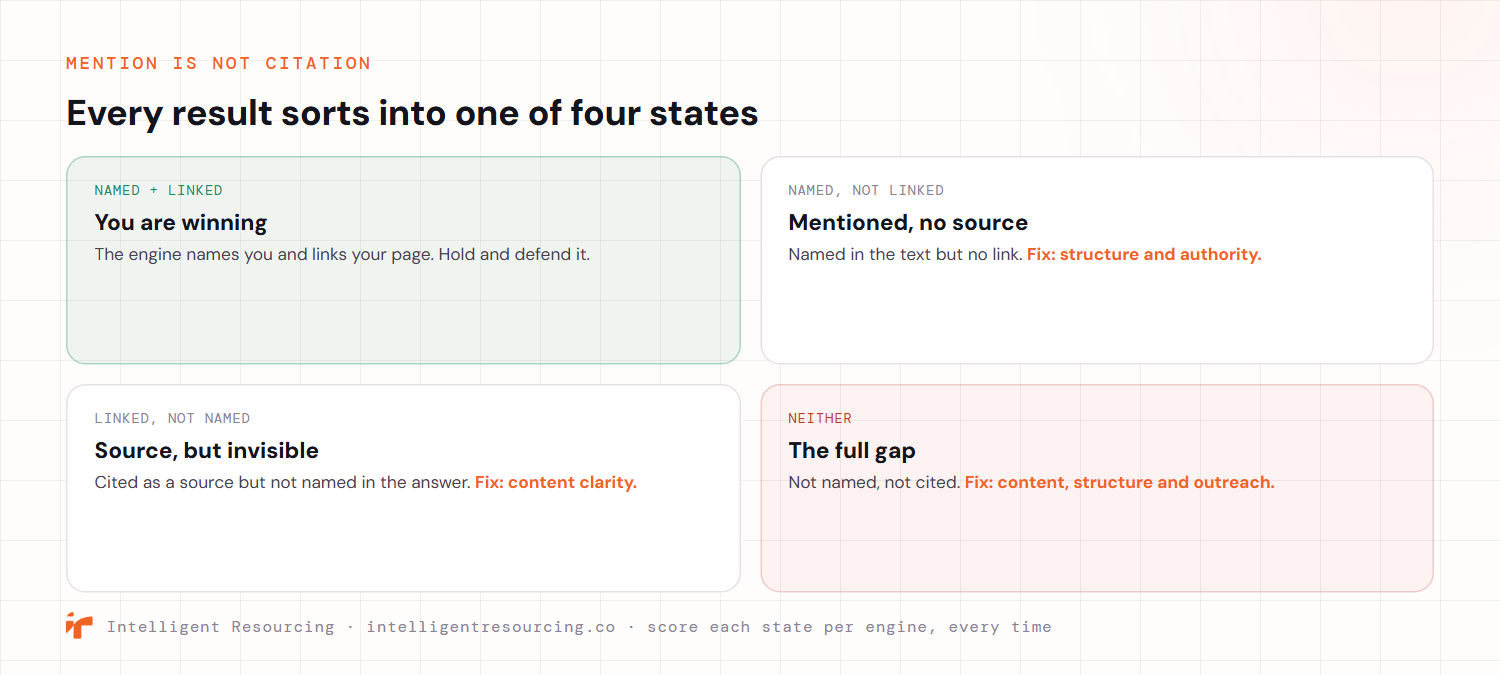
Most audits collapse two different outcomes into one number. A mention is the engine naming a brand in the text of its answer. A citation is the engine linking to the brand's actual page as a source. An engine can name a competitor without linking them, or link a competitor without naming them in the visible answer. Scoring these as one metric hides which fix applies.
This distinction has to run per engine, not once across all four. ChatGPT, Perplexity, Gemini, and Google AI Overviews pull from different source pools and reward different signals, so a brand can be well cited on one engine and invisible on another. A citation gap audit worth running scores mention and citation separately, on each engine, every time.
How Do You Check AI Citations Yourself?

A DIY AI visibility audit runs on four steps: build a locked set of buyer-intent prompts, run them across every major engine, score each answer for mention versus citation, and trace every result back to its source. Each step needs a specific action, not a vague check.
Start with 10 to 20 prompts phrased the way a real buyer would ask them, covering category questions, direct comparisons, and problem statements. Lock the set before running it, because a set that keeps changing cannot be tracked month over month. Run each prompt across ChatGPT, Perplexity, Gemini, and Google AI Overviews, more than once per engine, since the same prompt can return a different answer each time it runs.
Score every answer for two separate outcomes: whether the brand was mentioned by name, and whether it was cited with a link. Then trace each citation back to the exact page and passage the engine pulled from, and log which third-party domains appeared instead of the brand. Those domains are the real target for the next fix, whether that fix is content, structure, or outreach.
A free AI citation check needs very few tools

A free AI citation check B2B marketing teams can run in an hour needs no paid subscription to get a first read on the gap. Manual testing across the major engines, logged in a spreadsheet, covers every step above at zero cost. It is slower to repeat than a paid tracker, but it is enough to scope a gap and brief a vendor from evidence.
A few free resources extend that first pass without adding cost:
- Google Search Console surfaces schema and indexing errors already sitting on a site.
- A robots.txt check confirms whether AI crawlers such as GPTBot or Google-Extended are blocked outright, which hides content from every engine at once regardless of how good it is.
- A basic JavaScript-toggle test shows whether content that renders for a human disappears for a crawler that never executes the script.
Free tools scope the gap. They do not replace the sample size a reliable score needs, and that is exactly where a manual pass reaches its limit.
How Fast Does a Manual Audit Run Out of Reliability?
A single tracker run is one moment that does not repeat the same way twice, according to Discovered Labs (2026). AI answers vary between runs of the identical prompt, so a reliable read runs each prompt several times, with 250 to 400 prompts as a working rule of thumb, not the 10 or 20 most manual audits stop at.
This is the ceiling a manual DIY pass runs into. Ten to twenty prompts, checked once or twice by hand, tells a team the rough shape of the gap. It does not tell them a stable citation rate, and treating a small, noisy sample as a final number is exactly how a team ends up paying an agency to fix a problem the data never proved existed. The manual pass is the right first step; it is not the last one.
Why a Rented Tracker Falls Short
Most AI visibility tools score mentions, hand over a dashboard, and stop there. Intelligent Resourcing built its own AI-citation tracker instead of renting an off-the-shelf one, because a rented dashboard cannot slice results by topic, engine, branded versus non-branded query, and date the way a root-cause diagnosis requires.
That distinction matters more than it sounds. A rented tool that reports one blended citation rate cannot tell a team whether a Tuesday query about pricing behaves differently from a Thursday query about integrations, or whether Gemini and ChatGPT are citing entirely different source sets for the same buyer question.
Intelligent Resourcing's AI visibility work runs on a tracker built to answer exactly this kind of question, at the 250-to-400-prompt scale a reliable read requires.

Slicing by branded versus non-branded query matters just as much. A brand can score well when buyers already know its name and still be invisible on the generic category questions where new buyers start looking.
When Does It Make Sense to Pay an Agency Instead?

The manual pass earns its keep when the goal is scoping the gap and briefing a vendor. It suits a single brand, a handful of prompts, and a team with an hour to spare. Intelligent Resourcing's answer engine optimisation service is built for the moment the manual pass stops being enough. That happens when the fix needs a sample size a spreadsheet cannot hold, ongoing tracking a person cannot run by hand every week, or fixes across content, technical and authority gaps at once.
Waste shows up most clearly in authority gaps. Earned media drives 84% of citations, against just 0.3% for paid or advertorial content, according to Muck Rack (2026). A manual pass can spot that gap; closing it takes outreach and placement work a spreadsheet cannot do on its own.
Running the DIY pass first and handing the results to a vendor as a brief, rather than a blank request, is what keeps that spend pointed at the right problem from the first conversation.
Is a DIY Citation Audit Right for You?
Best for:
- Teams that want to scope a citation gap before committing budget to an agency
- B2B brands that suspect they are invisible in AI answers but have no evidence yet
- Marketing leads who want a real brief to hand a vendor, not a blank request
Not for:
- Teams that already have a 250-to-400-prompt tracker running and a root-cause diagnosis in hand
- Brands that need ongoing, always-on monitoring a manual pass cannot deliver
- Teams looking for a guaranteed citation rate rather than a starting diagnosis
The trade-off: a manual pass costs an hour and proves the shape of the gap. A proper audit costs money and proves the number. Running the free version first is what keeps the paid version honest.
Content Creation
We take your manual pass and run it at the 250-to-400-prompt scale a reliable score needs, split by engine, topic, and branded versus non-branded query, then hand you a root-cause diagnosis and the fixes that close the gap.
FAQs
What is the difference between an AI citation gap audit and an SEO audit?
An SEO audit measures rankings, backlinks, crawl health, and speed, aimed at position one to ten in Google. An AI citation gap audit measures whether AI engines name or cite a brand in a generated answer. Both matter, and neither substitutes for the other.
How many prompts do I need for a reliable AI citation audit?
A single run of any prompt set reflects one moment in a system that answers differently each time it runs. A reliable read runs each prompt several times, with 250 to 400 prompts as a working rule of thumb. A manual pass of 10 to 20 prompts still has value for scoping, just not as a final score.
Is a mention the same thing as a citation?
No. A mention is an engine naming a brand in its answer text. A citation is the engine linking to the brand's page as a source. A brand can be mentioned without a citation, or cited without being named prominently, and the two need different fixes.
Can I run a citation gap audit myself for free?
Yes, for scoping. Test the major engines by hand, log mentions and citations per engine in a spreadsheet, and trace each result back to the source page. It will not reach the 250-to-400-prompt sample size a reliable score needs, but it is enough to brief a vendor from evidence instead of a guess.
How do I audit AI citations without hiring anyone first?
Build a locked prompt set, run it across ChatGPT, Perplexity, Gemini and Google AI Overviews, and score each answer for mention versus citation before tracing it back to the source. That sequence is the whole method, and it costs nothing but the hour it takes to run.