
Why Has Social Media Automation Become Essential in 2026?
Social media automation has become essential because manual posting does not scale across the platforms a B2B buyer now researches on. AI tools handle drafting, scheduling, and engagement tracking, freeing reps for the timing and personalisation layer. The differentiation has shifted from posting volume to firing posts when a Verified Buying Window opens.
96% of social media professionals now use AI tools in their daily workflows, according to Metricool's 2025 State of AI in Social Media study, with 72.5% using AI every day. AI for content drafting, captions, and engagement triage is now table stakes. The competitive layer has moved upstream to timing and signal integration.
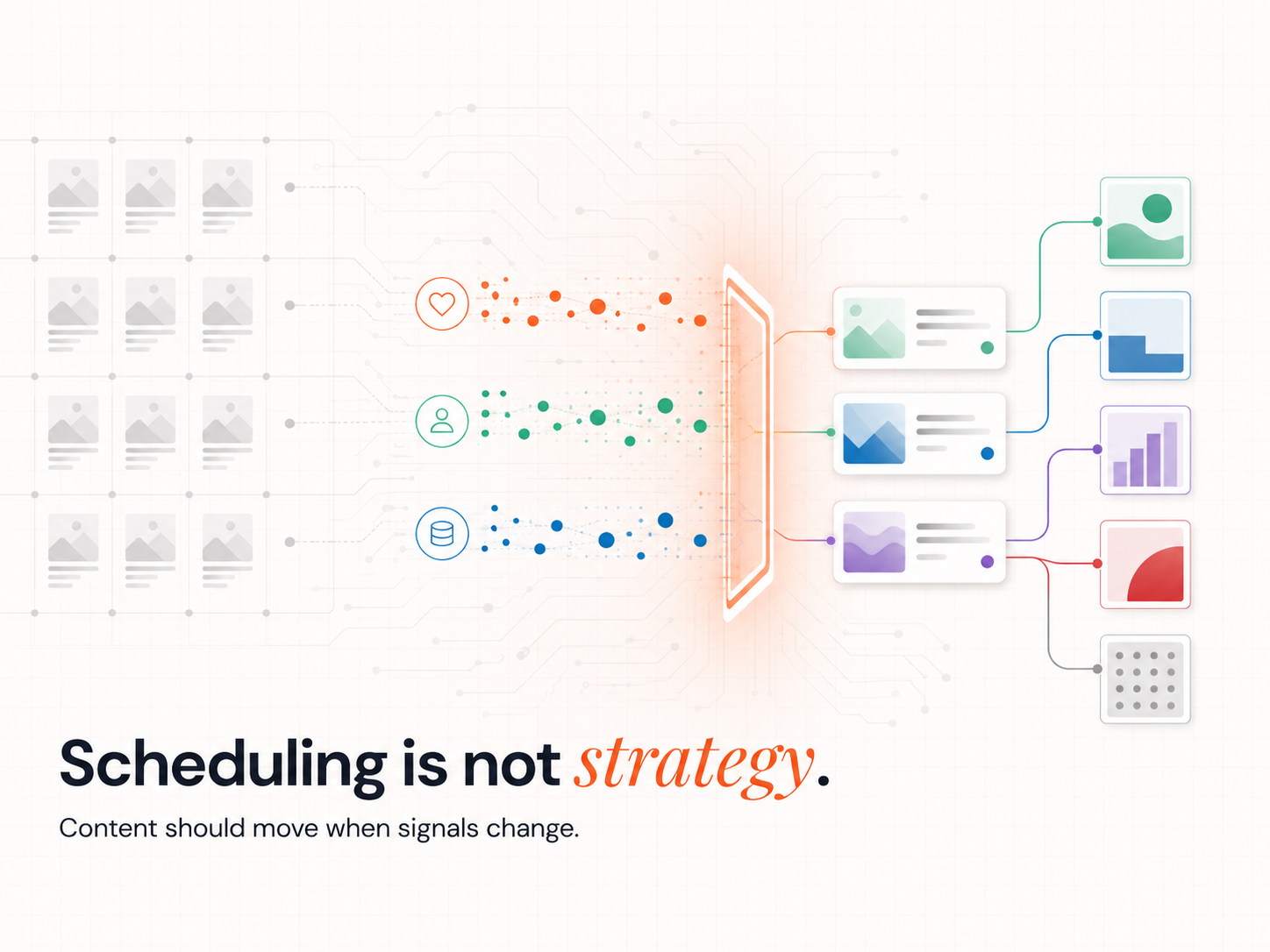
Manual scheduling at scale produces the same problems an Evergreen CRM solves: stale audience data, fragmented signals, and missed timing. The fix is not more tools, it is fewer tools connected to a Signal Response Protocol that fires posts when a real buyer signal opens.
Understanding how signal-based automation reduces wasted outreach clarifies why static schedulers hit a ceiling. The post still fires on a calendar even when the audience has moved on, because the system has no signal layer to override the schedule.
Which Tools Lead the 2026 Social Media Automation Stack?
The 2026 social media automation stack combines a scheduler (Hootsuite, Buffer, Sprout Social, or Later), a CRM with social integration (HubSpot or Salesforce), and a signal layer (Clay, n8n, or a custom orchestration). The strongest stacks add Signal Response Protocols that connect buyer behaviour on social to outbound posting and CRM updates.
The four most-used scheduling tools in 2026
- Hootsuite: Cross-platform scheduling, social listening, analytics. Best for marketing teams managing multiple brand accounts at scale.
- Buffer: Lightweight scheduling, AI-powered post drafting, engagement tracking. Best for smaller teams or individual creators.
- Sprout Social: Listening, scheduling, reporting, plus stronger CRM integration. Best for B2B teams that need cross-functional reporting.
- Later: Visual content scheduling, optimised for Instagram and Pinterest. Best for brands where visual content drives most engagement.
Each tool handles publishing well. However, most standalone schedulers need a CRM and orchestration layer before social engagement can trigger pipeline actions.
Why orchestration matters more than tool count
B2B audiences now use an average of 6.83 social platforms per month, according to DataReportal's Digital 2025 State of Social Media. Brand presence on one platform leaks the buyer to a competitor on another, therefore orchestration matters more than tool count.
The orchestration layer (n8n, Zapier, or a custom integration) connects scheduler events to CRM records, lead-scoring updates, and outbound triggers. Clay-HubSpot integration in practice shows how the Evergreen CRM model passes social engagement signals into HubSpot for routing.
How Does AI Personalisation Beat Scheduled Posting?
AI personalisation beats scheduled posting because it adjusts the message to the audience in real time, based on live behaviour. A scheduled post fires the same content to everyone in the segment. AI personalisation segments dynamically, rewrites copy per persona, and times the post when the user is most likely to engage.
60.4% of marketers have integrated AI-driven personalisation and automation into their strategies, with 58.6% finding AI very effective at improving engagement, according to Influencer Marketing Hub 2025. The lift comes from matching content to the audience, not from posting more.
How does signal-driven personalisation work in practice?
Signal-driven personalisation pulls from CRM behaviour, web analytics, email engagement, and social interaction data. When a user from a target account engages with a competitor's pricing page, the system fires a personalised LinkedIn post or paid ad pointing to the comparison. Real-time lead scoring updates the audience segment as new behaviour fires, replacing static persona lists that decay weekly.
The output is not "more posts". The output is the right post landing with the right person at the moment they are evaluating, which is what closes the gap between social engagement and pipeline.
How Do Signal Response Protocols Connect Social to CRM?
Signal Response Protocols connect social engagement events to CRM records via an orchestration layer (n8n or Zapier). When a target account engages with a post, the system updates the lead score, triggers a follow-up sequence, and routes the engagement to the assigned SDR. The post stops being a marketing artefact. It becomes a pipeline trigger.
LinkedIn posts with replied-to comments see a 30% lift in engagement, with a 21% lift on Instagram, according to Buffer's 2025 engagement research. Real-time response is the highest-leverage signal layer in social, because it converts passive scrollers into active conversations.
An example workflow
A target account follows the IR LinkedIn page. Three weeks later, a senior decision-maker at that account engages with a post about Verified Buying Windows. The Signal Response Protocol fires:
- Clay enriches the contact with current role, tenure, and tech stack
- HubSpot updates the lead score and lifecycle stage
- An SDR is notified within minutes
- A follow-up sequence in SmartLead fires with a personalised message referencing the post topic
The buying signals that map most reliably to social are profile visits from target accounts, comment engagement, and content shares to private networks.
Why Are B2B Buyers Already on Social Before They Reach Out?
B2B buyers are on social media before they reach out because they research vendors privately, comparing positioning, customer testimonials, and category authority before scheduling a demo. Social presence is the first credibility check. The vendor that shows up consistently with relevant content, replies to comments, and surfaces buyer-aligned messaging wins the comparison phase.
70% of B2B purchase decision makers use social media to help them decide, per Sopro's 2025 B2B Buyer Statistics. The buying window opens on social before it ever reaches the inbox, which is why social automation must be plugged into the same Signal Response Protocols as outbound.
That changes what social automation is for. It is no longer a brand-awareness loop. It is a Verified Buying Window detector, because every social engagement from a target account is a signal the buyer is in research mode. The job is to convert that signal into a pipeline event before a competitor does.
Where Do Standalone Social Tools Fall Short?
Standalone social tools fall short when they cannot integrate with the CRM signal layer. Hootsuite or Buffer schedule posts well but do not know which post triggered a sales-qualified meeting. Without a Signal Response Protocol layer, social engagement metrics stay disconnected from pipeline metrics, and reporting becomes anecdotal.
79% of social media managers now use AI in their daily workflows, per Hootsuite's 2026 Social Media Trends. Volume creation is solved. The remaining bottleneck is connecting the volume to the buyer signal.
Three common failure modes
- Generic content delivery. Posts fire on a schedule with no segmentation, no personalisation, and no audience-specific targeting.
- Tool sprawl. Marketing teams stack 4 or 5 tools, each owning a slice of the workflow, with no orchestration layer connecting them.
- Brand drift. Without real-time audience insights from the CRM, the brand voice evolves out of sync with the audience's actual concerns.
The fix is not more tools. The fix is the orchestration layer that connects the existing tools to a Signal Response Protocol.
What is the next step for connecting social automation to pipeline?
In 2026, the B2B teams that win on social media stop measuring impressions and start measuring pipeline. The shift is not from one tool to another. It is from a content distribution mindset to a signal routing mindset, where every social engagement from a target account becomes a CRM event, not a post metric.
Content Creation
Intelligent Resourcing installs Signal Response Protocols that connect Hootsuite, Buffer, or Sprout Social to HubSpot, Clay, and SmartLead, so every social engagement from a target account fires a CRM event, a lead-score update, and an SDR notification automatically.
FAQs
What is signal-led social media automation?
Signal-led social media automation fires posts, replies, or audience updates when a verified buying signal opens, rather than on a scheduled calendar. Examples of signals: a target-account user visits a competitor's pricing page, engages with a competitor's LinkedIn post, or downloads a piece of content. The system reads the signal and triggers a personalised social action.
Why do scheduled posts not work as well as signal-led content?
Scheduled posts fire at a calendar time regardless of whether the audience is ready to engage. Signal-led content fires when the buyer is actively in research mode, which is the moment a Verified Buying Window opens. The same content seen at the right moment converts at a higher rate than the same content seen at a random moment.
How do I integrate my social media tools with my CRM?
Use an orchestration layer (n8n, Zapier, or a custom integration) to connect scheduler events to CRM records. The orchestration layer reads social engagement events, updates lead scores in HubSpot or Salesforce, and triggers follow-up sequences when a buying signal opens.
What are the risks of social automation without signal integration?
Three main risks: posts fire to audiences that have lost interest, leads that should be routed to SDRs sit in social analytics dashboards instead, and brand voice drifts out of sync with audience concerns because the system never receives audience feedback.
How do I keep brand voice consistent across automated content?
Use brand guidelines built into the AI prompt layer (Hootsuite, Buffer, and Sprinklr all support this), governance review for every campaign, and a feedback loop that pulls audience response data into the next round of content.