

A One-Off AI Citation Audit Is a Fixed-Scope Diagnostic
You have two ways to spend on AI visibility, and they are not the same purchase. An audit is a diagnosis; a retainer is the treatment that acts on it. A one-off AI citation audit is a fixed-scope, point-in-time diagnostic that measures where your brand appears across ChatGPT, Perplexity, Gemini, and Google AI Overviews, and maps your citation gaps against competitors. Its value decays as the models refresh their indexes, because an audit is a diagnosis, not a cure.
The point of an audit is clarity: you learn where you stand today, but you do not change where you stand. That distinction matters, because AI models refresh constantly. Perplexity carries an aggressive freshness bias, favouring recently updated pages, so audit findings age fast.
Most of the work an audit uncovers sits off your own site. Roughly 85% of AI citations trace back to third-party pages, not owned domains, according to AirOps 2026 data, so an audit reads your review profiles, roundups, and third-party mentions, not just your pages. As of 2026, a one-time audit runs $1,500 to $5,000, a fixed scope at a fixed price.
Treat the audit as the first rung on the Citation Readiness Ladder. It tells you whether your generative engine optimisation has a real gap. It shows your baseline AI visibility before you spend on execution.
A credible audit delivers a defined set of artefacts:
- A baseline citation rate across ChatGPT, Perplexity, Gemini, and Google AI Overviews
- A tracked buyer-prompt set, typically 20 to 50 prompts, plus a citation gap map
- The competitor citation landscape for the same prompts
- Schema and structured-data findings
- A prioritised, sequenced fix list
- An off-site authority gap assessment
A GEO Retainer Is an Ongoing Programme That Builds Citation Share
A GEO retainer is an ongoing programme that turns audit findings into compounding citation share. A GEO strategist runs content, schema, and off-site authority work, while the team tracks citations monthly against a fixed prompt set. A retainer is continuous work, not a one-time fix, and it needs a working SEO foundation underneath it. The same programme sits beside classic search work, and our comparison of a GEO retainer and SEO retainer covers that overlap.
Here is who does the work and how it connects: a GEO strategist owns the programme, a content team writes answer-first blocks engineered for extraction, a technical resource ships FAQPage and Article schema, and an outreach lead builds off-site citations. These connect through one loop, monthly citation-rate tracking against a fixed prompt set, that turns activity into share of model.
AI visibility is not a one-time fix, because the engines keep changing and the work must continue. Off-site authority is the heaviest lever, because domain authority, high-DA backlinks, and referring domains rank among the top drivers of LLM citation, and a retainer builds those every month, not once.
A retainer is not a replacement for SEO; it sits on top of it. Get schema markup for AI right, structure content for AI citation properly, and treat LLM SEO as an added layer. Buy it before the foundation exists and the spend is wasted, which is the main risk. Before signing anything, check what a fair scope actually costs, because a clear pricing breakdown for Australia is where most buyers find out what other agencies hid.
A growth-stage retainer typically includes:
- Answer-first content engineered for AI extraction, with 40 to 60 word answer blocks
- FAQPage and Article schema implementation
- Entity and knowledge-graph authority building
- Off-site citation building across roundups, review sites, and digital PR
- Monthly citation-rate and share-of-model tracking against a fixed prompt set
- A quarterly content refresh at the 60 to 90 day mark
GEO Retainer vs One-Off AI Citation Audit: The Core Differences
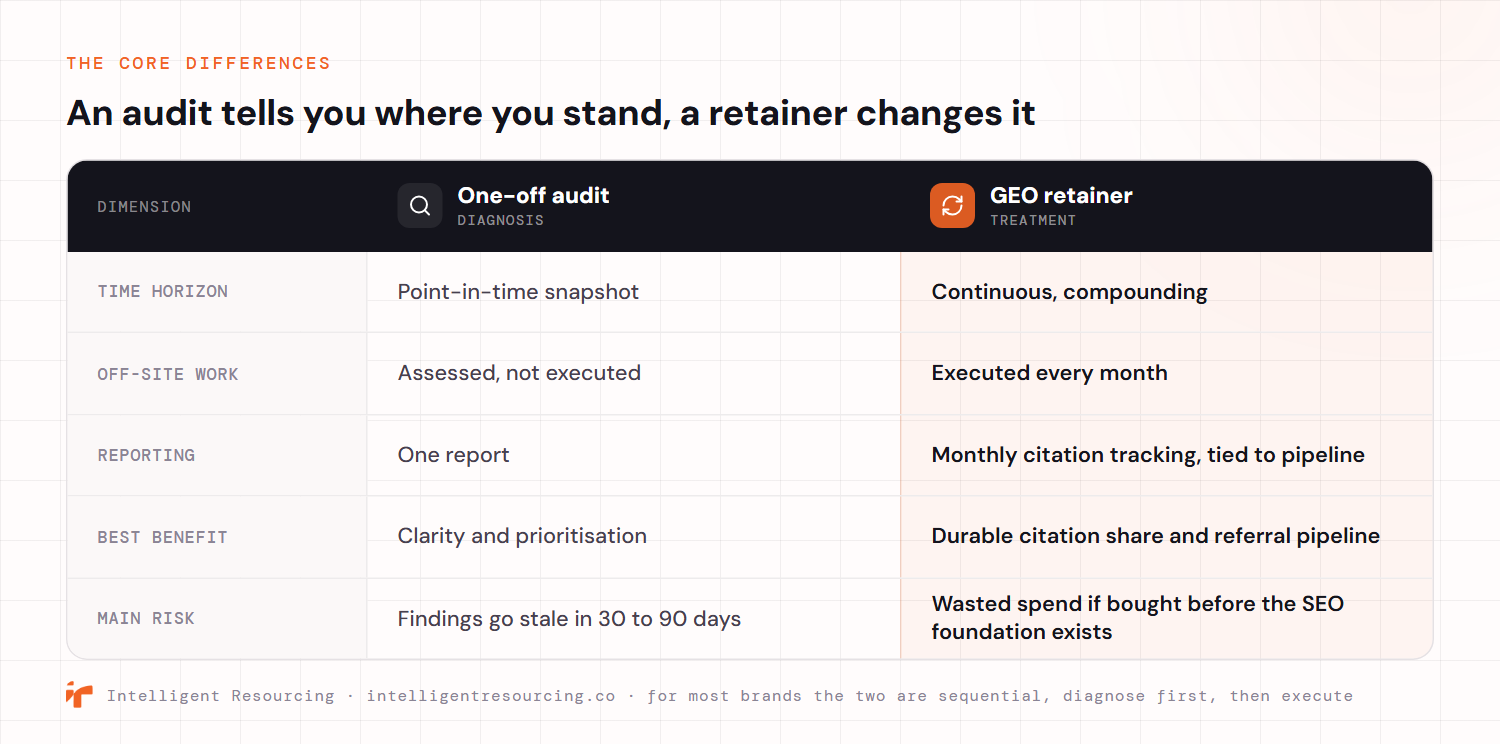
The core difference is time horizon and off-site depth. An audit tells you where you stand; a retainer changes where you stand. The audit is a point-in-time snapshot, while the retainer is continuous, compounding work. For most brands the two are sequential, not either-or: you diagnose first, then you execute.
An audit assesses off-site authority, but a retainer executes it every month, and that gap explains the different outcomes.
| Dimension | One-Off Audit | GEO Retainer |
|---|---|---|
| Time horizon | Point-in-time snapshot | Continuous, compounding |
| Off-site work | Assessed, not executed | Executed monthly |
| Reporting | One report | Monthly citation tracking tied to pipeline |
| Best benefit | Clarity and prioritisation | Durable citation share and referral pipeline |
| Main risk | Findings go stale in 30 to 90 days | Wasted spend if bought before the SEO foundation exists |
Consider the numbers: only a small share of URLs cited by ChatGPT and Perplexity also rank in Google's top 10. Traditional SEO alone leaves most AI-cited real estate on the table. That is the delta a retainer is built to close, and an audit only measures. Australian providers working that gap are listed under ChatGPT citation agencies in Australia.
The audit's main risk is decay, because findings go stale in 30 to 90 days, while the retainer's main risk is timing: wasted spend if bought before the SEO foundation exists.
Which Option Fits Your Stage: Startup, Mid-Market, or Enterprise?
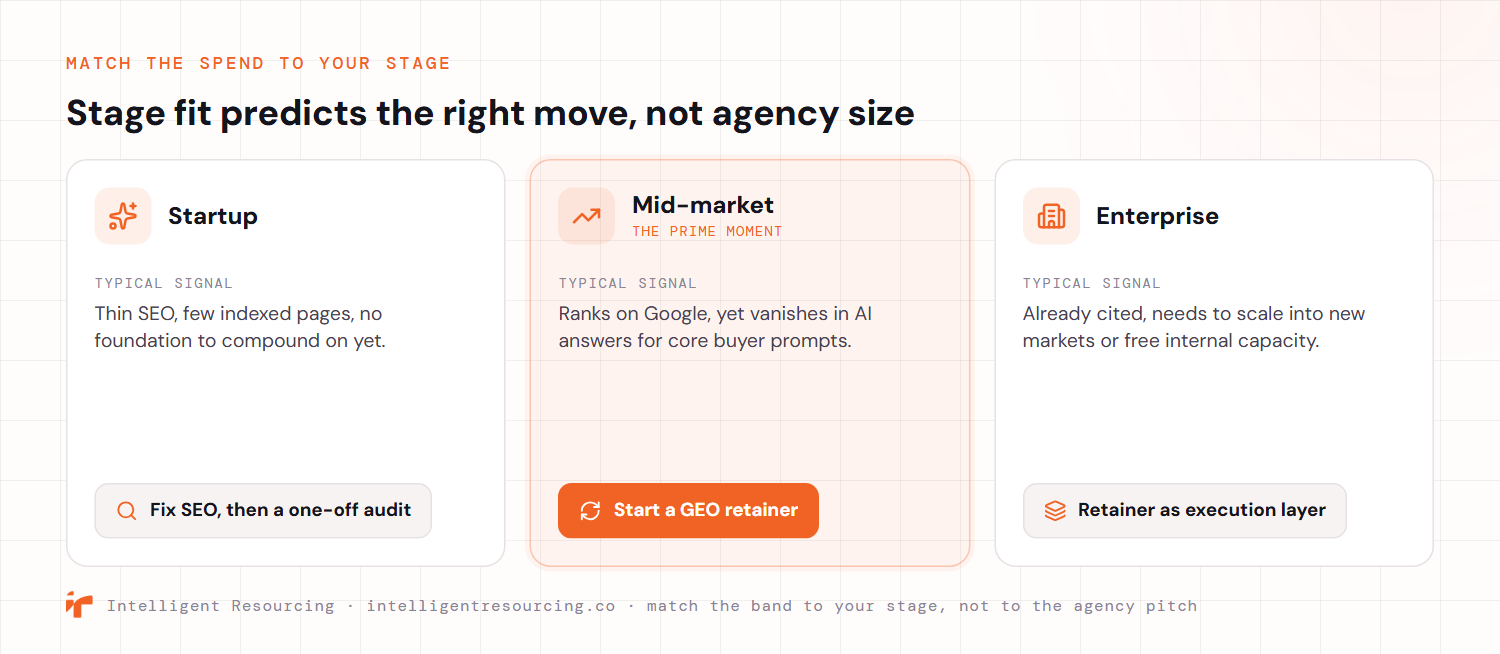
Match spend to stage, not to agency marketing. Startups and pre-foundation teams should fix SEO, then buy the audit. Mid-market brands that rank on Google but vanish in AI answers are the prime retainer moment. Enterprises use retainers to scale into new markets or free internal capacity.
| Stage | Typical signal | Best first move |
|---|---|---|
| Startup / pre-foundation | Thin SEO, few indexed pages | Fix SEO, then a one-off audit |
| Mid-market growth | Ranks on Google, absent in AI answers | GEO retainer (the prime moment) |
| Enterprise | Already cited, needs scale or new markets | Retainer as execution layer |
Stage fit is the real predictor, more than agency size, Clutch score, or years in business. Buyer behaviour backs the urgency: a meaningful share of B2B buyers now use AI platforms for vendor research before they ever visit a vendor site, and if AI answers omit you, you are absent from that first shortlist. If you are still sizing the spend against your overall marketing budget, a stage-by-stage AI visibility budget guide breaks that down. Quoted retainer prices rarely cover everything, so check the hidden costs in an AEO retainer first.
The shift is structural, not a fad. ChatGPT drives roughly 92% of AI referral traffic, according to Search Engine Land, so whichever stage you are at, the channel that matters most is already concentrated in one place. Waiting for the trend to settle costs you citation share now.
Startups should not start with a retainer, because they lack the foundation to compound, while mid-market growth brands are the prime moment and enterprises use the retainer as an execution layer.
When Should You Switch From an Audit to a Retainer, and What Is the ROI?
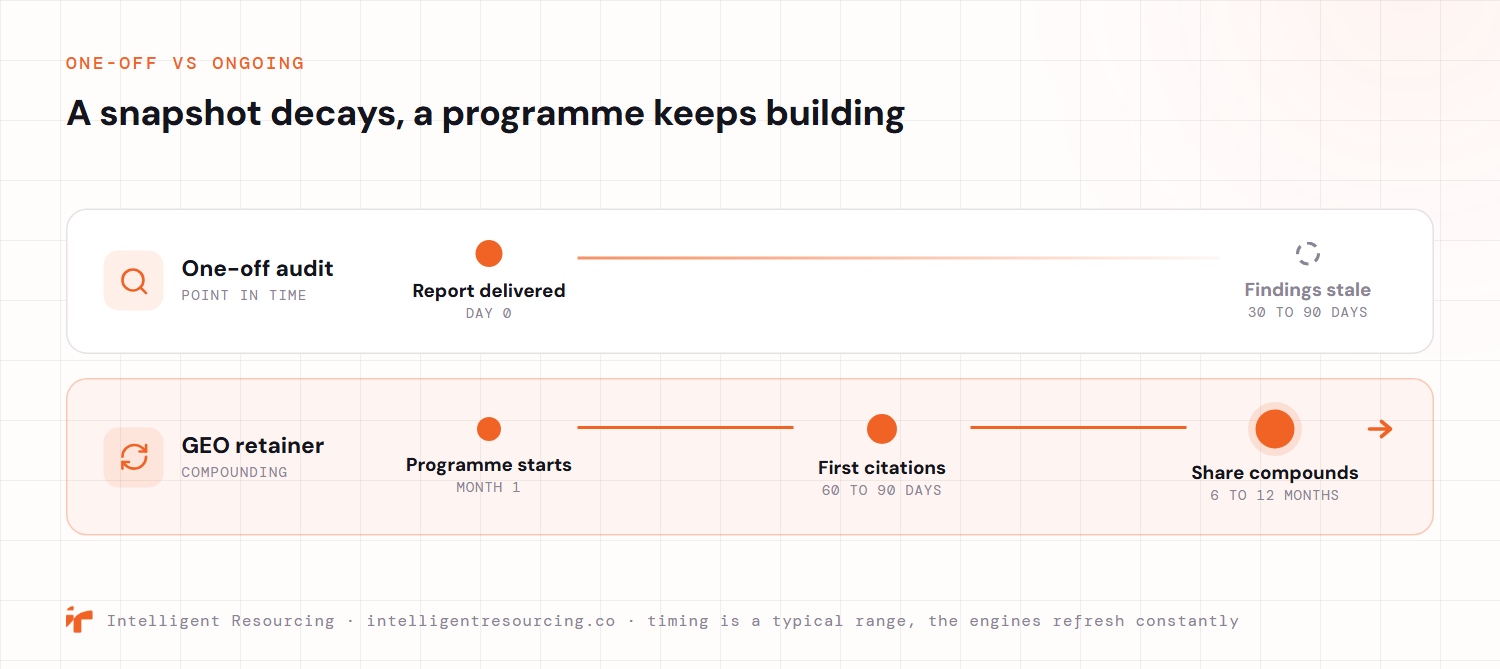
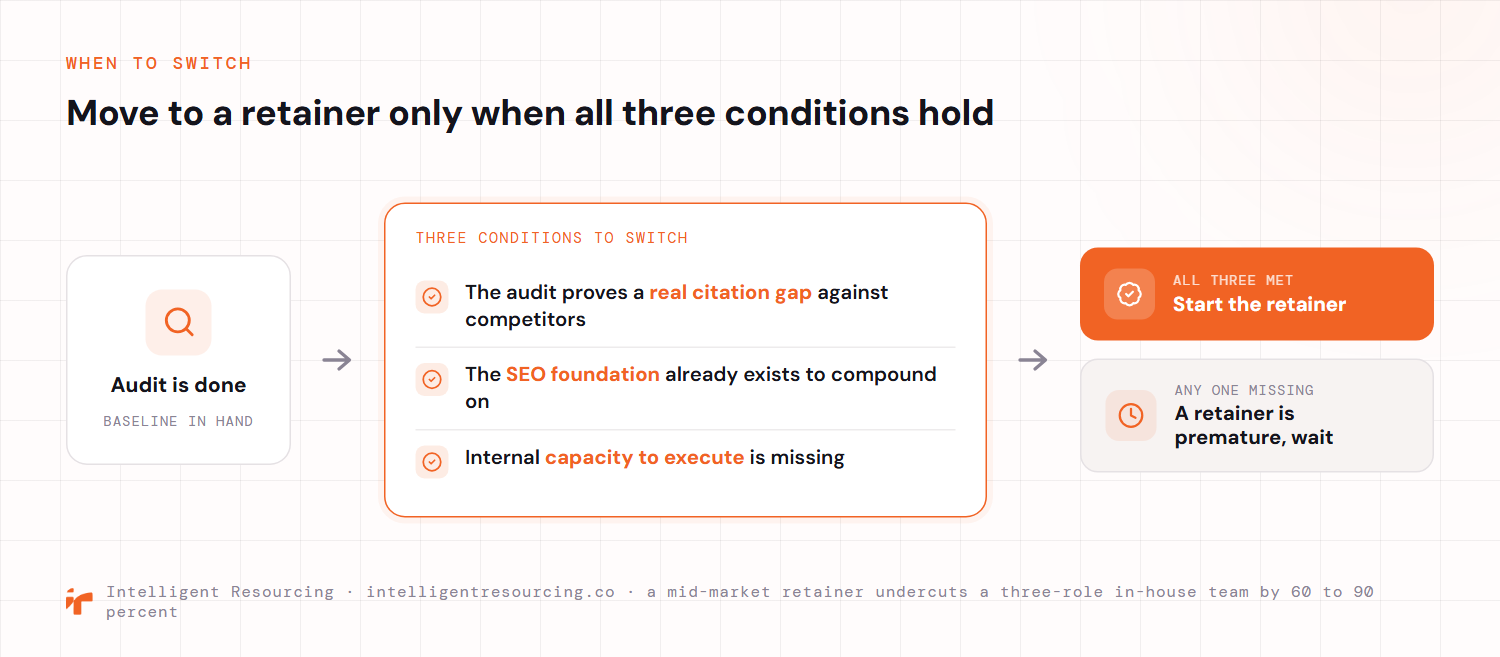
Switch when three conditions hold: the audit proves a real citation gap, the SEO foundation already exists, and internal capacity to execute is missing. Miss any one and a retainer is premature. For mid-market brands, the retainer wins on total cost and speed.
Run the cost comparison first, because building the equivalent in-house team is expensive. An in-house GEO team of a strategist, content specialist, and authority specialist runs roughly $180,000 to $350,000 a year before tooling. A mid-market retainer runs $3,000 to $8,000 a month, or roughly $36,000 to $96,000 a year. The retainer undercuts the three-role team by 60% to 90%. We have laid out the full in-house versus agency maths separately, if you want to run your own numbers.
Pipeline value is where it compounds, because AI-referred traffic converts well above non-branded organic, often by a wide multiple, according to one conversion analysis, so citation share carries outsized pipeline value. When we ran a citation baseline for a mid-market Australian SaaS brand at Intelligent Resourcing, it ranked on page one of Google yet appeared in zero ChatGPT answers for its core buyer prompts. The gap was executional, not foundational, which is exactly the switch trigger.
Before you commit, calculate your ROI against your own numbers.
The ROI logic in short:
- Audit cost is one-time and sunk; retainer cost is monthly and compounding
- A mid-market retainer of roughly $36,000 to $96,000 a year undercuts a three-role in-house team
- AI-referred traffic converts above non-branded organic, so citation share has outsized pipeline value
- Switch only after the audit confirms the gap is executional, not foundational
Match Your Stage to the Right GEO Investment
The logic is simple: audit to diagnose, retainer to execute, and match the spend to your stage. Before you commit budget, pressure-test where you actually sit. Book a call and we will map your stage against the Citation Readiness Ladder. If you are weighing retainer spend, estimate your return first, then decide.
Comparisons
Intelligent Resourcing runs both one-off AI citation audits and ongoing GEO retainers, and recommends the one your stage actually calls for. Book a call and we will map where you sit on the Citation Readiness Ladder and the fix that closes your citation gap.
FAQs
Is a one-off AI citation audit worth it, or should I go straight to a retainer?
An audit is worth it when you need proof of the gap or lack an SEO foundation. It gives you a citation baseline and a prioritised plan for $1,500 to $5,000, and most brands should diagnose first, going straight to a retainer only when the foundation and the gap are already clear.
How much does a GEO retainer cost compared to a one-off audit?
As of 2026, audits run $1,500 to $5,000 one-time. Growth-stage retainers run $3,000 to $8,000 a month. Enterprise scopes start near $15,000 a month. Australian buyers should expect local variation on all three bands. Match the band to your stage, not to the agency's pitch.
How long before a GEO retainer produces AI citations?
Expect first citation signals in 60 to 90 days. The effect compounds over 6 to 12 months as off-site authority builds. Anyone promising results in 30 days is overpromising. AI citation follows domain trust and off-site work, and both take time to accrue.
Can a one-off audit be a standalone deliverable, or is it just a sales lead-in?
A credible audit is a standalone deliverable you keep. You get a citation baseline plus a prioritised plan, even if you never sign a retainer. Be wary of audits that are thinly disguised pitches. A real audit has value on its own, whether or not you continue.
Does a GEO retainer replace my SEO?
No. SEO remains the foundation AI systems pull from. A GEO retainer, or answer engine optimisation programme, is an added layer on top, not a replacement. Kill your SEO and the retainer loses the base it compounds from. Run both together.