

What Separates a Business Case From a Marketing Pitch?
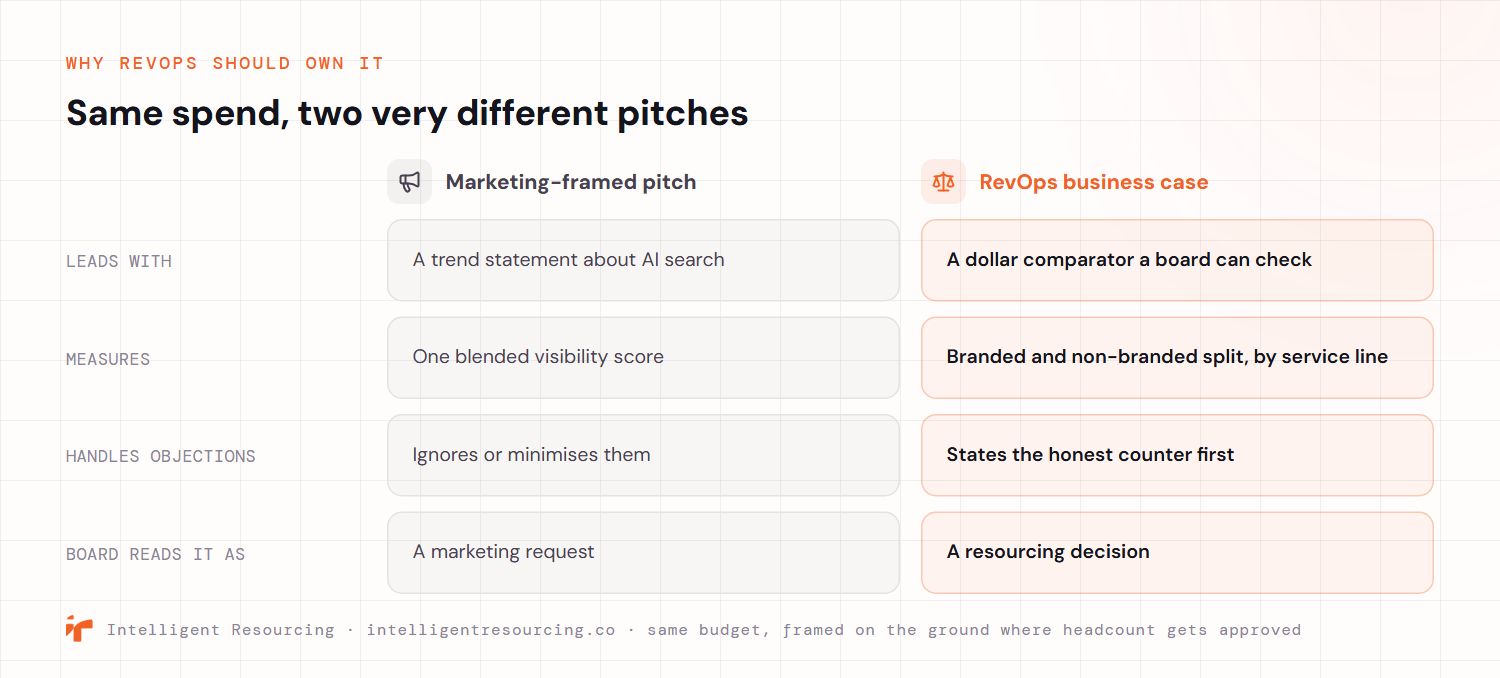
A marketing pitch argues that a channel matters. A business case argues that a specific dollar produces a specific result, and shows the comparator that proves it. Marketing usually owns the execution, but the argument for funding it is a RevOps argument, cost per outcome, not reach or impressions. That mismatch is why most internal GEO pitches stall. Intelligent Resourcing's GEO service is built around that RevOps framing directly, citation-engineered content priced and measured against pipeline, not impressions.
A marketing-framed pitch competes for budget against other marketing line items on marketing's own terms, awareness, engagement, brand lift. A RevOps-framed pitch competes on a different, more favourable ground, cost per qualified outcome, the same ground headcount decisions already get made on.
Asked 'what does this deliver,' a marketing-framed pitch falls back to visibility metrics, impressions, mention rate, share of voice on its own, none of which map to a dollar figure a board can act on. A RevOps-framed pitch has an answer ready, the cost comparator against an SDR hire, built into the pitch from the start.
The Cost Comparator Every Board Deck Needs
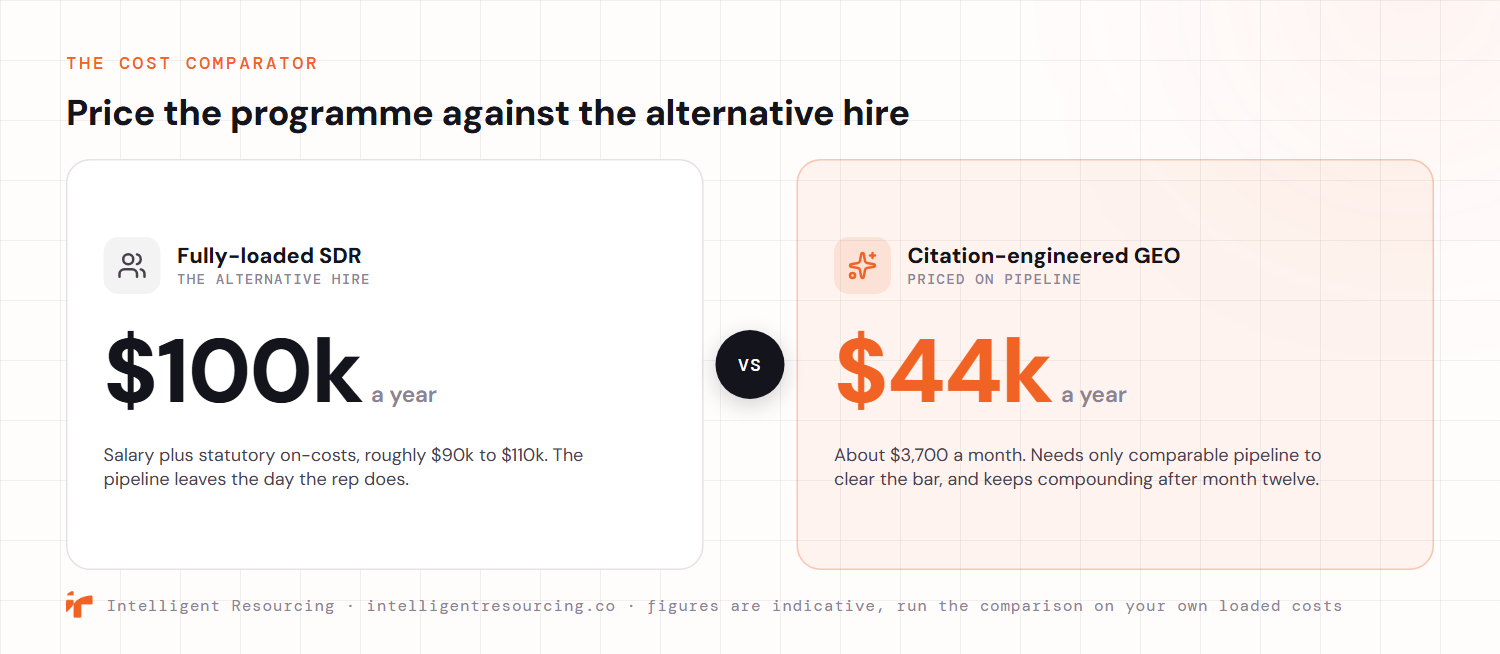
The single most useful number in this pitch is not a GEO metric at all. It is the fully-loaded cost of the alternative, an SDR hire. A fully-loaded SDR costs roughly AUD $90,000 to $110,000 a year, once salary and statutory on-costs are counted, built from public salary data.
Run the actual comparison rather than describing it. A citation-engineered programme priced at $3,700 a month runs to roughly $44,400 a year. Set against a $100,000 loaded SDR, it only needs comparable pipeline to justify itself on cost alone, and content keeps compounding after month twelve while a departing SDR's pipeline does not.
If the annual cost clears that bar, the case makes itself in language a finance function already understands, because a board evaluates a resourcing request against the resourcing alternative, not against an abstract improvement in search behaviour. If it does not clear that bar, that gap is the exact target the programme needs to hit next.
What Belongs in the Share-of-Voice Slide?
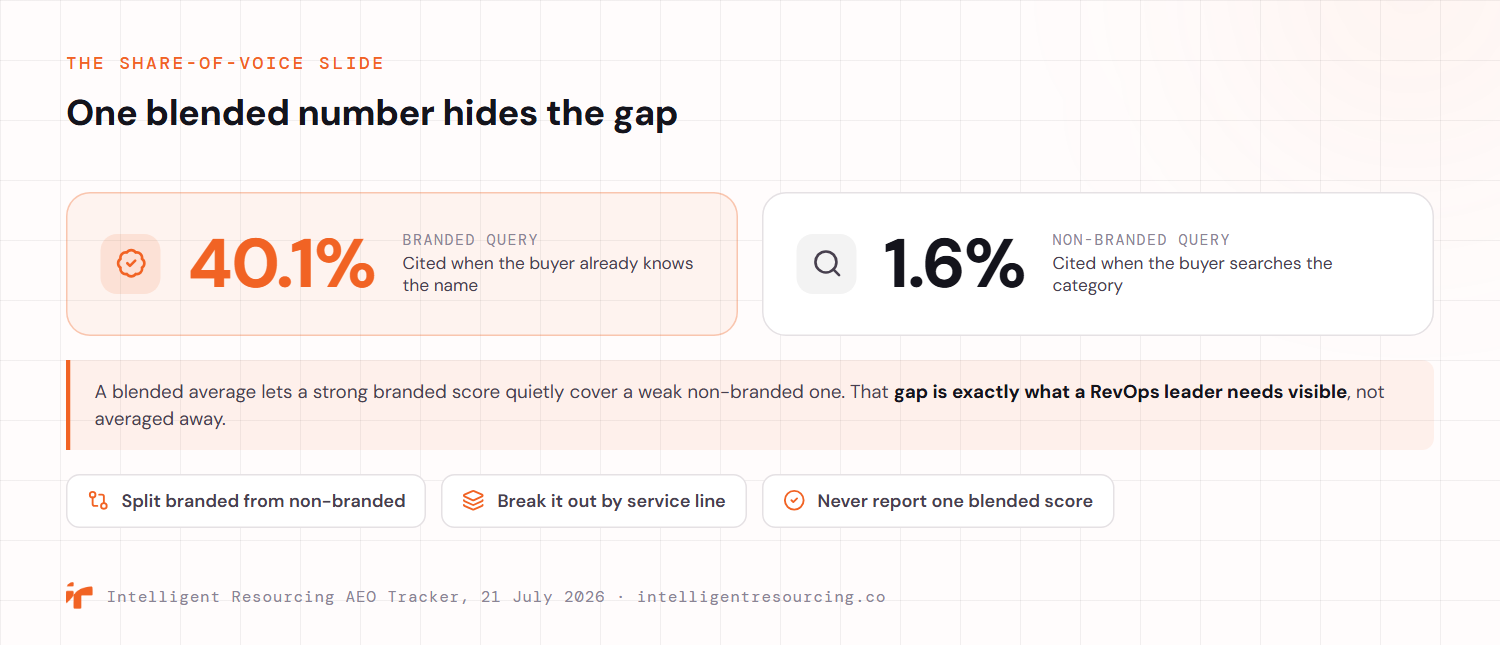
A single blended AI-visibility number is close to useless in a board deck, because it hides where the opportunity or the gap sits. The split worth showing runs two ways, branded versus non-branded, and by service line.
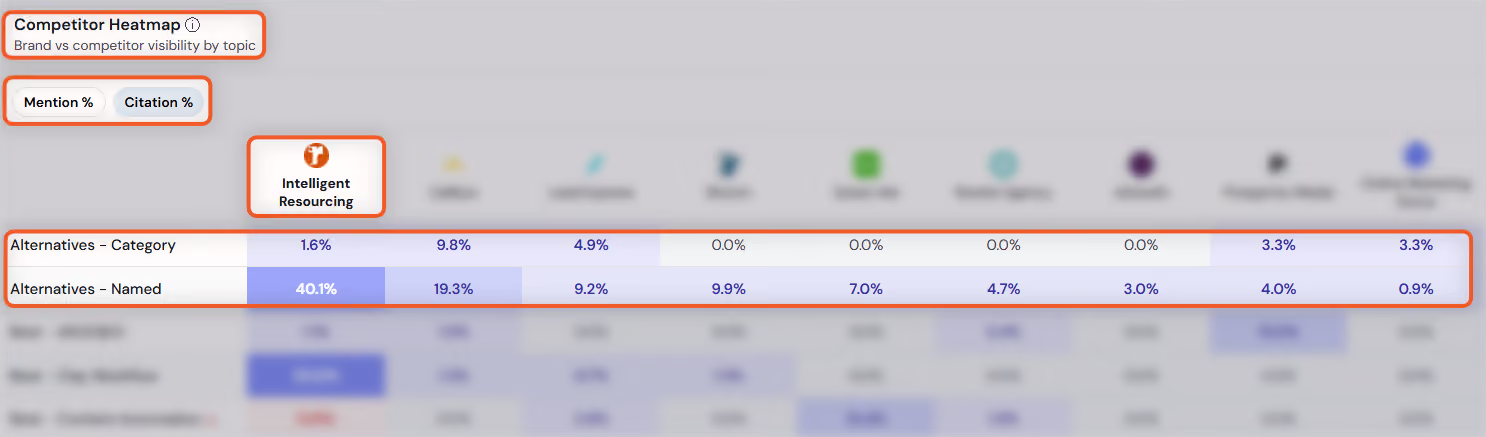
Reporting only a blended average lets a strong branded score quietly cover for a weak non-branded one, which is precisely the gap a RevOps leader needs visible. Intelligent Resourcing's own tracker shows exactly this gap, a 40.1% citation rate on branded queries where the buyer already knows the name, against 1.6% on the equivalent non-branded category query (Intelligent Resourcing AEO Tracker, 21 July 2026). A single split slide, mapped across the relevant service lines, tells a board what a blended number misses.
| Metric | What It Shows | Business Impact |
|---|---|---|
| Branded visibility | How often an engine names the brand when a buyer already searches for it by name | Confirms existing demand is not leaking to a competitor |
| Non-branded visibility | How often the brand surfaces when a buyer searches the category, not the name | Shows whether new, unprompted demand is reachable at all |
| Split by service line | Citation performance broken out per offering, not blended | Shows exactly where the gap sits, by offering, not overall |
A Credible Case Names Its Own Limit First
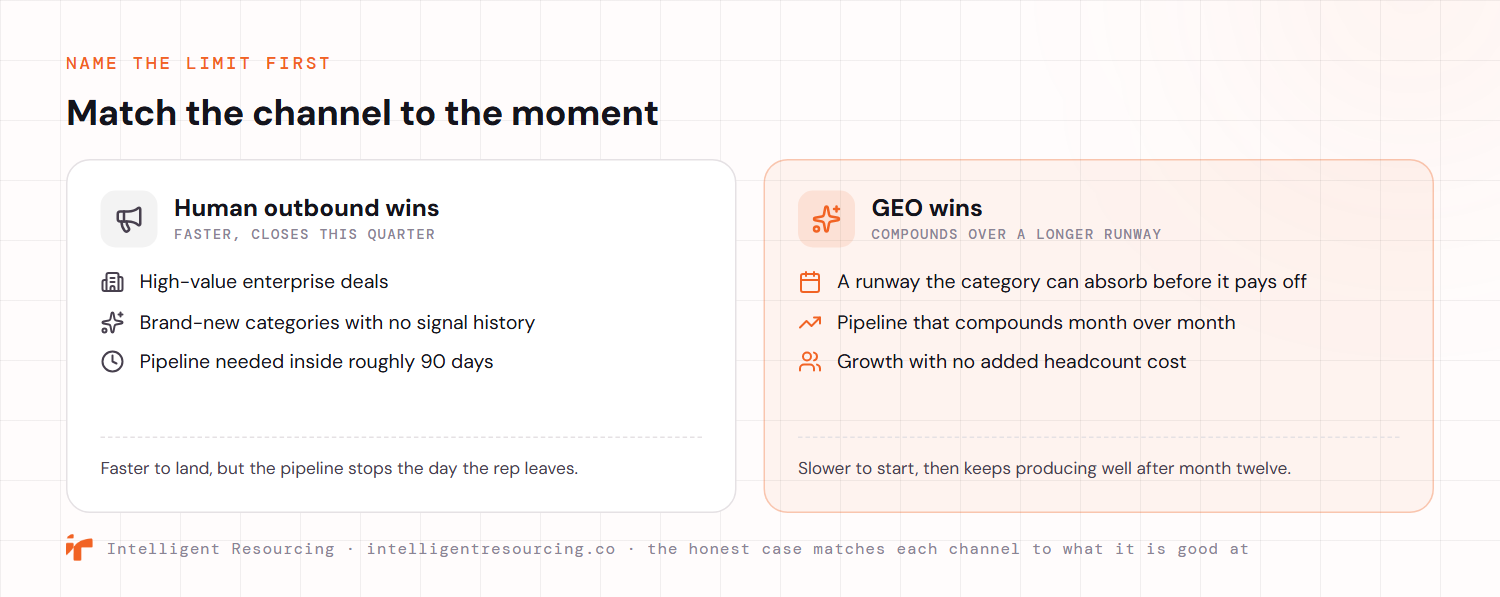
The strongest version of this pitch names its own limitation before anyone else raises it. Human outbound still wins in three situations.
- High-value enterprise deals
- Genuinely new categories with no existing signal history
- Pipeline that needs to land inside roughly 90 days
GEO takes months to earn its first citations, then keeps producing pipeline without adding headcount cost afterward, while an SDR delivers faster but stops producing the day they leave. The honest version of the case matches each channel to what it is good at, outbound when a deal needs to close inside the next quarter, GEO when the category can absorb a longer runway before it pays off.
Tight Budgets Make the Timing Argument Stronger
Overall marketing budgets are not expanding quickly. The CMO Survey found marketing spend grew 3.3%, digital 7.3% over the prior 12 months, digital growing more than double the overall rate. The same survey found 63% of CMOs reported rising pressure from their CFO specifically to prove marketing's value, up from 52% two years earlier.
That gap, not a general claim that 'budgets are growing,' is the number worth bringing to the board. Total budgets are tight, but the share moving toward digital channels is growing faster than the total itself. The AEO versus SEO budget split runs on the same dynamic, competition for the next marginal digital dollar, not for a bigger total pool. A GEO case that acknowledges tight overall budgets, rather than ignoring them, reads as realistic rather than aspirational.
Building the Case Also Costs Real Hours
Building this case is not free, and pretending otherwise undersells the point. Glassdoor's own data puts the average Revenue Operations Manager salary in Australia at $144,000 a year. The hours spent pulling AI-visibility data, drafting the cost comparator and building the split share-of-voice slide come out of a role already priced at that level.
This does not weaken the case for building it. It strengthens it, since the same hours produce a stronger pitch once, rather than a weak one now and a better one later after someone asks a question the first version could not answer. A single well-sourced pitch, backed by the SDR comparator and the branded/non-branded split, costs the same number of hours as a weak one and gets funded far more often.
Fit Check
This case is built for a specific moment, not every RevOps leader at every stage.
- Best for: RevOps leaders who already have some published content and a real, if unmeasured, AI visibility gap, and who need a resourcing argument a finance function will engage with.
- Not for: teams with no published content yet. There is no visibility gap to demonstrate on a page that does not exist, and the cost comparator has nothing to compare against.
- The trade-off: a cost-anchored case takes longer to build than a trend-based pitch, since it requires pulling real numbers rather than making a general argument. It is also far more likely to get funded, because it gives a board something specific to evaluate instead of something to take on faith.
The strongest internal case names the exact numbers a board can verify on its own.
Content Creation
Intelligent Resourcing builds and runs citation-engineered content on your own stack, priced and measured against pipeline, not impressions. Book a call to scope the business case, the SDR cost comparator and the branded versus non-branded split for your team.
FAQs
How do I pitch generative engine optimisation to a board that has never heard of it?
Lead with the cost comparator, not the terminology. Set the programme's cost against a fully-loaded SDR hire and frame it as a resourcing decision, the same category of decision the board already evaluates for headcount.
What is the single most important metric for a GEO business case?
Share of voice split two ways, branded versus non-branded, and by service line, rather than one blended visibility number. The split shows exactly where the gap sits, which a blended average hides.
Should I claim GEO will replace outbound sales?
No. State the honest limitation upfront. Outbound still wins for high-value enterprise deals, new categories and pipeline needed inside roughly 90 days. GEO compounds over a longer horizon and works alongside outbound, not instead of it.
Is now a good time to make this case, given tight marketing budgets?
Yes, framed correctly. Overall marketing budgets are growing slowly, but digital spend is growing faster than the total, so the real competition is for the next marginal digital dollar, not for a larger total budget.
Who should own generative engine optimisation internally, marketing or RevOps?
Execution usually sits with marketing, but the funding argument is a RevOps argument, cost per qualified outcome. Framing the pitch on RevOps terms rather than marketing terms is what gets it funded.