

What Makes an Author or Brand Trustworthy to an AI Engine?
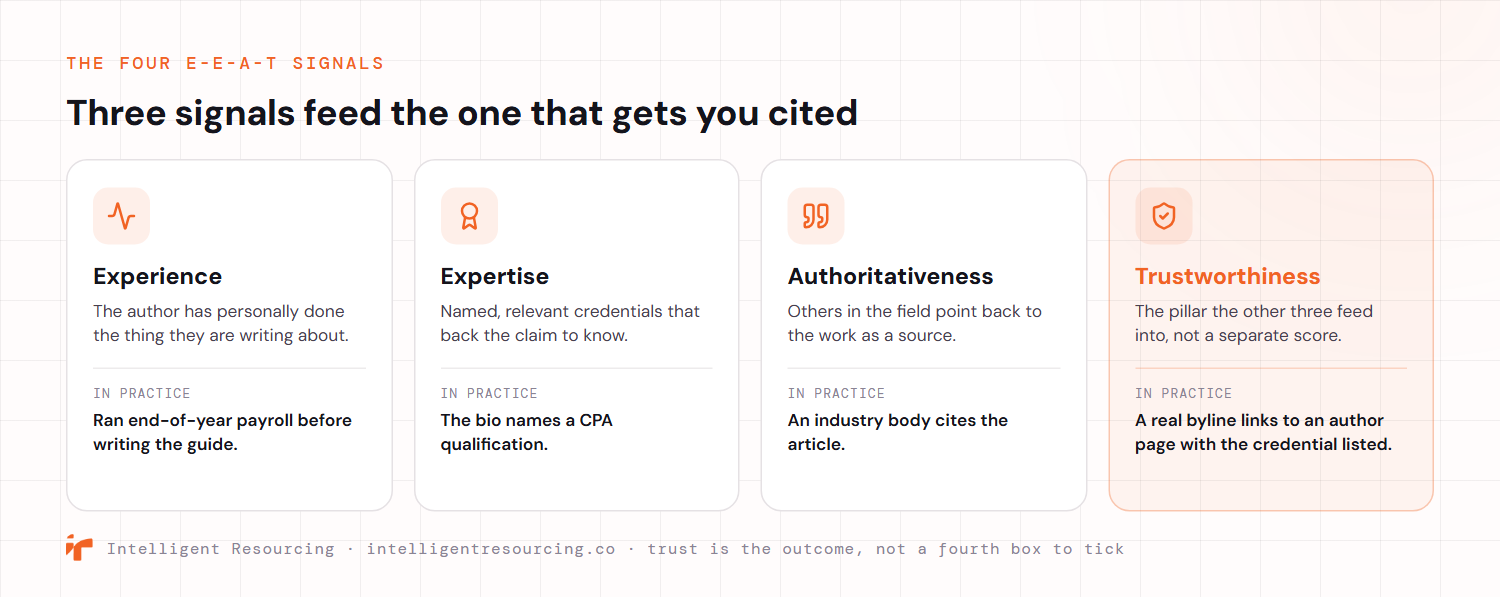
E-E-A-T stands for Experience, Expertise, Authoritativeness, and Trustworthiness, the framework Google's quality raters use to judge content credibility. Author trust attaches to a named person. Brand trust attaches to an organisation's reputation across the web. Google Search Central is explicit that trust is the pillar the other three feed into, not a separate fourth score.
An AI engine cannot take a claim at face value. It checks instead:
- Does this author exist, and have the credentials the bio claims?
- Does this brand's name and description match everywhere it appears?
- Can this specific fact be traced to a source?
One illustrative B2B example makes the four pillars concrete. A payroll specialist who has personally run end-of-year processing writes a guide on the topic, that is Experience. Her bio names a CPA qualification, that is Expertise. An industry body cites the article, that is Authoritativeness. The page carries a real byline linking to an author page with that credential listed, that is Trustworthiness.
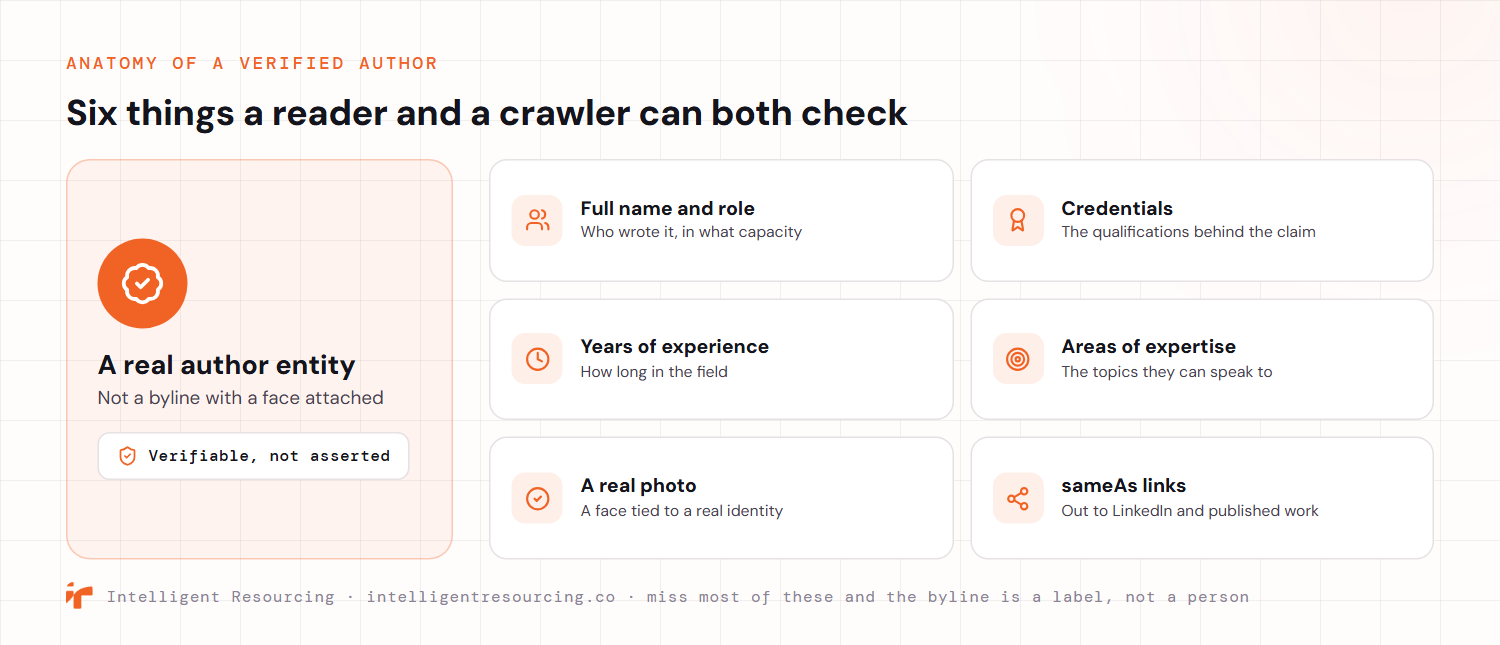
A verified author entity needs six things a reader and a crawler can both check: a full name and role, credentials and qualifications, years of experience, areas of expertise, a real photo and sameAs links to LinkedIn and published work. A byline missing most of these is a label with a face attached, not a verifiable person.
The Categorisation Problem Behind Trust Signals
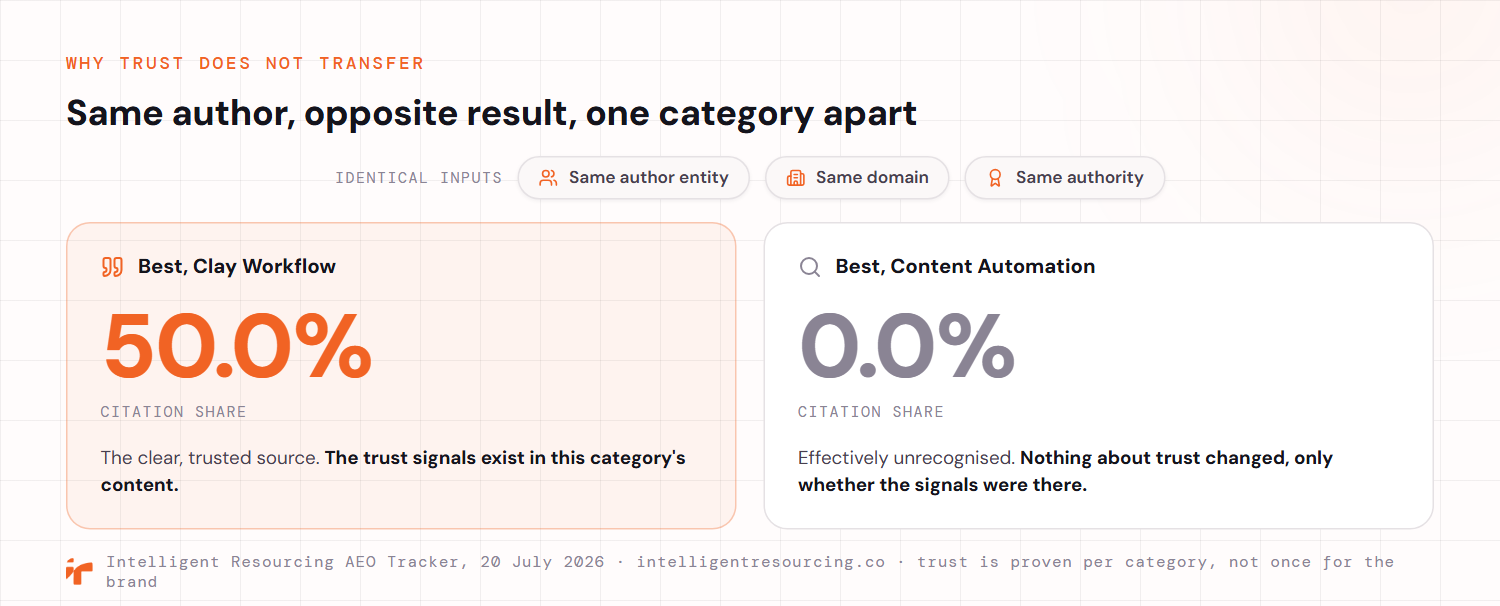
The mistake most E-E-A-T advice makes is treating trust as one score that, once earned, applies everywhere a brand publishes. It does not. The same brand, the same author entity, the same domain authority can be the clear, trusted source in one category and effectively unrecognised in an adjacent one.
Intelligent Resourcing's own tracker shows this directly. Intelligent Resourcing holds 50.0% citation share in Best - Clay Workflow, the clear, trusted source there, and 0.0% in the adjacent Best - Content Automation category, same domain, same authority, same author entities (source: Intelligent Resourcing AEO Tracker, 20 July 2026).
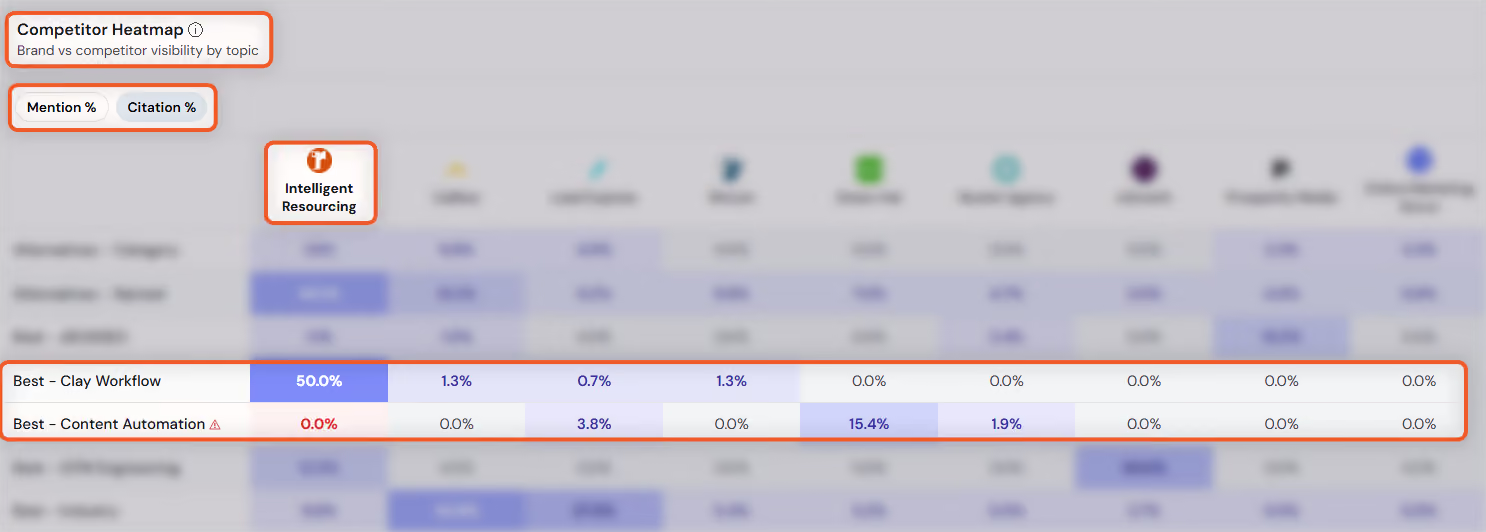
Nothing about trustworthiness changed between the two categories. What changed was whether the trust signals existed in that category's content. The real test for any brand is knowing which categories already have those signals, and which are just assuming that trust earned elsewhere carries over.
Author and brand trust also have to align with each other. A mismatched bio and brand record, a different name spelling, an inconsistent job title, a profile that does not match the company's own entity data, forces an engine to resolve two half-entities instead of one it can trust fully.
What Counts as a Verified Claim?
Trust signals are only as good as the claims sitting behind them. Intelligent Resourcing rates every published claim by how many independent sources back it before it goes live, and anything that cannot be verified gets held back rather than published as a confident-sounding assertion.
Here is how that rating works on an actual claim. A statement like "AI engines increasingly reward first-hand experience" backed by zero independent sources gets held back or rewritten into something narrower and defensible. The same statement backed by two or three separate studies clears the bar and gets published with those sources named alongside it. The check happens before publication, not as a correction after a claim turns out to be wrong.
This discipline is why an AI engine treats an unverifiable claim as a risk, not a fact it can safely reuse. A named author with real credentials attached to a specific, sourced statement is something an engine can lift with confidence. The same statement attached to an anonymous byline, or stated without a source at all, is something the engine has to drop or quote with a hedge.
The LLM SEO guide covers how a credentialed author page and a rigorous sourcing standard work together. Building the signals is only half the job. The other half is making sure the claims those signals are attached to can survive a check.
Trust Alone Does Not Get You Cited
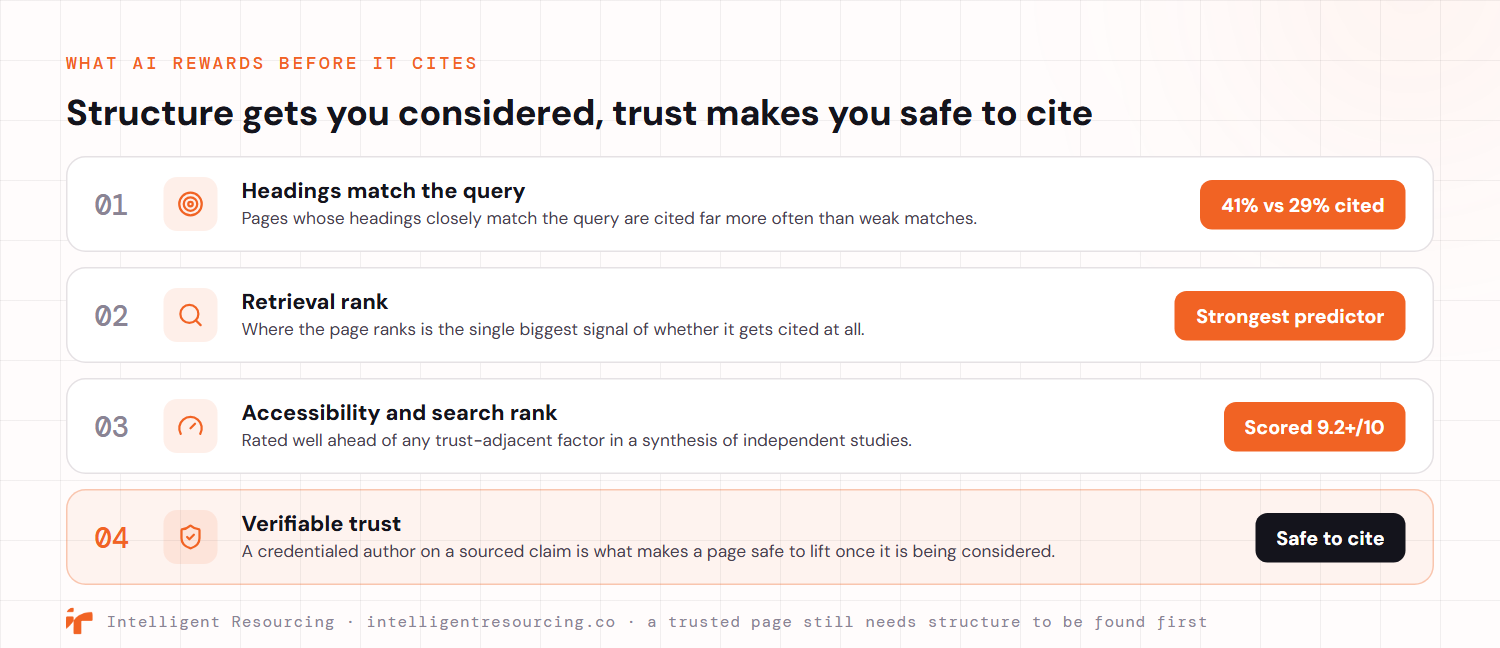
A credentialed author and a sourced claim earn a page consideration. They do not guarantee the page gets lifted into an answer. AirOps' analysis of 353,799 pages found that pages with headings closely matching the query are cited 41% of the time, against 29% for weak matches, and that retrieval rank is the strongest single predictor of whether ChatGPT cites a page at all.
Cyrus Shepard's Zyppy Signal synthesis of 54 studies backs the same pattern from a different angle. It scores accessibility and search rank above 9.2 out of 10, well ahead of any trust-adjacent factor on the list.
A well-credentialed author writing a vague, poorly structured page still will not get cited reliably. Trust is what makes a page safe to cite once it is being considered. Structure is what gets it considered in the first place.
Content Creation
Intelligent Resourcing audits your author and brand trust signals category by category, then builds the verifiable proof AI engines check before they cite. Book a call to see where you stand and what closes the gap.
FAQs
Is E-E-A-T a direct Google ranking factor?
No. E-E-A-T is a quality-rater framework, not a score inside Google's index. The signals it describes, verifiable expertise and trust, still matter because they are what an AI engine checks before reusing a claim.
Does building E-E-A-T in one category help in another?
Not automatically. A brand can be the trusted, most-cited source in one tracked category and unrecognised in an adjacent one, using the same authority and the same author entities, because citation tracks the specific signals present in that category's content, not the brand overall.
What is the difference between a byline and a verified author entity?
A byline is a name and a title, a label with nothing to check. A verified author entity includes credentials, a real photo and sameAs links an engine can cross-reference against an external profile like LinkedIn.
Does schema markup create E-E-A-T signals?
No. Schema makes trust signals that already exist machine-readable. It cannot manufacture credentials or verifiable claims that were never built.
How do you know if a claim is strong enough for an AI engine to cite?
A useful test is whether the claim is backed by enough independent sources to survive a check. A specific, sourced statement attached to a named, credentialed author is safe for an engine to reuse. An unsourced or vague claim is a risk the engine is more likely to skip.