

Kynection achieved 20.9% AI share of voice and ranked first in its monitored category on 16 June 2026. The B2B software provider reached approximately 2.4 times the visibility of its nearest tracked incumbent after implementing Intelligent Resourcing’s AEO and GEO service, which combined prompt mapping, focused content production, citation tracking and structured answer optimisation.
The programme covered 198 monitored buyer prompts, 71 focused content pieces and citations across more than 25 Kynection URLs, despite the company having a domain rating only in the high 30s.
These results describe a dated, monitored prompt sample. They are not a guarantee of future performance across every query, model or market.
What did Kynection actually achieve in AI search?
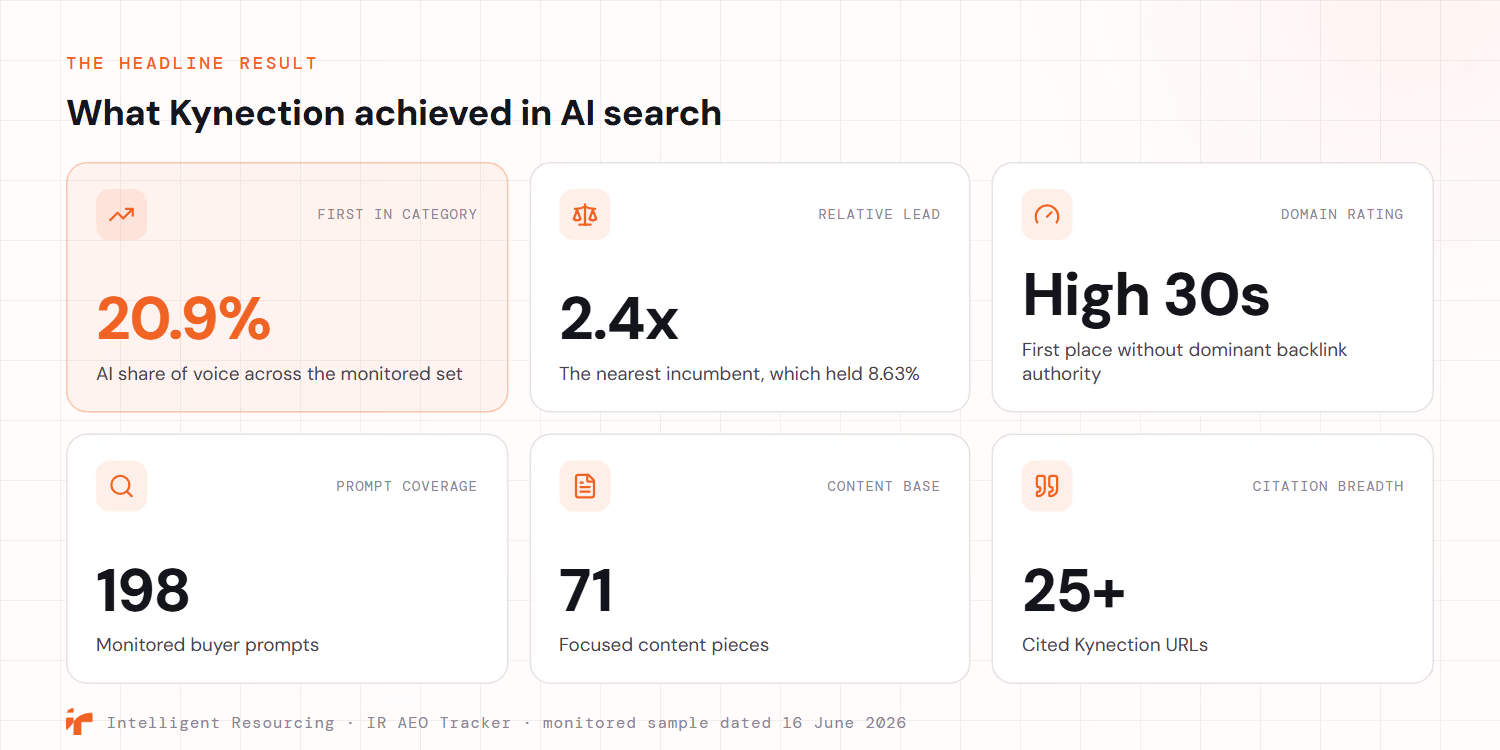
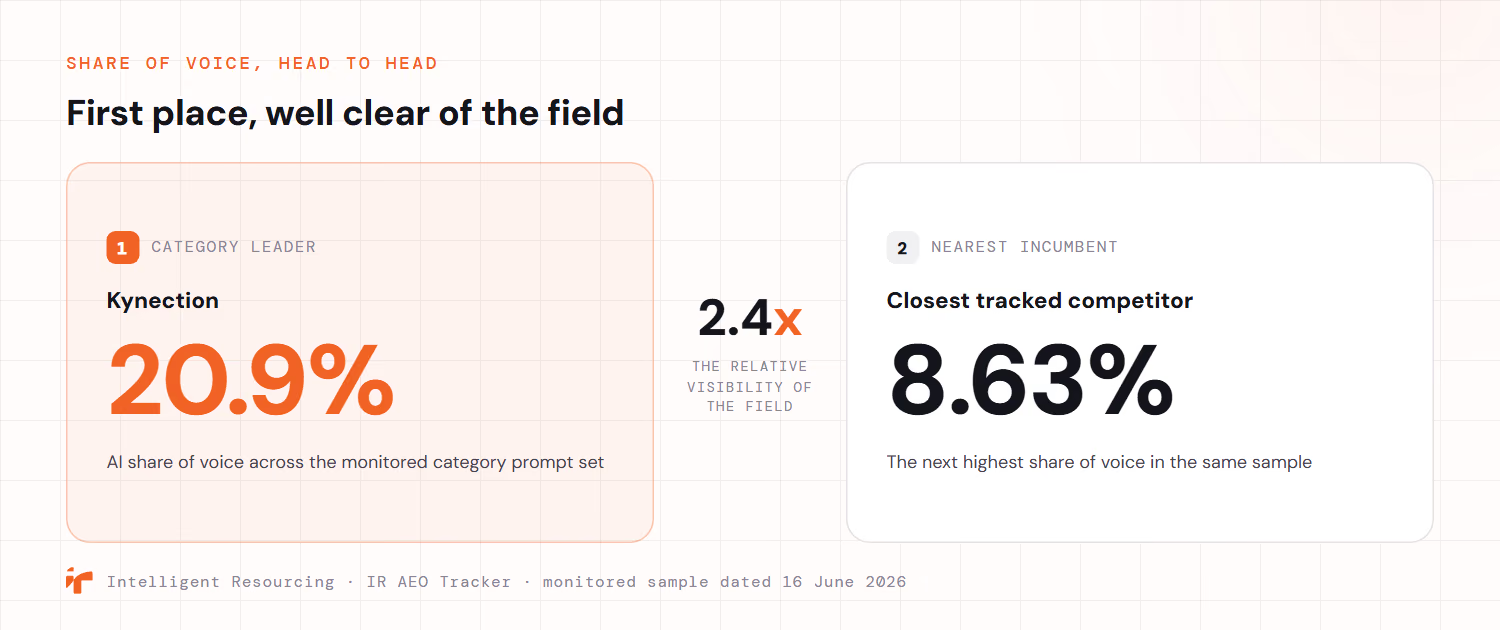
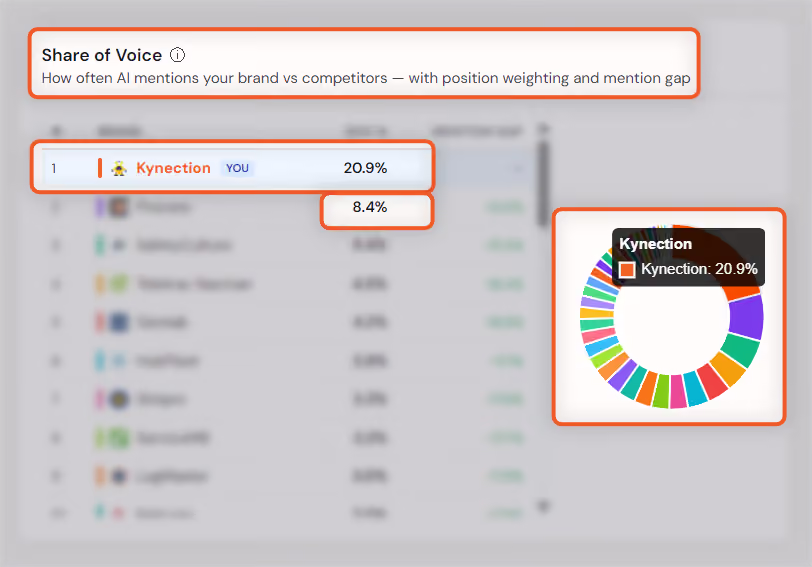
In the sampled tracker reading dated 16 June 2026, Kynection held a 20.9% AI share of voice across the monitored category prompt set.
That placed the company first among the tracked competitors. The nearest incumbent held 8.63%, giving Kynection approximately 2.4 times the relative visibility of its closest rival within that sample.
This distinction matters because AI share of voice is not the same as website traffic, organic ranking or market share. It measures how prominently a brand appears relative to competitors across a defined set of prompts and AI-generated responses.
The result therefore needs to be read within its measurement context. It reflects the prompts selected, the competitors included, the engines monitored and the date on which the sample was taken.
| Metric | What it measures | Kynection reading |
|---|---|---|
| AI share of voice | Kynection's proportion of tracked category visibility relative to competitors | 20.9% |
| Category position | Kynection's position in the monitored competitor set | First |
| Nearest incumbent | The closest tracked competitor by share of voice | 8.63% |
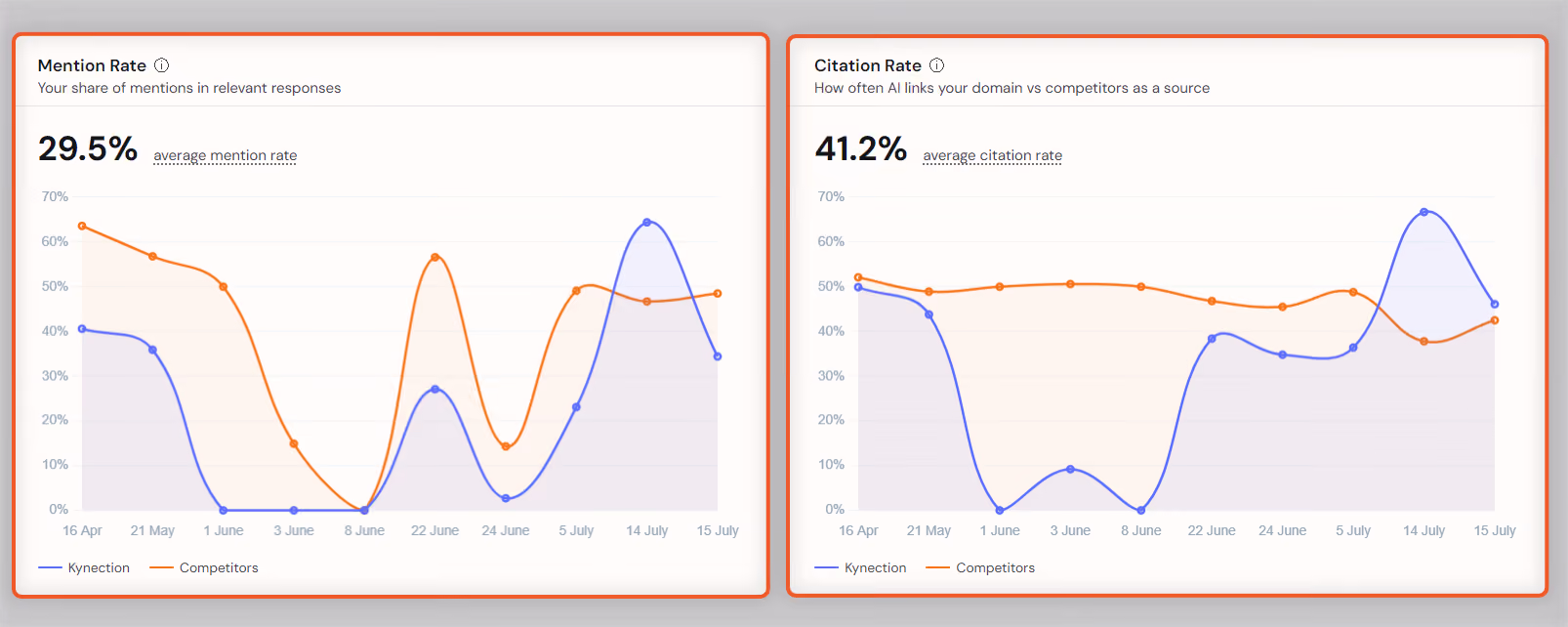
| Mention rate | The percentage of runs in which Kynection appeared | 29.5% as of 22 July 2026 |
| Citation rate | The percentage of runs in which a Kynection source was cited | 35.18% as of 22 July 2026 |
The headline result is useful, but it does not explain why Kynection moved ahead. The more instructive signal sits below the top-line figure. AI systems were not relying on one unusually successful page. They were retrieving Kynection across a broad set of URLs and buyer questions.
The GEO mechanism behind Kynection's 20.9% share of voice
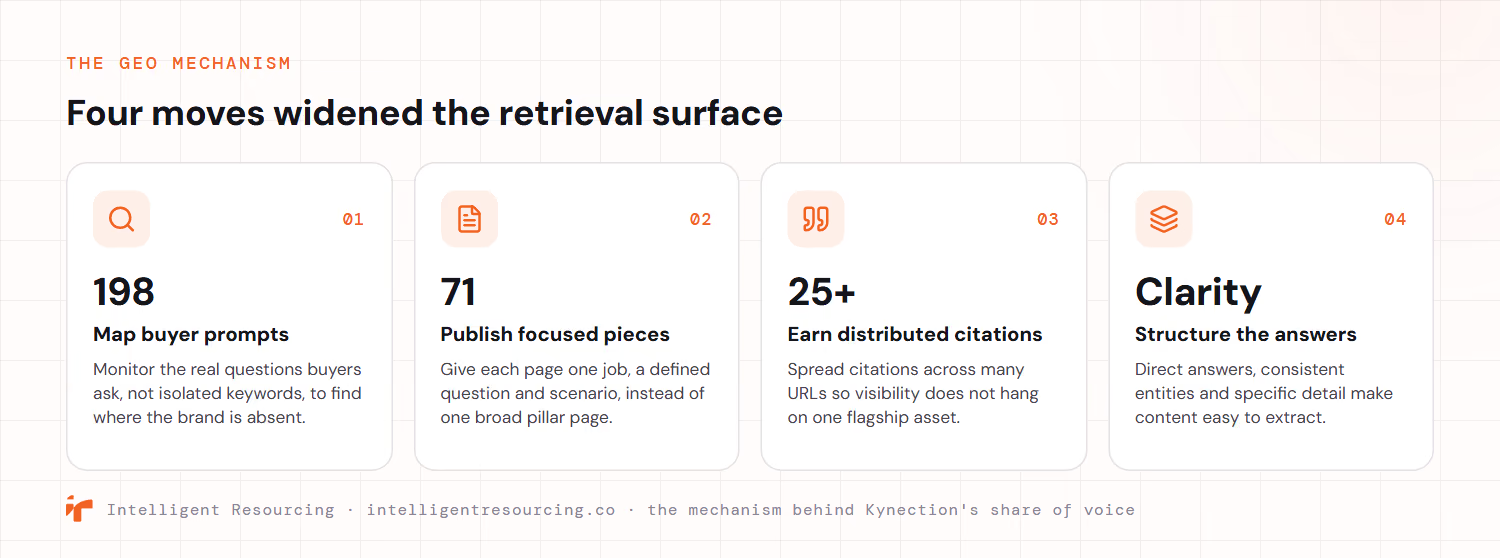
Kynection's first-place reading did not come from one isolated tactic.
The campaign combined prompt mapping, focused publishing, distributed citation coverage and structured answer design. Together, these elements expanded the number of situations in which an AI system could identify Kynection as a relevant source.
1. The campaign mapped 198 buyer prompts
The programme began with questions rather than isolated keywords.
The 198 monitored prompts represented the ways buyers might investigate software for transport, construction, mining and related operational environments. These included technical questions, product-fit questions, use-case prompts, comparison queries and decision-stage requests.
This matters because an AI-generated answer is often built from the intent behind a complete question.
A buyer may not search for a short category phrase. They may ask:
- Which software connects field operations with finance systems?
- What platform is suitable for transport compliance reporting?
- Which system can support construction workflows across multiple teams?
- What should a mining business use to manage operational risk?
- Which platform can replace disconnected fleet and workforce tools?
Each variation creates a different retrieval problem.
By monitoring a broad prompt set, the campaign could identify where Kynection was absent, where competitors were being cited and which questions lacked a strong Kynection-owned answer.
This made content production measurable, pages were not commissioned simply because a keyword had volume. They were developed to fill specific gaps in the AI research journey.
2. Kynection published 71 tightly scoped content pieces
The strategy did not depend on one large guide attempting to cover the entire category.
Kynection published 71 focused pieces aligned with specific questions, operational scenarios and commercial concerns. A tightly scoped page can explain one integration, risk, workflow or sector requirement in greater detail than a general product page. That makes it easier for an AI system to understand what the page is about and when it should be retrieved.
The approach also increased topical depth across the site.
Instead of making a single broad claim that Kynection supported complex operations, the content could provide separate evidence around subjects such as:
- Fleet management and financial integrations
- Construction reporting and workforce coordination
- Mining compliance and operational risk
- Cross-functional data visibility
- Disconnected system replacement
- Industry-specific implementation requirements
This created more entry points into the category.
Publishing 71 pieces did not create value simply because the number was high. The value came from assigning each piece a defined retrieval role. The campaign expanded the range of questions for which Kynection had a relevant, indexable and structured answer.
3. More than 25 Kynection URLs earned citations
The strongest evidence of breadth was the number of cited pages.
More than 25 separate Kynection URLs earned citations within the monitored environment.
That is important because citation concentration can create fragility. When most AI visibility depends on one or two pages, a change in ranking, model preference, content freshness or competitor activity can affect a large share of the brand's presence.
Distributed citations create a wider evidence base, they indicate that AI systems found value across multiple parts of the site rather than repeatedly relying on one flagship asset.
This increases the number of answer contexts in which the brand can appear. A product integration page may be relevant to one prompt. A compliance guide may support another. A comparison page, technical explanation or industry-specific article may answer a different stage of the buying journey.
Together, these pages form a citation portfolio, the breadth of this portfolio appears to be one of the clearest mechanisms behind the result.
Because Kynection could answer more specific questions across more pages, AI systems had more opportunities to retrieve an appropriate source.
This does not prove that citation breadth alone caused the 20.9% share of voice. It does show that Kynection's visibility was distributed across a meaningful part of its content estate.
4. Structured answers made the content easier to extract
Publishing the right topics was only one part of the work. The content also needed to be structured so that AI systems could identify clear statements, relationships and use cases.
That meant reducing ambiguity, pages were built around direct answers, consistent entity naming, short factual paragraphs and explicit links between the product, the problem and the audience.
For example, a generic statement such as “Kynection helps businesses improve operations” offers limited retrieval value.
A more specific explanation identifies:
- Which type of business is involved
- Which operational problem is being solved
- Which systems or teams are connected
- Which workflow changes
- Which risks or constraints matter
- Which outcome the solution is intended to support
This level of specificity creates stronger grounding material. It also helps distinguish Kynection from generic software providers that use similar marketing language without providing enough detail for an AI system to verify the claim.
Where structured data is used, schema markup for AI citation should also remain consistent with visible page content. Conflicting descriptions, outdated product names or unsupported claims can reduce trust and create uncertainty during retrieval.
The objective is not to write for machines at the expense of buyers but, to make the buyer answer clearly that both a person and a retrieval system can understand it without interpretation.
Publishing more pages was not the goal by itself. Volume becomes useful only when each page fills a distinct retrieval gap. Kynection's result came from expanding the number of questions for which the company could provide a credible and specific answer.
Breadth versus authority: what the Kynection data suggests
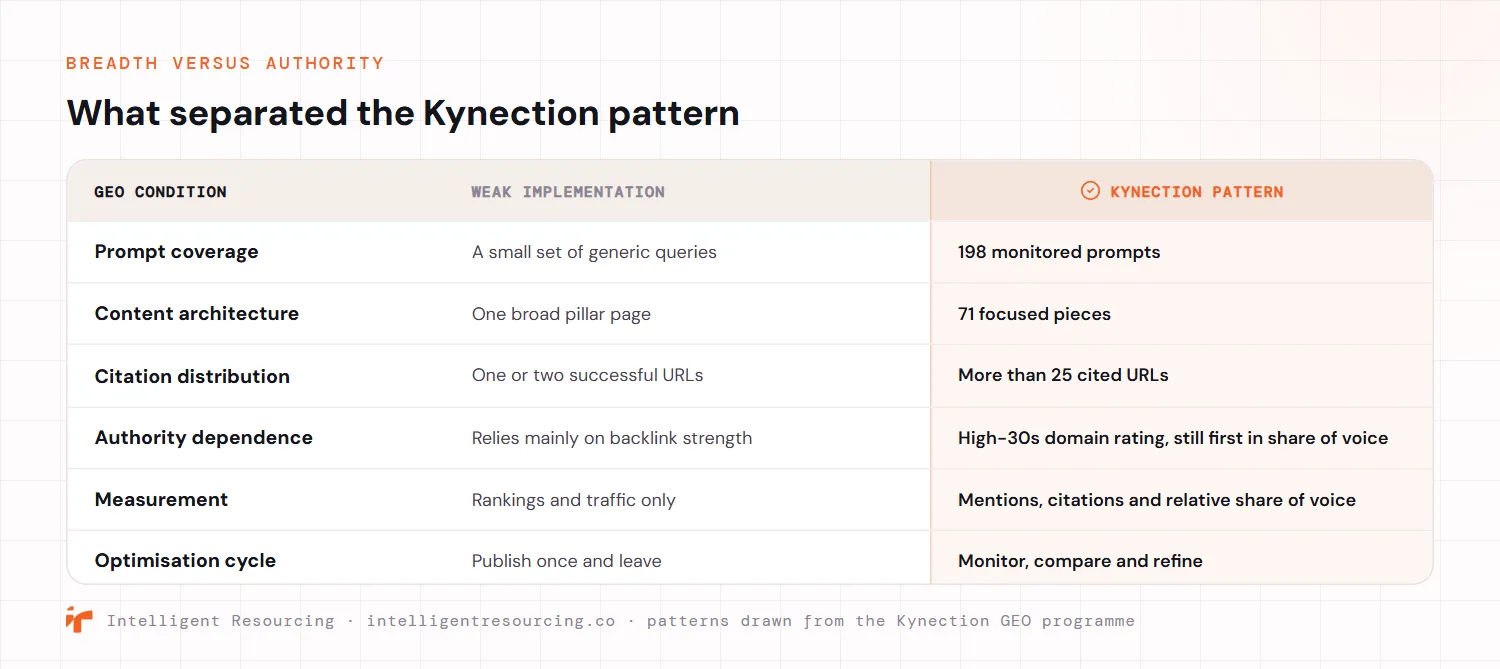
Kynection's performance offers a useful way to think about the relationship between domain authority and GEO. Authority may improve the probability that a page is discovered, crawled and considered, but it does not automatically make that page the best source for every buyer question. Generative engines still need answer-level relevance.
Within the monitored prompt set, Kynection combined five conditions:
- Broad prompt coverage across 198 questions
- A substantial content base of 71 focused pieces
- Distributed citations across more than 25 URLs
- Sufficient, but not dominant, domain authority
- Structured content tied to specific product and industry scenarios
The result is consistent with the idea that AI visibility depends on the size and quality of a brand's retrieval surface. Because Kynection could answer more specific questions across more indexable pages, AI systems had more opportunities to select it as a relevant source. This wider retrieval surface appears to have supported the increase in share of voice.
| GEO condition | Weak implementation | Kynection pattern |
|---|---|---|
| Prompt coverage | A small set of generic queries | 198 monitored prompts |
| Content architecture | One broad pillar page | 71 focused pieces |
| Citation distribution | One or two successful URLs | More than 25 cited URLs |
| Authority dependence | Relies mainly on backlink strength | High-30s domain rating, but first in tracked share of voice |
| Measurement | Rankings and traffic only | Mentions, citations and relative share of voice |
| Optimisation cycle | Publish once and leave | Monitor, compare and refine |
This does not mean businesses should ignore links, technical SEO or organic rankings because GEO and SEO are connected.
A technically inaccessible page cannot become a reliable citation source. A weakly indexed site will struggle to enter the retrieval set. A company with inconsistent entity signals may be misunderstood or confused with other brands.
The difference is that traditional SEO authority gets a page into consideration, while answer quality helps determine whether the page is useful once it is considered.
What happened after Kynection reached first place?
GEO performance should be treated as a monitored system rather than a permanent ranking.
On 22 July 2026, a later live tracker reading recorded:
- A 29.48% mention rate
- A 35.18% citation rate
- 4,363 tracked runs
These figures measure different parts of AI visibility. A mention occurs when the brand appears in an answer while citation occurs when the AI system references a Kynection-owned source. Share of voice compares Kynection's relative visibility with the tracked competitor set.
These metrics should not be treated as interchangeable because a brand may be mentioned without receiving a citation. It may earn citations on a smaller number of highly relevant prompts. Its share of voice may change even when its own visibility remains stable because competitors gain or lose presence.
The difference between the 16 June and 22 July readings also illustrates why every GEO result needs a date.
AI-generated outputs can vary because:
- Models update their retrieval behaviour
- Prompt wording changes
- Competitors publish new content
- Existing pages become fresher or less relevant
- Search indexes refresh
- Citation preferences shift
- The monitored prompt set changes
- The number of runs increases
Kynection's first-place reading should therefore be treated as a verified point-in-time result, not a permanent category position.
The later mention and citation data provides a continuing view of how frequently the brand and its sources appeared across live runs.
What B2B companies can learn from the Kynection GEO case study
Kynection's result does not provide a universal formula, but it does reveal several practical principles for B2B organisations competing for AI visibility.
Measure prompts, not just keywords
Keyword rankings show whether a page appears in a search result. Prompt monitoring shows whether a brand appears in the answer itself.
A useful GEO measurement set should include the complete questions buyers ask during research, comparison and decision-making, which is also how you should structure content for AI citation in the first place.
This may include:
- Best-fit questions
- Product comparison prompts
- Integration requirements
- Sector-specific use cases
- Compliance concerns
- Implementation questions
- Alternatives to incumbent platforms
- Requests for recommendations
Monitoring these questions reveals where the company is missing from AI-assisted buying journeys.
Build a citation portfolio
A company should aim to earn citations across multiple pages, topics and stages of the buyer journey. A distributed citation portfolio reduces dependence on one asset and increases the number of prompts for which the brand can provide evidence.
This requires disciplined content architecture with each page having a clear job: it should answer a defined question, focus on a specific problem and avoid duplicating the role of another page.
Create content around technical specificity
B2B companies should document the technical and operational details that buyers need in order to evaluate a solution because generic claims are easy to replace but specific information is more defensible.
That includes:
- Integrations
- Data flows
- Workflows
- Implementation requirements
- Industry constraints
- Security considerations
- Compliance obligations
- Failure points
- Suitability limits
This type of content gives AI systems something concrete to retrieve and it also improves the human buying experience because prospects can assess fit before speaking with sales.
Separate authority from answerability
A strong domain may improve visibility. It does not guarantee that the content contains the clearest or most relevant answer. Authority and answerability are related, but they are not identical.
Answerability depends on whether the page:
- Responds directly to the question
- Uses consistent terminology
- Provides enough context
- Supports claims with evidence
- Explains who the solution is for
- Identifies limits and risks
- Connects the product to a specific problem
Kynection's high-30s domain rating makes this distinction commercially important.
The company did not need to become the strongest domain in the category before competing for AI visibility. It needed to become one of the most useful sources across the monitored buyer questions.
Date every performance claim
GEO reporting should always state:
- The measurement date
- The number and type of prompts
- The AI engines included
- The competitor set
- The run volume
- The definition of each metric
- Whether the reading is sampled or live
Without this context, a share-of-voice figure can sound broader than it is. Dated reporting also makes optimisation more useful. Teams can compare changes in content, citations and competitor visibility over time.
Treat GEO as an optimisation loop
AI visibility is not secured permanently after publication.
A mature GEO process includes:
- Auditing where the brand is absent
- Mapping the questions buyers ask
- Identifying existing citation sources
- Publishing or restructuring useful evidence
- Monitoring mentions and citations
- Comparing visibility with competitors
- Refreshing pages as results change
This turns GEO into a measurable operating system rather than a one-off content project.
When GEO is and is not the right investment
GEO is not automatically the right first investment for every business. It is most useful when buyers already use generative AI to understand the market, compare vendors or investigate complex problems.
| GEO suitability signal | More likely to be suitable when | Less likely to be the first priority when |
|---|---|---|
| Buyer behaviour | Buyers ask complex questions that require research, comparison or technical explanation. | The company cannot clearly define who the content should help. |
| Competitive visibility | Other vendors already appear or receive citations in AI-generated answers. | The category shows little evidence of meaningful AI-assisted research behaviour. |
| Expertise | The company has specific use cases, workflows, technical knowledge or outcomes worth documenting. | The site relies on unsupported marketing claims rather than verifiable expertise. |
| Differentiation | The business can explain why its offer is suitable for particular situations, industries or use cases. | The offer is generic and provides little meaningful differentiation for AI systems to retrieve. |
| Content capacity | The site can support multiple focused assets across technical, commercial and decision-stage topics. | The company cannot maintain content, meaning information is likely to become outdated. |
| Measurement | The team can track prompts, brand mentions, citations and share of voice over time. | There is no reliable way to measure AI visibility or compare changes. |
| Technical accessibility | Core pages are crawlable, indexable and easy for search and AI systems to retrieve. | Crawling, indexing or rendering problems remain unresolved. |
| Entity consistency | Product, company and service descriptions are consistent across the site. | Entity signals conflict across pages, schema or external profiles. |
| SEO foundations | The site has the technical SEO foundations required for discovery. | Basic SEO is missing, limiting the likelihood that content will enter the retrieval set. |
Kynection did not reach first place because GEO replaced every other marketing discipline. It achieved a defined AI visibility result because its content architecture gave generative engines more relevant evidence to retrieve across the monitored question set.
How to measure an AI share-of-voice programme
A GEO measurement framework should be reproducible.
The following process provides a practical starting point.
1. Define the category
Identify the specific market, problem space or product category being monitored. A category that is too broad will produce noisy results. A category that is too narrow may not reflect real buying behaviour.
2. Select the competitor set
Including the companies buyers are likely to compare. The competitor list should remain consistent between measurement periods unless a documented change is required.
3. Build a fixed prompt set
Create prompts across:
- Problem awareness
- Solution research
- Product comparison
- Technical suitability
- Industry use cases
- Implementation
- Purchase decisions
Prompts should reflect genuine buyer language rather than rewritten target keywords.
4. Run prompts across selected AI engines
Use the same platforms, settings and methodology for each reporting period. Because outputs can vary, repeated runs provide a more useful picture than a single response.
5. Separate mentions from citations
Record when the brand appears and when a company-owned URL is cited. This distinction shows whether the company is known as an entity and whether its content is being used as evidence.
6. Calculate relative share of voice
Compare the company's visibility with the defined competitor group. Document the formula so that future readings are comparable.
7. Track cited URLs
Record which pages receive citations because this reveals whether visibility is concentrated or distributed and helps identify the formats, topics and page types AI systems prefer.
8. Repeat on dated intervals
GEO reporting should show movement over time since every reading should include the date, prompt count, run volume, engines and competitor set.
The final takeaway
Kynection's 20.9% share-of-voice result matters because it challenges the assumption that AI visibility automatically belongs to the largest domain. Within the monitored category, a challenger reached first place by covering 198 buyer prompts with 71 focused pieces and earning citations across more than 25 URLs.
Its domain rating was only in the high 30s, which means dominant backlink authority did not fully explain the result.
Kynection created a wider surface of relevant, structured and specific answers. That gave AI systems more opportunities to retrieve the company across technical, commercial and decision-stage prompts.
The lesson is not to publish indiscriminately but to identify where the brand is absent, create evidence for those specific questions and measure whether AI systems actually use it.
Intelligent Resourcing's AI search visibility process identifies gaps in high-value AI answers, maps the questions creating those gaps and builds the structured evidence required to compete for mentions and citations, part of our broader AI visibility work.
Content Creation
Our answer engine optimisation team maps the prompts your buyers ask, finds where you are absent from AI answers, and builds the structured evidence needed to earn mentions and citations across your own stack.
FAQs
What AI share of voice did Kynection achieve?
Kynection achieved 20.9% AI share of voice in its monitored category on 16 June 2026. This placed it first in the tracked competitor group and approximately 2.4 times ahead of the nearest incumbent, which recorded 8.63%.
How many Kynection pages were cited by AI engines?
More than 25 Kynection URLs earned citations. This distributed citation pattern suggests that its visibility was supported by a portfolio of relevant pages rather than a single high-performing article.
Did Kynection need a high domain rating to rank first in AI share of voice?
Kynection’s domain rating was only in the high 30s. Its result suggests that strong prompt coverage, specific answers and citation breadth can help a challenger outperform higher-profile competitors within a defined AI search category. It does not mean that authority or traditional SEO is irrelevant.
Are GEO results guaranteed?
No. Kynection’s result is a dated outcome from a defined prompt set and tracker methodology. AI outputs, source selection, competitor activity and model behaviour change over time, so GEO visibility requires ongoing monitoring and optimisation.
Is GEO the same as AEO?
Answer engine optimisation is the broader practice of structuring content so it can appear as a direct answer. Generative engine optimisation focuses specifically on brand visibility, mentions and source citations within generative AI systems. The disciplines overlap, but GEO places greater emphasis on performance inside generated responses.