

What Is GEO for Professional Services Firms?
GEO, or Generative Engine Optimisation, is the process of making a firm easier to find, understand and cite inside AI-generated answers. For professional services firms, that means structuring expertise so AI systems can connect the firm to the right services, sectors, problems and proof.
This is different from simply publishing more thought leadership. A consultancy may have strong people, deep experience and detailed client work, but AI systems still need clear signals. They need to understand what category the firm belongs to, which problems it solves and which evidence supports its claims.
Google's own guidance states plainly that optimising for generative AI search is optimising for the search experience, and still SEO, while confirming that AEO and GEO are simply newer terms for the same underlying work of improving visibility in AI search experiences.
For a professional services firm, the practical goal is simple: when a buyer asks an AI system which firm can help with a specific problem, your expertise should be legible enough to be retrieved and credible enough to be cited.
Professional Services Discovery Is Moving From Search Results to AI Shortlists

Professional services discovery used to move through search results, referrals, comparison calls and long proposal processes. Those steps still matter, but buyers increasingly use AI systems to summarise options before they visit websites or speak to firms.
The shift is already measurable. G2's 2026 research found that 51 percent of B2B software buyers now begin their research with an AI chatbot more often than with Google, up from 29 percent a year earlier. That means providers need to evolve from driving traffic through SEO alone to driving visibility through answer engines and AI discovery environments.
That shift is especially important for consultancies and advisory firms. Buyers rarely ask only, "Who is the biggest consultancy?" They ask judgement-based questions: who understands my sector, who has solved this problem, which provider is credible, what are the risks, and what should we compare?
This changes the job of a professional services website. It must still convert human visitors, but it also needs to act as a source layer for AI systems.
Why Do Professional Services Firms Struggle to Get Cited in AI?
Professional services firms struggle to get cited in AI because their expertise is often clear to clients but unclear to machines. The website may be polished, but the underlying category signals, proof assets and answer structure are often weak.
The most common issue is generic service content. A page may say the firm provides "strategy consulting," "digital transformation" or "advisory support," but it may not define the specific problem, sector, method, deliverables, evidence or outcomes. That makes the content difficult to use in a generated answer.
The second issue is hidden proof. Many firms keep valuable expertise inside PDFs, proposal decks, pitch documents, partner biographies and unpublished case work. AI systems are more likely to retrieve clear HTML pages, structured answers and citable sources than buried internal material.
Intelligent Resourcing's AEO Tracker shows that one of its clients, a specialist firm, held broad category awareness but fell away on the queries closest to its own expertise. Across its full category prompt the firm ranked third for Share of Voice at 8.4%.
On the specialist cluster matching its flagship service, Share of Voice dropped to 5.7% and seventh place, and a direct competitor was 22.0%, which is 3.86 times higher. The lesson is clear: AI systems do not automatically cite the deepest expert. They cite the clearest, most retrievable and best-supported source (source: Intelligent Resourcing AEO Tracker, geo_score, live data, July 7, 2026).

| Tracker finding | What it proves | GEO lesson for professional services |
|---|---|---|
| The firm had real specialist expertise | Subject-matter relevance existed before AI recognised it | Expertise must be translated into retrievable content |
| The firm held only 5.7% SOV on its core niche | Specialist relevance did not become AI visibility | Category pages need stronger structure |
| Competitors were cited instead | AI systems found other sources easier to retrieve or compare | Build proof assets and comparison content |
| Broad visibility was stronger than specialty visibility | General awareness can hide commercial gaps | Track prompt-level performance, not only overall visibility |
The Specialist Visibility Gap Is a Category Structure Problem

The specialist visibility gap is not usually caused by a lack of expertise. It is caused by weak category structure. AI systems need to know what a firm should be cited for, and that information must be visible across pages, proof, schema and external sources.
A consultancy may describe itself in broad terms because that feels more flexible commercially. The problem is that broad language often weakens retrieval. "We help organisations transform" is harder to cite than "we help professional services firms improve AI search visibility through entity clarity, proof assets and AI citation tracking."
Category structure should answer five questions:
- What category does the firm belong to?
- Which problems does the firm solve?
- Which industries or roles does it serve?
- What evidence proves delivery?
- Which comparison or recommendation prompts should it appear for?
This does not mean every firm should narrow its commercial offer too far. It means each service page needs a sharper relationship between category, problem and proof. AI systems need enough specificity to decide when a firm is relevant.
The same report from Intelligent Resourcing's AEO Tracker also identified 49 citation gaps, meaning there were prompts where the tracked brand was absent while competitors were cited instead. That is the practical reason professional services firms need prompt-level visibility tracking, not just a ranking report.

For professional services, this is the difference between being known by existing clients and being cited by AI systems that have no relationship context.
How Can a Consultancy Improve AI Search Visibility?
A consultancy can improve AI search visibility by making its expertise easier to retrieve, verify and compare. That requires content, structure, proof and measurement working together.
Step 1: Define the category you want to be cited in
Start by naming the commercial category clearly, this could be workforce planning consulting, revenue operations advisory, compliance consulting, CRM implementation, procurement transformation or another specialist area. Avoid hiding the category behind abstract positioning.
Step 2: Build answer-first service pages
Each core service page should open with a concise answer to what the service is, who it helps and what problem it solves. This gives both buyers and AI systems a clear summary to work from.
Step 3: Create problem-led content around buyer questions
Professional services buyers ask problem-led questions before they ask vendor-led questions. Build pages around prompts such as "how to reduce contractor compliance risk" or "how to choose a revenue operations partner."
Step 4: Structure case studies as evidence assets
A case study should not only tell a story. It should state the industry, starting problem, intervention, timeframe, measurable outcome and proof artefact where available.
Step 5: Add schema and entity consistency
Use structured data to clarify organisation, services, people, case studies and FAQs. Google's structured data guidelines say not to mark up content that is not visible to readers of the page, so schema should reinforce visible content rather than contradict it.
Step 6: Earn third-party corroboration
AI systems may draw from directories, partner pages, review platforms, publications, YouTube, LinkedIn, Reddit and other third-party sources. A firm's own website matters, but external validation helps support credibility.
Step 7: Track AI citation prompts over time
Run repeatable prompt sets across relevant engines. Track whether the firm appears, which competitors are named, which sources are cited and whether the firm is described accurately. This is the same discipline behind Intelligent Resourcing's own AI Visibility guide.
The Professional Services GEO Stack
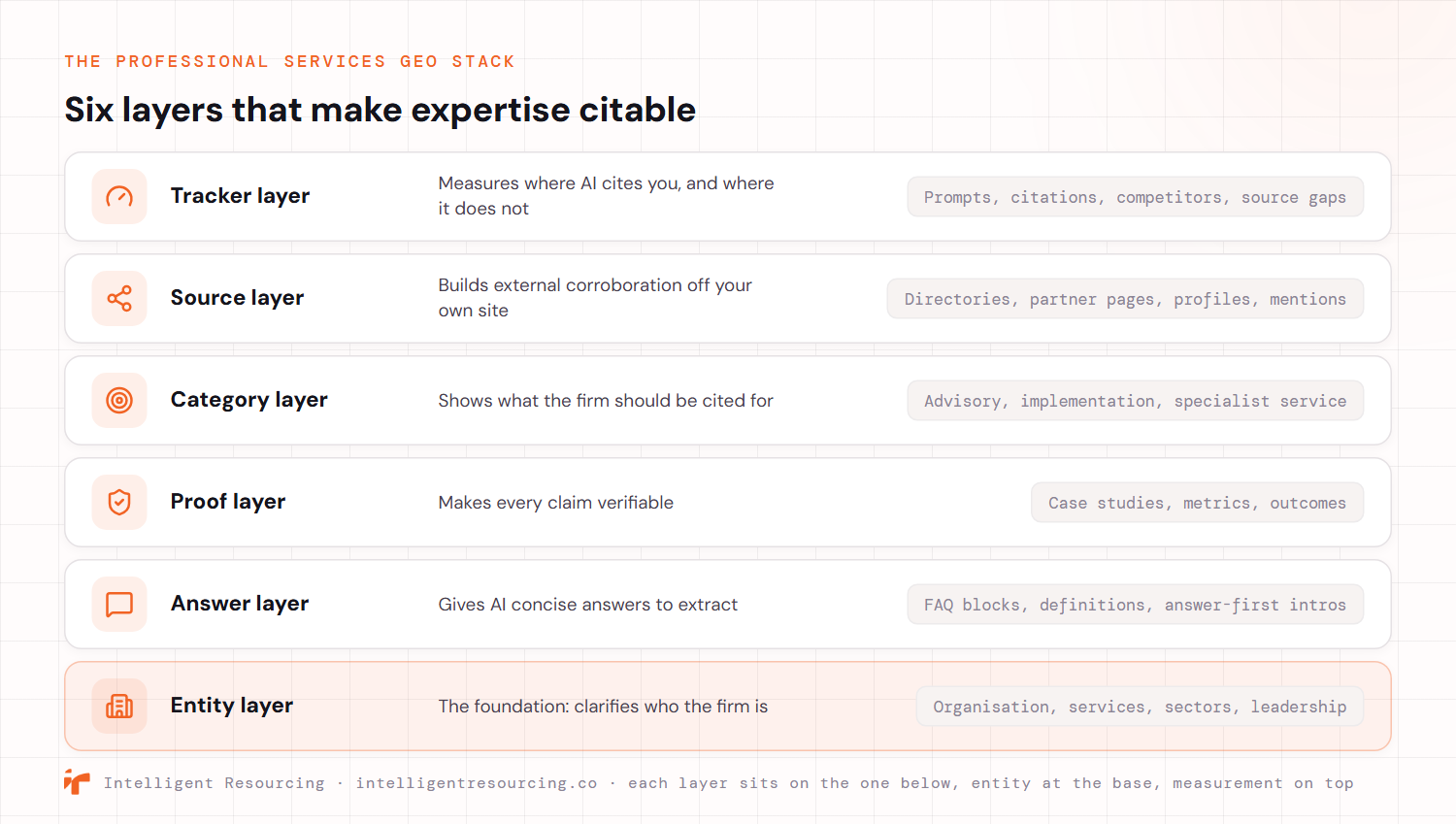
Professional services GEO works best when it is treated as a stack, not a set of isolated content tasks. The firm needs entity clarity, answer-ready content, proof, category ownership, external corroboration and measurement.
| Layer | Purpose | Example |
|---|---|---|
| Entity layer | Clarifies who the firm is | Organisation, services, sectors, leadership |
| Answer layer | Gives AI concise answers | FAQ blocks, definition sections, answer-first intros |
| Proof layer | Makes claims verifiable | Case studies, metrics, client problems, outcomes |
| Category layer | Shows what the firm should be cited for | Consultancy, advisory, implementation, specialist service |
| Source layer | Builds external corroboration | Industry mentions, directories, partner pages, profiles |
| Tracker layer | Measures visibility | AI prompts, citations, competitors, source gaps |
The tracker layer is important because GEO cannot be managed by intuition alone. A firm may feel visible because it ranks for branded search, receives referrals or publishes regular content. Prompt-level tracking reveals whether AI systems actually connect the firm to the categories that drive demand.
This stack also prevents over-optimisation. GEO is not about forcing brand mentions into every page but making the firm's expertise clear enough that AI systems can cite it naturally when the buyer question fits.
What Content Should Professional Services Firms Create for GEO?
Professional services firms should create content that answers how buyers actually evaluate expertise. That means moving beyond generic thought leadership and building a library around categories, problems, comparisons, proof and sectors.
| Content type | GEO role | Example |
|---|---|---|
| Definition pages | Own the category | "What is workforce planning consulting?" |
| Problem pages | Match buyer pain | "How to reduce contractor compliance risk" |
| Comparison pages | Capture evaluation prompts | "Consultancy vs internal RevOps team" |
| Case studies | Prove capability | Before, intervention, outcome, timeframe |
| Expert explainers | Build authority | Partner-led insight with named expertise |
| FAQ pages | Feed answer extraction | Short, schema-matched answers |
| Sector pages | Connect expertise to industries | Professional services, logistics, utilities, SaaS |
The strongest content connects a problem to a commercial decision. A consultancy that wants to be cited for "best CRM implementation partner for professional services" should not rely only on a CRM service page. It should also publish comparison guidance, implementation risks, sector-specific examples and proof-led case studies.
Professional services expertise is usually deep. The problem is that the expertise is often scattered across partners, proposals and client work instead of being converted into reusable source assets.
Case Studies Need to Become Evidence Assets

Case studies are one of the strongest GEO assets for professional services firms, but only when they are structured for citation. A vague success story is hard for AI systems to use. A clear evidence asset is much easier to retrieve, summarise and connect to a service category.
| Weak case study | GEO-ready evidence asset |
|---|---|
| "We helped a client improve efficiency" | Industry, problem, intervention, timeframe and measured outcome |
| PDF-only proof | HTML summary with structured sections |
| Vague testimonial | Attributable quote plus visible result |
| No service link | Clear relationship to service and problem page |
| No schema | Article or CaseStudy-style structured data where appropriate |
A strong case study should explain the starting state, intervention and outcome in plain language. It should also connect back to the service page and problem page, so AI systems can understand the relationship between the case study and the firm's expertise.
For professional services firms, the aim is not to expose confidential client information. The aim is to make proof usable. An anonymised case study can still be powerful if it states the industry, challenge, work performed and measurable commercial change.
This is how a firm moves from "we have experience" to "here is structured evidence that supports our expertise."
Which GEO Metrics Should a Professional Services Firm Track?
A professional services firm should track GEO at the prompt, source and category level. Rankings and traffic still matter, but they do not show whether AI systems are citing the firm in generated answers.
| Metric | What it shows |
|---|---|
| AI citation rate | How often the firm appears in answer outputs |
| Prompt coverage | Which buyer questions the firm is visible for |
| Source frequency | Which pages or third-party sources AI systems cite |
| Competitor co-mentions | Which firms appear beside or instead of you |
| Category accuracy | Whether the firm is described correctly |
| Evidence gap | Which claims lack proof assets |
| Conversion from AI traffic | Whether AI visibility produces qualified demand |
Prompt coverage is especially important, a firm may appear for branded queries but disappear from unbranded commercial prompts such as "best consultancy for workforce planning" or "AI search visibility agency for professional services."
Competitor co-mentions also matter. If the same competitor appears repeatedly in AI answers, the firm should inspect which pages, proof assets and third-party sources are supporting that competitor's visibility.
The purpose of measurement is prioritisation. GEO tracking should show which pages to build, which proof assets to strengthen and which external sources need attention.
GEO Works Best When It Supports Existing SEO, Not Replaces It
GEO should not replace SEO because search fundamentals still matter and AI systems rely on crawlable, useful and well-structured web content.
Google's guidance is clear that optimisation for generative AI features in Google Search is still part of optimising for the search experience. It also advises site owners to focus on what is useful and accessible, rather than chasing every new term or tactic around AEO and GEO.
GEO is a higher-resolution visibility layer for firms whose buyers ask complex advisory questions, compare options and want evidence before speaking to sales.
SEO helps the page get discovered and GEO helps the expertise get selected, summarised and cited.
The best professional services visibility strategy includes both:
- Technical SEO: crawlability, indexation, performance and site structure.
- Content SEO: service pages, sector pages, problem pages and internal linking.
- Entity clarity: consistent naming of the firm, people, services and sectors.
- Proof assets: case studies, outcomes, methodologies and third-party support.
- AI visibility tracking: prompt coverage, source frequency and category accuracy.
The goal is not to optimise for a single engine but to make the firm's expertise easier to understand across the wider answer ecosystem.
Build AI Search Visibility With Intelligent Resourcing's GEO Playbook
Professional services buyers are already asking AI systems which firms understand their problem. They are asking for comparisons, recommendations, risks, frameworks, providers and evidence.
Your firm may have the expertise, but AI systems need to understand it before they can cite it. Intelligent Resourcing's GEO Playbook helps professional services firms structure their expertise around the questions buyers actually ask. It connects answer-first content, entity clarity, proof assets, structured service pages, source visibility and AI citation tracking into one practical system.
Professional services firms do not need more generic thought leadership. They need a system that makes expertise visible, verifiable and citable across AI search.
Content Creation
FAQs
What is GEO for professional services?
GEO for professional services is the process of structuring a consultancy or advisory firm's content, proof and entity signals so AI systems can retrieve, verify and cite the firm in generated answers.
How do professional services firms get cited in AI answers?
Professional services firms get cited by publishing clear answer-first content, structured service pages, proof-led case studies, expert explanations and third-party corroboration that AI systems can retrieve and trust.
Why can a specialist firm be invisible in AI search?
A specialist firm can be invisible when its expertise is not structured around the prompts, categories, proof assets and sources AI systems use to generate answers. Expertise must be visible, specific and supported before AI systems can cite it confidently.
Is GEO different from SEO?
Yes. SEO focuses on ranking in search results. GEO focuses on being included and cited in AI-generated answers. The two should work together because AI search still depends on crawlable, high-quality web content.
What should a professional services firm track for GEO?
A professional services firm should track AI citation rate, prompt coverage, competitor mentions, source frequency, category accuracy, evidence gaps and conversions from AI-influenced traffic.
Can a niche consultancy win in AI search?
Yes, especially when the category is under-structured. A niche consultancy can win by owning specific problem questions, publishing proof-led service content and measuring where AI systems already cite competitors or adjacent sources.