

Citation velocity is the frequency and consistency with which AI answer engines cite your content over time, across prompts and platforms. Intelligent Resourcing treats citation velocity as a measurable AEO performance signal, using AI visibility tracking, citation analysis and content optimisation to help brands move from isolated mentions to repeat visibility across answer engines.
You can earn a mention in an AI answer once and still disappear the next time someone asks a similar question. That happens because ChatGPT, Perplexity, Gemini and other answer engines do not maintain a permanent list of sources. They reassess which pages to cite for each query based on relevance, freshness and trust signals.
This guide explains why a single AI citation is not enough, how citation velocity builds durable visibility, and the practical steps content teams can use to turn one citation into a repeatable source of authority in AI search.
What citation velocity really means in AI search

Citation velocity is how frequently and consistently AI answer engines cite your content over time, across prompts and platforms, not just how fast you earn a first mention. Most competitor guides stop at time-to-first-citation, the easiest number to measure and the least useful to act on.
Velocity is frequency, not just speed
Speed measures the gap between publishing and your first AI citation. Velocity measures the rate and breadth at which citations accumulate across prompts, engines and weeks, and it is the number that predicts durable visibility. The distinction matters because AI engines re-read the web far more often than a search crawler does.
When Conductor published a new page, ChatGPT crawled it 5 times and Perplexity 3 times on day one alone, while Google and Bing had not crawled it at all yet, only arriving 1 to 2 days later. That intensity makes citation an ongoing contest, not a one-time win. Timing sharpens the point: early citations signal relevance and timeliness, which makes citation timing as important as citation totals.
Why AI rebuilds its citations on every query
Answer engines do not keep a fixed list of who to cite for a topic, they assemble a fresh shortlist every time a prompt runs, weighing relevance, freshness and trust in the moment, which means a citation is never locked in. Your page has to re-earn its place on the next query, so the goal is to become the source an engine reaches for repeatedly, not the one it quoted once.
Intelligent Resourcing's AEO tracker confirms this at the account level. Across 292 tracked buyer prompts run 3,168 times over 30 days, averaging more than 10 runs per prompt, Intelligent Resourcing holds a 15.79% share of voice at position number 1. That means IR is cited in roughly 1 in 4 queries across those prompts, not every time the same question is asked.

Only one of the two common framings reflects durable authority.
| Framing | What it measures | Why it falls short on its own |
|---|---|---|
| Speed-only velocity | Time from publish to first AI citation | Ignores whether you are ever cited again |
| Frequency velocity | How often and how broadly you are cited over time | Reflects durable, defensible authority |
Speed-only velocity flatters your reporting without protecting your visibility, because it records the moment you first appear and ignores every query after. Frequency velocity measures the pattern engines actually reward, since a source cited repeatedly reads as dependable. Which means you should optimise for the rate and spread of citations over time, not the date of your first one.
Why getting cited once is not enough

One AI citation is a snapshot, not a ranking position, and AI answers vary from prompt to prompt and refresh as engines re-crawl and re-select sources, so a mention that shows up today can be gone on the next query.
AI answers vary from prompt to prompt
Ask two near-identical questions and you can get two different sets of sources. Answer engines generate each response independently, so small changes in wording, context or timing reshuffle who gets cited. That variability means a one-off citation is unreliable as a visibility strategy, because you cannot count on the same prompt surfacing you twice. Consistent presence across many phrasings is what turns a mention into a dependable one.
Retrieved is not the same as cited
Being pulled into an engine's candidate set is not the same as being quoted in the answer. Engines retrieve broadly, then select narrowly, and the gap between the two is where most brands lose their citation. Answer engines commonly retrieve several sources but cite only a handful, with selection decided by topical relevance, source position, freshness, completeness and trust cues. Which means a brand cited once has cleared retrieval but not secured selection, and selection is the part that repeats. Retrieval gets you considered; selection, earned again and again, is what builds a durable position in AI answers.
How multiple citations build brand authority in AI search

Repetition is the mechanism of authority in AI search. When your brand is cited repeatedly across prompts and across engines like ChatGPT, Gemini, Perplexity and Claude, engines read that consistency as consensus, and you become a default source.
Repetition signals consensus
A single citation can be a coincidence but repeated citation across independent prompts reads as a pattern, which means engines grow more confident surfacing you for the topic. Each additional mention is corroborating evidence that your page is the right answer, so consistency compounds into brand authority in AI search rather than a scattering of one-off hits.
Authority compounds across engines
Being cited on more than one engine is a stronger trust signal than depth on a single platform, because it shows cross-platform agreement rather than one model's quirk. A brand quoted by ChatGPT, Perplexity and Claude on the same topic looks like consensus; a brand quoted by only one looks like a preference. Breadth across engines is therefore harder to displace than depth on one.
The signal an engine reads depends on the citation pattern behind it.
| Citation pattern | Signal to answer engines | Authority outcome |
|---|---|---|
| One citation, one engine | Possible one-off relevance | Fragile, easily displaced |
| Repeated across prompts | Consistent topical relevance | Recognised as a go-to source |
| Repeated across engines | Cross-platform consensus | Durable brand authority |
The progression is the point: one citation on one engine is easily displaced, repetition across prompts marks you as a go-to source, and repetition across engines reads as durable authority. Which means the work is not a single high-profile placement but consistent presence, widened one engine and one prompt at a time.
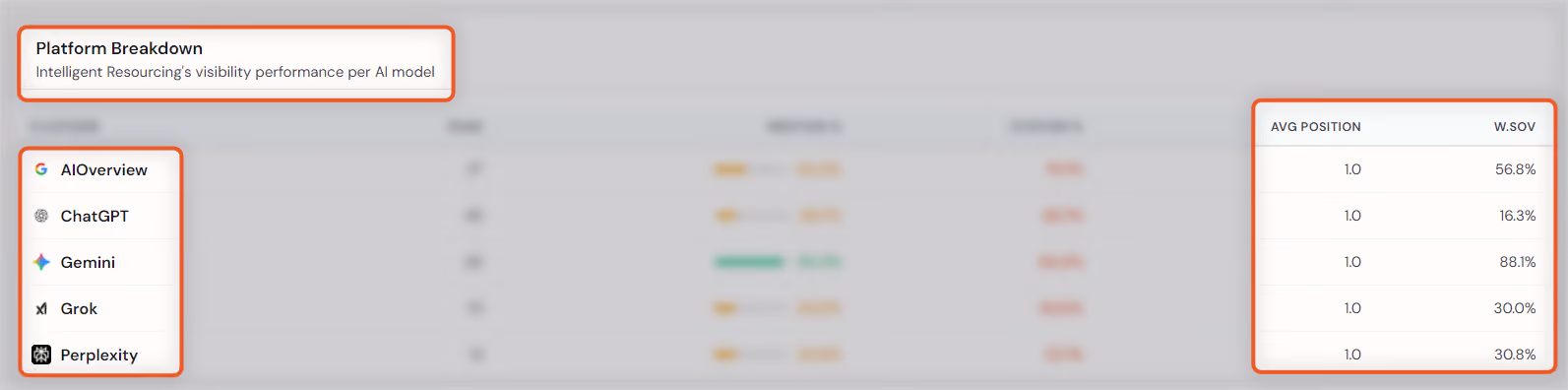
The Intelligent Resourcing tracker measures this across 5 engines simultaneously: ChatGPT, Gemini, Google AI Overview, Perplexity, and Grok. In the Best Clay Workflow category, Intelligent Resourcing holds the number 1 position in all engines.
Source diversity and information gain as ranking factors
Two factors decide whether repeated citations actually accrue: source diversity and information gain. Engines deliberately pull from a spread of domains, and they reward sources that add something new rather than restate the consensus.
Why answer engines spread citations across sources
Answer engines diversify their sources to reduce single-source risk, so no brand owns an answer outright. Being one credible voice among several is the normal state, not a failure, which means repeated presence is how you hold ground rather than expecting to dominate. If you want to be cited consistently, structure content for AI citation so an engine can lift a clean, self-contained answer from your page.
Information gain: earn citations by adding something new
Each page must add net-new data, examples or framing, because content that echoes competitors gives engines no reason to cite it again. This is the principle behind Google's information gain patent, which scores how much new information a page adds beyond what a reader has already seen. Optimising a source using GEO techniques can meaningfully lift its visibility in generative-engine responses. Marking up your pages with schema markup for AI citation helps engines parse what is genuinely new. Which means original contribution, not repetition of the consensus, is what earns the repeat citation.
How citation breadth affects click-through in AI search
In AI answers, citations function as the new impressions. Appearing repeatedly across an answer and across related prompts increases the odds a reader clicks through to you instead of a competitor.
Citations are the new impressions
A cited link is the click surface in an AI answer, so citation frequency is the closest available proxy to impression share. The more prompts your brand is cited on, the more often your link is on screen when a reader decides where to go next. That makes breadth of citation, not a single placement, the metric that tracks with attention.
Why repeated citations win the click
A reader who sees your brand cited across several answers is primed to trust and click it, which means breadth of citation and click-through reinforce each other. Public click-through benchmarks for AI search are still thin, so measure the channel directly. The same source cited above recommends tracking monitored prompts, cited URLs and LLM referral traffic in analytics, since reliable public CTR benchmarks do not yet exist. Which means brands that track citation breadth can watch the clicks compound before competitors even notice the channel.
How to build citation velocity: a practical playbook

Moving from one citation to many is a sequence, not a single tactic. The playbook below runs from prompt research to measurement, and each step closes with the outcome it produces.
Publish citation-ready passages
Write short, self-contained blocks that answer one question cleanly, because engines cite passages, not whole posts. A tidy question-and-answer structure, backed by question mining for AI search, gives an engine something it can lift verbatim, which raises your odds of being the quoted source.
Earn repeated mentions across the web
Off-site references on trusted third-party pages reinforce your on-site content, which means your citation odds rise as the wider web repeats your brand. It is worth keeping AI crawlers welcome while you do it: Anthropic warns that blocking its search crawler can reduce a site's visibility and accuracy in Claude's search experiences. Getting AI to crawl your best content is the precondition for being cited at all.
Track, then refresh what is close but not cited
Identify pages that are retrieved but not cited, then strengthen answer clarity, sourcing and freshness until they cross the line. This measure-and-improve loop, extended with ChatGPT search optimisation tactics, is how you convert near-misses into repeat citations without starting from scratch.
Run the sequence in order; each step feeds the next.
- Map the prompts your buyers ask AI tools, grouped by awareness, consideration and decision.
- Publish citation-ready passages with a direct answer at the top of each section.
- Add schema and clean heading structure so engines can parse the page.
- Add net-new data or examples to satisfy information gain.
- Earn repeated third-party mentions to build off-site consensus.
- Track cited URLs against competitors monthly, then refresh pages that are close but not cited.
The loop matters more than any single step, because citation velocity is a trend you maintain, not a box you tick. Which means the brands that win are the ones that treat steps one through six as a monthly cadence rather than a launch checklist.
Build a repeatable citation system
Citation velocity improves when prompt research, content production and performance tracking work as one continuous process. Intelligent Resourcing's answer engine optimisation services help B2B teams build that system, so valuable content does not earn one isolated mention but continues gaining visibility across AI platforms over time.
Building citation velocity into your AI search strategy
A single citation proves you can be found; citation velocity proves you can be trusted, repeatedly. The practical move is to stop optimising for the first mention and start engineering for the repeat: publish citation-ready passages, add net-new information, and track which pages are retrieved but not yet cited. That work compounds, and so does its absence, because every month competitors publish citation-ready content, single-citation brands quietly slip out of the answer.
If your content earns the occasional AI citation but never the repeat, book a call with our team to know how to build AI search optimisation into your content system.
Content Creation
Intelligent Resourcing builds prompt research, citation-ready content and AEO tracking into one system, so your best pages keep getting cited across ChatGPT, Perplexity, Gemini and Claude, not just once.
FAQs
What is citation velocity in AI search?
Citation velocity is the frequency and breadth with which AI answer engines cite your content over time, across different prompts and platforms. It is not the same as speed, which only measures how quickly you earn a first citation. Velocity treats visibility as a running total: the more consistently engines like ChatGPT, Gemini and Perplexity reach for your pages, the more durable your presence in AI answers becomes.
Why is getting cited once not enough?
Because answer engines re-select their sources on every query, a single citation is never locked in. Two near-identical prompts can surface different sources, and a mention that appears today can vanish on the next refresh as engines re-crawl and re-rank. Durable AI visibility comes from being cited repeatedly across prompts and engines, which is what signals that your presence is a pattern rather than a coincidence.
How many citations do you need to build authority?
There is no fixed number. What matters is consistency: being cited across many related prompts and on more than one engine beats a single high-profile mention. Cross-platform repetition tells answer engines your content is a reliable, go-to source rather than a one-off match. Track the trend over weeks, not the count on any single day, because velocity is about the pattern, not a milestone.
What is information gain in AI search ranking?
Information gain is the degree to which a source adds new information beyond the existing consensus. Answer engines favour sources that contribute something original, whether that is fresh data, a new example, or a sharper framing, over pages that restate what competitors already say. In practice, content that only echoes the consensus gives engines no reason to cite it, so net-new contribution is what earns the repeat citation.
Do more citations improve click-through rates?
Repeated citations increase the surface area for clicks and prime reader trust, because someone who sees your brand cited across several answers is more likely to click it. Reliable public click-through benchmarks for AI search do not yet exist, so track LLM referral traffic in your analytics directly. Treat citation breadth as the leading indicator and referral clicks as the confirming one.
How do you measure citation velocity?
Track a fixed set of buyer prompts on a monthly cadence, record which URLs and brand mentions each engine cites, and compare your presence against competitors over time. Pair that with LLM referral traffic in your analytics to see clicks arriving from AI answers. The goal is a trend line: is your share of citations across prompts and engines rising, holding, or slipping?