
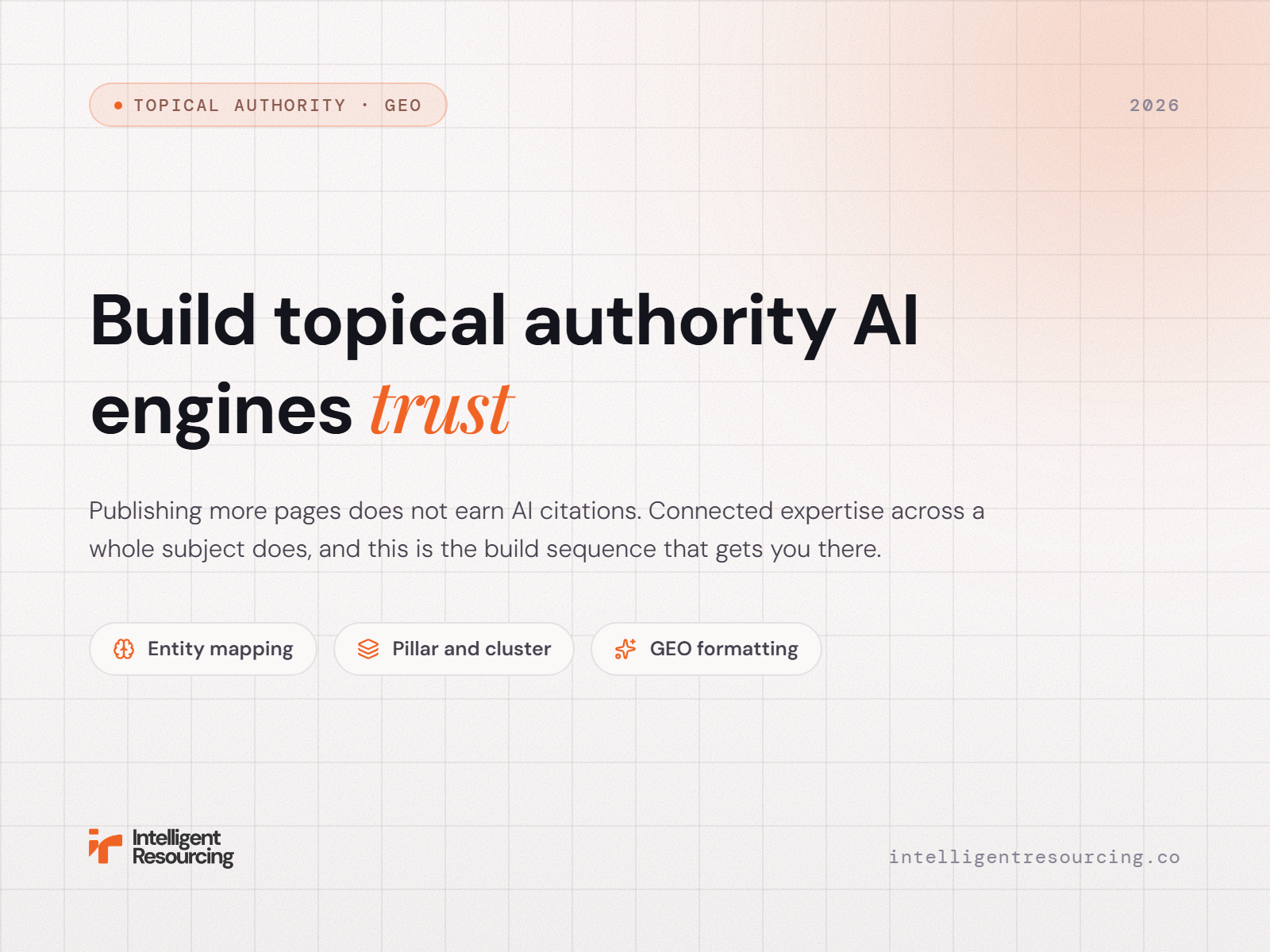
Topical authority is built by demonstrating complete expertise across a subject, not by publishing more individual pages. Intelligent Resourcing builds topical authority for AI visibility by combining focused content clusters, entity optimisation, structured data and answer-engine optimisation, helping brands become sources that AI engines can confidently cite.
Your team can publish more content every quarter and still see ChatGPT, Perplexity, Gemini and Google AI Overviews cite competitors because answer engines do not simply reward volume. They look for sources that show consistent, connected expertise across a topic.
This guide explains how AI engines determine topical authority, why topic ownership influences citations, and the build sequence marketing and content teams can use to create a subject area that both search engines and answer engines trust.
What Topical Authority Means When AI Engines Are The Audience
Topical authority is a site's demonstrated, complete command of a subject that search and answer engines treat as a citation-worthy source, not a per-keyword play. It is the foundation of AI search visibility. For AI engines the bar sits higher: Conductor's research found that answer engines prioritise sources that demonstrate complete expertise across an entire subject, not just one strong page. That makes coverage depth the entry ticket, a systems discipline rather than a tactic.
Domain authority rewards accumulated links and age, both slow to move; topical authority rewards connected coverage a focused team can build on purpose. A smaller site can earn citations on a topic a larger, unfocused competitor never fully owns.
Topical Authority VS Domain Authority
A low-authority site can outrank a giant on a topic it owns. The Search Initiative documented a niche retailer outranking Amazon on a high-volume commercial term after building topical depth, because its focused coverage beat what a general marketplace could match. Resourcing depth beats chasing a site-wide metric you cannot shift in a quarter.
| Signal | Domain authority | Topical authority |
|---|---|---|
| Measures | Site-wide backlink strength | Subject-specific expertise |
| Earned by | Links, site age | Complete, connected coverage |
| Who can win | Established sites | New or small sites on an owned topic |
Why AI Engines Reward Topic Ownership
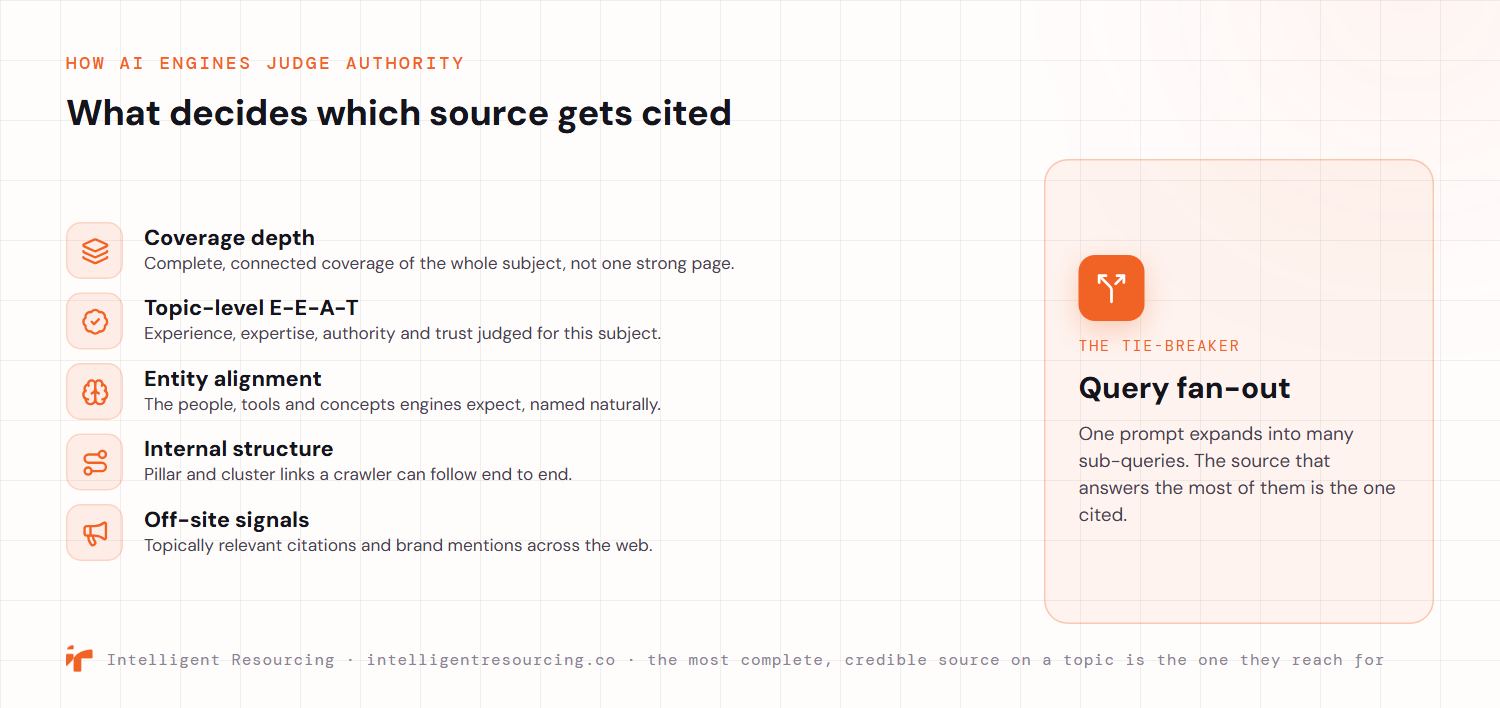
AI engines use query fan-out: they expand one prompt into many sub-queries, then build an answer from the sources covering the most of them. Google's search VP has confirmed AI Mode issues a burst of background searches from a single prompt, as Search Engine Journal reported. Depth on a topic compounds your visibility across every AI surface at once.
How AI Search Engines Determine Topical Authority In 2026
AI engines now model each site's whole topical identity, rather than scoring pages one at a time. Google's 2024 API leak exposed internal signals describing how tightly a site concentrates on a subject, and the lineage behind them runs back more than a decade.
| Year | Update | What it meant for topical authority |
|---|---|---|
| 2013 | Hummingbird | Ranking shifted from keywords to query intent |
| 2022 | Helpful Content | Site-wide quality signals; thin content suppresses the domain |
| 2024 | API leak | Site focus score and site radius revealed |
| 2025 to 2026 | AI Mode and query fan-out | Coverage breadth compounds AI visibility |
Each update moved trust further from the single keyword and closer to the subject as a whole. The site that owns a topic end to end is the one AI engines now reach for first.
Site Focus Score And Site Radius
The leak surfaced two signals. Ahrefs describes a site focus score measuring how concentrated a site's content is around one core subject, and a site radius capturing how far pages stray from it. Shaun Anderson's Hobo-web analysis agrees that a high site radius flags pages that are topical outliers. Off-topic publishing is not neutral; it can actively dilute your authority.
How Measurement Evolved From 2024 To 2026
In 2024 the API leak made site-level focus legible, and the Helpful Content system folded into the core algorithm, so site-wide quality became permanent. Through 2025, coverage depth increasingly decided which pages fed AI answers. By 2026, AI Mode and query fan-out made breadth the multiplier. Topical authority became a prerequisite for AI visibility, not a bonus.
Entity-Based SEO: The Groundwork AI Engines Read
Entity-based SEO makes topical authority machine-readable. It means aligning content with the people, tools, concepts, and relationships that define your niche, not with exact-match keyword strings. Engines have worked this way since Google launched the Knowledge Graph in 2012 to understand entities and their relationships rather than match keywords, and AI engines inherit that model.
Map The Entities In Your Niche
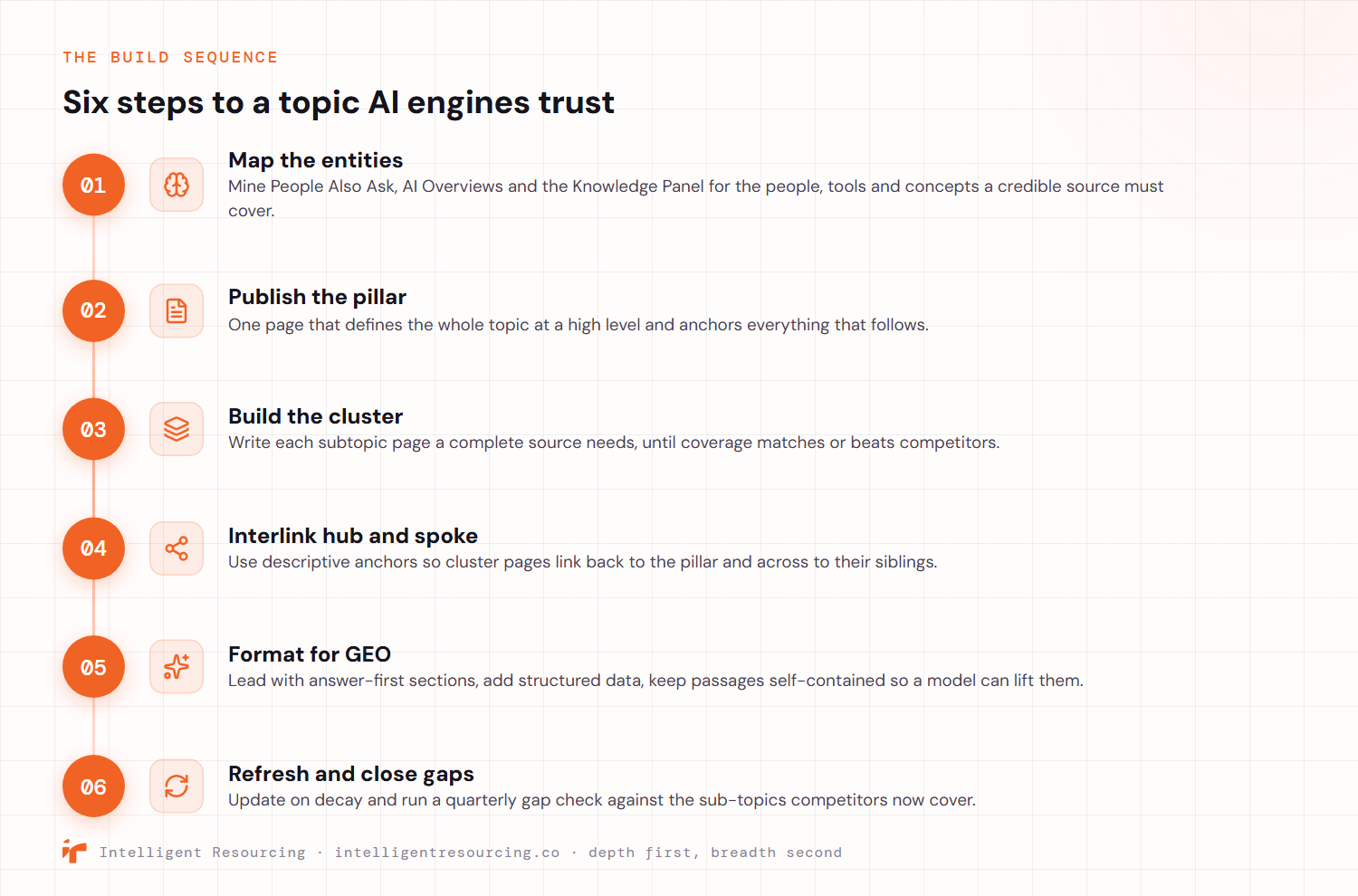
Build the entity list before you write. Work through these sources in order:
- Mine People Also Ask for the questions engines tie to the topic.
- Scan AI Overviews for the sources and sub-topics engines already cite.
- Read related searches for adjacent entities.
- Study the Knowledge Panel for the people and concepts Google links to the subject.
- Reverse-engineer top-ranking pages for entities you have missed.
The output is a working list of the people, tools, and concepts engines expect a credible source to cover.
Co-Occurrence And The Knowledge Graph
Co-occurrence is how often two entities appear together across trusted sources. When authoritative pages repeatedly mention the same tools and concepts side by side, engines treat that pairing as a relevance signal. Referencing related entities naturally strengthens credibility without keyword stuffing, because you match a pattern engines already trust. The next move is connecting those entities on your own site, which is what internal linking does.
E-E-A-T As A Topic-Level Trust Signal For AI Engines
E-E-A-T is evaluated against a topic, not your whole site. Google assesses content using Experience, Expertise, Authoritativeness, and Trustworthiness, and AI engines lean on the same signals to choose which sources to quote. Google itself weights trust as the most important of the four, though experience is the pillar hardest for a competitor to fake, which is why it earns citations even when it isn't the top-weighted signal. A site can hold strong E-E-A-T for one subject and none for another.
| E-E-A-T pillar | On-page signal an AI engine can verify |
|---|---|
| Experience | First-hand methodology, original data, case outcomes |
| Expertise | Named author with relevant credentials |
| Authoritativeness | Topically relevant citations and brand mentions |
| Trustworthiness | Author schema, sameAs markup, transparent sourcing |
Each pillar maps to something an engine can read on the page. E-E-A-T is a checklist of concrete signals you add on purpose, not an abstract score.
If your best content is already thorough but still gets skipped, the gap is usually structural, and the cluster and GEO steps below are where to look next.
Experience And Expertise AI Engines Can Verify
First-hand experience and named expertise separate a page from content-farm output. A visible methodology, original data, and an author with relevant credentials give an engine evidence that a qualified human produced the work. Ahrefs frames trust as topic-specific, assessed for the subject at hand, not the domain in general. Who wrote this, and whether they have done the thing they describe, is now a ranking input.
What Topic Ownership Looks Like In Our Own Tracker
We run this play on ourselves. Intelligent Resourcing publishes on one subject: AI search, answer engine optimisation, and GTM engineering. Its own answer-engine tracker shows what that concentration earns, and original first-party data is itself an experience signal an engine can read.
The figures below come from the Intelligent Resourcing AEO tracker, pulled on 9 July 2026.
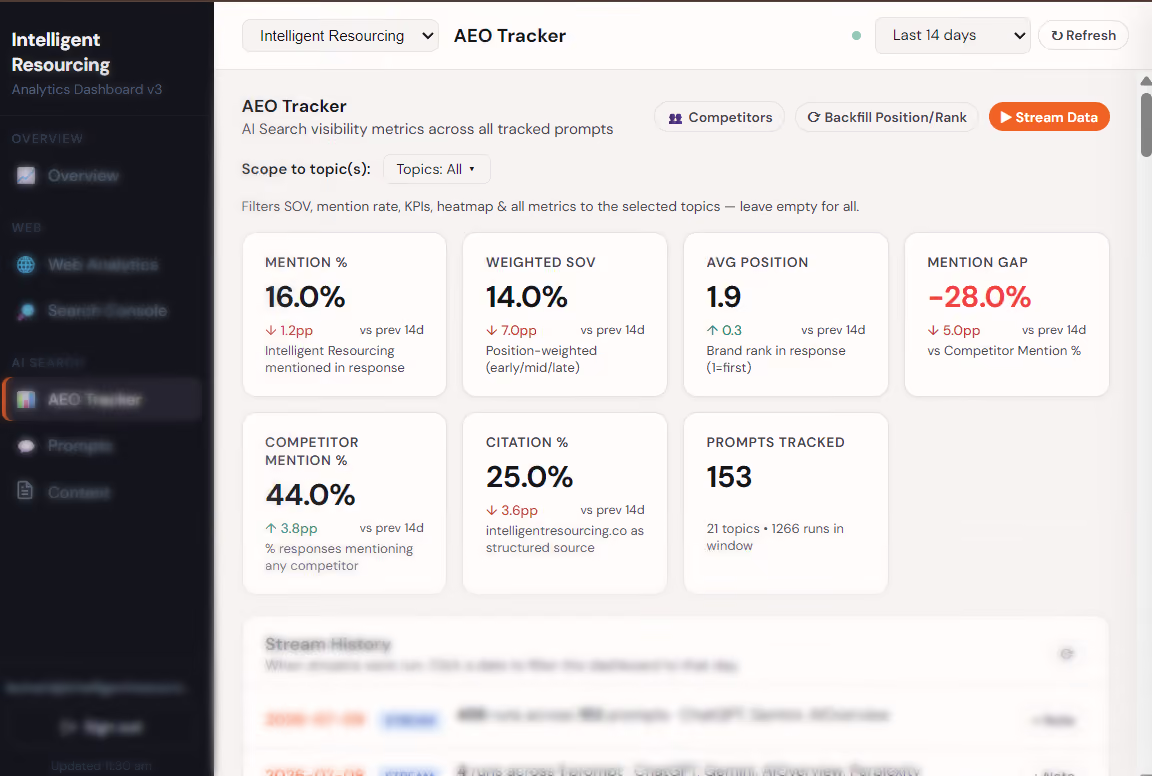
| Metric (Intelligent Resourcing) | Reading, 9 July 2026 |
|---|---|
| Share of voice in category | 16.1% |
| Average mention rank | 1.9 |
| Citation rate (domain linked) | 25% of runs |
| Mention rate (brand named) | 16% of runs |
| Prompts tracked / runs sampled | 153 / 1266 |
They lead their category on share of voice against 51 other agencies, and their average mention rank is 1.9, so it shows that an engine names Intelligent Resourcing first, which is what topic ownership buys.
Author Authority, Bylines, And Schema
Make author authority explicit and machine-readable. Give every article a byline with credentials, add author schema with sameAs markup linking to the author's LinkedIn and on-site author page, and cite primary sources directly. The guide to structured data for AI covers the fields that make authorship verifiable.
Build The Topic Cluster AI Engines Can Follow
A pillar-and-cluster architecture, tied together with internal links, shows engines and crawlers that your coverage is complete. A pillar page owns the broad topic; cluster pages address sub-topics and link back. Search Engine Land notes that a planned cluster structure prevents keyword cannibalisation, where several of your own pages compete for one query and split the signal. Structure here is a ranking signal, not decoration.
Pillar And Cluster Architecture
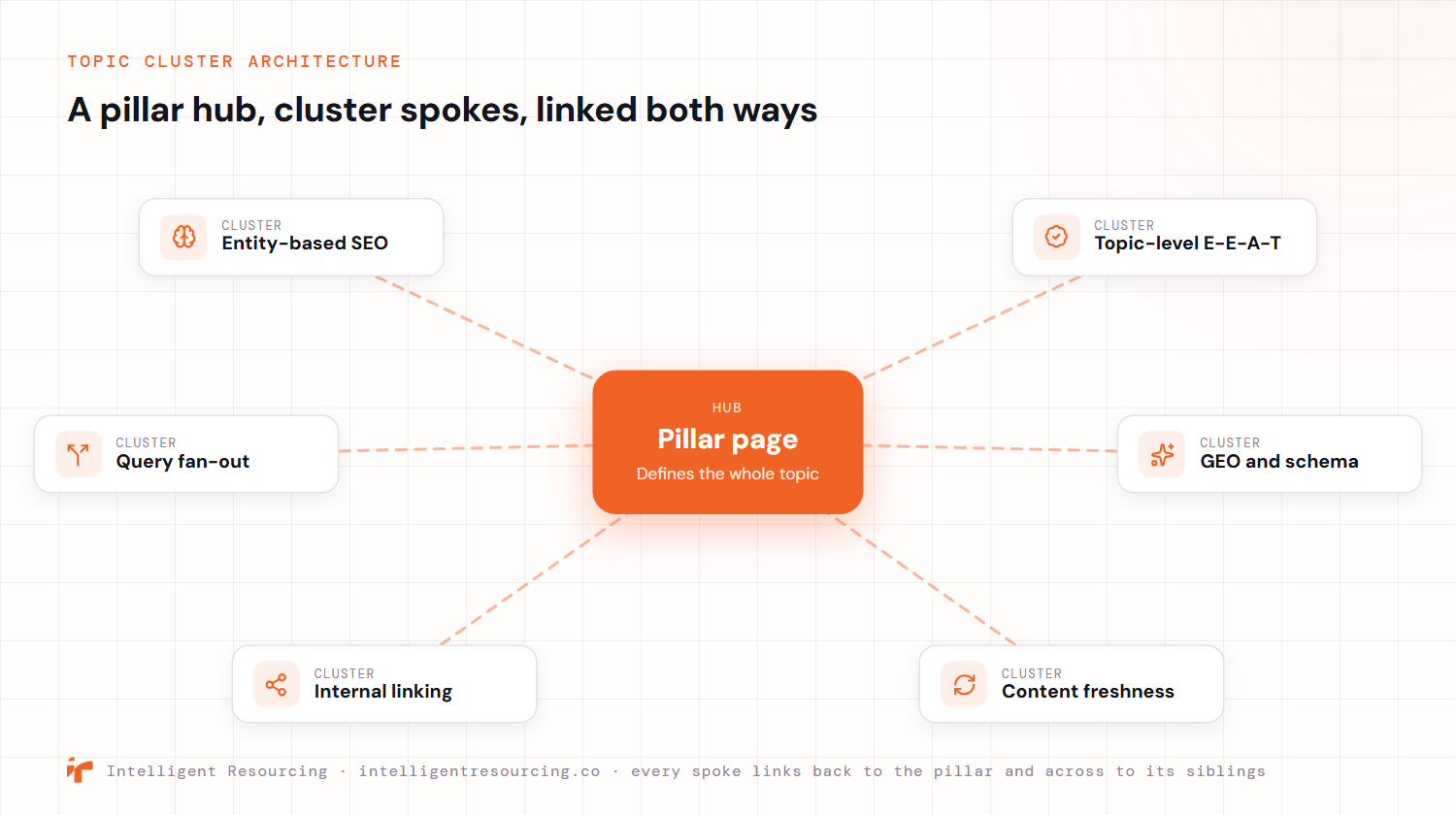
The pillar is the hub; cluster pages are the spokes, each linking back. You can build pillar-first or cluster-first; pick one and stay consistent, because switching mid-build leaves orphaned pages. A reliable sequence:
- Publish the pillar that defines the topic at a high level.
- List the subtopics a complete source must cover.
- Write and interlink each cluster page back to the pillar and its siblings.
- Run a gap check against competitor coverage and close what is missing.
Internal Linking That Signals Relationships
Internal links tell engines which pages belong together. Use descriptive anchor text that names the target, link in a hub-and-spoke pattern, and audit for orphan pages that nothing points to. Our guide to structuring content for AI citation covers the link patterns that make relationships legible to a crawler.
Being Selective: Which Topics To Leave Out
Authority is defined partly by what you refuse to publish. Every off-topic post raises your site radius and dilutes focus. Ahrefs offers a test: would a first-time visitor immediately understand what your site is about? If a planned article muddies that answer, it belongs elsewhere. Saying no is an authority-building decision, not a missed opportunity.
Structure And Maintain Content For Generative Search (GEO)
Generative engine optimisation (GEO) formats your content so AI engines can extract, cite, and trust it, then keep it current. It is an extension of topical authority, not a separate trick: the same depth that earns trust has to be presented so a machine can lift it cleanly.
| GEO tactic | AI outcome it supports |
|---|---|
| Answer-first paragraphs | Snippet and zero-click extraction |
| Structured data and schema | Eligibility for AI citation |
| Self-contained sections | Cleaner passage retrieval |
| Regular freshness updates | Retained AI Overview placement |
Each row pairs a formatting choice with the mechanism it feeds. GEO is less about gaming the engine than removing friction between your expertise and the model reading it.
Formatting Content So AI Engines Can Cite It
Lead each section with a direct answer, write headings that mirror real queries, add structured data, and keep sections self-contained so a model can quote one without the rest. Formatting like this is what makes content quoteworthy: a self-contained passage a model can lift and cite. Our guide to optimising for ChatGPT shows the formatting patterns that get passages picked up.
Freshness And Closing Coverage Gaps
Refresh a page when traffic drops from its peak, a cited statistic is superseded, it loses an AI Overview placement, or a competitor updates first. Ahrefs treats freshness as a live ranking signal. Run a gap analysis each quarter to catch sub-topics competitors now cover.
Building Your AI Search Authority
Owning a topic, not chasing individual keywords, is what earns trust from AI engines, and the payoff is citations you did not have to bid for. Our own tracker makes the case: a single-subject site can lead its category in AI answers within a focused build.
For the next quarter, pick one subject you can credibly own, map its entities, and build the cluster before you widen scope. Depth first, breadth second. If you want that handled end to end, our answer engine optimisation team builds topic clusters designed for AI citation.
Content Creation
Pick one subject you can credibly own, and our answer engine optimisation team maps its entities, builds the pillar-and-cluster architecture, and formats every page so AI engines can extract and cite it. Depth first, breadth second.
FAQs
How long does it take to build topical authority AI engines trust?
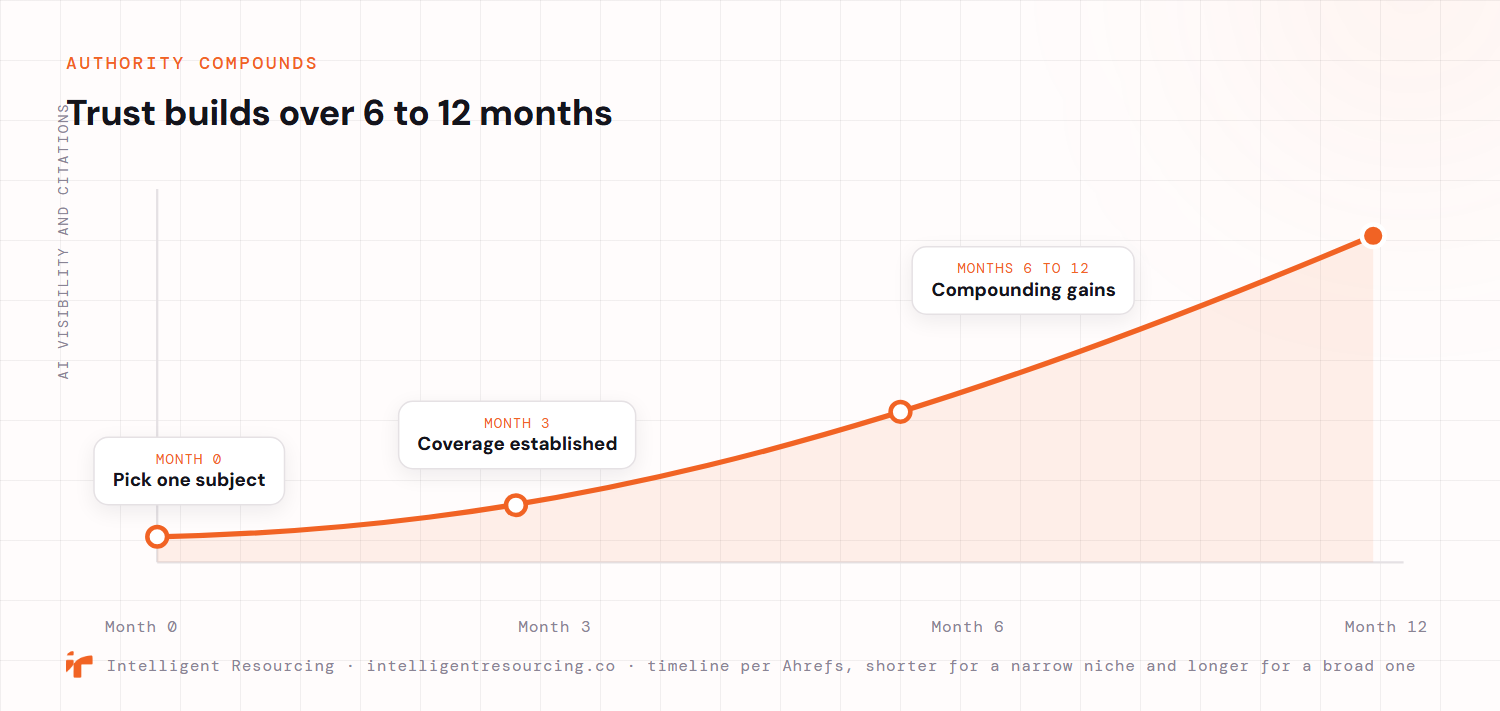
Expect 6 to 12 months. Coverage is usually established in the first 3 months, with compounding ranking and AI-visibility gains between months 6 and 12, according to Ahrefs. The timeline shortens for a narrow niche and lengthens for a broad one, but the pattern holds.
How is topical authority different from domain authority?
Topical authority measures subject-specific expertise; domain authority measures site-wide backlink strength. A small or new site can win on a topic it fully owns, because depth on one subject beats the broad, shallow coverage a larger domain often carries across many topics.
What is entity-based SEO and why does it matter for AI engines?
Entity-based SEO aligns your content with the people, tools, and concepts in your niche and the relationships between them, rather than exact-match keywords. It matters because AI engines map meaning through entities, so naming the right ones helps them build a trustworthy model of your topic.
How do AI search engines decide which sources to trust?
They weigh coverage depth, topic-level E-E-A-T, entity alignment, internal structure, and topically relevant off-site signals. Query fan-out then rewards the sources that answer the most sub-queries behind a prompt. The most complete, credible source on a topic is the one they cite.
Does topical authority replace backlinks for AI visibility?
No. Backlinks still matter, but topic depth lets a focused site outrank stronger domains in a niche it owns. The strongest sites have both: authoritative links and complete, connected coverage. Treat topical authority as the lever you can build fastest, not a replacement.
How many articles do you need to build topical authority?
There is no fixed number. Complete coverage relative to competitors matters more than raw count. As a rough guide, a narrow niche may need 15 to 20 pieces, while a broad subject can require 50 or more. Cover the topic completely, then stop.