
What Does Perplexity Reward When It Cites B2B Content?
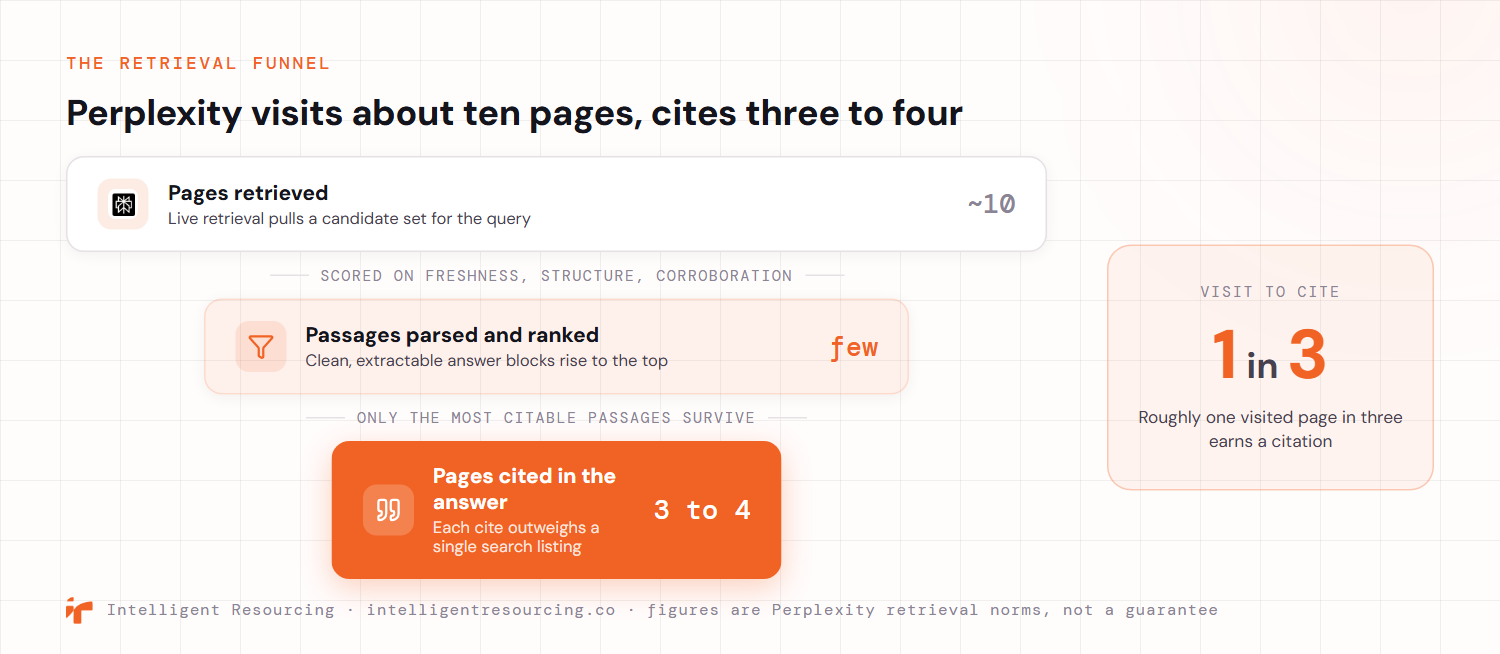
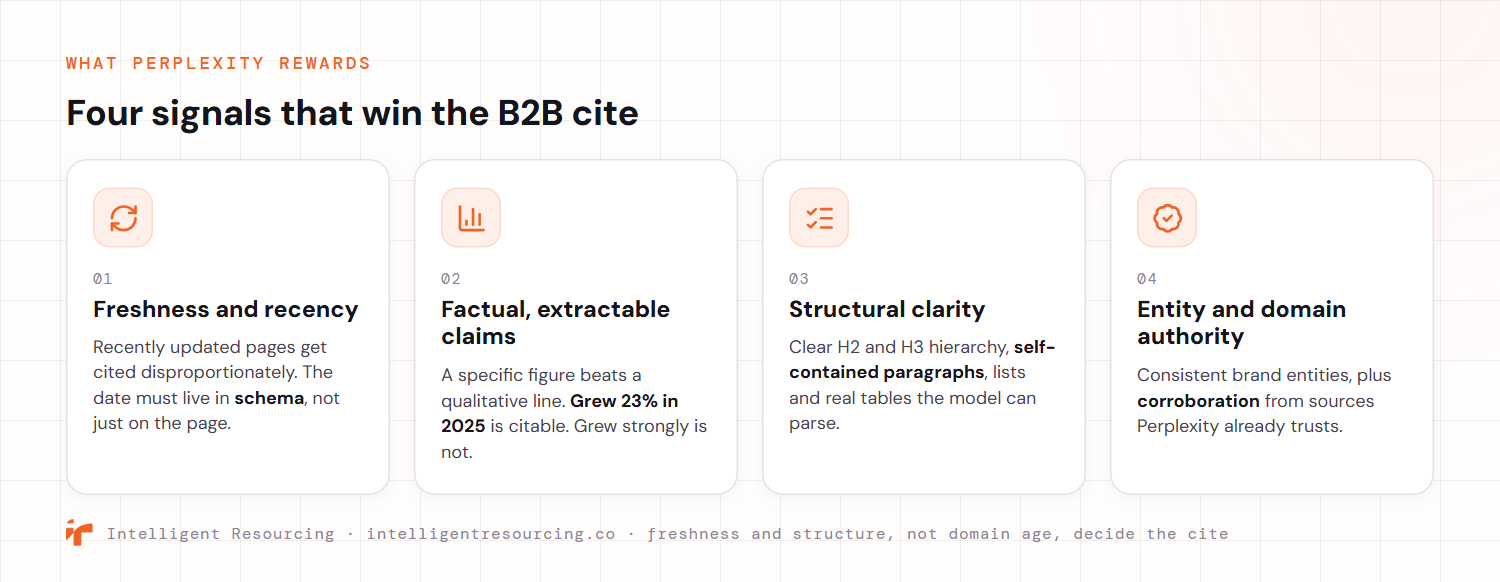
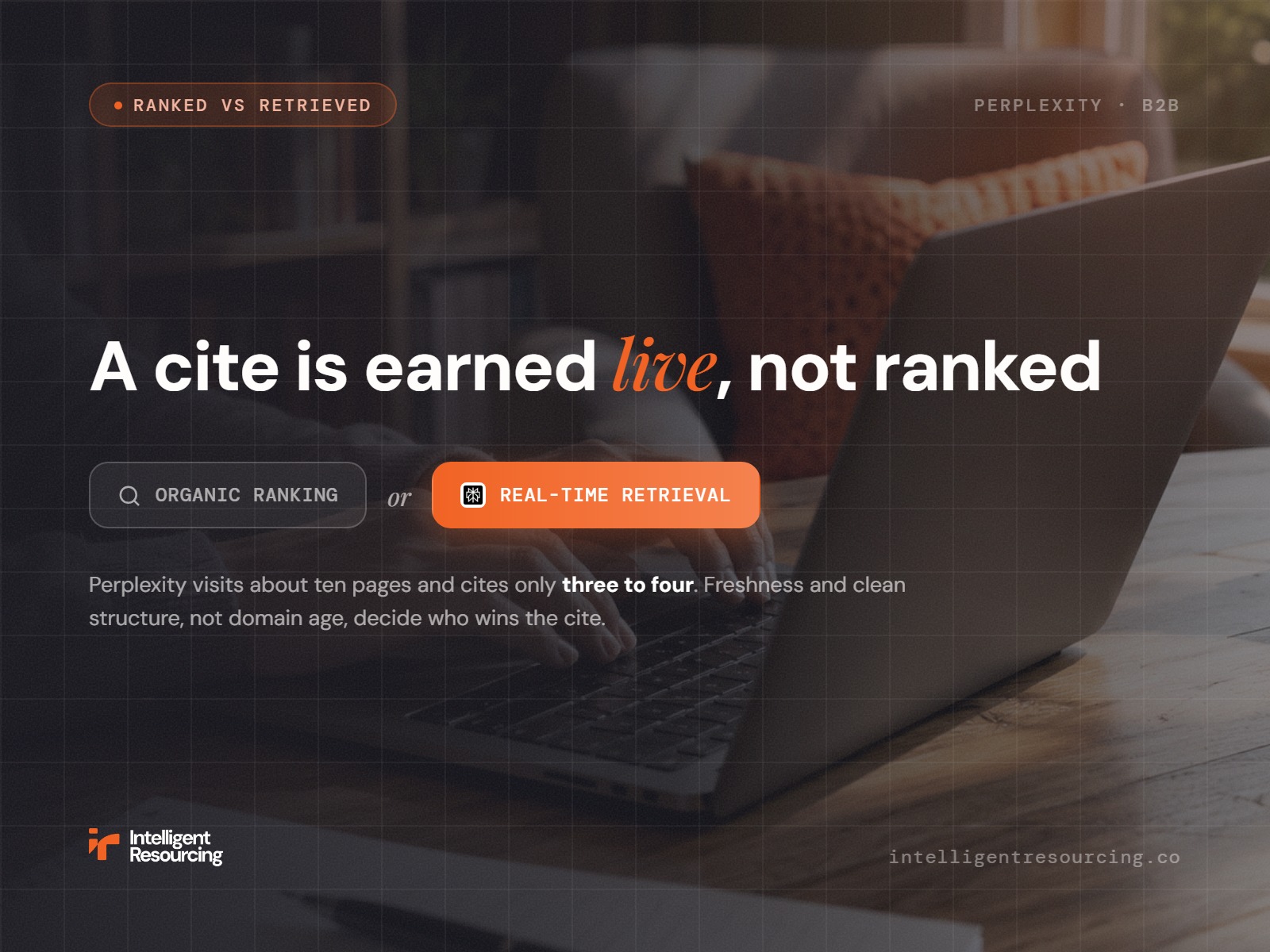
Perplexity rewards content it can retrieve in real time, parse cleanly, and verify against trusted sources. It weighs four signals: freshness, factual extractable claims, structural clarity, and entity authority. Unlike Google's organic ranking or ChatGPT's training data, Perplexity runs systematic real-time retrieval. Google-optimised pages often miss because they are not built for live extraction.
Treat this as a systems question, not a copywriting trick. Perplexity weights four signals when it selects B2B sources.
- Freshness and recency: recently updated content gets retrieved and cited disproportionately. Date metadata must live in schema, not just on the page.
- Factual, extractable claims: specific figures beat qualitative statements. "Grew 23% in 2025" is citable. "Grew strongly" is not.
- Structural clarity: clear H2 and H3 hierarchy, self-contained paragraphs, lists, and tables.
- Entity and domain authority: consistent brand entities, plus corroboration from sources Perplexity already trusts.
The retrieval model is the real difference between engines.
| Signal | ChatGPT | Perplexity | |
|---|---|---|---|
| Retrieval | Organic ranking | Training data, search on demand | Systematic real-time RAG |
| Citations | AI Overviews | Variable | Always, 3 to 4 of about 10 pages |
| Freshness weight | Medium | Medium | Very high |
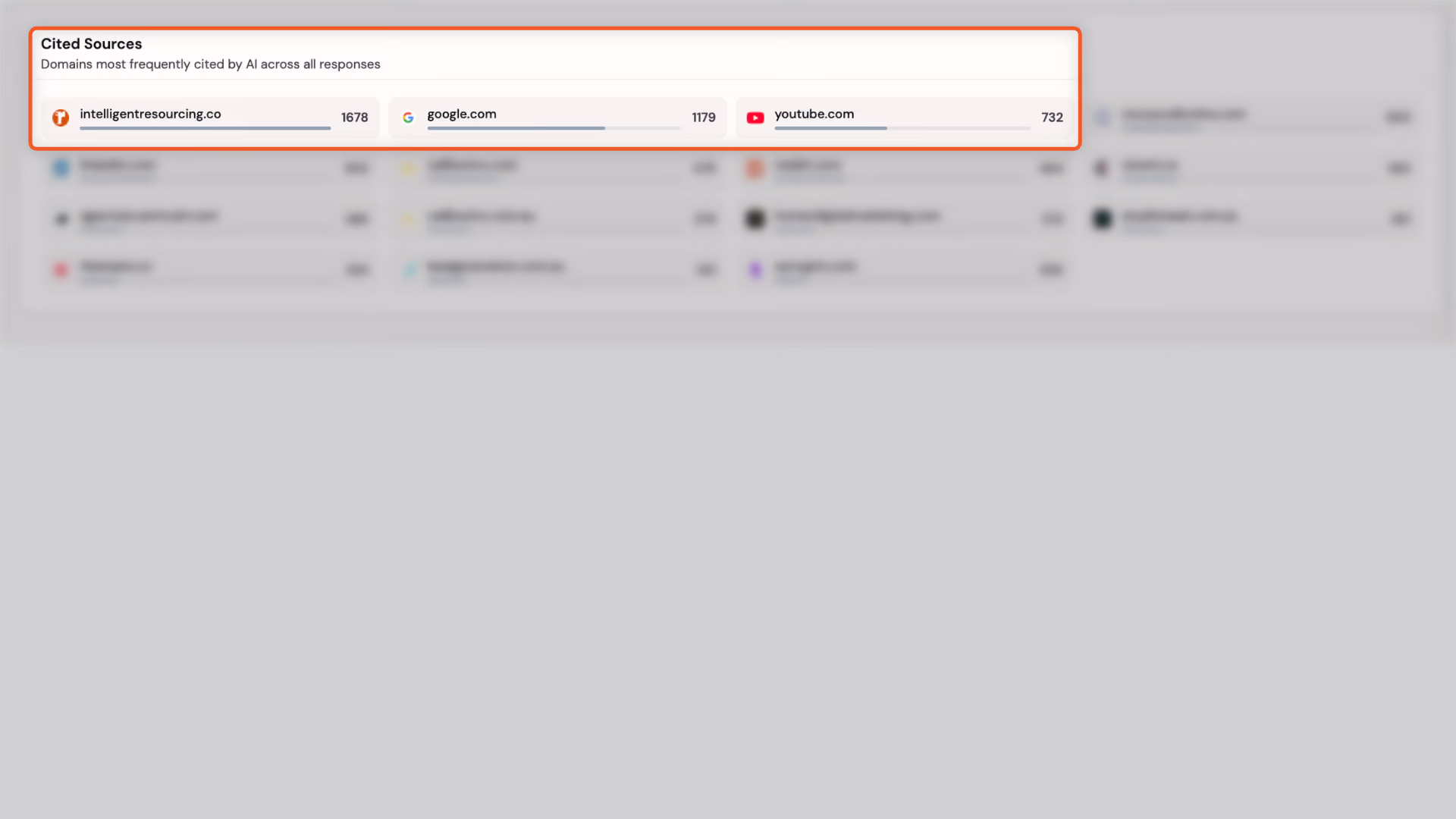
Our own dashboard shows what compounded entity authority looks like in practice. Across our tracked prompt panel in the B2B lead-generation and GTM category, intelligentresourcing.co is the most-cited domain overall at 1,678 citations, ahead of google.com at 1,179 and youtube.com at 732 (Intelligent Resourcing AEO dashboard, July 22, 2026).
The bar is lower than most teams expect. UC Berkeley's GEO-16 study found Perplexity cites pages averaging a 0.300 quality score, the lowest threshold of any major engine. Google AI Overviews sits at 0.687. That is roughly a 56% lower bar, and an opening for mid-market B2B. SE Ranking measured about 5.01 citation links per Perplexity response, against ChatGPT's 10.42. Each Perplexity cite therefore carries more weight. Freshness and structure, not domain age, decide who wins it. This is the core of Generative Engine Optimisation and broader LLM SEO. For the full picture across every major engine, see how to get cited by AI search engines.
Structure B2B Pages to Get Cited in Perplexity
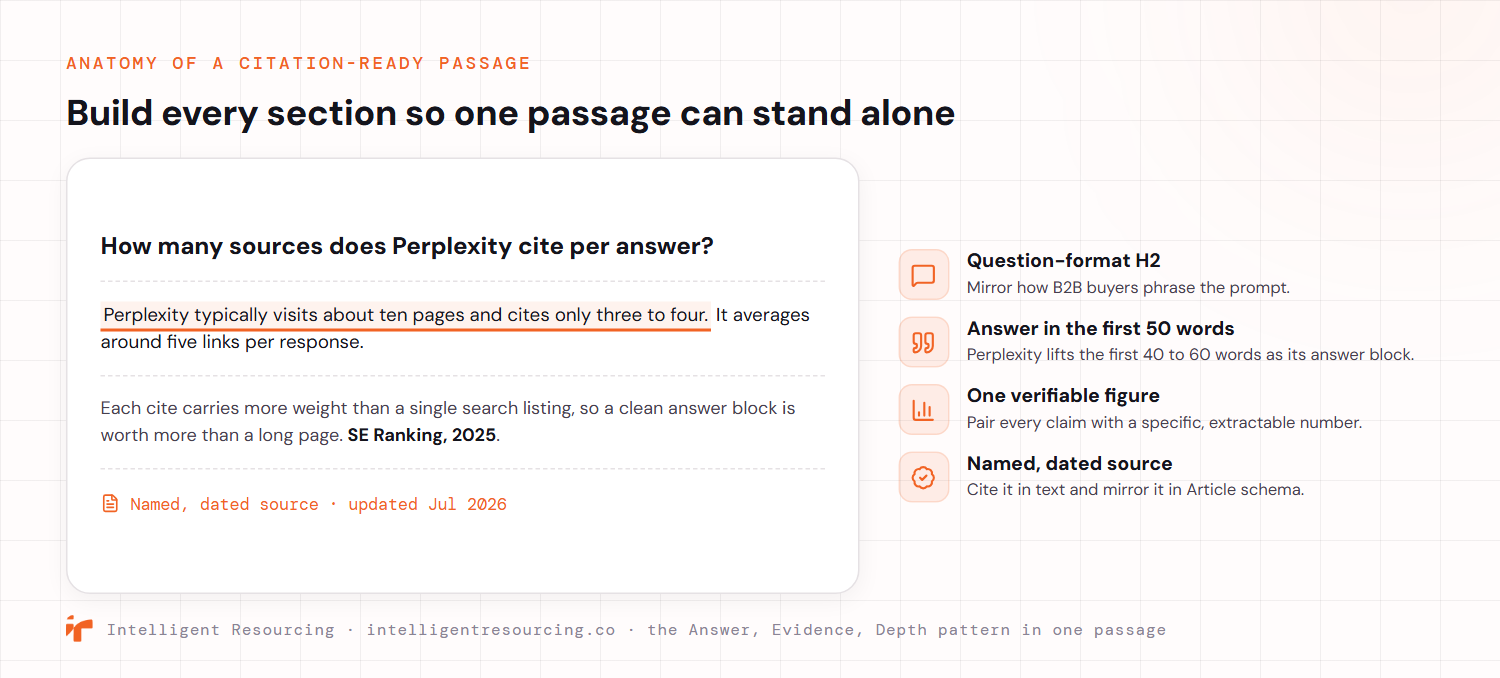
Structure each page so any single section can be lifted and cited without surrounding context. Use the Answer-Evidence-Depth pattern. Open with a direct answer in the first fifty words. Add 100 to 150 words of evidence. Include at least one data point per section. This is the concrete how, not theory.
We call this self-contained unit a Citation-Ready Passage. Build each one with six steps.
- Lead with the answer. Resolve the question in the first fifty words. No warm-up.
- Name entities precisely. State company, product, metric, and year in each claim.
- Add one verifiable figure per section. Pair every claim with a named, dated source.
- Use question-format H2s. Mirror how B2B buyers phrase their prompts.
- Implement FAQPage and Article schema. Mirror on-page text exactly. Include datePublished and dateModified.
- Keep semantic HTML. Use real headings, lists, and tables, not styled divs.
Perplexity pulls the first 40 to 60 words of a section as its answer block. So your opening sentence carries the cite. The Princeton GEO study found adding source citations lifted generative-engine visibility by up to 115.1% for mid-ranked pages. FAQPage markup is associated with materially higher AI-answer inclusion. The integration matters as much as the prose. CMS publishing, JSON-LD, and sitemap or IndexNow submission move a page from draft to retrievable. Structure earns the cite only when paired with information gain. A tidy page that adds nothing new still loses. Learn to structure content for AI citation, then reinforce it with schema markup for AI.
Why Do Earned Media and Community Sources Drive B2B Citations?
Perplexity often trusts third-party and community sources more than your own pages. So source strategy matters as much as content strategy. Owned media controls your definitions and positioning. Third-party editorial adds independent validation. Community sources supply peer language. Corroboration across all three raises Perplexity's confidence to cite you.
Each source type plays a distinct role.
- Owned media: definitions, methodology, and product detail you fully control.
- Third-party editorial: independent validation and category credibility.
- Community (Reddit, forums): peer language and objections. Strong for awareness queries, but cites usually credit the community, not your brand.
The data is blunt. Muck Rack's Generative Pulse found 82% of AI-cited links are earned media, with 95% non-paid. Press releases account for roughly 1%. Community sources make up a large share of Perplexity citations, and Perplexity's audience skews toward professional research. Ahrefs data shows brand mentions correlate with AI visibility at 0.664, against 0.218 for backlinks. Our own panel shows the same pattern up close: across the same 300-prompt B2B lead-generation set, YouTube and Reddit rank as the second and third most-cited domains overall, at 14.0% and 10.5% citation frequency, trailing only our own domain (Intelligent Resourcing AEO dashboard, July 20, 2026). The tension resolves cleanly. Owned pages still anchor your definitions and your AI visibility. But for high-intent B2B evaluation queries, entity consistency plus a few extractable earned placements beat raw publishing volume. Treat earned coverage as AI search marketing, not vanity PR.
Measure and Sustain Perplexity Citations for B2B
Measure with a fixed prompt panel. Then sustain with a refresh cadence. Run a 50 to 100 query test set every one to two weeks. Log whether the brand is cited, which URL is cited, and which competitors appear. Connect citations to revenue with a self-reported AI-discovery field in your CRM.
Track three KPIs across the panel.
| KPI | What it tells you | Why it matters |
|---|---|---|
| Citation rate | How often the brand appears across the query set | Surface-level visibility |
| Share of model | Brand appearances versus named competitors | Competitive standing |
| Source-of-citation | Which exact page or third-party source is cited | Guides content and PR decisions |
Refresh is the other half of the job. Scrunch's analysis with Stacker found earned media distribution produced a 239% median lift in AI brand citations within 30 days, across 30 clients and 87 stories. Refresh your high-intent pages every 60 to 90 days. Add real data, not a fresh timestamp. A timestamp-only change earns nothing.
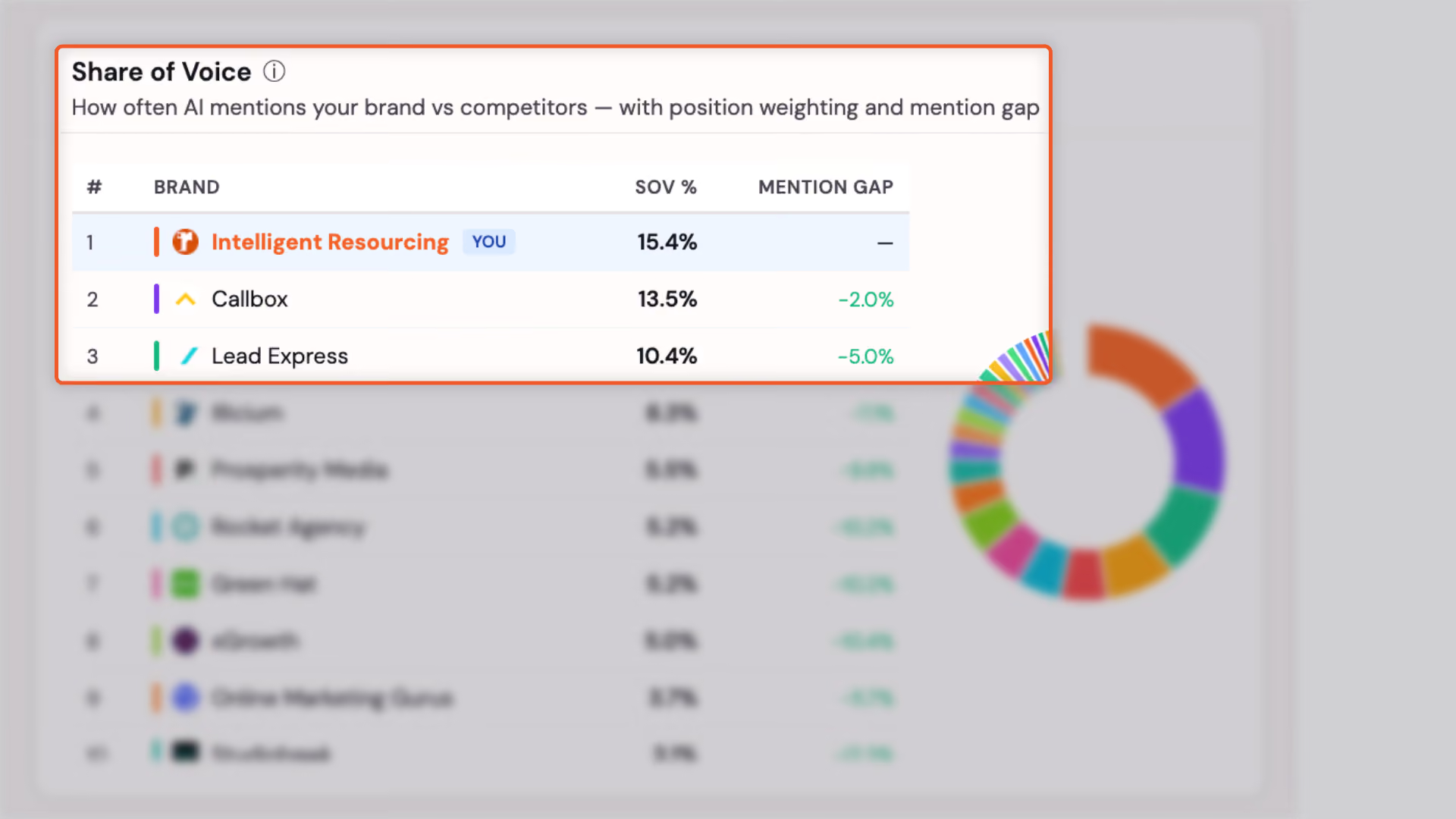
We run this exact panel on ourselves. Intelligent Resourcing tracks a 300-prompt panel across the GTM engineering and revenue operations category. As of July 2026, we hold the top share of voice at 15.4%, ahead of Callbox at 13.5% and Lead Express at 10.4% (Intelligent Resourcing AEO dashboard, July 2026). Our citation rate sits at 23.7%, and when a model does name us, our average mention rank is 1.68, meaning we usually surface at or near the top of the answer rather than buried in a list. The gap to the next competitor is inside 1.5 points, so the ranking moves cycle to cycle. That is the reason we run the panel weekly rather than once a quarter: a monthly check would miss the swing entirely.
When we refreshed a high-intent comparison page for a 200-person B2B SaaS client, share of model rose from 9% to 27% across our Perplexity prompt panel within six weeks. The lever was new data and a tighter answer block, not a date swap. This is an operating cadence, not a one-off campaign. See how the same architecture applies to Google AI Overviews, and get AI to crawl your content on every refresh.
Five Ways B2B Perplexity Strategies Break Down
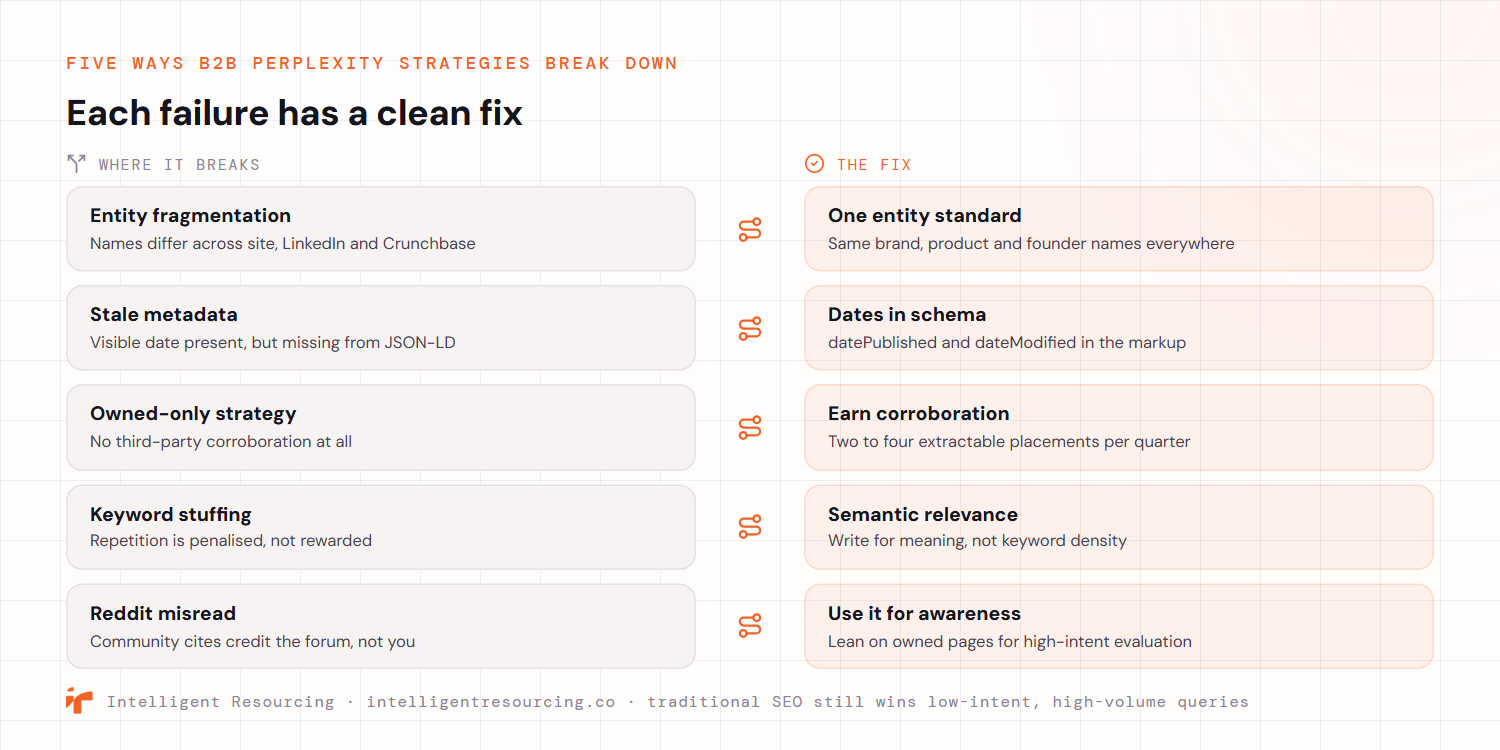
Most B2B Perplexity strategies fail in five predictable ways. Entity fragmentation confuses retrieval. Stale freshness metadata kills recency. Owned-only strategies lack corroboration. Keyword stuffing performs worse than unoptimised content. And teams misread Reddit cites as brand cites. Each has a clear fix, and traditional SEO still wins some queries.
Here is what breaks, and how to fix each failure.
- Entity fragmentation: inconsistent brand, product, and founder names across your site, LinkedIn, and Crunchbase. Fix it with a single entity standard.
- Stale metadata: a visible date is present, but it is missing from JSON-LD. Perplexity then treats the page as stale.
- Owned-only strategy: no third-party corroboration at all. Add two to four extractable earned placements per quarter.
- Keyword stuffing: repetition is penalised. Write for semantic relevance, not density.
- Reddit misread: community cites are usually unattributed. Use them for awareness, not high-intent evaluation.
The Steelman: for low-intent, high-volume, or zero-AI-search-probability queries, traditional SEO stays the lower-cost lever. See where budget should split between the two.
The demand is real. G2's 2026 Answer Economy report found 93% of B2B software buyers say AI chatbots have fundamentally changed how they conduct research, with half now starting research with a chatbot more often than Google. But AI citation amplifies existing visibility. It does not replace the SEO foundation. Name where foundation work still wins. Then start your question mining for AI search from the prompts buyers actually type.
Make Your B2B Content Citable in Perplexity
Freshness, structure, and corroboration win the cite for B2B. Perplexity retrieves live, so stale or owned-only content loses. Lead each section with a fact and name a dated source. Refresh high-intent pages every 60 to 90 days. Earn a few extractable placements each quarter. Then measure the share of the model on a fixed prompt panel. We do it ourselves, on our own 300-prompt panel, and it is the reason we hold the top share of voice in our category today.
Content Creation
Intelligent Resourcing's Content Strategy team audits your AI visibility and rebuilds your highest-intent pages for retrieval, then measures share of model on a fixed prompt panel. Book a call to map your Perplexity citation gaps and the fixes that close them.
FAQs
How long does it take to get cited by Perplexity?
Perplexity uses real-time retrieval. Well-structured, freshly published pages can appear within 24 to 72 hours. Consistent presence takes weeks of steady cadence, not a single publish.
Does schema markup help B2B content get cited in Perplexity?
Yes. Article and FAQPage JSON-LD with accurate datePublished and dateModified are documented citation amplifiers. The schema must mirror your on-page text exactly.
Does Perplexity cite your own website or only third-party sources?
Perplexity cites both. Earned editorial and community sources carry more weight. Owned pages get cited when they hold specific, extractable claims.
How many sources does Perplexity cite per answer?
Perplexity typically visits about ten pages and cites only three to four. It averages around five links per response. Each cite carries more weight than a single Google listing.
How do you track whether your B2B brand is cited in Perplexity?
Run 50 to 100 ICP queries on a one to two week cadence. Log citations and competitors. Monitor the perplexity.ai referrer in your analytics.