

Generative Engine Optimisation for Manufacturing and Industrial B2B is the practice of structuring technical content so ChatGPT, Perplexity or Google's AI Overviews retrieve and cite it. Intelligent Resourcing turns technical expertise, product data and specifications into structured, AI-readable content that can become the source AI systems reference.
Right now your best spec sheet is probably a download-only PDF, and the engineer sourcing your product is asking an AI assistant a question that PDF will never answer. Technical buyers now open AI engines before they reach a vendor site, and the answer they read is built from sources the model could parse and trust.
This guide covers how AI engines rank industrial content, why spec sheets go missing, and how answer engine optimisation closes the gap. If your data lives in PDFs, the final section shows where visibility leaks first.
What GEO Means for Manufacturing and Industrial B2B
For Manufacturing and Industrial B2B, Generative Engine Optimisation (GEO) is the practice of structuring technical content so AI engines like ChatGPT, Perplexity, Gemini and Google's AI Overviews can retrieve, trust and cite it.
A procurement lead who once typed a keyword and scanned links now asks a full question and reads one answer, often before any vendor knows the project exists. If your capability data is unreadable to an AI engine, you are not in that answer.
Which means the target has shifted from ranking a page to becoming one of the sources an engine quotes.
How AI Search Differs From Traditional SEO for Technical Buyers
Traditional SEO competes for rank; GEO competes for citation. Engineers rarely type keywords, they ask full-sentence questions like "best pump seal material for sulfuric acid at 80°C", so the goal is no longer to hold position three, it is to inform the answer the buyer acts on.
| Dimension | Traditional SEO | Generative Engine Optimisation |
|---|---|---|
| Target | Google crawler, SERP rank | LLMs and AI Overviews |
| Primary signal | Keywords, backlinks | Structure, entities, citations |
| Output | Ranked list of links | Cited answer in a synthesised response |
| Success metric | Rank position, clicks | Share of answer, citations |
Where Generative Search Meets the RFQ Journey

AI research now sits at the top of the specification and request-for-quote journey, before a shortlist forms. If your technical data is unreadable to AI, you are absent from the shortlist even when you are the best-fit supplier, because the engine cannot see you to introduce you.
How AI Engines Rank and Cite B2B Manufacturing Content

AI engines do not rank pages, they retrieve passages, synthesise an answer, then cite the sources they trusted enough to quote.
The mechanism is retrieval-augmented generation (RAG): the engine pulls relevant passages from an index and grounds its response on them, which is why structure beats keyword density. The Princeton and Georgia Tech GEO study, presented at KDD 2024, found its three most effective tactics, adding expert quotations, statistics and authoritative citations, each lifted source visibility by roughly 30 to 40% on the study's main metric, up to 41% at best.
| Content signal | Why it earns citations | What it means for manufacturers |
|---|---|---|
| Add expert quotations | Named, credible voices an engine can attribute | Quote your engineers by name and role |
| Add statistics | Hard numbers an engine can lift as fact | Put real spec and performance numbers on the page |
| Add authoritative citations | Verifiable standards and sources that build trust | Reference standards and named sources |
Which means the content that wins citation looks like evidence, real numbers and named standards, not marketing copy.

A B2B management software and technology solutions provider client tracked in the Intelligent Resourcing AEO tracker shows this, its highest-cited pages are not product overview pages, they are regulation-specific compliance guides tied to named legislation and government authority sources. Across 3,322 tracked AI responses, those pages carry a 36.4% citation rate: cited as a structured source in more than 1 in 3 AI answers.
The Retrieval-to-Citation Pipeline
The pipeline runs in four steps: query fan-out, retrieval, synthesis and citation. Retrieval is where industrial content fails, because content that cannot be parsed cleanly is skipped to avoid hallucination risk, which means an unreadable spec is simply left out of the answer.
The Citation Signals That Decide Inclusion
Four key signals influence whether content is included in AI-generated answers:
- Machine-readable structure: Clear formatting, schema markup and logical page architecture help AI systems parse and understand the content.
- A direct answer up front: A concise, answer-first summary gives AI systems a citation-ready response.
- High named-entity density: Specific details such as part numbers, certifications, standards and product names strengthen relevance and accuracy.
- Off-site corroboration: Mentions in directories, industry publications and editorial content provide external validation.
Mersel's B2B GEO guide reaches a similar conclusion, identifying five drivers of AI citations: machine-readable infrastructure, citation-first content, entity density, off-site trust and freshness.
How Google AI Overviews Reshape Industrial Search Results
AI Overviews collapse the ten blue links into a single synthesised answer with a handful of cited sources, which means visibility is now close to binary: you are in the answer, or you are invisible.
This zero-click shift is already measurable: one Fractl analysis of over a million high-volume keywords found search volume down 29% in a year as queries move to AI assistants. Mersel's research found 85% of AI Overview citations come from content published in the last two years, so publish and refresh capability content, because stale pages are cited far less often.
Zero-Click Shift and What It Costs Industrial Firms
When the buyer gets a complete answer without clicking, the only way to influence the decision is to be a cited source. Industrial firms must be among the handful of sources an AI cites or they are invisible to the buyer. In long, trust-based sales cycles, an early AI introduction shapes the shortlist before an RFQ lands.
How Share of Voice Replaces Rankings
Share of voice, how often your firm appears in generated responses for relevant prompts, is the metric that replaces keyword position and the honest measure of AI search visibility. Analytics under-report AI-assisted discovery, so instrument for it: add a "where did you first research this?" field to your RFQ form.
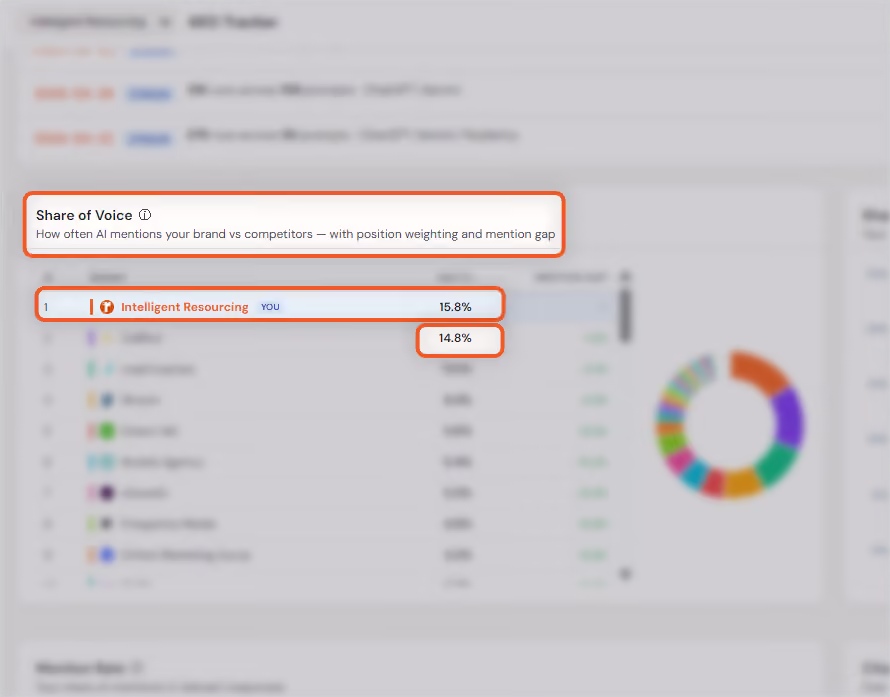
To illustrate: Intelligent Resourcing tracks its own AI visibility across 153 prompts on ChatGPT, Perplexity, Gemini and Google AI Overview. Its current share of answer in the B2B lead generation and GTM engineering category sits at 15.79%, #1 among 50+ tracked competitors across 2223 total runs. That single percentage, updated each run cycle, replaces a keyword position report. The nearest competitor sits 1 percentage point behind, that margin is what active content output protects.
How to Structure Industrial Product Data for LLM Discovery

AI engines cite specifics, so the win is making product data machine-readable through schema and consistent entities.
Structured data tells an engine what a number means: that 316L is a material, that 150 psi is a pressure rating, that AS 4041 is a standard. That precision pays off because Yext's analysis of 6.8 million AI citations found 86% originate from brand-managed sources, split across first-party websites (44%), listings (42%) and reviews or social (8%).
Which means the fastest path to citation is marking up the data you already have, not writing more of it.
Schema Types That Matter for Industrial Products
Deploy Product and Offer schema for part numbers, MPNs, materials, tolerances, dimensions, MOQ and lead time; Organization with sameAs for entity consistency; FAQPage for buyer questions; and HowTo for installation and maintenance. Unmarked data creates hallucination risk, which means the engine skips it rather than guesses wrong.
| Schema type | Mark up | Why it helps |
|---|---|---|
| Product / Offer | Part numbers, materials, tolerances, MOQ, lead time | Lets AI answer capability and availability prompts |
| Organization (sameAs) | Brand name, profiles, directory listings | Keeps your entity consistent across the web |
| FAQPage | Buyer questions and answers | Feeds question-answer pairs to AI |
| HowTo | Installation and maintenance steps | Wins process and "how do I" queries |
Entity Consistency Across Distributors and Catalogues
If a distributor's page is better structured than yours, the AI cites the distributor, not you. Establish your own site as the source of truth, then give distributors clean, machine-ready data with part numbers identical across channels and Organization sameAs tying your profiles together.
How to Optimise Industrial PDFs and Spec Sheets for AI Indexing
Critical specifications trapped in download-only PDFs are hard for AI systems to retrieve accurately, so the highest-value move is migrating that data into live HTML.
This is where most industrial catalogues lose, scanned pages, image-based text and inconsistent table layouts all make technical specifications harder for AI systems to retrieve accurately, so priority data belongs in structured on-page HTML. A PDF is a fine secondary download, but a poor primary home for the numbers a buyer asks about.
- Audit which specs live only in PDFs.
- Extract the critical specifications, certifications and application data.
- Publish them as structured HTML tables on the relevant product pages.
- Add concise context in natural language around each table.
- Keep the PDF available as a secondary download.
- Validate the schema after publishing.
Which means the same specification, moved from a PDF into an HTML table, goes from invisible to citable without a single new fact being written.
Why Download-Only PDFs Go Missing in AI Answers
Scanned pages, image-based text and inconsistent table layouts all reduce retrievability. The specification exists, but the engine cannot read it, so it cites a competitor whose numbers sit in clean on-page HTML instead. You are not ranked lower, you are simply not in the answer.
The PDF-to-HTML Migration Workflow
Put the key specifications on the product page, material properties, certifications, performance data, dimensions and application details, in proper HTML table markup, then add a short explanatory copy. Keep the PDF for engineers who want the full document, but treat the website as the primary source of truth for anything an AI might quote.
A Practical GEO Roadmap for Manufacturers

Start with an audit and a small, high-value slice rather than a full rebuild, because you can prove the approach on a handful of pages before you commit the engineering backlog.
- Audit technical content and current AI visibility.
- Move priority specs into structured HTML.
- Deploy Product and Organization schema.
- Build authority via trade directories and editorial mentions.
- Monitor AI mentions and run a refresh cycle.
Staged Rollout You Can Start Now
Sequence the work so results show before the bigger investment. Pick your highest-value capability pages first, the products that win the best margin or carry the hardest specifications, structure those, then expand. Take a baseline measurement before and after, because that is the only honest way to show the change is real rather than seasonal.
Common Mistakes That Keep Manufacturers Invisible
- Keeping specifications only in PDFs: Move critical product specifications into crawlable HTML so AI systems can access and interpret them.
- Publishing thin, sales-led product pages: Add measurable specifications, technical details and named industry standards.
- Using inconsistent part numbers: Standardise product and part references across your website, distributors and external listings.
- Lacking off-site trust signals: Claim and complete relevant trade directory, industry association and supplier listings.
- Treating GEO as a one-off task: Build a regular content refresh cycle, because freshness is an important citation signal.
Ready to Improve Your Visibility in AI Search?
A focused GEO audit can show where your technical content is being overlooked, which product pages should be prioritised and what changes are most likely to improve inclusion in AI-generated answers.
Book a call with our team to discuss a practical GEO roadmap for your manufacturing business.
Make Your Industrial Expertise the Source AI Cites
The principle underneath all of this is simple: AI cites the clearest, best-structured and most trusted technical source, so the work is making your expertise machine-readable and corroborated rather than producing more of it. The single action worth taking this week is an audit: find out where your specifications actually live and whether an AI engine can read them.
If your product data still lives in download-only PDFs, that is where AI visibility leaks first. See how our answer engine optimisation works for industrial content.
Content Creation
A focused GEO audit shows where your technical content is being overlooked, which product pages to prioritise, and the changes most likely to earn inclusion in AI answers.
FAQs
What is Generative Engine Optimisation for manufacturers?
It is the practice of structuring technical content, specs, certifications and application data, so AI engines cite it in their answers. The payoff sits in the RFQ journey: when a buyer researches a material through an AI assistant, structured content makes your firm one of the sources the engine introduces early.
How do AI engines decide which manufacturing content to cite?
They favour 4 things: machine-readable structure, a direct answer up top, named-entity density like part numbers and certifications, and off-site corroboration from directories and editorial mentions. The Princeton and Georgia Tech GEO study found quotations, statistics and authoritative citations each lifting visibility by roughly a third or more.
Does GEO replace SEO for industrial B2B?
No, GEO extends SEO. Strong technical SEO fundamentals, crawlable pages, clean architecture and fast load times, are the foundation an AI engine relies on to retrieve you at all. Run both together; GEO adds structure, entities and citation signals on top.
How should we handle our product spec sheet PDFs?
Keep the PDFs for download, because engineers still want the full document. But move the critical specifications, material properties, certifications and performance data, into structured on-page HTML so AI systems can retrieve them accurately. Treat the web page as the primary source of truth and the PDF as a secondary copy.
How do we measure GEO results when sales cycles are long?
Track share of answers and AI-referred sessions as early indicators, because they move before revenue does. Add a self-reported "where did you first research this?" field to your RFQ form to capture AI-assisted discovery that analytics miss, then tie those responses back to closed deals across a full cycle.