
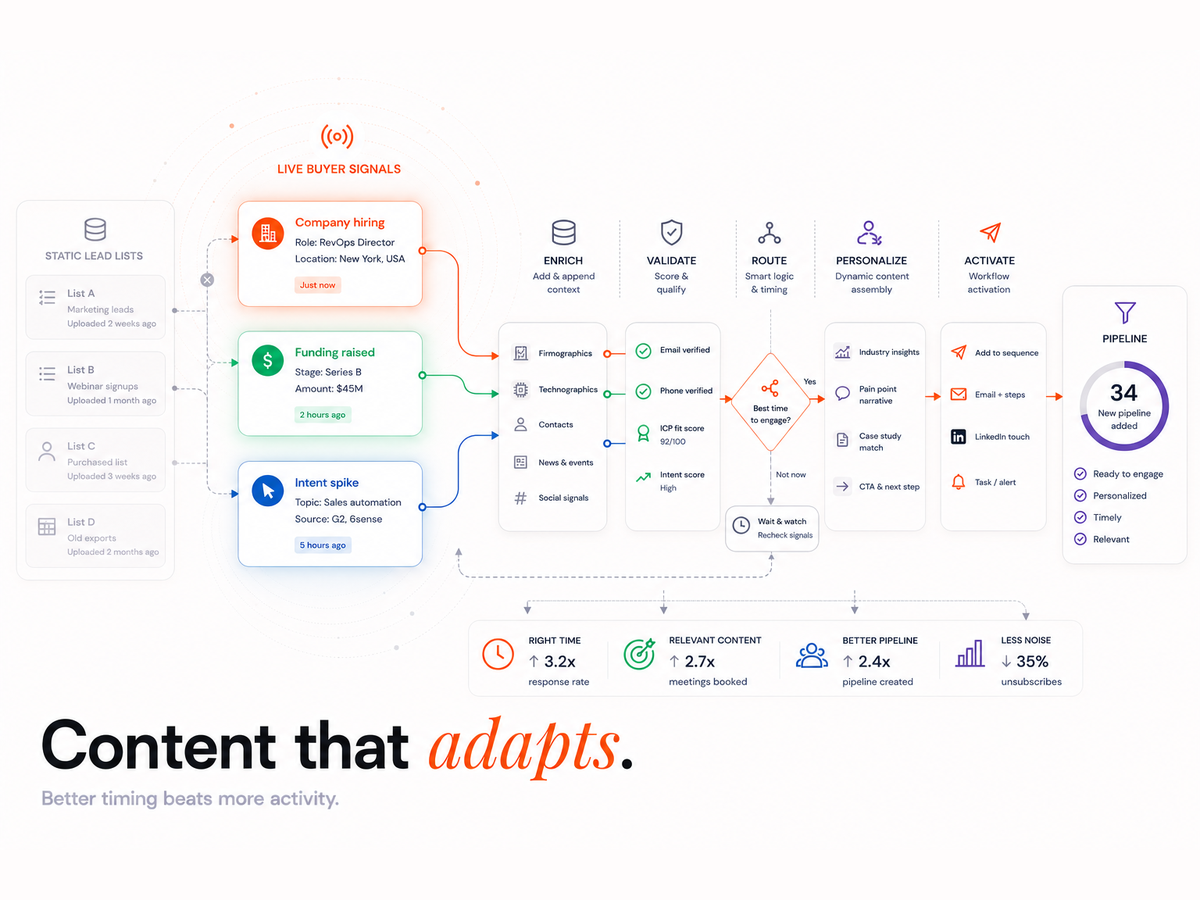
Personalisation is now the expectation, not the edge. Buyers want content that reflects what they have done and where they are in their research, and a fixed campaign schedule cannot keep up. Dynamic content automation closes the gap: it reads live buyer signals and adapts what each person sees across emails, landing pages, and web content, in real time rather than on a calendar. Twilio Segment's 2024 State of Personalization report found 89% of business leaders say personalisation is important to their growth, which makes the question how to deliver it at scale, not whether to.
What dynamic content automation actually is
Dynamic content automation is a system, not a single tool. It turns raw behaviour into the right message by moving through four layers, each feeding the next. Get the layers working together and personalisation holds up across thousands of contacts; bolt one on alone and it breaks.
| Layer | What it does | Example in practice |
|---|---|---|
| Signal capture | Reads behaviour and context in real time | A return visit to the pricing page is logged as intent |
| AI segmentation | Groups accounts by live behaviour, not static lists | An account moves into a "comparing vendors" segment automatically |
| Adaptive flows | Changes the next message based on what the buyer did | A case-study download triggers a relevant demo offer |
| Landing-page personalisation | Tailors the page on arrival to the visitor | A pricing searcher lands on a page that leads with pricing |
The shift from static sends to this kind of system is the difference between guessing and responding. It sits inside a wider signal-based marketing approach, where the buyer's own behaviour decides what happens next.
Start with the signal, not the send
Personalisation only works if it is triggered by something real. The buyer has usually moved before you notice: 6sense's 2025 B2B Buyer Experience Report found buyers complete about 61% of their journey before they contact a vendor. Dynamic content automation lets you respond to that hidden activity, surfacing the right message while the buyer is still researching rather than after they raise a hand.
The play: define the signals that matter, such as repeat pricing views, content downloads, and return sessions, then let each one trigger a tailored response. For the full picture of which cues to track, see our guide to B2B buying signals.
AI-powered segmentation
Static lists fall behind the moment a buyer's behaviour changes. AI-powered segmentation builds and updates audiences from live behavioural data, so content always matches what an account is doing now. The return is well documented: HubSpot's State of Marketing research found 93% of marketers say personalisation improves leads or purchases, a result that only holds at scale when segments update automatically rather than by hand.
The play: let segments form from behaviour rather than maintaining them by hand, and connect that data to your delivery system so the segment and the message stay in sync.
Watch out for over-segmenting. Dozens of tiny segments are impossible to maintain and add little; a handful of behaviour-based segments that map to real buying stages do the work.
Adaptive content flows
Adaptive flows change the next message based on what the buyer just did, instead of running a fixed sequence. Email is where this pays off first, because it is both personalisable and measurable. Litmus reports that email drives an ROI of $36 for every dollar spent, higher than any other channel, and signal-triggered emails beat batch sends because they reference the buyer's actual behaviour.
The play: build flows that branch on real actions, a click, a download, a return visit, and let the system learn which content moves a buyer forward. Turn these into documented stage-aware workflows so the logic is repeatable, not locked in one person's head.
Watch out for automation that only ever sells. A flow that pushes a demo after every action wears thin fast; mix genuinely useful content in so the buyer keeps opening, and save the direct ask for a strong signal.
Landing-page personalisation
The page a buyer lands on should reflect why they came. Dynamic content automation tailors the page in real time using the same signals: search query, prior interactions, or location. A visitor who searched for pricing can land on a page that leads with pricing and a relevant offer, which lifts relevance and removes friction.
The play: match the page to the strongest signal you hold on the visitor, and test the variants so the system keeps improving which content converts each segment.
Watch out for personalising the headline and nothing else. If the page promises a tailored experience and then shows a generic form and offer, the mismatch costs you trust; the whole path has to match the visitor's intent.
The payoff: automation that earns its place
Done well, this is an efficiency engine as much as a relevance one. Nucleus Research found marketing automation delivers a 14.5% increase in sales productivity and a 12.2% reduction in marketing overhead. The gain comes from removing manual list-building and one-off sends, so the team spends its time on strategy rather than busywork.
That freed-up time is the real return. Instead of building lists and scheduling batch sends, the team works on the offers, the segmentation logic, and the content that actually moves buyers. The automation handles the repeatable execution, and the people handle the judgement, which is the split that scales without adding headcount.
| Dimension | Static campaign | Dynamic content automation |
|---|---|---|
| Trigger | A fixed schedule or batch send | A live behavioural signal |
| Audience | One list, one message | Segments that update as behaviour changes |
| Message | The same content for everyone | Content matched to the buyer's last action |
| Measurement | Opens and clicks | Conversion, pipeline, and retention |
| Outcome | Relevance decays as the list ages | Relevance holds because it follows the buyer |
How to roll out dynamic content automation
Build it in sequence rather than all at once, so each layer is reliable before the next depends on it:
- Map the signals that show intent, and agree what each one should trigger
- Unify the data so web, product, email, and CRM behaviour feed one place
- Build behaviour-based segments that update automatically
- Create adaptive flows that branch on real actions, starting with email
- Personalise the landing pages the flows point to, then test and refine
Where dynamic content automation goes wrong
The most common failure is automating noise: triggering off weak signals so buyers get irrelevant messages faster. The second is dirty data, because personalisation built on stale or duplicated records personalises the wrong thing. The third is treating it as a one-off setup rather than a system that needs tuning as behaviour shifts.
When we build these systems for clients, the first month is mostly plumbing: cleaning data and wiring sources together. The personalisation only earns its keep once the foundation is solid, and the teams that skip that step ship faster but convert worse. This is the kind of build a GTM engineer owns, connecting the stack so the signals actually flow.
Key takeaways
- Personalise at scale: buyers expect it, so the question is delivery, not whether
- Trigger on signals: real behaviour, not a calendar, should drive the message
- Segment from behaviour: live segments beat static lists that age
- Start with email: it is the most measurable, highest-ROI channel to automate
- Fix the data first: clean, unified data is what makes automation pay
Content Creation
Schedule a free personalisation audit. We'll show you which buyer signals to act on first and how to wire AI segmentation, adaptive flows, and landing page personalisation into a single signal-led growth system.