
Content automation is no longer optional for lean go-to-market teams. The digital content creation market is projected to grow from $32.28 billion in 2024 to $69.80 billion by 2030, per Grand View Research, and investment is following: in 2025, 14% of organisations planned to put more than 40% of their marketing budget into martech, up from 6% a year earlier. This guide walks through the 6 steps to implement a content automation strategy using Clay, n8n, and AI, built on a GTM architecture that keeps quality and brand voice intact as you scale.
1. Content Audit and Segmentation
Why an audit is essential
Start by auditing your existing content before automating anything. Catalogue what you have, what performs, and what is missing, using your CRM and analytics to map content against personas and funnel stages. Automating a disorganised library just scales the disorganisation, so the audit is the foundation every later step depends on.
Segmentation
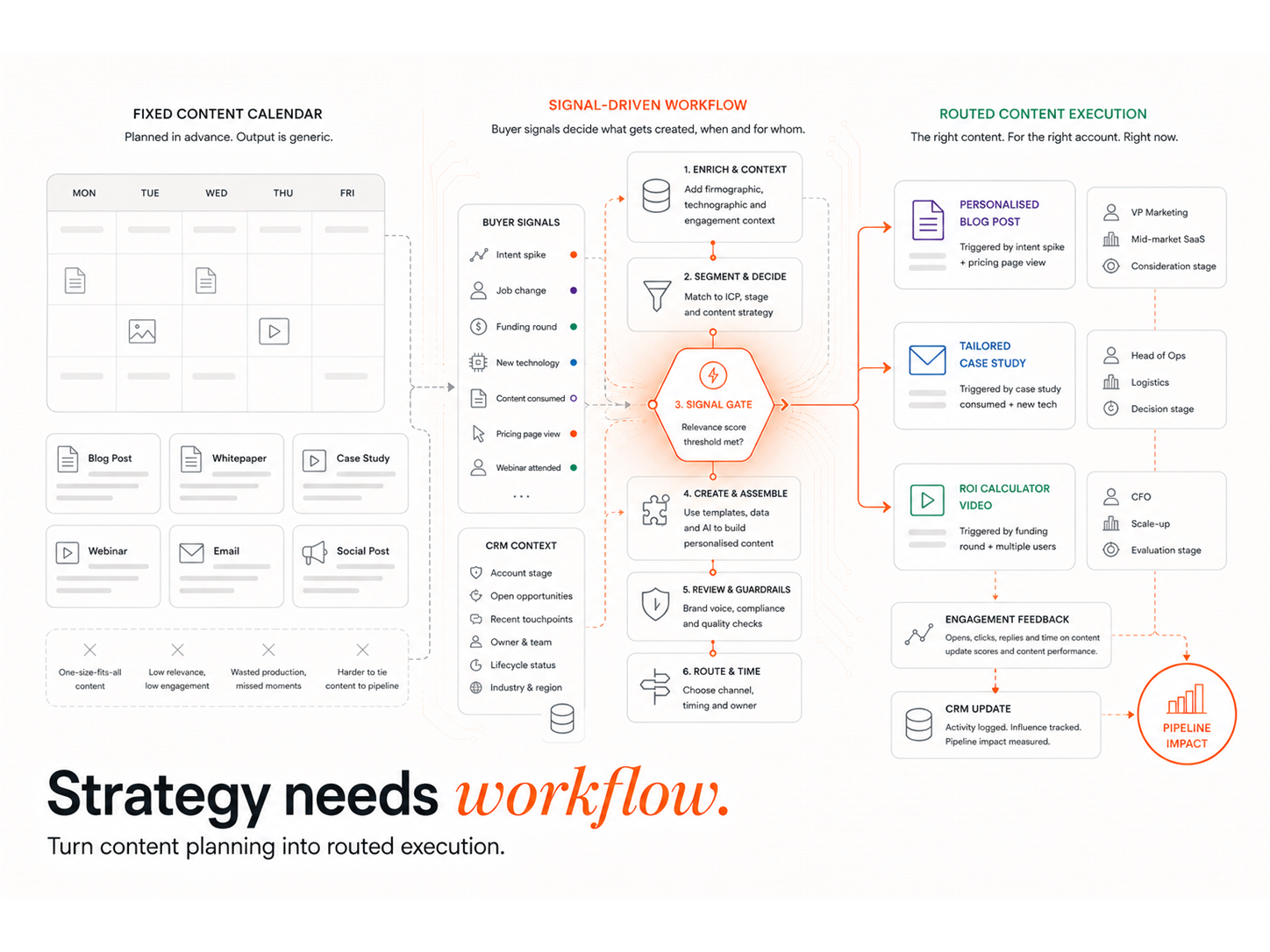
Then segment by content type, persona, and buyer stage. Clean segmentation is what lets the automation route the right content to the right audience later, rather than blasting everything to everyone. The process below shows the full loop, from audit through build, QA, scale, and feedback.
2. Clay and n8n Build Steps
Clay: the integration hub for content automation
Clay acts as the integration and enrichment hub, connecting your CRM, CMS, and HubSpot so content decisions run on enriched, current data. Used well, Clay automation removes a large share of the manual data entry that slows content teams down, freeing them to work on the message rather than the spreadsheet.
n8n: multi-channel workflow automation
n8n is the orchestration layer that automates multi-channel distribution. It connects the tools, applies the rules, and pushes content to each channel on trigger, so a single approved piece can fan out to email, social, and the CMS without manual reposting.
Step-by-step setup
- Map the flow: define the trigger, the enrichment step, the approval gate, and the publish destinations before building anything.
- Wire Clay: connect your data sources so every record is enriched and deduped before it reaches the workflow.
- Build in n8n: add the conditional logic, approval routing, and channel-specific publish nodes.
- Test in a sandbox: run sample content end to end before pointing the workflow at live channels.
3. Scaling Workflows with QA
Workflows and scalability
Design workflows to scale from day one by keeping logic modular and centralised. When routing, approval, and publish rules live in one place rather than scattered across tools, you can add channels and volume without rebuilding the system each time.
Governance
Build governance in as automated gates, not end-of-line meetings. Each piece passes a brief gate, a brand-voice gate, and a publish gate, each with a clear pass criterion. Moving governance upstream is what stops volume from turning into off-brand sludge.
QA: automated content checks
Automate the quality checks that humans forget: broken links, missing alt text, schema validation, and brand-voice scoring against an exemplar. Anything below threshold routes back automatically, so only content that passes every gate reaches publish.
4. Integrating AI and Data for Enhanced Personalisation
Leveraging customer data
Personalisation starts with unified customer data. When Clay and HubSpot data feed one source of truth, content can adapt to behaviour, stage, and segment. Segmentation pays off directly: Mailchimp reports that segmented campaigns drive 23% higher open rates and 49% higher click-through rates than unsegmented sends.
AI-driven content
AI now does the heavy lifting on drafting and variation: 63% of marketers have used or use AI tools to help create marketing content, per Wyzowl. The win is analysing user behaviour to tailor each variant, while a human checkpoint protects voice. Generic AI output forfeits AI Source Inclusion; voice-trained, fact-grounded content earns it.
5. Automating Feedback Loops
Continuous optimisation
Treat optimisation as a loop, not a quarterly project. A/B test subject lines, formats, and offers continuously, and let the system promote winners automatically. This is the Evergreen CRM mindset applied to content: the data stays current and the workflow keeps improving.
Automated feedback loops
Wire performance data back into the workflow so the system learns. Engagement, conversions, and reply data feed the next round of content decisions through Signal Response Protocols, so the engine compounds rather than decays as campaigns run.
6. Optimising and Scaling Content Automation
Scale by tying content to buying signals, not just publishing cadence. Signal-based marketing connects each piece to a Verified Buying Window, so content fires when a prospect shows intent rather than on an arbitrary calendar. That is what turns a content factory into a pipeline engine.
Recap: the 6-step process
- Audit and segment your existing content.
- Build the Clay (data) and n8n (orchestration) layers.
- Scale workflows with governance and automated QA.
- Integrate AI and customer data for personalisation.
- Automate feedback loops for continuous optimisation.
- Optimise and scale around buying signals.
What is content automation, and why is it important?
Content automation streamlines the creation, scheduling, distribution, and optimisation of content using connected tools and AI. It matters because it lets a lean team publish at scale without losing brand voice or review discipline, turning content from a bottleneck into a repeatable system.
How do I integrate Clay and n8n for content automation?
Clay enriches and unifies your customer data; n8n orchestrates the multi-channel distribution. Connect your CRM and CMS into Clay, then build the routing, approval, and publish logic in n8n. Clay is the data layer, n8n is the workflow layer, and the two together form the engine.
Can content automation work for personalised content?
Yes. With unified customer data, behavioural signals, and AI, automated content can adapt to each segment and stage rather than sending the same message to everyone. Personalisation and segmentation are what make automated content lift engagement rather than dilute it.
What is the role of GTM engineers in content automation?
GTM engineers design the system and integrate the tools, wiring Clay, n8n, and your CRM into one workflow while keeping quality control and brand voice intact. They build the architecture so the content engine scales reliably rather than breaking as volume grows.
Content Creation
The 6 steps are the method. The Revenue Operations Studio at Intelligent Resourcing builds the system: Clay for enriched data, n8n for orchestration, automated QA for brand voice, and feedback loops wired to the Verified Buying Window. Your team owns it.