
AI content generation is no longer a tool problem. It is a workflow problem. 63% of marketing teams now use AI in content production, with 78% reporting positive impact, according to Jasper's 2025 State of AI in Marketing report. Only 43% have a formalised AI programme in place. The gap between using AI and governing it is where quality, voice, and brand integrity break down.
This article walks through the 9-step workflow that Intelligent Resourcing installs as part of a Revenue Operations Studio engagement, with the editorial discipline, source grounding, and AI Source Inclusion layer that scales content without losing voice.
Why do AI content programmes need a workflow rather than a toolset?
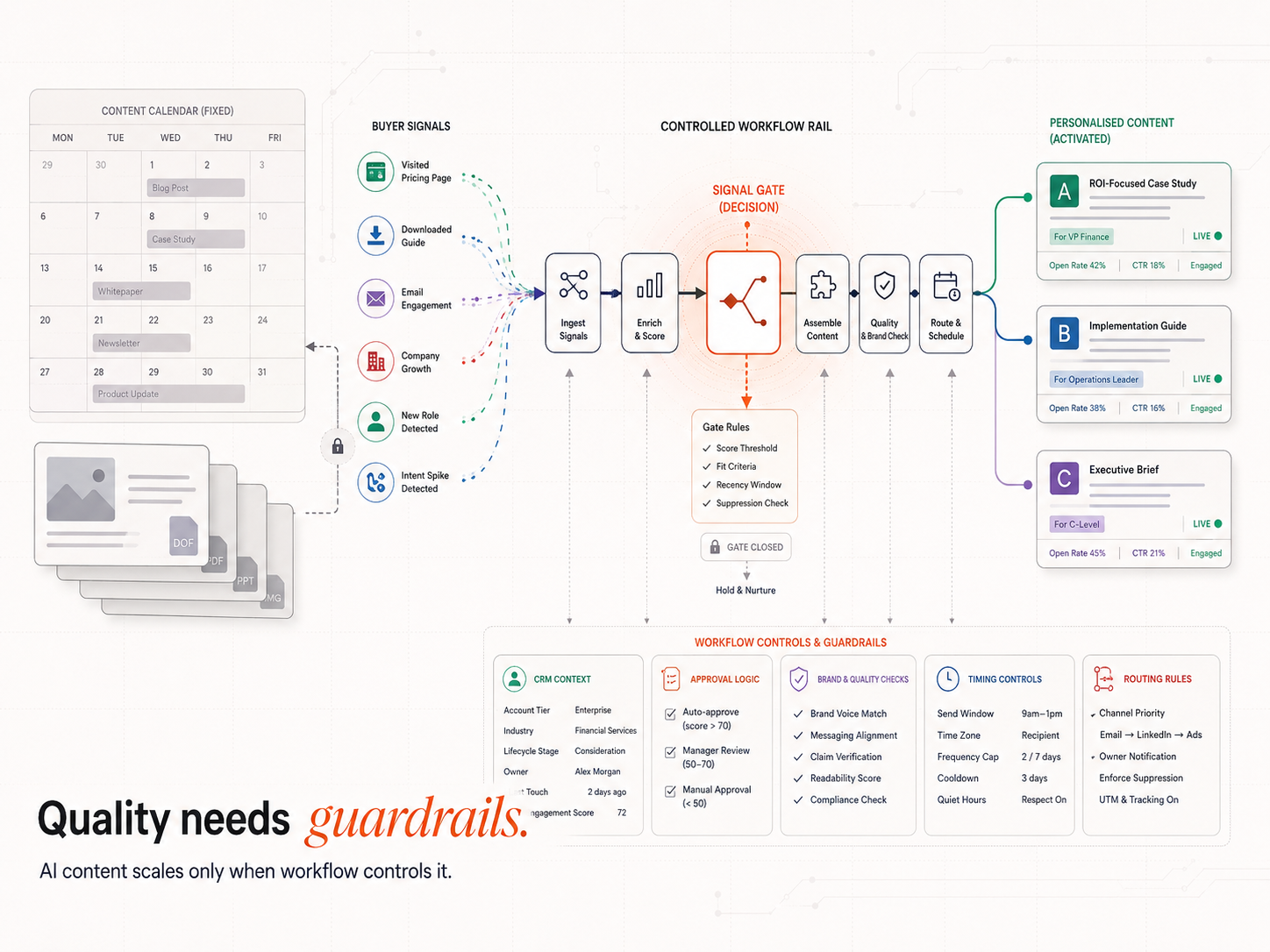
Quality and consistency at scale rely on clear rules, approved inputs, and repeatable checks
AI without workflow is like a kitchen with no recipes and no food safety protocol. You can get dinner on the table once. You cannot run service every night. Teams scaling AI content need defined rules for tone, terminology, approved inputs, and validation at every stage. In content terms that means standardised input packs, editorial stages with named owners, and success metrics tied to brand voice and pipeline outcomes. The workflow is the operating system.
Pilots fail in production when governance, data grounding, and ownership are undefined
AI pilots that work in a demo fall apart in production. Without governance, the model deviates from brand tone. Without grounding, it cites outdated or invented sources. Without clear ownership, edits stall and review loops repeat. GTM Engineering is essential for scaling beyond the pilot stage because it standardises inputs, prompts, voice rules, and sign-off stages into one operating system.
What are the end-to-end steps in a stable AI content workflow?
A resilient AI content engine follows a 9-step process, each supported by tight roles, tools, and templates.
Prepared inputs reduce variance and accelerate briefing
Inputs are reusable assets: ICP profiles, tone rules, terminology files, exclusion lists, approved sources. Each input is versioned and stored in a content operations library. Briefing time drops because the brief no longer rebuilds the inputs from scratch.
Structured briefs translate strategy into instructions models can execute
A structured brief defines objectives, audience, outline, key terms, internal links, and the success metric for the piece. Treat the brief as the control layer. The model executes against the brief, not against vibes.
Grounded drafting with retrieval and constraints prevents drift
Use retrieval-augmented generation (RAG) with approved content libraries. Retrieval should reference only validated source packs. Include a citation policy in the prompt that requires the model to flag uncited claims and refuse to fabricate stats.
API customers deploy Claude for marketing materials in 4.7% of business use cases, according to Anthropic's September 2025 Economic Index. The same report shows 77% of business AI use cases involve automation patterns versus 50% for consumer use, which is the operational gap a content workflow closes.
Human editors safeguard accuracy, voice, and compliance before publish
Two human editing layers. The first reviews structure, argument, tone, clarity, and risk. The second handles fact-checking against approved sources and terminology alignment.
53% of Americans are not confident they can detect whether content was written by AI or a person, according to Pew Research's 2025 study. That trust gap is why source grounding and human review matter more than raw throughput.
Publishing packs content with metadata, links, and channel-ready assets
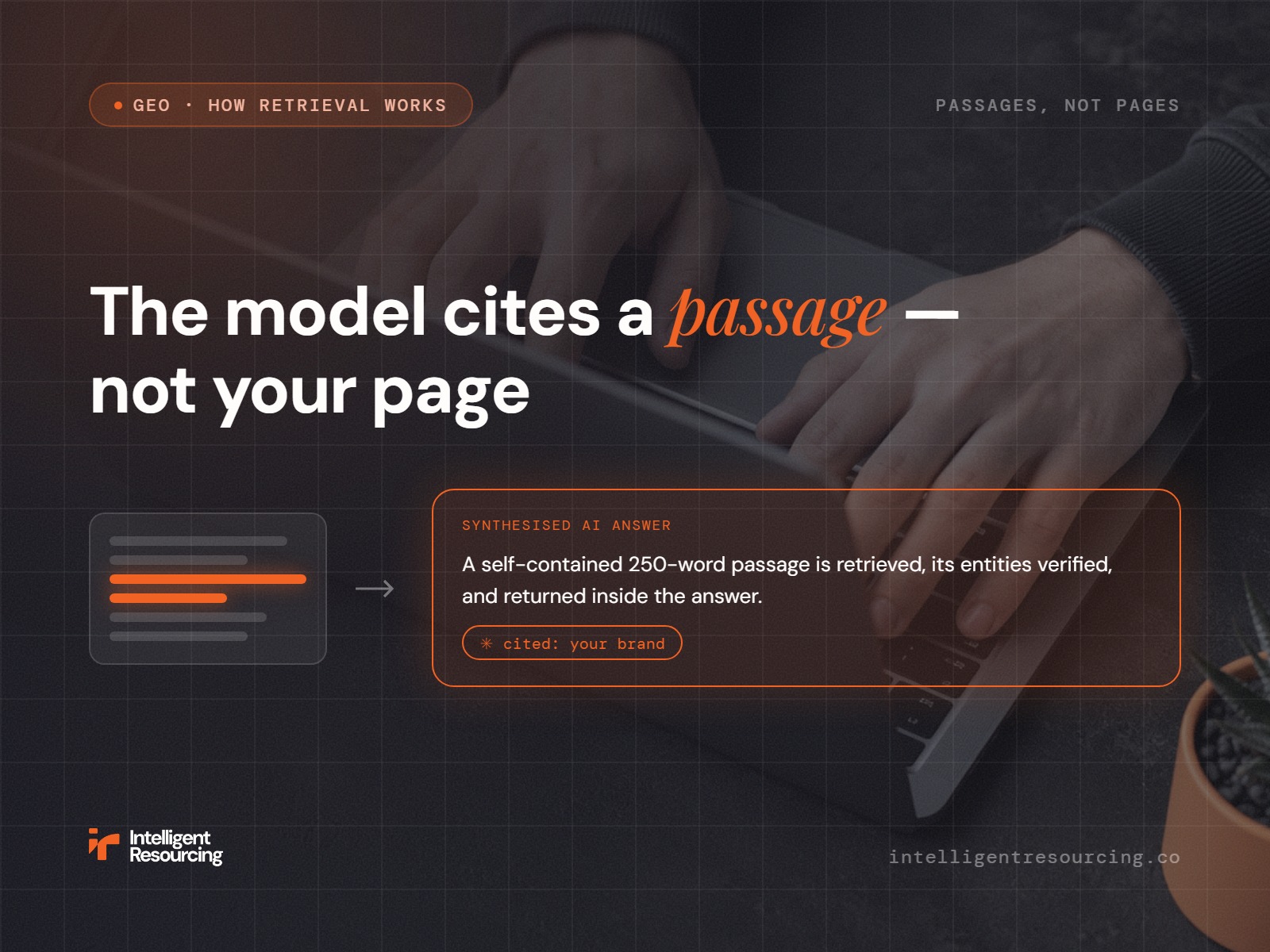
Wrap the content with CMS metadata, schema, internal links, alt text, and image fields. Align with GEO and AI Source Inclusion principles so the piece is citable by ChatGPT, Gemini, and Perplexity when buyers research vendors. The automation layer maps content status changes to routing and reporting events.
Closed-loop feedback tunes prompts, libraries, and checklists over time
Performance data feeds back into the system. Edit rates, engagement, and compliance issues update prompts and checklists. Tie publication events to multi-system workflows so the loop closes automatically. For more workflow examples, see how a content operations layer connects to B2B lead generation automation.
Stable AI Content Workflow Checklist
The 9-step checklist:
- Inputs: ICP profile, tone rules, terminology, banned claims, approved sources.
- Brief: objectives, audience, outline, keywords, internal links, success metric.
- Draft: model choice, prompt template, retrieval context, citation policy.
- Human edit 1: structure, argument, clarity, risk checks.
- Human edit 2: fact check against approved sources, terminology alignment.
- Compliance: privacy, regional claims, accessibility.
- Publish: CMS fields, schema, internal links, images, alt text.
- Measure: quality, consistency, business, and operational signals.
- Learn: update prompts, libraries, and checklists using results.
Why do many AI workflows struggle with tone and quality?
Missing brand memory causes inconsistent voice and terminology
Without a living style guide and a library of approved samples, AI tools cannot consistently mimic voice. The model defaults to a neutral, slightly corporate tone that does not match any specific brand. The fix is a brand memory document with approved language patterns, banned phrases, and exemplar sentences the model retrieves at prompt time.
Unversioned prompts create drift and unpredictable outputs
Teams iterating prompts ad hoc create silent variation between pieces. Two writers using the same prompt template a week apart produce different output. Use version-controlled prompt templates with change logs, so the team has one source of truth and every change is auditable.
Weak sourcing invites factual errors and outdated claims
Open web sourcing without curation introduces outdated or misleading data. Ground the model with curated source packs and a citation policy that requires the model to attribute every stat to a verifiable URL. If the model cannot cite, it must say so rather than fabricate.
Fuzzy roles and stages lead to rework and slow cycles
When no one owns each stage, rework loops eat the throughput gains. Assign swimlanes and tight checklists so each stage has a named owner, a defined input, and a defined deliverable.
WHAT GOES WRONG, AND HOW DO YOU FIX IT? No brand memory? Create a living style guide with approved samples. One-off prompts? Use versioned templates with change logs. Hallucinated facts? Ground with approved source packs and citations. Inconsistent tone? Run automated tone checks plus a human voice pass. Editor overload? Define swimlanes and tight checklists. Weak measurement? Set quality and business metrics before scaling.
Where should human editors step in for maximum impact?
Brief approval secures angle, messaging, and examples
Review the brief before any prompting starts. A weak brief produces weak content even with a strong model. Approval at brief stage prevents the team from editing the same piece twice.
Voice, clarity, and accessibility reviews align content with brand
The first editorial pass assesses tone, message delivery, scannability, and accessibility (heading structure, image alt text, plain-language gates). This is where brand voice gets enforced.
Privacy, regional, and legal checks control risk
Validate any regional claims, disclaimers, or compliance-sensitive language before publish. For Australian content, check Spam Act and APP 7 implications if the piece touches lead capture or direct marketing.
How can ICP, CRM, and intent data sharpen AI output?
Audience attributes become prompt variables that guide relevance
Include industry, job role, region, maturity level, and current tech stack in the prompt as variables. The output becomes specific to the buyer instead of generic to the category.
Intent signals choose format, depth, and conversion path
The buying signals that drive content format and depth include funding events, leadership changes, tech-stack installs, and pricing-page visits at target accounts. A buyer in active research wants a comparison article. A buyer in awareness wants a thought-leadership piece. The intent signal chooses the format. The Verified Buying Window decides whether to publish a comparison or a guide.
Guardrails enforce sectors, regions, and exclusions
Prompt restrictions enforce compliance zones and do-not-talk topics. If a sector or region is off-limits, the guardrail catches it before publish, not after.
What is the most effective way to repurpose video, transcripts, and webinars?
Clean transcripts and speaker tags make content reusable
Tagged transcripts with speaker labels reduce repurposing prep time. The transcript becomes the source library for every downstream asset.
A standard asset kit multiplies value from each recording
Each video yields a blog post, an FAQ block, a quote set, a carousel, and a clip pack. The kit is defined once and applied to every recording, which is how production scales without adding headcount. For deeper examples, see our content automation case studies.
Shared facts files keep narratives and figures consistent
Store product descriptions, stat citations, and customer stories in a shared facts file. Every asset draws from the same source of truth.
How should success be measured beyond content volume?
Quality metrics track accuracy, readability, and editorial change rates
Define acceptable edit levels per piece. If a draft requires more than 30% editorial change to ship, the prompt or input pack needs work.
Consistency metrics verify tone, terminology, and linking policies
Automated tone and vocabulary checks catch drift between pieces. Audit the internal linking policy at the article level so every piece pulls weight in the topic cluster.
Business outcomes confirm influence on pipeline and activation
Track pipeline influence, deal acceleration, and content reuse. The strongest content programmes connect output to real-time lead scoring that updates as the account engages with each piece.
Operational metrics guide throughput, cost, and reuse
Time-to-publish, cost per piece, and asset reuse rate are the operational signals. Cost should drop as the input pack matures.
What steps create a stable AI content workflow from ideation to publishing?
Standardise inputs (ICP, tone rules, terminology, approved sources), then move through structured brief, grounded draft, two rounds of human editing, compliance check, publishing with metadata and schema, measurement, and a learning loop. The 9-step workflow is the operating system. GTM Engineering is the foundation that makes it run.
Why do most AI workflows fail to maintain consistent tone or quality?
They lack a central style guide, version-controlled prompts, and defined review stages. Inconsistency comes from unclear roles, ad hoc prompting, and ungrounded sourcing. Fix all three at once or quality continues to drift.
Where should human editors step in within an AI-assisted content process?
Brief approval, voice and clarity review, and legal or compliance checkpoint. Editors catch what models cannot: strategic angle, narrative arc, and risk specific to your sector or region.
How can ICP, CRM, or intent data improve AI-driven content precision?
Audience attributes become prompt variables. The CRM customises content paths per buyer stage. Intent data matches format and depth to where the buyer is in their research. The Verified Buying Window concept ties the publish decision to whether the account is actually in-market.
What is the most effective way to repurpose videos, transcripts, and webinars using AI?
Start with clean tagged transcripts. Apply a standardised asset kit (blog, FAQ, quotes, carousel, clip pack) to every recording. Keep a shared facts file so every asset draws from the same source of truth.
How do companies measure performance beyond content volume when using AI workflows?
Track editorial quality (edit rate, accuracy), voice consistency (tone audit), business outcomes (pipeline influence, deal acceleration), and operational metrics (time-to-publish, cost per piece, asset reuse). Volume is the weakest signal.
Content Creation
The 9-step workflow is the operating system. Intelligent Resourcing installs it as part of a Revenue Operations Studio engagement, with editorial discipline, source grounding, a GEO and AI Source Inclusion layer, and signal-led measurement. Your team owns it.