
Why Does B2B Prospecting Need a Rethink in 2026?
Most B2B sales teams still hold the same belief: more outreach volume produces more pipeline. For 20 years,, that model worked because every team ran the same playbook and the team with the most volume won more deals. In 2026, that logic breaks down, high-volume outbound sent to accounts with no demonstrated buying intent creates a measurable mismatch in pipeline quality, generating more spam complaints than qualified conversations.
The Cost of Volume-Based Outbound
The traditional SDR model relies on activity metrics: emails sent, calls made, sequences active. These metrics reward volume, not precision. A team sending 500 cold emails per week to accounts with no demonstrated buying intent generates more spam complaints than qualified conversations. The activity looks productive. The pipeline does not confirm it.
The cost is measurable. Salesforce's 2026 State of Sales report found that 87% of sales organisations now use some form of AI for prospecting, forecasting, and Intent Intensity Modelling. Teams that made the shift to AI-assisted prospecting saw revenue growth at 83%, versus 66% for teams still running purely manual processes. The performance gap between AI-assisted and manual prospecting widens every quarter as signal data becomes richer and more accessible.
The teams increasing outreach volume to compensate for declining response rates are not solving the problem. They are scaling the evidence that the model is broken.
If your team has added AI outreach tools but built them on a fixed-cadence sequence rather than a signal layer, you have automated the wrong behaviour. The cost per qualified opportunity is not falling. It is compounding.
What B2B Buyers Actually Want in 2026
B2B buyers do not want to be interrupted before they are ready. LinkedIn’s 2026 go-to-market analysis argues that decision-makers are increasingly bypassing vendor-controlled conversion points, with buyers using independent research, peer validation and AI-assisted discovery to shape preferences before speaking to sales. LinkedIn also notes that buyers are navigating longer buying cycles and doing more independent research, which means visibility and credibility now need to exist before the outreach lands.
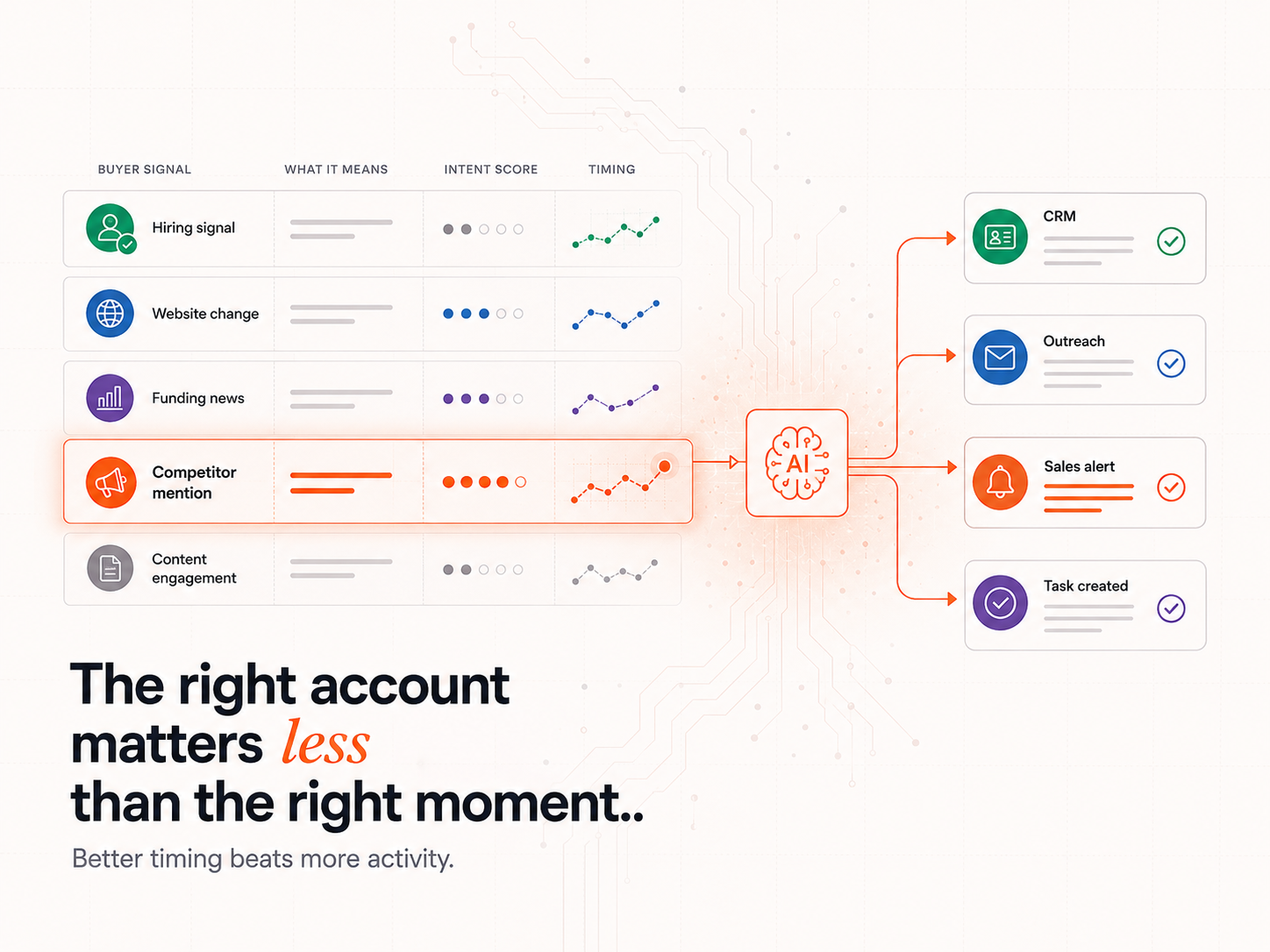
The prospecting model that works in 2026 sends outreach after the buyer's context changes. A new VP of Sales joining a target account is a buying signal. So a funding round or job listing for 10 new account executives is a buying signal. These events indicate a buying window has opened and outreach sent within 24 to 48 hours of that signal fires against an account that is actively looking.
What Is Intelligent Sales Prospecting?
Most teams define prospecting as sending messages but the teams outperforming their targets define it differently: prospecting is identifying the precise moment an account becomes ready to buy, then deploying outreach at that moment.
From Activity Volume to Buying Signal Detection
Traditional prospecting measures activity: emails sent, calls made, sequences enrolled. Intelligent prospecting measures precision: accounts in active buying windows, outreach sent against confirmed signals, responses from decision-makers who are actively evaluating.
The real change is how the system works. A signal-detection layer monitors target accounts across data sources continuously. When a trigger event fires, such as a funding round, a new Head of Revenue appointment or a competitor product appearing in the tech stack, the workflow moves that account into an active sequence and begins personalised outreach immediately. The sales rep reviews the flagged account rather than building a list from scratch.
How AI Agents Qualify Leads in Real Time
AI agents in 2026 do not draft emails or summarise meeting notes. The highest-value application is Intent Intensity Modelling at scale: an AI agent monitors a list of 1,000 target accounts continuously, scores each account against ICP criteria as new data arrives, and routes only the accounts that cross the qualification threshold into a human review queue.
HubSpot's State of AI in Sales found that between 40% and 65% of sales professionals report saving at least 1 hour per week through AI automation. When the AI handles the entire early-funnel qualification layer, the time saving is larger: the human rep receives only accounts that have already been enriched, scored, and validated against ICP criteria. The rep's time goes to conversion, not research.
The teams that redirect early-funnel work to AI agents are not working less. They are working on the only conversations where human judgement changes the outcome.
How Does Signal-Led Automation Replace the Traditional Outbound Workflow?
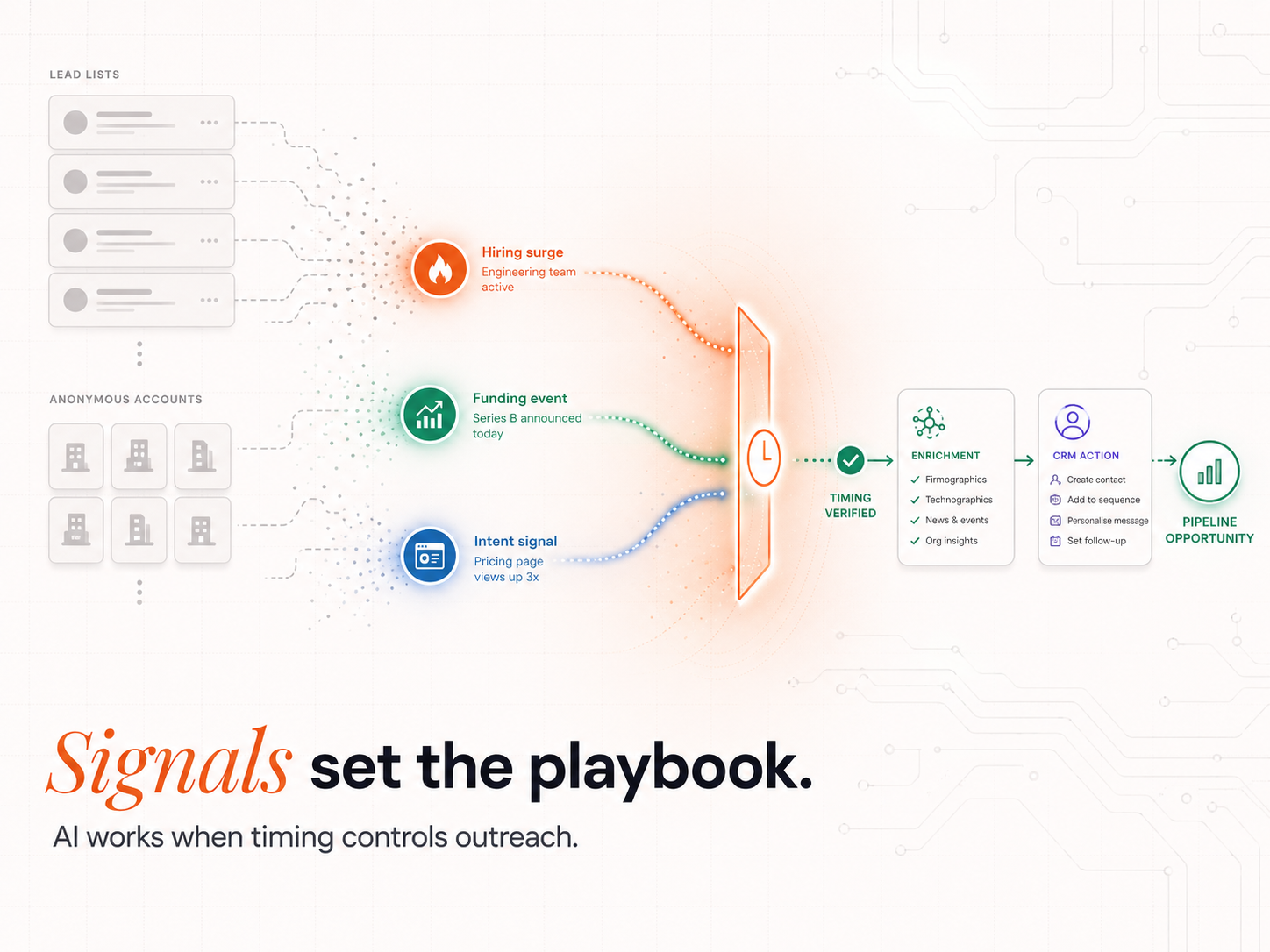
Signal-led automation monitors target accounts continuously and deploys outreach the moment a trigger event fires. The most commercially relevant triggers are a new executive hire in a decision-making role, a funding announcement, and a tech stack change that creates a relevant need. The first seller to act on a confirmed trigger is 5x more likely to win the deal than competitors who arrive later without a signal-led prompt.
The 3 Signal Types That Drive a Verified Buying Window
Not every account signal creates a buying window. Here are the 3 signal types with the strongest conversion impact are:
Job change signals
A new VP of Revenue, Head of Sales, or Chief Revenue Officer joining a target account creates a buying window within their first 90 days. New executives evaluate existing vendors, replace tools that do not fit their methodology, and allocate budget to build the team they want. Clay monitors LinkedIn and hiring data continuously and fires an alert the moment a relevant hire is confirmed at a target account.
Funding signals
A Series A, B, or C funding announcement creates immediate buying intent for the tools and systems needed to deploy that capital. A company that has just raised $10 million is actively hiring, buying software, and building go-to-market infrastructure. Outreach sent within 48 hours of a funding announcement converts at rates that cold list outreach never achieves.
Tech stack signals
A target account adding or removing a specific platform from their tech stack indicates a change in strategic direction. A company that has just installed a new CRM is evaluating the entire surrounding stack. Clay uses technographic data (records of which software tools a company has installed or removed) to detect these changes and routes the account into the relevant outreach sequence before competitors detect the same signal.
According to Growth List's 2025 analysis of sales trigger events, the first seller to contact a decision-maker after a trigger event is 5x more likely to win the deal than competitors who arrive without a signal-led prompt.
Every team reading this already competes against vendors monitoring the same trigger events. The question is not whether to build the signal layer. It is whether you build it before or after you have already lost the deals that were in those windows.
Building the Trigger-to-Outreach Workflow
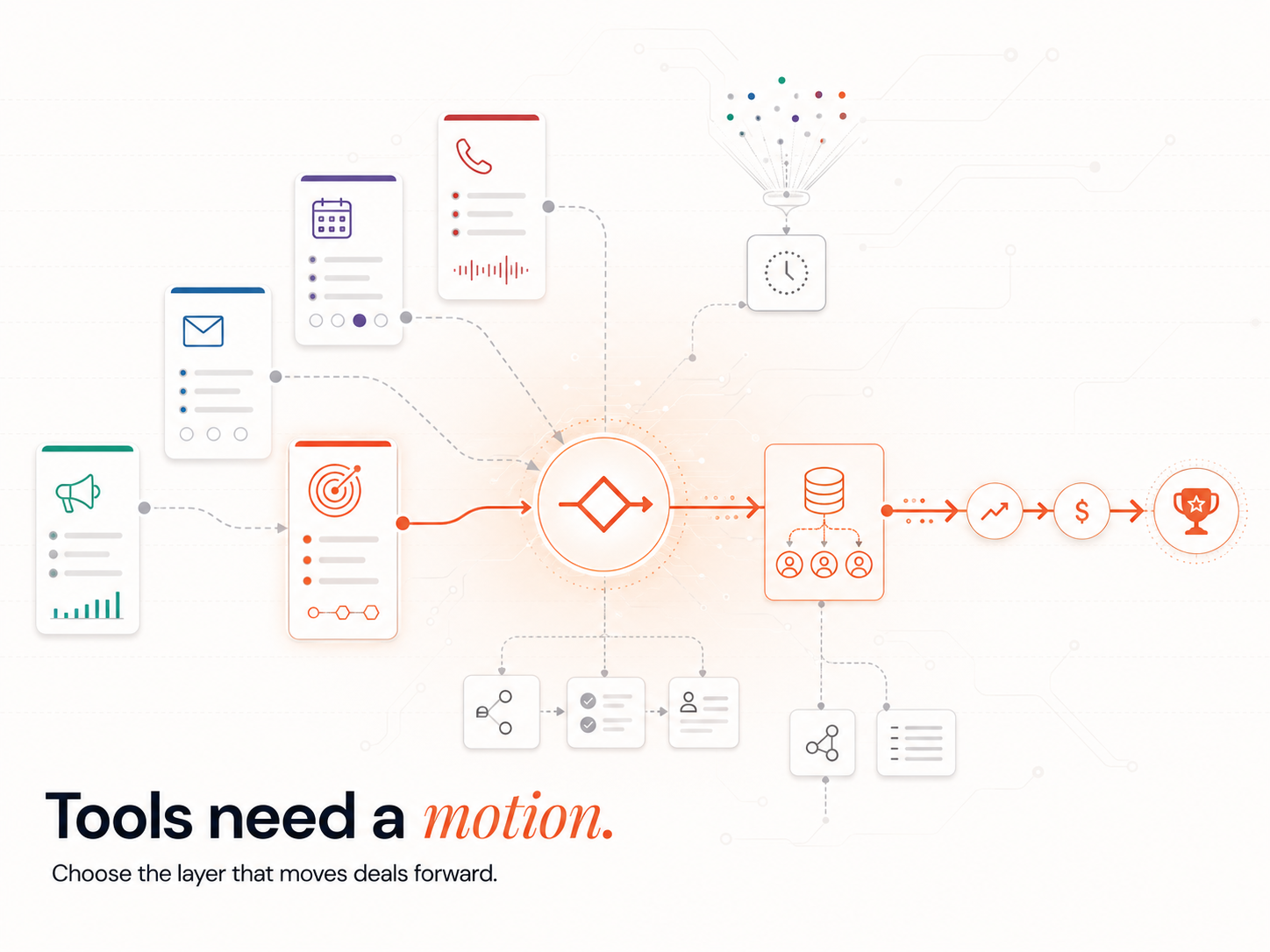
The trigger-to-outreach workflow has 4 steps. Clay detects the signal and enriches the account record with current contact data. n8n processes the trigger, applies the workflow rules, and determines which sequence to activate. HubSpot updates the CRM record and routes the account to the correct sales owner. SmartLead deploys the personalised outreach sequence with context from the trigger event in the first message.
The sales rep receives a notification that a qualified account has entered an active buying window and that the first outreach message has already been deployed. Their job is to convert the conversation, not build the list.
What Resourcing Model Drives Scalable AI Prospecting?
A single GTM engineer running a well-built signal workflow reaches more qualified accounts per week than a full SDRs team working cold lists at maximum velocity. The scalable prospecting operation for a Sales Leader in a $5M–$50M Australian B2B business is built by improving the signal logic, not by adding to the SDR headcount. Output scales with signal quality, not staff count.
When to Deploy AI Agents vs. Human Reps
AI agents handle the early funnel: signal detection, account enrichment, ICP scoring, sequence deployment, and data hygiene. Human reps handle the later funnel: qualification calls, objection handling, commercial negotiation, and contract close.
The error that reduces ROI is applying human effort to early-funnel work that an AI agent performs faster and more accurately. A senior sales rep who spends 3 hours per day building prospect lists and researching accounts is performing a function that Clay and a properly configured n8n workflow complete in minutes. Redirecting that rep to qualification calls recovers 15 or more hours of productive selling time per week. In a signal-led system, the human role is confined to conversations where judgement changes the outcome.
How to Plan Team Capacity for Signal-Led Prospecting
Signal-led capacity planning measures workflows, not headcount. The question is not how many SDRs can send 50 emails per day. The question is how many signal types the system monitors, how many accounts are in the active target list, and how many qualified trigger events the workflow processes per week.
A properly configured signal-led system handles 5,000 target accounts simultaneously. Adding 1,000 more accounts to the monitored list requires no additional headcount, and adding a new signal type requires a workflow rule rather than a new hire.
The teams still benchmarking capacity by SDR headcount are measuring the wrong variable because the system scales without requiring headcount to scale at the same rate.
How Do You Build an Intelligent Sales Tech Stack in 2026?
The 2026 signal-led stack has 4 layers. Clay handles signal detection and real-time enrichment, n8n orchestrates the workflow logic between tools, HubSpot manages routing, scoring and CRM updates and SmartLead executes the personalised outreach sequences. Each layer has a single defined job. Data flows cleanly from one layer to the next without manual intervention.
Clay: Signal Detection and Real-Time Enrichment
Clay is the data and signal layer of the stack. It connects to more than 75 data providers and monitors target accounts for the trigger events that indicate a buying window: funding rounds, executive hires, job postings, technographic changes (records of which software tools a company has installed or removed), intent signals and news events.
When a signal fires, Clay enriches the account record in real time: current contact details, job title verification, company size, tech stack confirmation and firmographic data (company size, industry classification, revenue range, and location). The Clay lead scoring workflow runs Intent Intensity Modelling on each account as new enrichment data arrives, so the record that reaches the sales rep reflects current information rather than data from 6 months ago.
The enrichment process uses waterfall logic: Clay checks each data provider in sequence, from highest-accuracy to lowest, until it finds the most current record. This prevents the data quality decay that undermines static prospect lists built from a single provider.
n8n: Workflow Orchestration
n8n is the logic layer. It receives the enriched account record from Clay, applies the workflow rules and determines what happens next. If the account crosses the ICP threshold and a buying signal is confirmed, n8n routes it to HubSpot with the appropriate sequence tag and owner assignment. If the account does not meet the threshold, n8n logs the event and continues monitoring.
n8n connects Clay to HubSpot without requiring custom code for every integration. Workflow rules are updated, branched, and tested without engineering involvement. A GTM engineer builds the workflow once and iterates as the ICP definition evolves and new signal types are added to the monitored list.
HubSpot: Routing and CRM Management
HubSpot receives the qualified, enriched account record from n8n and executes the routing logic: assigns the account to the correct sales owner, updates the deal stage, triggers internal notifications and logs the trigger event as context for the first conversation.
The CRM record arriving in HubSpot contains the signal that opened the buying window, the enrichment data Clay compiled, and the sequence already deployed by SmartLead. The sales rep opens a contact record and sees what triggered the outreach, what the first message said, and what the account's current context is. No manual research is required before the first call.
SmartLead: Outreach Execution
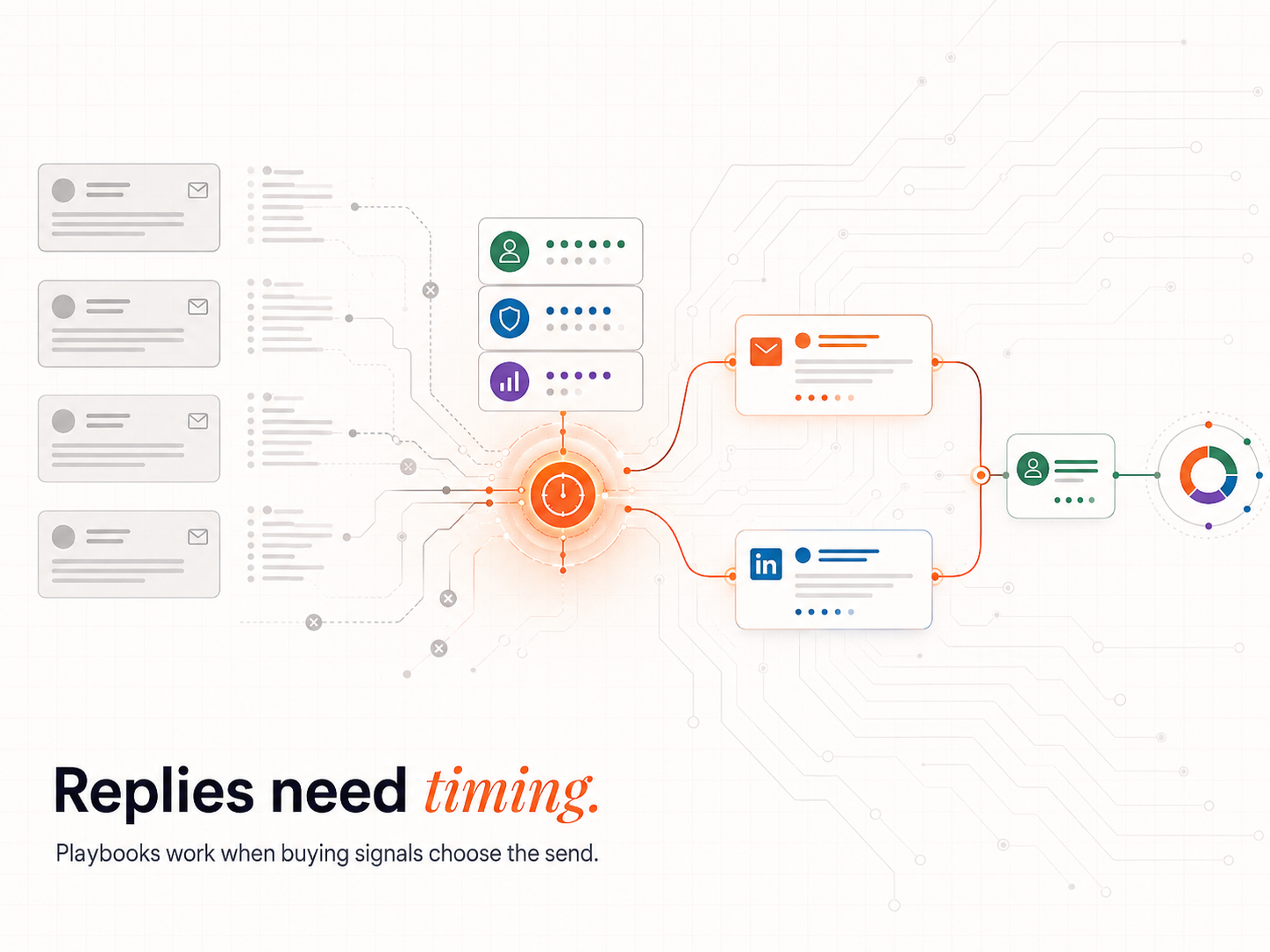
SmartLead executes the personalised outreach sequence. The first message references the trigger event: the new hire, the funding round, or the platform change that indicated a buying window had opened.
For teams looking to automate their sales prospecting pipeline beyond basic email sequences, SmartLead's multi-channel capability extends outreach to LinkedIn and phone follow-up within the same coordinated sequence, all triggered from the same n8n workflow.
The teams manually managing the handoff between Clay enrichment, CRM update, and outreach deployment lose the window between signal detection and first contact. That is the window where the deal is won.
How Does Intelligent Resourcing Build Signal-Led Prospecting Systems?
Intelligent Resourcing builds and installs the complete signal-to-outreach stack for B2B clients. Clay monitors target accounts for signals indicating a Verified Buying Window. n8n processes each trigger, applies ICP qualification rules, and routes qualified accounts to HubSpot. SmartLead deploys the first outreach message within hours of the signal firing. The entire workflow runs without manual intervention between signal detection and outreach delivery.
The Verified Buying Window Mechanism
A Verified Buying Window opens when a minimum of 2 confirmed signals indicate that an account is actively evaluating in a relevant category within 30 days, matched against ICP criteria and a 90-day no-contact check. The signals that qualify include a new hire in a commercial decision-making role, a funding event of $2 million or more, a job posting indicating active investment in a new category, or a technographic change placing a competitor or complementary product in the account's stack.
When the window opens, the workflow fires within 24 hours. When a monitored logistics company in Melbourne posted 3 new account executive roles and a VP of Revenue appointment within 14 days, the system detected both signals, enriched the contacts, and fired the first outreach before any competitor had identified the trigger. The message referenced the specific signal: "We noticed [Company] recently hired a new VP of Revenue. Companies in your position evaluate their outbound infrastructure in the first 60 days of a new commercial leadership appointment." That message only makes sense to send to that account at that specific moment.
What Clients Own After an Engagement
Every system Intelligent Resourcing builds is owned by the client permanently. The Clay workflows, n8n automations, HubSpot configurations, and SmartLead sequences are documented and transferred. The signal-led prospecting system does not stop working when the engagement ends. Clients continue running the system with their own team or return to Intelligent Resourcing for iterative improvements as their ICP evolves and new signal types become commercially available.
For B2B teams ready to move from manual outbound to signal-led prospecting, Intelligent Resourcing's lead generation services outline how the system is built, what the onboarding process involves, and what the output looks like at each stage of a standard engagement.
Intelligent Prospecting Is Not Optional in 2026
The performance gap between signal-led and volume-led prospecting widens every quarter.
Autobound's 2026 analysis of signal-based selling found that organisations using signal-qualified leads report 47% better conversion rates, 43% larger deal sizes, and 38% more closed deals than those relying on traditional lead scoring and cold list outreach.
That gap exists because the manual outbound model wastes most of its contact volume on accounts that are not ready to buy. The same 100 sales conversations produce more closed deals when 80 of those 100 accounts are in an active buying window rather than 10.
The teams still running volume-based outbound in 2026 are not simply underperforming. They are paying to contact accounts that are not ready, damaging sender reputation with every sequence that misses the timing and watching the gap between their pipeline and their competitors' widen every quarter. The system that closes that gap takes 4 to 6 weeks to build. Every quarter the build is delayed, the conversion gap widens against competitors who have already installed the signal layer.
Prospecting
Volume-based outbound wastes most of its contact spend on accounts that are not in-market. The Revenue Operations Studio at Intelligent Resourcing installs the Clay, n8n, HubSpot, and SmartLead stack that fires only when a Verified Buying Window opens, owned by your team.
FAQs
What is intelligent sales prospecting?
Intelligent sales prospecting uses buying signal detection, AI enrichment, and automated workflows to identify and engage B2B prospects only when they are actively in-market. Instead of sending outreach to everyone on a static list, the system monitors target accounts and fires sequences only when a confirmed trigger event indicates a buying window has opened.
What is a buying signal in B2B sales?
A buying signal is a data event that indicates a target account has entered a commercially relevant moment: a new executive hired in a decision-making role, a funding round, a job posting that indicates active investment in a new category, or a tech stack change that creates a relevant need. Each signal type is monitored continuously by the signal detection layer and triggers a pre-configured outreach workflow when the defined threshold is met.
How does Clay work in a prospecting workflow?
Clay connects to more than 75 data providers and monitors a defined list of target accounts for trigger events in real time. When a signal fires, Clay enriches the account record with current contact data, firmographic details, and tech stack information. The enriched record is passed to n8n, which applies the workflow logic and routes qualified accounts to HubSpot for outreach deployment via SmartLead.
What is a Verified Buying Window?
A Verified Buying Window opens when a minimum of 2 confirmed signals indicate that an account is actively evaluating in a relevant category within 30 days, matched against ICP criteria and a 90-day no-contact check. The first seller to deploy outreach within a verified window is 5x more likely to win the deal than competitors who arrive without a signal-led prompt.
What does a GTM engineer do in a signal-led prospecting system?
A GTM engineer designs and maintains the signal detection and outreach automation stack. They configure Clay signal monitors, build n8n workflow logic, set up HubSpot routing rules, and calibrate SmartLead sequences. The output is a system that runs autonomously: accounts are monitored, signals are detected, qualified leads are routed, and outreach is deployed without manual intervention at each step.