
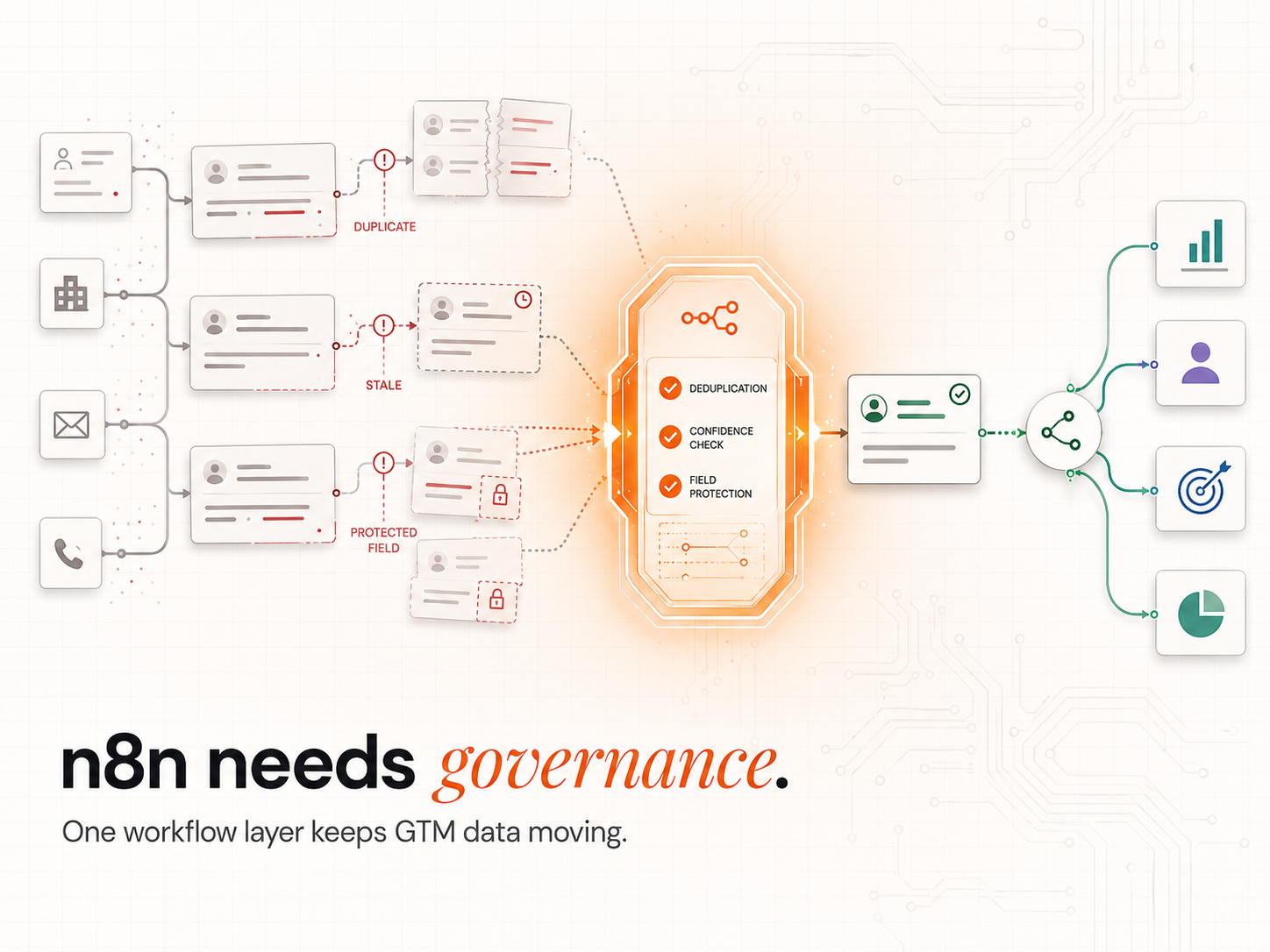
Why does operational consistency make or break go-to-market teams?
Operational consistency decides whether a GTM stack produces pipeline or chaos, because every broken sync, duplicate record, or missed handoff costs a deal. Automation is now mainstream: 44% of automated processes are built outside IT, by the revenue teams themselves. The payoff for getting it right is large. BCG found aligned, connected operations deliver 10 to 20% productivity gains and 30% lower go-to-market costs. n8n provides the governed layer that makes that consistency repeatable.
Why does data break or duplicate across CRMs, ad platforms, and email tools?
Data breaks for two reasons: API rate limits and outages interrupt syncs mid-flow, and decentralised logic with inconsistent naming creates duplicate records. The cost is real, with over a quarter of organisations losing millions a year to poor data quality. The root cause is usually sprawl: organisations now run around 275 SaaS apps, each with its own copy of the truth. n8n fixes this by centralising the sync logic in one place, with retry handling and a single naming standard, so the same record does not arrive three different ways.
How does n8n improve routing accuracy and lead speed?
n8n improves routing by triggering on the event, not on a batch schedule, then applying conditional logic to send each lead to the right owner instantly. A webhook or polling trigger fires the moment a form is submitted, an if/else node checks fit and intent, and the lead routes to an AE, an SDR, or nurture without a human touching it.
- Trigger-based flow: webhooks fire on form fills, demo requests, or CRM changes in real time.
- Conditional routing: high fit plus high intent goes straight to an AE; lower scores route to SDR or nurture.
Wired to a Signal Response Protocol, real-time lead scoring decides ownership the instant a Verified Buying Window opens.
What is the best structure for a qualification flow that prioritises fit and intent?
The best qualification flow uses branch nodes to score firmographic and behavioural signals separately, then combines them to assign ownership. Fit (industry, size, tech stack) and intent (engagement, page visits, demo requests) are evaluated as distinct branches, with territory and segment data stored in Airtable or a database so the flow assigns the right rep by rule, not by guesswork.
- Score fit and intent on separate branches, then combine for the routing decision.
- Store territory, size, and segment rules in a database the workflow reads from.
- Assign ownership automatically so the Verified Buying Window is acted on, not queued.
How are companies enriching incomplete records with n8n and third-party APIs?
Companies enrich records by calling third-party data APIs from n8n HTTP Request nodes, with retry and fallback logic for failures. A record missing firmographics triggers a call to a primary provider such as Breeze Intelligence (formerly Clearbit) or ZoomInfo, and if that call fails or returns nothing, the workflow falls back to a secondary provider or an internal data lake like Snowflake. The clean, deduped output then writes to the CRM. The same discipline behind a high-fill enrichment workflow is what keeps records actionable rather than half-empty.
What error-handling prevents silent workflow failures?
The key safeguard is n8n's Error Trigger node, which runs a dedicated error workflow whenever a linked workflow fails and passes through the failure details. n8n documents this directly: the Error Trigger node "gets details about the failed workflow and the errors, and runs the error workflow." Route those alerts to Slack, Teams, or email with context, and run a scheduled heartbeat workflow so a failure surfaces in minutes, not at the next manual check.
How does n8n manage audience refresh and segmentation across multiple tools?
n8n manages audience refresh by running scheduled syncs that rebuild segments across CRMs, ad platforms, and email tools from a single source of truth. A scheduled workflow pulls the current segment from HubSpot or Salesforce, applies tag and field-based logic, then pushes the refreshed audience to LinkedIn Ads and Mailchimp, so the same definition of an audience is enforced everywhere rather than maintained by hand in each tool.
What is the simplest way to standardise naming conventions and fields for reporting?
The simplest way is to normalise fields in transit using n8n's Code node (which replaced the legacy Function node) and Set nodes, so every record reaches your BI tool in one format. n8n's docs confirm the Code node replaced the Function and Function Item nodes from version 0.198.0. Use it to trim whitespace, force ISO dates, and standardise UTM tags and campaign names before the data lands, so reporting is clean at the source instead of patched in the dashboard.
How do teams manage security and permissions while staying flexible?
Teams manage security with workspace-level access controls and credential governance, so flexibility never means open access. Roles control who can edit which workflows, and API keys are stored as managed credentials with IP, role, and expiry restrictions plus a rotation schedule. The result is a layer that revenue teams can extend safely without exposing raw secrets in workflow logic.
What is the difference between sandbox and production environments in n8n?
The difference is that sandbox is where you test with safe data and production is where live workflows run against real systems, and the two should never mix. Companies separate them so a test run cannot corrupt live CRM data, then use Git-based workflow versioning to track changes, review them, and roll back cleanly if a deployment misbehaves. That separation is what makes iteration safe at scale.
How can n8n push real-time data to dashboards without manual exports?
n8n pushes metrics to dashboards automatically using webhook triggers, so nobody exports a CSV again. A workflow sends performance data straight into Metabase, Grafana, or Google Sheets as events happen, which means the dashboard reflects current pipeline rather than last week's manual pull. Real-time visibility is what lets a team act on a stalled deal today instead of discovering it at month-end.
How do you scale orchestration without losing control?
You scale by running n8n in queue mode, which separates a main instance from worker instances that execute the workflows. n8n's docs describe queue mode as multiple instances where "the worker instances perform the executions," and note it "provides the best scalability." Add workers to handle thousands of daily operations, batch API calls to respect rate limits, and the same governed logic holds whether you run hundreds or hundreds of thousands of executions.
RevOps Tools
Point-to-point integrations break as you grow. The Revenue Operations Studio at Intelligent Resourcing makes n8n the governed orchestration layer for your GTM stack: routing wired to Signal Response Protocols, enrichment feeding an Evergreen CRM, and error handling that catches failures before they cost pipeline.
FAQs
How scalable is n8n for high-volume workflows?
Run in queue mode with worker instances and n8n handles thousands of daily operations. Add workers to scale up, batch API calls to respect rate limits, and stagger heavy jobs with wait nodes. The governed logic stays the same whether you run hundreds or hundreds of thousands of executions.
Can n8n replace a traditional ETL tool?
For many RevOps use cases, yes. n8n is not a full enterprise ETL platform, but it covers the operational extract, transform, and load work across GTM systems, with the advantage of conditional logic and real-time triggers that batch ETL tools lack.
How often should workflows be audited or updated?
Audit quarterly, and again right after any connected platform ships a breaking change or API update. Set expiry reminders on API keys so credentials are rotated on schedule rather than discovered expired when a workflow silently fails.
What is the best way to test a complex flow?
Use a sandbox environment with test data, never live records. Add debug nodes to inspect data at each step, and build conditional branches that exercise the edge cases before you promote the workflow to production.
How do I maintain API limits and avoid throttling?
Rate-limit your HTTP Request nodes, respect retry-after headers, and stagger large jobs with wait nodes. Batch records where the API supports it. These controls keep high-volume workflows inside provider limits without manual babysitting.