

ABM strategy implementation works best when the signal layer is designed before campaigns, channels or platforms. Intelligent Resourcing builds this layer by combining fit, intent and engagement signals into one scoring and routing system, so teams act on accounts that are both commercially relevant and showing live buying behaviour.
Most teams launch account-based marketing by buying a platform and loading a large target-account list, then wonder why the activity never becomes pipeline. The missing piece is rarely budget; it's the signal layer that tells you which accounts are worth acting on now.
This guide sets out an eight-step ABM implementation sequence with that signal layer built in from the start. It is designed for B2B marketing and RevOps teams that want plays to fire on timing, not reach, and follows the same logic as a broader account-based GTM motion.
What the signal layer is in an ABM strategy
The signal layer is the always-on data layer that captures, scores and routes buying signals so your ABM program acts on timing, not just fit. Treat it as a systems component, not a tactic, because every downstream decision depends on the signals feeding it. Teams that track buying signals well stop guessing which accounts are ready, and that shift toward signal-based marketing separates pipeline from reports.
Fit signals vs intent signals vs engagement signals
Signal-based ABM blends three inputs rather than trusting any one alone: fit tells you whether an account should buy, intent whether the market is moving, and engagement whether the account is moving toward you.
| Signal type | What it captures | Example source |
|---|---|---|
| Fit | Does the account match your ICP | Firmographic and technographic data |
| Intent | Is the account in-market now | Third-party topic surges |
| Engagement | Is the account interacting with you | Site visits, content, ad clicks |
High fit with no intent is a long game, and high intent with poor fit is a distraction; blending all three means effort lands where it converts.
Where the signal layer sits in your ABM stack
The signal layer sits between your data sources and your activation channels, turning raw inputs into scores your CRM and orchestration tools can act on. It reaches those systems without manual interpretation, which means plays fire faster and better timed.
Why building it in from day one beats bolting it on
Building the layer in from day one beats retrofitting it, because a live program has already hard-coded its scoring, routing and reporting around fit alone. Bolt signals on later and you rebuild all three, re-scoring the list and re-baselining every metric mid-flight.
The signal-based ABM implementation framework
Strong ABM implementation is sequential, and it starts with accounts and the commercial outcome, not channels. As ABM Logic puts it, the strongest programs begin with the accounts and the result you want, then work outward to tactics. Decide who you are pursuing and why before you touch a platform.
Why accounts and signals come before channels
Channel-first ABM is the common failure mode: teams pick LinkedIn or display, launch campaigns, and end up with disconnected activity and no pipeline. Tool adoption is not strategy; a platform does not tell you which accounts are ready. When accounts and signals lead, channels just deliver a decision you have already made.
The eight-step sequence at a glance
Here is the full sequence, in build order:
- Define ICP and selection criteria.
- Build and validate the target account list with sales.
- Tier accounts by fit and signal strength.
- Map the buying committee in each account.
- Build the signal layer: choose, weight and threshold signals.
- Create signal-triggered content by tier.
- Orchestrate multi-channel plays off score changes.
- Measure account progression and iterate.
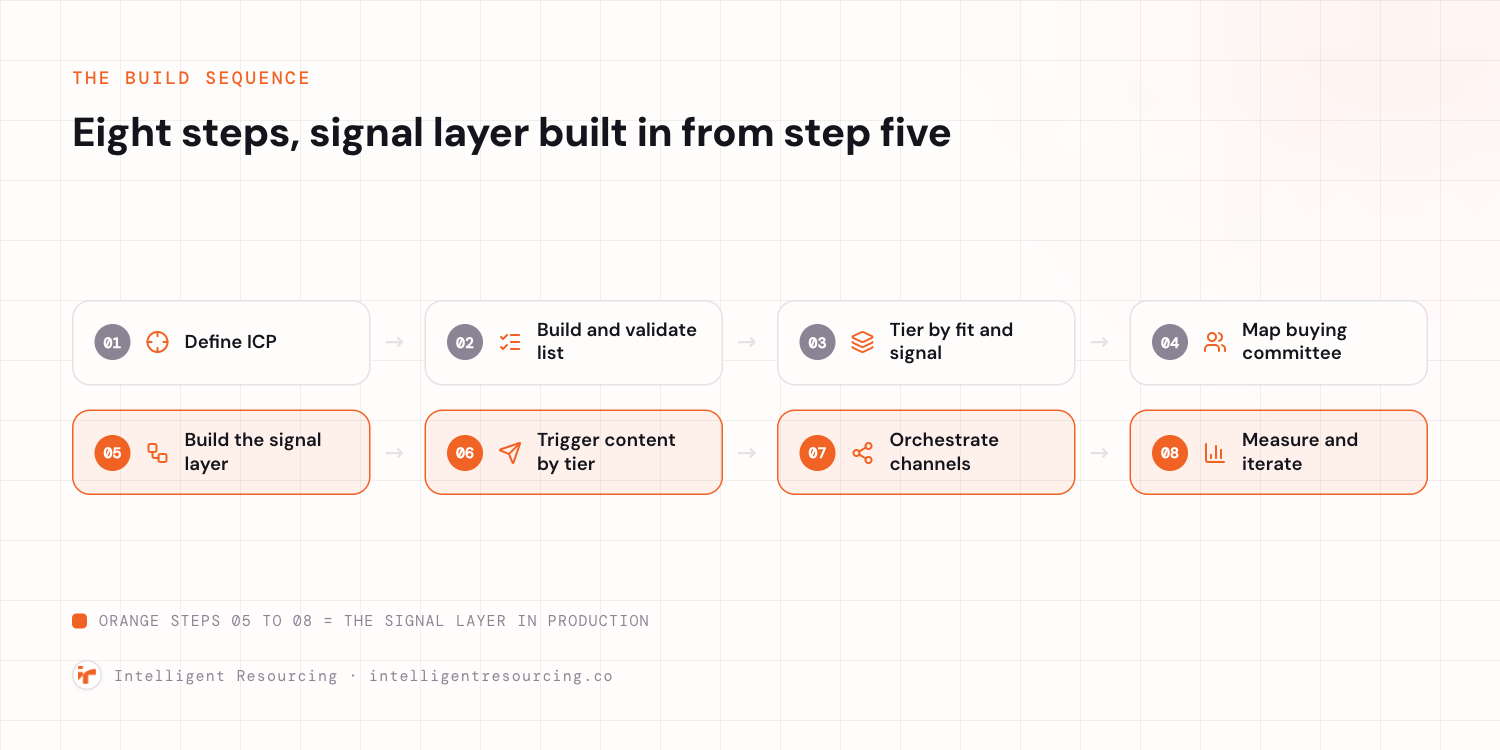
Each step assumes the one before it, which means orchestrating channels before tiering accounts produces the busy-but-flat programs teams complain about.
Steps 1 to 3: Define your ICP, build and tier your target account list
Your account list is where ABM succeeds or fails, so build it with sales input, not marketing alone. Steps one to three turn a vague sense of who you serve into a tiered list; in signal-based ABM, that list is a living asset, not a one-off export.
Step 1: Define ICP and account-selection criteria
Define your ICP across three dimensions: firmographic (industry, size, region), technographic (the tools they run) and behavioural (how they buy). Resist the "biggest company wins" default, because a large logo that never adopts your category is a worse account than a mid-market team replacing a competitor.
Step 2: Build and validate the list with sales
Combine marketing's data with sales' relationship context, because a list marketing builds alone is a prospect list, not an ABM list. Sales knows which accounts have stalled deals or warm champions worth reopening. Validate every account against both before it earns a place.
Step 3: Tier accounts by fit and signal strength
Tier accounts by fit and signal strength, not size alone; a smaller account with strong intent can outrank a dormant larger one. Feeding early signal data and structured lead scoring into tiering keeps the list honest.
| Tier | Account count | Treatment |
|---|---|---|
| One-to-one | 5-20 | Fully bespoke, exec engagement |
| One-to-few | 20-200 | Cluster messaging by segment |
| One-to-many | 200+ | Programmatic, signal-triggered |
The tier sets the investment, so setting it by signal strength means budget tracks probability, not logo size.
Steps 4 to 5: Map buying committees and build the signal layer with intent data
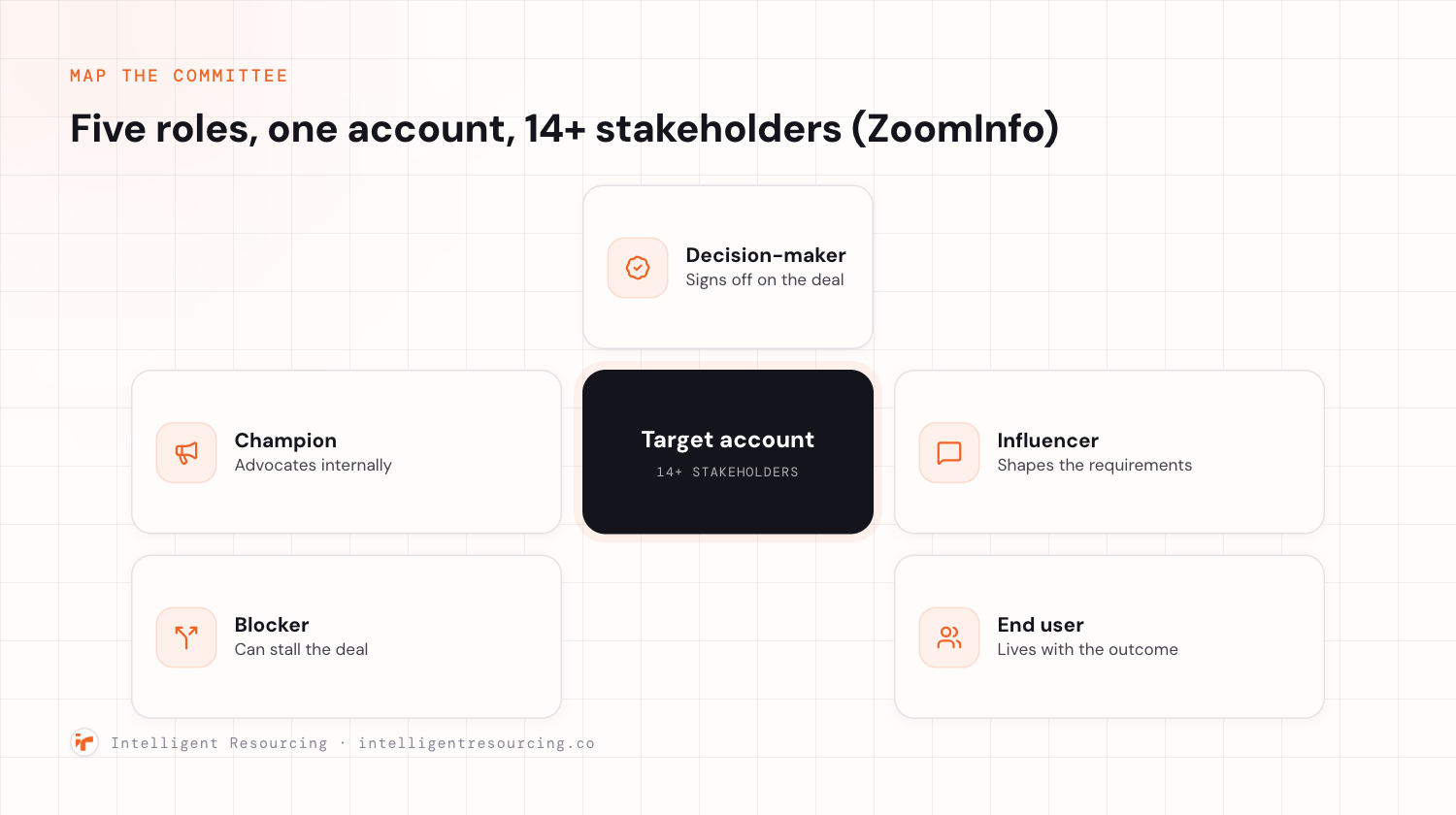
According to ZoomInfo, enterprise buying decisions routinely involve 14 or more stakeholders, so single-contact ABM is structurally insufficient. Steps four and five map that committee and turn scattered intent data into one prioritisation score.
Step 4: Map the buying committee roles
Map the roles in every target account: the champion who advocates internally, the decision-maker who signs, the influencer who shapes requirements, the blocker who can stall it, and the end user who lives with the outcome. Each needs role-appropriate messaging, because a champion needs internal ammunition while a decision-maker needs the commercial case. Tracking B2B buying signals per role shows who is engaging.
Step 5: Choose, weight and threshold your signals (signal stacking)
Signal stacking is a weighted score that blends fit and trigger signals into one number with an activation threshold. Cognism upgrades an account from 1:many to 1:few once its prioritisation score passes 55%, which stops teams reacting to every minor blip. Weight your inputs, sum them, and activate only when the score crosses the line; this is where signal-based lead generation becomes systematic.
| Signal | Weight (example) |
|---|---|
| ICP fit (industry, size, region) | 40% |
| Third-party intent surge | 30% |
| First-party engagement (site, content) | 20% |
| Trigger event (hiring, funding) | 10% |
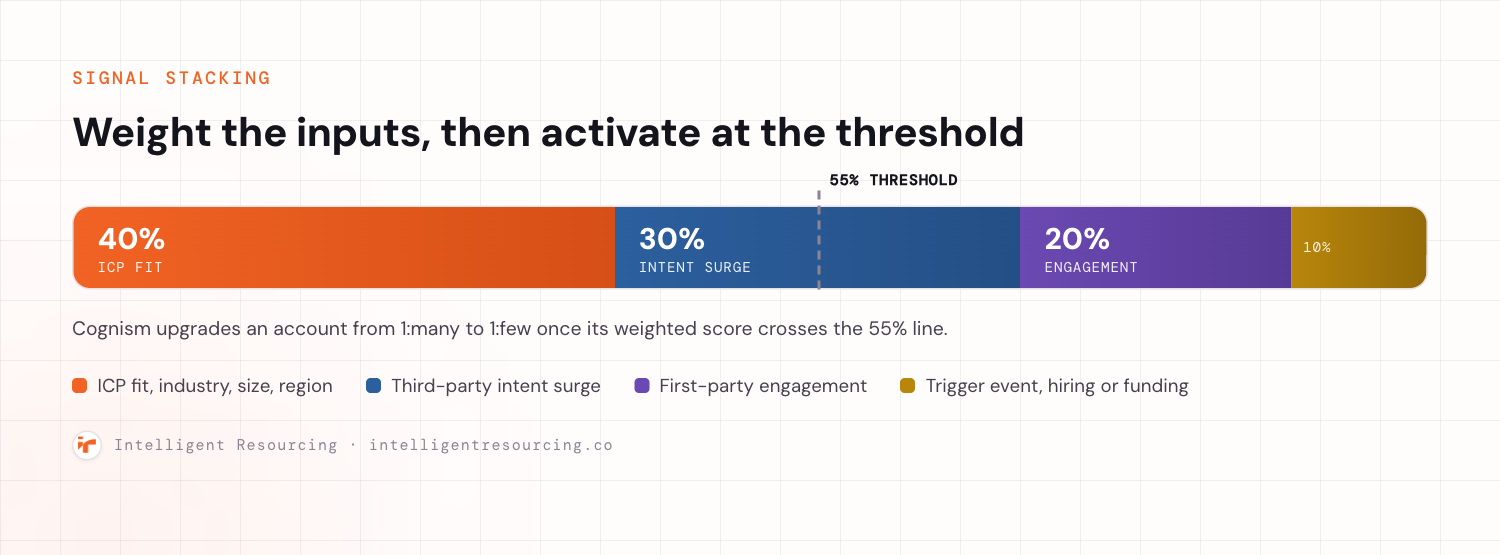
Fit anchors the score so you never chase a poor-fit account, while trigger events add urgency; an account crossing the threshold is the moment a play should fire.
Steps 6 to 7: Trigger signal-based content and orchestrate multi-channel plays
In a signal-based program, content and channels are triggered by score changes, not a broadcast calendar. Coordination beats volume: one message reinforced across channels at the right moment beats more messages on a schedule. Used well, intent data in ABM decides not just who to reach but when.
Step 6: Build signal-triggered content by tier
Match content investment to tier and funnel stage, then let signals decide when it fires. One-to-one accounts warrant bespoke assets; one-to-many tiers reuse modular content that deploys when a signal crosses its threshold. Calendar content ignores timing; signal-fired content meets the buyer in-market.
Step 7: Orchestrate coordinated plays across channels
Orchestrate LinkedIn, display, email and sales outreach so they reinforce one message rather than compete. Coordinated signal-based outreach turns a single trigger into a sequence the buyer experiences as one conversation.
| Signal trigger | Play | Channel |
|---|---|---|
| Intent surge on topic | Serve topic ad + SDR alert | Display + sales |
| Pricing-page visit | Trigger case-study sequence | Email + retargeting |
| New role hired | Personalised outreach | LinkedIn + email |
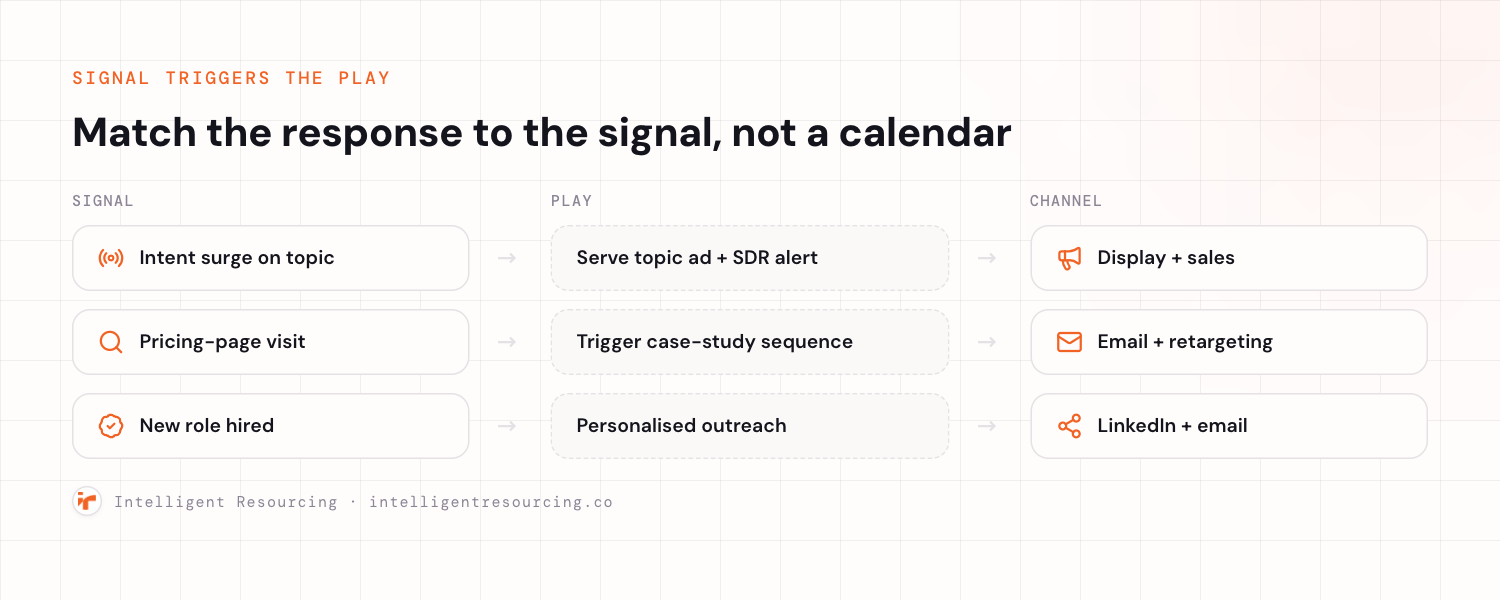
Each row starts with a signal, not a campaign date, and signal-based marketing tools that watch triggers and fire across channels make this practical at scale.
Step 8: Measure account progression and prove the signal layer works
Measure at the account level, not the lead level. Engagement depth, buying-committee coverage and pipeline within named accounts tell you whether the program works; MQL counts do not. A sound ABM implementation framework defines its metrics before the first play runs, because measurement design belongs at the front of the build.
Account-level metrics that matter
Track four account-level metrics: engagement score, account penetration, pipeline progression, and win rate on target versus non-target accounts. ZoomInfo reports that Snowflake saw roughly a 2x conversion lift on ZoomInfo-scored accounts, which means tighter forecasts because pipeline ties to accounts you can name and track.
Common measurement mistakes to avoid
Three mistakes undo account-level measurement. Reverting to MQL reporting hides whether target accounts are progressing. Launching with no baseline means you cannot prove lift later. And without multi-touch account attribution, you credit the last click and miss the plays that moved the committee.
Best tools for building your ABM signal layer
You need three capability layers, not one platform: signal and intent sources, enrichment and orchestration, and an activation surface. The right ABM signal layer tools come after you have defined your ICP, tiers and signal design. Marketsizer's 2026 guide puts it plainly: align tools to your ABM strategy, not the other way around, because no stack rescues a target account list that was wrong before procurement started.
Signal and intent-data sources
Signal and intent-data sources detect which accounts are in-market: third-party intent, website de-anonymisation, and review-site and social signals. More sources means fewer blind spots, but only if they feed one score.
Enrichment and orchestration tools
Enrichment and orchestration tools turn raw signals into scored, routed, CRM-ready records. This is where Clay-style workflows do the heavy lifting: enriching and scoring, then syncing clean records into your CRM. Fragmented data undermines this: Demand Gen Report's January 2026 analysis found that only half of B2B organisations have reached a single source of truth for sales and marketing data, leaving the other half arguing over whose numbers are right, the gap an orchestration layer closes.
| Capability | What it does | Example tool category |
|---|---|---|
| Signal/intent source | Detects in-market accounts | Intent-data platform |
| Enrichment + orchestration | Scores, routes, syncs signals | Workflow tool (e.g. Clay) |
| Activation | Runs plays across channels | ABM/orchestration platform |
The orchestration layer in the middle is what most stacks miss, which means signals get detected but never acted on. A GTM engineering partner usually assembles all three into one system.
What to look for when choosing signal-layer tools
Intelligent Resourcing's GTM Engineering approach connects signal sources, enrichment workflows, CRM systems and activation channels into a unified revenue infrastructure, so buying signals move from detection to sales action without manual handoffs.
The single principle behind every step above is that the signal layer turns a static account list into a program that acts on timing. Fit tells you who to pursue, but signals tell you when, and without them even a well-built list decays into cold outreach.
Your next move is not to shortlist platforms; it is to design the signal layer first, deciding which signals matter and where the activation threshold sits, then choosing tools that serve that design. Every quarter you run without one, plays fire on stale timing and reps chase accounts that have already gone cold. If you want that layer built in rather than bolted on later, book a call with our GTM engineering team.
GTM Engineering
Design the signal layer first, then choose the tools that serve it. Our GTM engineering team builds the scoring, routing and CRM sync that turns your target account list into a program that acts on timing, not a fixed calendar.
FAQs
What is the signal layer in an ABM strategy?
The signal layer is the always-on data layer that captures, scores and routes fit, intent and engagement signals into your ABM plays. Blended into one score, they tell your team which accounts to act on and when, so plays follow timing rather than a fixed calendar.
How do you incorporate intent data into ABM strategy steps?
Layer third-party intent on top of your ICP fit and first-party engagement, then weight and threshold the three into one prioritisation score. Fit anchors the score, intent adds timing, and a play only fires once the combined score crosses the threshold you set.
How many accounts should you start an ABM program with?
Start with roughly 10 to 50 Tier 1 accounts. A tight list lets you prove ROI with high-touch engagement before you scale, and it keeps measurement clean. Once the program converts, expand into one-to-few and one-to-many tiers using the same scoring.
How long does it take to implement an ABM strategy?
Teams with mature data, sales alignment and a clear ICP can stand up a working program in 60 to 90 days. From a low baseline, with fragmented data or no tiering, expect closer to six months. The gap is foundational work, not tooling.
What are the best tools for an ABM signal layer?
You need three capability layers, not one platform: an intent or signal source to detect in-market accounts, an enrichment and orchestration layer such as Clay-style workflows to score and sync signals into your CRM, and an activation platform. The orchestration layer is the one most teams skip.
How is signal-based ABM different from traditional ABM?
Traditional ABM targets a static account list on a fixed campaign calendar, so everyone gets the same sequence regardless of timing. Signal-based ABM triggers plays only when an account shows a timing signal, such as an intent surge or a new hire.